Xona is developing PULSAR – a high-performance positioning, navigation and timing (PNT) service enabled by a commercial constellation of dedicated LEO satellites.
“Our Skydel GNSS simulation engine will provide support for Xona’s PULSAR signals and satellite constellation to offer OEMs, developers, and integrators a unique tool that enables early testing and validation of Xona’s LEO PNT signal performance,” Pierre-Marie Le Véel, GNSS products director with Safran, said.
The PULSAR service aims to advance PNT security, resilience and accuracy capabilities by augmenting existing GNSS while also operating as an independent PNT constellation.
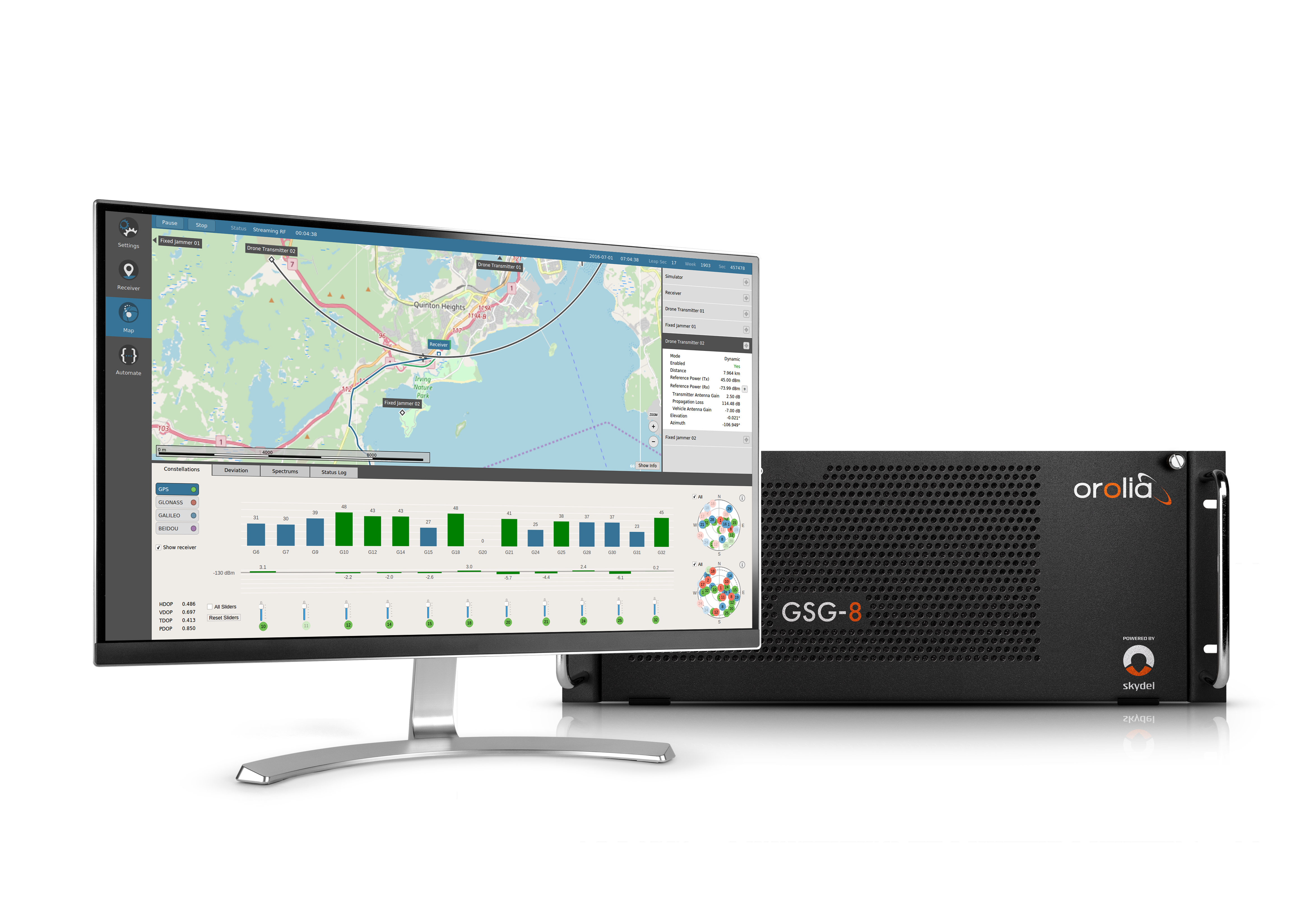
Skydel powers Safran’s advanced GNSS simulators such as GSG-8.
Xona Space Systems fully funded for first LEO satellite navigation mission
Xona Space Systems is preparing for the launch of its first commercial positioning, navigation and timing (PNT) satellite, the first in a planned 300-satellite low-Earth orbit (LEO) constellation designed to cover the globe.
Xona has raised a new funding round co-led by Seraphim Space Investment Trust and MaC Venture Capital, with participation from Toyota Ventures, Daniel Ammann (co-founder of u-blox), and Ryan Johnson (former CEO of BlackBridge, operator of the Rapideye constellation). Follow-on investors also include 1517 Fund and Stellar Solutions.
Xona’s Pulsar precision LEO positioning, navigation and timing (PNT) service leverages advances in small satellite technology to provide users with a secure and robust alternative to traditional GNSS. The satellites will orbit 25 times closer to Earth than GPS satellites do.
Xona’s patent-pending system architecture makes use of the efficiency of small satellites to provide an affordable global service with 10 times better accuracy and 100 times better interference mitigation than the legacy systems, the company claims.
“We view global coverage of a safe, secure, and highly accurate navigation service as critical to the future of autonomy and countless other markets,” said Jeff Crusey, investment director of Seraphim Space Investment Trust. “We’re excited to continue supporting Xona because they’re an extremely talented and uniquely positioned team to execute on this plan.”
The funds raised this round will support the completion of Xona’s first orbital mission, scheduled for mid-2022, to demonstrate the capabilities of their Pulsar precision LEO PNT service.
Xona successfully tested its navigation system during a ground-based demonstration earlier this year, marking a major milestone for the company. It is now expanding laboratory facilities to support further development and enable on-site testing and manufacturing. This funding round will also provide for the growth of Xona’s technical team, which includes space and GNSS experts previously from NASA, Lockheed Martin, Maxar, L3 Harris, Blue Origin and SpaceX.
“Knowledge of location and time is one of the most fundamental aspects of both human life and machine operation,” said Brian Manning, CEO of Xona. “GNSS creates trillions of dollars of value by accurately answering the questions of ‘where am I?’ and ‘what time is it?’ for users all around the world. Xona was founded around the mission of enabling modern technology to operate safely in any environment, anywhere on Earth. To achieve this for both humans and machines, a foundation of reliable and accurate PNT is an absolute necessity, which is exactly what we are working to provide at Xona.”