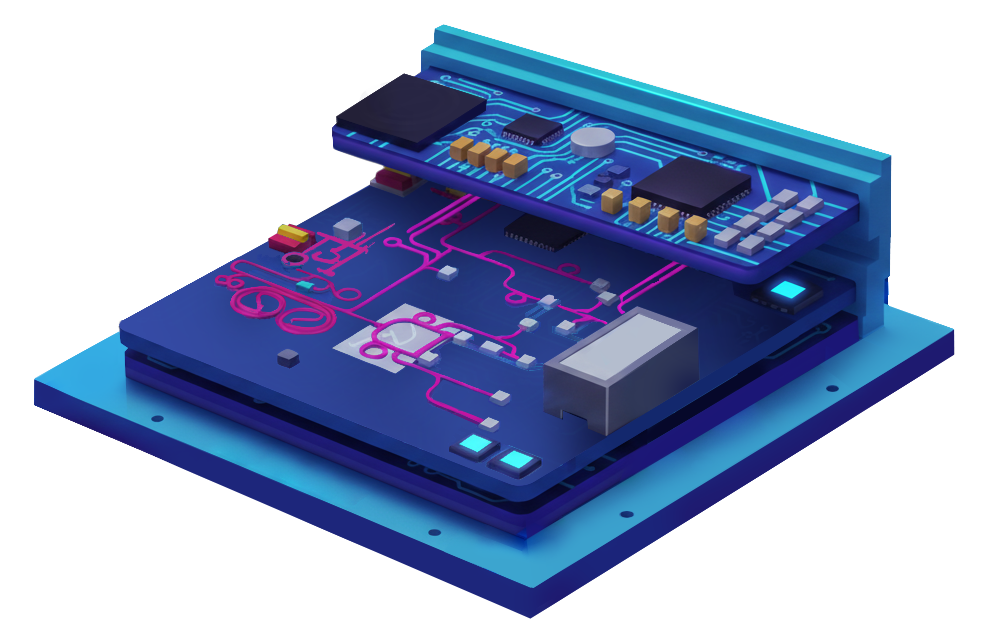
Infleqtion has announced availability of its first quantum-enabled precision timing solution delivered as part of the company’s partnership with Safran Electronics & Defense. The new solution includes Infleqtion’s Tiqker quantum optical clock, which has been integrated and validated with Safran’s White Rabbit and SecureSync systems.
Modern systems, from financial markets to military operations, telecom networks and datacenters, depend on technologies such as GPS or GNSS for precise timing, but these are vulnerable to jamming, spoofing, and natural disruption. As threats to traditional timing infrastructure grow, the need for resilient, independent alternatives has become critical.
In a recent live demonstration conducted in partnership with Quantum Corridor, the solution integrating Tiqker, White Rabbit and SecureSync system was validated in a real-world environment, demonstrating picosecond accuracy vs. nanosecond GPS accuracy.
The combined, validated solution delivers enhanced stability and resilience, ensuring continuity of operations for mission-critical systems even in environments where traditional timing signals are challenged or denied.
The collaboration between Infleqtion and Safran Electronics & Defense makes the validated solution available to customers globally, across allied defense, telecommunications, and critical infrastructure sectors, enabling rapid deployment of precision timing architectures designed to operate even in GNSS-challenged environments.
Projects will advance technology used for secure GNSS, quantum timekeeping and communications
ColdQuanta, which specializes in cold atom quantum technology, has been awarded two development contracts from U.S. government agencies worth $2.55 million. Both projects are based on the company’s Quantum Core technology, which uses atoms cooled to a temperature of nearly absolute zero and lasers to manipulate and control the atoms with extreme precision.
Prototype Atomic Clock
The Office of the Under Secretary of Defense for Research & Engineering (OUSD R&E) awarded ColdQuanta $1.8 million for the development of a prototype atomic clock that could enable reliable, highly accurate position, navigation and timing (PNT) capabilities necessary for the functioning of critical infrastructure around the world. Atomic clocks are used for GPS/GNSS systems as well as for time-distribution services that are the basis of financial networks, computer, TV and radio services and other applications.
Alternative PNT. However, services such as satellite-based GPS can be spoofed, lack encryption or other security features, and often can’t deliver the signal strength required. Because of this, the development and deployment of a PNT system that doesn’t depend on GPS is a critical need across governments and industry, according to ColdQuanta. The company said this is especially true for mobile systems such as aircraft and spacecraft that need to know their position with great precision even when GPS is unavailable.
Under this project, ColdQuanta will deliver a state-of-the-art atomic clock with “instant on” capability if a GPS signal is lost, with a timing accuracy comparable to the best commercial clocks. It will also be ruggedized, portable and compact to enable its use in aircraft, and will minimize the power draw in between periods of demand.
“High-performance atomic clocks are the backbone of the internet, electrical power grids, financial networks, and autonomous navigation. Combining this with ColdQuanta’s development of related inertial navigation devices — such as gyroscopes, accelerometers and gravimeters — will lead to the first Quantum Positioning Systems,” said Dan Caruso, executive chairman and CEO of ColdQuanta. “We’re excited to work closely with the Department of Defense to meet their urgent needs, while also advancing the capabilities needed for future, unassailable global positioning technology.”
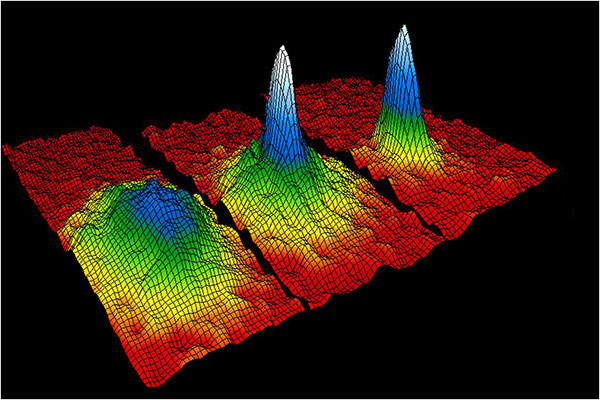
This velocity-distribution data for a gas of rubidium atoms confirmed the discovery of the Bose–Einstein condensate in 1995. In these three snapshots in time, atoms—cooled to near absolute zero—condensed from less dense areas on the left (red, yellow, and green) to very dense areas at the center and the right (blue and white). (Image: NIST/JILA/CU-Boulder)
Miniaturized Ion Trap System
Also, the Air Force Research Laboratory (AFRL) awarded ColdQuanta $750K for the development of a high-performance miniature ion trap system. Compact ion trap systems are applicable to a spectrum of quantum applications including quantum networks, computing, metrology, and timekeeping.
ColdQuanta previously developed a prototype miniaturized ion trapping system with performance that is competitive with traditional, large-footprint vacuum systems. The system maximizes performance and robustness while minimizing size, weight, and power consumption (SWaP). The new AFRL award will build on the success of this prototype to increase performance, reduce cost, and create a robust architecture for deployable quantum platforms.
Bose-Einstein Condensate
The story of ColdQuanta began in 1924 with the discovery of the Bose-Einstein condensate (BEC) — also known as the fifth form of matter — by Satyendra Bose and Albert Einstein. Seventy years later, BEC was first synthesized at the University of Colorado at Boulder in collaboration with the National Institute of Standards and Technology (NIST), for which Eric Cornell and Carl Wieman won a Nobel Prize in 2001. Their colleague, Dana Anderson, co-founded ColdQuanta, which is using the fifth form of matter as the foundation for its cold atom quantum technology.
When atoms are cooled to a few millionths of a degree above absolute zero, they take on quantum properties. Lasers are used to arrange the atoms, hold them in place, run computations on them, and read out the results. Quantum calculations, communications and sensing are the result.
ColdQuanta is collaborating with global customers including major commercial and defense companies; the U.S. Department of Defense; national laboratories operated by the Department of Energy, NASA, and NIST; major universities; and quantum-focused technology companies to advance products and services development with Cold Atom Quantum Technology. ColdQuanta is based in Boulder, with offices in Madison, Wisconsin, and Oxford, United Kingdom.
INC 16 will address cutting-edge issues in positioning, navigation and timing. Of global importance, INC 16 will feature the latest developments in topics such as GNSS, indoor positioning, autonomous transport, security against cyber attack, resilience and quantum technology. Booking for the conference is now open.
The conference will include both peer-reviewed and non peer-reviewed tracks, and will cater to academic, industrial and end-user interests. The conference proceedings will be made available online in a digital repository in the weeks following the conference.
The abstract submission process varies depending on whether the paper is for the peer-reviewed or non peer-reviewed track:
Those wishing to submit a non-peer-reviewed paper for the conference should submit an abstract through the “Submit abstract” option on the conference home page, and can submit a paper for publication in the proceedings of any length. Non peer-reviewed submissions are due March 14.
Those wishing to submit a peer-reviewed paper should submit by March 14 a four-page short paper first, using the “submit short paper option” on the website’s home page. Following a selection process by the conference committee, successful authors will be invited to submit a longer paper (up to 10 pages) by June 15 for further peer review.