Tag: Quebec

  • NV5 Geospatial maps North American shorelines and riverine environments

    NV5 Geospatial maps North American shorelines and riverine environments

     NV5 Geospatial has mapped more than 26 million acres of North America’s shoreline and riverine environments across more than 200 projects.

    The projects have spanned from the Nuyakuk River in Alaska, Lake Tahoe in California, the Rio Grande in Texas, the entire coasts of South and North Carolina, the Achigan River in Quebec, Chesapeake Bay in Maryland and the Florida Keys.

    In 2022, the company mapped and acquired topobathymetric lidar data for 14 projects including the Yellowstone River, Wyoming; Hells Canyon, Indiana; Revillagigedo Island, Alaska and Iles de la Madeleine in Quebec.

    NV5 Geospatial first mapped these environments in 2012 using high-resolution bathymetric lidar and natural color imagery. The company mapped 34,051 acres of shoreline along the Sandy River, located in northwestern Oregon, to study the ever-changing basin geomorphology.

    NV5 has also signed a two-year contract with the National Geodetic Survey of the National Oceanic and Atmospheric Administration to provide topobathymetric lidar, 4-band imagery and mapping of 3,115 sq miles of the Maine shoreline.

    “For a decade we have been helping local, state, and federal government agencies as well as commercial and private entities gain the insights they need to solve some of their most challenging nearshore and riverine projects through our mapping technologies including topobathymetric lidar,” Kurt Allen, vice president of NV5 Geospatial, said. “Whether it be mapping the shoreline after a hurricane, updating the national shoreline, assisting water boards with flood planning, or hundreds of other possible use cases, we are constantly improving our technology and scalability to always be at the ready for our customers.”
  • First autonomous shuttle drives on Canada’s public roads

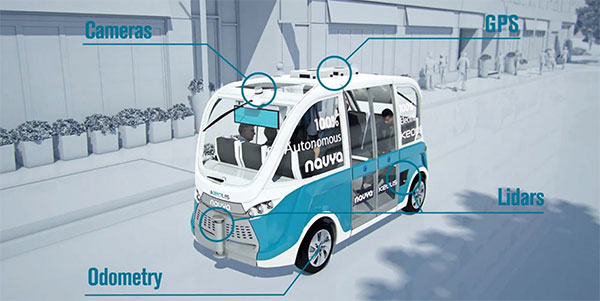
    Keolis Canada and Montreal suburb City of Candiac have launched a long-term demonstration project of an autonomous electric shuttle on public roads in Canada. The shuttle will complement the public transit services currently available in Candiac.

    The pilot project will take place over a period of 12 months, with about eight months dedicated to serving citizens.

    This initiative was made possible through the financial support and expertise of the Quebec government and the collaboration of Propulsion Québec, the Cluster for Electric and Smart Vehicles and the Technopôle IVÉO.

    Screenshot from Keolis Canada video.
    Screenshot from Keolis Canada video.

    The NAVYA autonomous shuttle will operate along a two-kilometer route between the park-and-ride lot and exo’s bus terminal and the intersection of Marie-Victorin and Montcalm North boulevards with several stops along the way, including City Hall, a retirement complex and local businesses.

    The autonomous shuttle, which will coexist with regular traffic, will allow employees in the area to reach their workplaces from the bus terminal.

    Along the route, the shuttle will go through a railway crossing and an intersection where it will communicate with four traffic lights. During the winter period, a research and development project, without passengers on board, will test how the autonomous electric shuttle adapts to Quebec winter conditions.

    “This initiative is exciting because it’s the first pilot project in Canada, and the way it’s carried out will set the course for the next one,” said Marie Hélène Cloutier, vice president, Passenger Experience, Marketing & Sales for Keolis Canada. “For Keolis Canada, multimodal service is the key to the future of transportation. Autonomous electric shuttles are a great example of this because they complement existing services. The enthusiasm for this project has surpassed our expectations, which is very promising for the future.”

    “We are extremely proud to be enabling Candiac residents to participate in this historic achievement,” said Normand Dyotte, mayor of Candiac. “It’s an outstanding opportunity for our citizens to be able to travel aboard the first-ever electric autonomous shuttle on a public road in Canada. We invite all public transit users and anyone who is curious or interested to come and try it now.”

  • Canada investigates collision between drone and aircraft

    The Transportation Safety Board of Canada (TSB) is conducting an investigation into the collision between a drone and a passenger aircraft that took place on approach to the Jean Lesage International Airport in Québec City on Oct. 12.

    On that day, a Beech King Air A100 operated by Skyjet M. G. was on an instrument flight rules flight from the Rouyn-Noranda (Quebec) airport to the Jean Lesage International Airport in Québec City with two crew members and six passengers on board.

    The aircraft was approaching runway 24 and had just passed the final approach fix when the crew noticed an unmanned aerial vehicle (UAV) off the left wing. The aircraft struck the UAV at an altitude of 1500 feet and the crew declared an emergency.

    Aircraft rescue and firefighting services were deployed and the aircraft safely landed on runway 24. The aircraft inspection revealed a few scratches and some paint transfer on the top surface of the left wing and scrape marks on the de-icing boot.

    The aircraft was then returned to service. No one was injured.

    Learn more about the investigation here.

    The TSB is an independent agency that investigates marine, pipeline, railway and aviation transportation occurrences to advance transportation safety.