Tag: Queen Elizabeth Prize

  • GPS pioneers honored with Queen’s award at Buckingham Palace

    GPS pioneers honored with Queen’s award at Buckingham Palace

    On Dec. 3, four U.S. engineers were awarded the 2019 Queen Elizabeth Prize for Engineering during a ceremony at Buckingham Palace for their work creating the first truly global, satellite-based positioning system, GPS.

    The QEPrize is the world’s most prestigious engineering accolade, a £1 million prize that celebrates the global benefit of engineering innovation on humanity. The honorees were announced in February.

    His Royal Highness The Prince of Wales presented the trophy to Dr. Bradford Parkinson, Hugo Fruehauf, Richard Schwartz and Anna Marie Spilker, who accepted the award on behalf of her late husband, Professor James Spilker, Jr. Learn more about Spilker from his wife’s account.

    Bradford Parkinson — often regarded as the “father of GPS” — led the development, design, and testing of the system. Hugo Fruehauf developed a highly accurate, miniaturized atomic clock, a foundational component of the system. Richard Schwartz engineered a satellite hardened to resist intense radiation in space, with a lifespan three times greater than expected. Professor James Spilker, Jr, was the main designer of the GPS civil signal and, with his team at Stanford Telecommunications, built the receiver that processed the first GPS satellite signals.

    Lord Browne, chairman of the Queen Elizabeth Prize for Engineering Foundation, highlighted the critical role of collaboration in engineering, and in groundbreaking innovations such as GPS: “Our laureates’ success was the result of inter-disciplinary collaboration, a drive for excellence, and an ability to turn the fruits of scientific discovery into practical solutions. That is what engineers do,” he said.

    Today, an estimated four billion people around the world use GPS. At just $2 per receiver, GPS provides an accessible service and a powerful tool that people can integrate with their applications. Simple smartphone apps can track disease outbreaks, self-driving tractors can optimize crop harvests, and sports teams can improve team performance. New applications for GPS continue to revolutionize entire industries, and its annual economic value has been estimated to be $80 billion for the USA alone.

    GPS combines a constellation of at least 24 orbiting satellites with ground stations and receiving devices. Each satellite broadcasts a radio signal containing its location and the time from an extremely accurate onboard atomic clock. GPS receivers need signals from at least four satellites to determine their position; they measure the time delay in each signal to calculate the distance to each satellite, then use that information to pinpoint the receiver’s location on earth.

    This year’s QEPrize trophy was designed by 17-year-old Jack Jiang from Hong Kong. Jack’s elegant trophy design won the 2019 Create the Trophy competition, an international competition that invites those aged between 14-24 around the world to submit innovative trophy designs for the world’s leading engineers. The 2019 competition saw a record number of entries, with submissions stemming from over 50 countries worldwide.
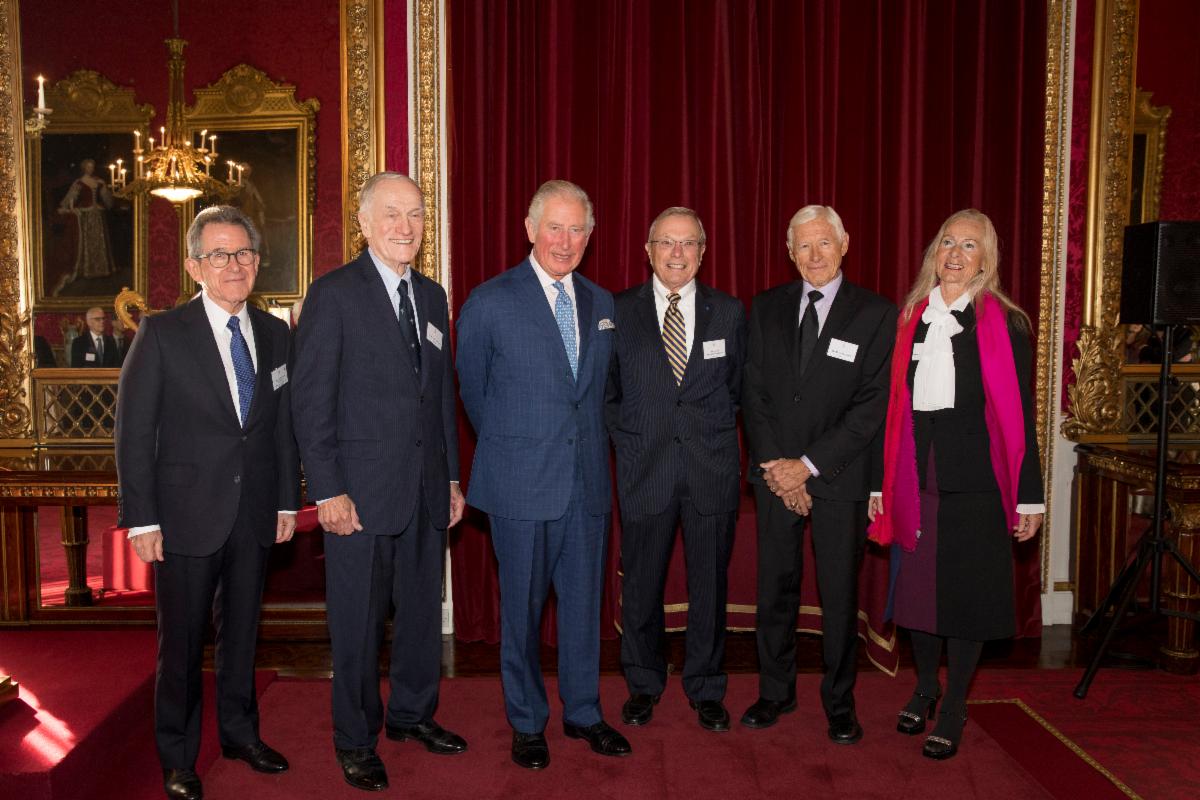
    From left: Lord John Browne, Richard Schwartz, HRH The Prince of Wales, Bradford Parkinson, Hugo Fruehauf, Anna Marie Spilker at the Queen Elizabeth Prize for Engineering ceremony at Buckingham Palace, December 3, 2019. (Photo: Jason Aldean)
    From left: Lord John Browne, Richard Schwartz, HRH The Prince of Wales, Bradford Parkinson, Hugo Fruehauf, Anna Marie Spilker at the Queen Elizabeth Prize for Engineering ceremony at Buckingham Palace, December 3, 2019. (Photo: Jason Aldean)

    Lord Browne of Madingley, Chairman of the Queen Elizabeth Prize for Engineering Foundation, said, “This year’s laureates have demonstrated that engineering makes things happen. With the first global, satellite-based positioning system, they created an engineered system which provides free, immediate and accurate information about position and time, anywhere around the globe.

    “The world now depends on GPS completely and without exception. The high-frequency trading systems, telecommunications and electricity grids of today are all built around GPS. And we will rely on it for the drone delivery systems, self-driving cars and climate monitoring solutions of tomorrow.

    “In honoring the 2019 prize winners, we hope to inspire the next generation of engineers to continue to push back the frontiers of the possible.”

    Bradford Parkinson said: “Today marks a landmark moment in all of our lives—there is no prize for engineering greater than this, it is an honor. This recognition reflects the responsibility incumbent upon those developing technology today to strive to do so for the good of humanity. Day-after-day, we are astounded at the new ways in which people across the world use GPS. It is a ‘System for Humanity’ in each and every sense.”

    Hugo Fruehauf said: “The accuracy of modern GPS satellites astounds me. The atomic clocks we built for the satellites were accurate to within billionths of a second, but today’s generation are working a factor of 100 times better than that. They’re a lot like wine, in a sense—they only get better with time. And they have to be accurate; the timing for GPS is used for core systems around the world—vital infrastructure like banking systems, telecommunications networks, and power grids. Today the world relies on those clocks.”

    Richard Schwartz said: “One of the best things about GPS is its accessibility. We designed the system to produce a signal that anyone can use, regardless of where they are on the planet. Today, engineers around the world can still access that signal, for free, and use it to build creative solutions to benefit people around them. It took a great deal of collaboration to make the system work, and it’s great to see the next generation collaborating on innovative products now because of that.”

    Anna Marie Spilker, on behalf her late husband, Professor James Spilker, Jr, said: “Jim’s mission statement has always been to create, teach, and mentor for world-changing benefits to humanity through his engineering talents. When working on GPS, Jim knew that it could be of profound benefit globally, and he was right; because of their work, Jim and his colleagues have helped billions of people around the world. He was immensely proud of that. He said many times that ‘Engineering technology is the necessary catalyst for progress to world changing benefits to humanity; it’s magic.’”

  • 2019 Queen Elizabeth Prize for Engineering goes to GPS

    2019 Queen Elizabeth Prize for Engineering goes to GPS

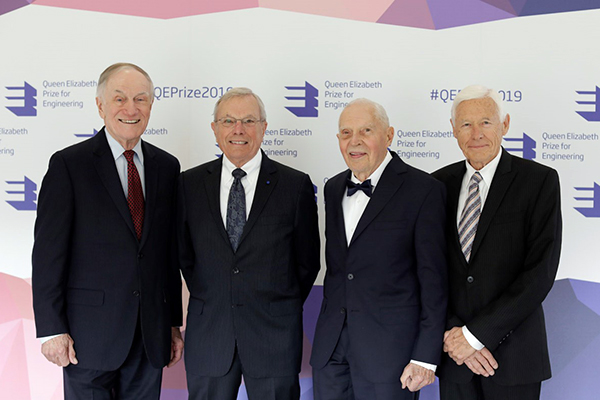
    From left: 2019 QEPrize winners Richard Schwartz, Bradford Parkinson, James Spilker and Hugo Fruehauf. (Photo: QEPrize)
    From left: 2019 QEPrize winners Richard Schwartz, Bradford Parkinson, James Spilker and Hugo Fruehauf. (Photo: QEPrize)

    The United Kingdom’s 2019 Queen Elizabeth Prize for Engineering has been awarded to the creators of the U.S. Global Positioning System (GPS).

    Four engineers — Dr. Bradford Parkinson, Professor James Spilker, Hugo FrueHauf and Richard Schwartz — were honored for creating the first truly global, satellite-based positioning system. The QEPrize is a prestigious worldwide engineering accolade, a £1 million prize that celebrates the global impact of engineering innovation on humanity.

    The 2019 winners were announced Feb. 12 by Lord Browne of Madingley, chairman of the Queen Elizabeth Prize for Engineering Foundation, in the presence of HRH The Princess Royal (Princess Anne) in London.

    The four winners will be formally honored at a ceremony later this year; they will receive the £1 million prize and an iconic trophy designed by the 2019 Create the Trophy competition winner, 16 year-old Jack Jiang from Hong Kong.

    Why GPS

    An estimated four billion people  use GPS, and its annual economic value has been estimated to be $80 billion for the U.S. alone. Its applications range from navigation and disaster relief through to climate monitoring systems, banking systems, and the foundation of tomorrow’s transport, agriculture and industry.

    The basic tracking required for GPS dates back to the start of the space race, when radio operators tracked Sputnik I on its groundbreaking flight in 1957. Sputnik’s radio signals appeared to drop in frequency as it passed overhead, a phenomenon known as the Doppler shift that allowed the satellite’s position to be determined.

    The GPS Creators

    The chief architect, Bradford Parkinson, is often called the “father of GPS” after successfully building upon several separate systems to create the current GPS design. Parkinson directed the program and led the development, design, and testing of its key components.

    Parkinson insisted that GPS needed to be intuitive and inexpensive, which later made navigation accessible to billions. In 2016, Parkinson was honored with the Marconi Prize. To learn more about his achievements and how GPS began, read this article.

    To realize the project, Parkinson recruited James Spilker to design the signal that the satellites broadcast. This type of ranging signal is critical to the success of GPS for civilian use; it is resistant to jamming, precise, and allows multiple satellites to broadcast on the same frequency without interfering with each other.

    The 2019 QEPrize trophy, designed by 16-year-old Jack Jiang. (Photo: QEPrize)
    The 2019 QEPrize trophy, designed by 16-year-old Jack Jiang. (Photo: QEPrize)

    Spilker’s team also developed and built the first receiver to process the GPS satellite signals; his delay-locked loop process, used for tracking code division multiple access (CDMA) signals, is essential to GPS accuracy.

    GPS receivers rely on accurate timing information, broadcasted from satellites, to determine their position on earth. Each satellite uses multiple atomic clocks — accurate to within billions of a second — to ensure consistent timing. Hugo Freuhauf, then chief engineer at Rockwell Industries, led the development of a miniaturized, radiation-hardened atomic clock — the heart of the GPS satellite. Its accuracy is the backbone of communications systems, power grids, financial networks and other critical infrastructure.

    For the GPS program to be affordable, each satellite had to be long-lived. Richard Schwartz, the program manager at Rockwell during the development of these satellites, was tasked with ensuring a three-year life span. His design was resistant to the intense radiation from the upper Van Allen belt, and it also lasted for more than nine years.

    Reflections from the Winners

    “One of the most important things we had when the project started was a vision of world impact. Without that inspiration, it would have been difficult for us to weather the storms of doing something for the first time,” Parkinson said.

    An infographic by the QEPrize organization explains the history of GPS.
    An infographic by the QEPrize organization explains the history of GPS.

    “Back in 1978, I made a few drawings that depicted GPS applications that I could personally foresee; they included an automobile navigation system, semi-automatic air traffic control, and wide-area vehicle monitoring, and seem to be rather accurate 41 years later,” Parkinson said. “That said, none of us could fathom the sheer breadth of GPS applications — the many ways that it would become a ‘System for Humanity’.”

    In reflecting on the impact of GPS, Freuhauf said, “What surprised me the most was the general response from industry – it blew me away. The world’s tech industry reduced a 40-pound, $100,000 backpack-sized GPS receiver into a fingernail-sized chip receiver that now costs less than $2. Because of that, GPS is everywhere; it is part of the global economic engine and key to global safe-keeping. It’s had an almost unimaginable impact on the globe.”

    “It’s hard to imagine what young and creative engineers will come up with next,” Schwartz said.  “It’s such a rapidly developing world. That said, in the not too distant future I think I will be able to step into a driverless car, tell the car where I’d like to go, and then sit back and enjoy the ride.”