Tag: railroad

  • FRA awards $203 million in grants for positive train control systems

    FRA awards $203 million in grants for positive train control systems

    The Federal Railroad Administration (FRA) awarded $203,698,298 in grant funding for 28 projects in 15 states to assist with the deployment of positive train control (PTC) systems.

    The $203 million in grants is part of the total $250 million specifically appropriated under the Consolidated Appropriations Act of 2018 for the implementation of PTC systems, via the Consolidated Rail Infrastructure and Safety Improvements (CRISI) program.

    “These $200 million in grants will help the railroads continue to implement positive train control, a technology that could help reduce accidents and save lives,” said U.S. Transportation Secretary Elaine Chao.

    The awards fund many aspects of PTC system implementation for intercity passenger or commuter rail and freight rail transportation, including back office PTC systems; wayside, communications, and onboard PTC system equipment; personnel training; PTC system testing; and interoperability.

    Second-quarter PTC data

    In addition, FRA released its second-quarter update on railroads’ self-reported progress toward implementing PCT systems. As of June 30, 15 railroads have installed 100 percent of the PCT system hardware that must be installed for implementation, based on a review of the railroads’ PTC Implementation Plans and quarterly progress reports for the second quarter of 2018. Twelve other ailroads have installed between 95 and 99 percent of the PTC system hardware identified in their PTC Implementation Plans.

    According to FRA, this marks improvement from December 2016, where freight railroads had PTC active on just 16 percent of required tracks, while passenger railroads were at 24 percent.

    In addition, second quarter data shows a 25 percent drop in the number of “at risk” railroads from 12 to nine. FRA considers any railroad that installed less than 90 percent of its PTC system hardware as of June 30 to be at risk.

    “The railroads have achieved some significant improvements over the past year implementing this safety technology,” said FRA Administrator Ronald Batory. “While we are seeing progress among a majority of railroads, we want to see everyone meet their requirements.”

    Awards Granted

    When choosing the recipients of the grants, the FRA considered a number of factors, including supporting economic vitality; leveraging federal funding; using innovative approaches to improve safety and expedite project delivery; and holding grant recipients accountable for achieving specific, measurable outcomes.

    Under the CRISI Program, at least 25 percent of funds are available for rural projects, the FRA said. In addition, federal funds awarded for CRISI grants must not exceed 80 percent of the total cost of a project, and the required 20 percent non-federal share may be composed of public sector (state or local) or private-sector funding, or both.

    Agencies that received grants are:

    • Alaska Railroad Corporation
    • California Department of Transportation
    • Peninsula Corridor Joint Powers Board
    • Sonoma-Marin Area Rail Transit
    • Southern California Regional Rail Authority
    • Florida Department of Transportation
    • Iowa Interstate Railroad
    • Iowa Northern Railway Company
    • Belt Railway Company of Chicago
    • Chicago Rail Link
    • Commuter Rail Division of the Regional Transportation Authority
    • Chicago South Shore & South Bend Railroad
    • Northern Indiana Commuter Transportation District
    • Massachusetts Bay Transportation Authority
    • Springfield Terminal Railway Company (ST)/Pan Am Railways
    • Maryland Transit Administration
    • Nebraska Central Railroad Company
    • Rio Metro Regional Transit District
    • Middletown and New Jersey Railroad
    • New York & Atlantic Railway Company
    • Allegheny Valley Railroad Company
    • North Shore Railroad Company
    • Capital Metropolitan Transportation Authority
    • Dallas Area Rapid Transit
    • Denton County Transportation Authority
    • Utah Transit Authority
    • Puget Sound and Pacific Railroad
  • Railway in France to test GNSS for train control

    A region in France is working with SNCF (the French National Railway Company) to foster the emergence of new solutions — including GNSS technologies — for the operation and control of regional trains and railway infrastructure.

    On Sept. 1, the Occitanie/Pyrénées-Méditerranée Region and GUIDE (GNSS Testing Laboratory) signed an agreement to open a railway line to field tests for companies seeking to perform assessments aboard trains. The agreement is supported by the French space agency CNES and the Aerospace Valley Center.

    The Geofer project, managed by GUIDE, will allow the testing of applications in operational situations. The applications are based on radionavigation and telecommunication data initially intended for other business sectors.

    Through the Geofer project, the Occitanie/Pyrénées-Méditerranée Region is pursuing two strategic goals. The first aims to strengthen mobility within the region through better control of operating costs. The second is to diversify industrial activities with rail. The project could lead to modernization of secondary lines of the national railway network by embedding, for example, some functions of railway signaling.

    The test region — the Tessonnières-Rodez line (Tarn/Aveyron) — crosses a mountainous area conducive to tests in constrained environments.

    As leader of the project, GUIDE is working to geo-reference the line and to instrument a train that will calibrate future embedded applications. The collected data will then be re-used and replayed on test benches to help solution developers tune their embedded systems more easily.

    A co-financer of Geofer, CNES is actively involved in the tests. A receiver implementing an algorithm (PPP-WIZARD) developed by its engineers will be tested on board, using software to exploit future satellite services to achieve decimetric accuracy. This technology could make possible many rail applications such as precise dock stops or a better prediction of maintenance operations.

    M3 Systems will supply the mission receiver responsible for dispatching accurate and real-time data about the positioning and speed of the train to embedded applications. This device merges the satellite measurements with those of other sensors used to ensure the quality of the geolocation messages.

    For example, devices such as shock sensors to detect unusual efforts of the pantograph against the overhead cable, speed control systems for eco-driving, and roaming systems for telecommunication will be developed, implemented and evaluated on the line and on simulation benches.

  • FAA Pathfinder test inspects rail tracks

    Launching at a tower site near Vaughn, New Mexico, Insitu accomplished a commercial beyond-visual-line-of-sight operation with an unmanned aerial system (UAS).

    The Oct. 25 event marked the beginning of a week-long series of flights with BNSF Railway designed to show how UAVs can enhance the safety of critical infrastructure by aiding with inspections.

    During the 14 hours of flyovers, the Insitu ScanEagle targeted problems such as washouts and bridge damage. The information gathered was then fed back to Insitu personnel on the ground in real time.

    Insitu and BNSF officials launch ScanEagle for the historic first flight. (Photo: Insitu Inc.)
    Insitu and BNSF officials launch ScanEagle for the historic first flight. (Photo: Insitu Inc.)

    The flights were part of the U.S. Federal Aviation Administration’s (FAA’s) Pathfinder program announced on May 6. For Pathfinder, the FAA selected three companies — CNN, PrecisionHawk and BNSF — to explore commercial use of drones beyond operations proposed in its draft UAS rule published in February.

    The FAA tasked BNSF Railway, the second-largest freight railroad network in North America, with inspecting rail infrastructure beyond visual line of sight. BNSF operates 32,500 miles of track.

    BNSF selected the Scan-Eagle because it carries an FAA certification for commercial applications. The UAV is capable of providing 3D rendering as well as high-resolution video magnification.

    In its first day of operations, the ScanEagle UAV provided real-time video covering 64 miles of the 132-mile stretch of track that BNSF has designated for the exercise. The ScanEagle is capable of flying for up to 24 hours at speeds of up to 80 knots.
    The exercise demonstrated how, in addition to a railway company’s traditional methods of track monitoring, unmanned aircraft can not only improve inspections, but keep employees out of harm’s way and harsh conditions.

    Insitu, a subsidiary of The Boeing Company, creates and supports unmanned systems and software technology for collecting, processing and understanding sensor data.

    Under Pathfinder, CNN is researching visual line of sight operations for newsgathering in urban areas, and working with Georgia Tech University to improve newsgathering for all organizations. PrecisionHawk is investigating agricultural operations for rural areas, flying outside line of sight.

  • SiTrack:One by Leica Geosystems Makes 3D Point Clouds without GNSS

    SiTrack:One by Leica Geosystems Makes 3D Point Clouds without GNSS

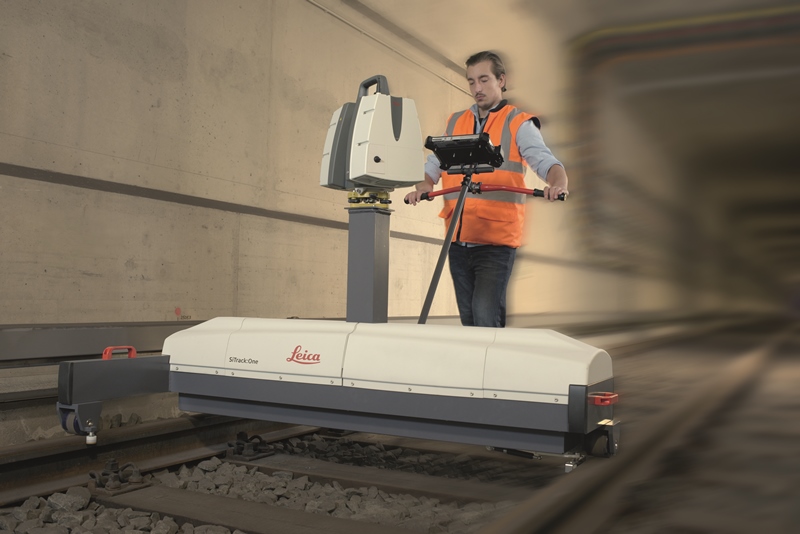
    Photo: Leica Geosystems

    Leica Geosystems has released SiTrack:One, a highly accurate rail track maintenance and refurbishment system incorporating the Leica ScanStation P40 to generate 3D point clouds. 

SiTrack:One by Leica Geosystems ensures complete coverage of an entire rail infrastructure surface without the need to receive GNSS signals for position information, the company said.

    With a new mounting design, the total solution for rail maintenance and refurbishment produces synchronized engineering, survey-grade 3D point clouds for accurate as-built drawings. 
The Leica ScanStation P40 can either be mounted vertically in the centre of the rails or inverted directly over the rail track. Rail bridge sleeper replacements can be measured quickly generating a numbered as-built replacement plan for each individual sleeper on a rail bridge.

    The sophisticated system is equipped with two powerful distance measurement instrument (DMI) or odometers that provide accurate positioning in GNSS-denied areas, such as underground railway tunnels or underground subway networks. The system’s on-site calibration process guarantees permanent alignment of the relative position between the sensors and its onboard inertial measurement unit, guaranteeing position accuracy.

    The German engineering firm Vermessungsbüro Riemenschneider GbR was the first to use the SiTrack:One by Leica Geosystems. When converting existing railway tracks in the course of track maintenance for the Deutsche Bahn AG, the firm required complete, accurate and consistent information on existing tracks, clear structure gauge, route topography and civil engineering works. With the SiTrack:One, Vermessungsbüro Riemenschneider GbR experienced significant workflow gains by leveraging the highly accurate point clouds directly into the engineering process.

    “The SiTrack:One by Leica Geosystems guaranteed  the complete survey of railway sidings with a minimum stay of surveying personnel in the danger zone of rail transport,” said Dipl.-Ing. Andreas Riemenschneider, principal of Vermessungsbüro Riemenschneider. “Thus, the costs of security measures were significantly reduced. The state-of-the-art system conforms efficiently to the demands for survey, visualisation, documentation, evaluation and approval of existing and new routes, all in accordance with rail transportation guidelines.”

    Developed from acquired knowledge 
SiTrack:One is the first solution to be released under Leica Geosystems from the acquisition of the former Technet-Rail 2010 GmbH. Leica Geosystems acquired the previous firm’s specialised knowledge of geospatial big data for rail transportation networks in May to increase its mobile mapping offerings for the rail industry.

    “One of our goals in obtaining this specific know-how was to provide users with a dedicated tool for passenger rail networks monitoring and maintenance, and with the development of SiTrack:One, we are taking the first step on this roadmap,” said Stuart Woods, Leica Geosystems Geospatial Solutions Division vice-president. “Professionals can now trust their measurements on rail are accurate even in the most difficult conditions.”

    SiTrack:One by Leica Geosystems includes software enabling data synchronization, post-processing and feature extraction. This solution is part of the SiRail Suite, which includes the SiRailScan and SiRailManager software solutions.

    SiRailScan allows for a complete extraction of the railway network with engineering accuracy level, while SiRailManager, the database management tool, creates a holistic view of an operator’s railway network from point cloud to geometry and signal layers. The combination of these solutions form the  SiControl platform, which conforms to the requirements of the  European Train Control System and produces complaint rail xml outputs for full train feedback control.

  • NDGPS Destined for the Technological Boneyard

    Let us not exaggerate — nor prematurely announce — the death of a subsystem. However, the demise of the U.S. Nationwide Differential GPS (NDGPS) network can be confidently foretold. Although a Federal Register notice dated Aug. 18 merely seeks public comment on plans to shut down a large portion of NDGPS, the handwriting is on the wall. Once having writ, the hand of fate moves on.

    We should neither lament nor applaud. NDGPS, like many other technologies, has seen its time come and go, while competitors have arisen to perform its role and take its place. Such is evolution in the industrial world as well as in the biological kingdoms.

    In 2016, three quarters of the currently operating NDGPS reference stations will be taken down and decommissioned. That’s not what the federal notice states, but that’s what it effectively says. The document’s comment period ends on Nov. 16. It is difficult to conceive of a public outcry that might reverse the intended course of the U.S. Coast Guard, Department of Transportation and Army Corps of Engineers.

    The NDGPS network had its birth in the 1980s, as a tool to provide real-time positioning accuracy for harbor entrances and coastal navigation. Inland components were added over the years to improve river navigation, NDGPS use in precision agriculture began to grow, and a role in railroad positive train control (PTC) was much discussed. But all these efforts could not gather enough momentum to firmly establish the network’s viability. Meanwhile, satellite-based differential services from both commercial providers and the U.S. government’s own Wide Area Augmentation System (WAAS), and a network of continuously operating reference stations (CORS) from the National Geodetic Survey continually nibbled away at NDGPS’s potential customer base. Consequently, industry fielded a meager range of radiobeacon DGPS receivers.

    The real death blow came in 2013, when the Federal Railroad Administration (FRA) eliminated an NDGPS requirement from its PTC program. The railroads, never a nimble industry nor one receiving the governmental support it enjoys in other countries, had by that time become the last hope of NDGPS. Ag users had already for the most part moved over to WAAS and commercial SBAS providers. Marine users did not by themselves form a sufficiently large constituency, and even they were not fully equipped nor wholesale adopters of the system.

    The story of Loran bears some similarities to NDGPS, but Loran now enjoys a resurgence that NDGPS will never see. It is destined for the technological graveyard. There is an ecosystem of positioning, navigation and timing (PNT) tools and applications. Operating in a free market, with some measure of governments’ interference and manipulation, it has its own patterns of natural selection. We will continue to see the rise and fall of species. NDGPS has now been branded a dinosaur. It will be interesting to see how other technologies, competing for the same finite range of resources, will interact, thrive, or decline.

  • Most Railroads Will Miss Positive Train Control Deadline

    Most railroads will miss the Dec. 31, 2015, deadline for implementing positive train control (PTC), according to a report submitted to the U.S. Congress by the Federal Railroad Administration (FRA). Congress established the deadline in 2008.

    An automatic train control system — many of which use GPS — was not installed on the commuter rail route where an Amtrak train left the track in May.

    The FRA sent its “Status of Positive Train Control Implementation” report to Congress this week. The report is mandated by the House of Representatives Appropriations Committee.

    “Positive train control is the most significant advancement in rail safety technology in more than a century,” U.S. Transportation Secretary Anthony Foxx said. “Simply put: it prevents accidents and saves lives, which is exactly what we seek to do at the Department of Transportation every single day. We will continue to do everything in our power to help railroads install this technology.”

    The National Transportation Safety Board (NTSB) began calling for train control systems like PTC in 1969, and the FRA was involved in establishing PTC standards with stakeholders for more than a decade before the 2008 mandate. Three years before Congress passed the PTC mandate, the FRA issued its final rule that established uniform PTC standards for railroads willing to voluntarily install the technology.

    Positive train control prevents train-to-train collisions, over-speed derailments, incursions into established work zone limits and a train going to the wrong track because a switch was left in the wrong position.

    In 2008, Congress passed the Rail Safety Improvement Act, requiring all Class I railroads transporting poisonous-by-inhalation hazardous (PIH) or toxic-by-inhalation hazardous (TIH) materials, and all railroads providing passenger service, to implement Positive Train Control by Dec. 31, 2015.

    The FRA has provided assistance and support to railroads to help them become PTC compliant. Those efforts include:

    • Providing more than $650 million to passenger railroads, including nearly $400 million in Recovery Act funding.
      Issuing a nearly $1 billion loan to the Metropolitan Transportation Authority to implement PTC on the Long Island Rail Road and Metro-North.
    • Building a PTC testbed in Pueblo, Colo.
    • Working directly with the Federal Communications Commission and the Advisory Council on Historic Preservation to resolve issues related to spectrum use and improve the approval process for PTC communication towers.
    • Dedicating staff to continue work on PTC implementation in March 2010, including establishing a PTC task force.

    “The Federal Railroad Administration will continue to use its resources and expertise to help railroads achieve the critical goal to have Positive Train Control implemented,” FRA Acting Administrator Sarah Feinberg said.

    Read the full report.

  • Trimble Acquires Nexala to Expand Rail Transport Role

    On Dec. 1, Trimble acquired privately held Nexala, a provider of enterprise solutions for the rail transport industry, headquartered in Dublin, Ireland. Financial terms were not disclosed.

    Nexala’s enterprise solutions manage the lifecycle of rail transport vehicles from operation through maintenance and repair. The Nexala enterprise solutions complement Trimble’s existing portfolio of rail solutions, enabling Trimble to address the broader railway workflow — from initial greenfield track alignment planning to managing the maintenance of locomotives in a repair depot.

    Trimble’s existing railway solutions leverage the spectrum of Trimble technology for track and structure construction and maintenance — including construction machine control systems, Building Information Modeling (BIM) software and highly precise track measurement systems — to enable high-quality railway construction on time and budget. On the operations side, Trimble’s fleet mobility solutions, RFID reading technology and Positive Train Control (PTC) mapping systems enable productive and safe operation of passenger and freight railroads. The addition of Nexala will accelerate Trimble’s ability to deliver more complete solutions for both railway infrastructure managers and transport operators.

    Nexala provides an integrated suite of on premise and software as a service (SaaS) solutions for large transport operators and global train and component manufacturers. The solutions include:

    Engineering Maintenance Management (E2M):  The Nexala E2M system is an enterprise-wide engineering, asset and maintenance management system. E2M is designed to control assets, manage stock, streamline procurement, schedule workshop operations and plan maintenance in order to achieve optimum asset availability and labor utilization.

    Real-time Remote Diagnostic Monitoring (R2M):  The Nexala R2M system combines shore-based software and on-train equipment to deliver fault alerts as they occur for effective condition-based maintenance. Communicating with the maintenance depots in real-time, the system allows for efficient fault diagnostics and work scheduling by the maintenance team. In addition, by analyzing irregularities of individual components and their behaviors across the entire fleet, the R2M system allows maintenance actions to be performed to avoid future failures.

    In-Service Performance Planning and Management (P2M):  The Nexala P2M system uses timetable, actual vehicle location and real-time diagnostics information to help identify the root cause of delays and plan journeys for optimum timetable adherence. Through a combination of journey planning and improved driver awareness, it also is used to maximize energy/fuel efficiency and manage driver behavior. The P2M system also provides the operations teams with in-service recommendations when fleet failures occur to reduce delays and penalties. P2M is also available as an on-board cab advisory system for drivers.

    Component Condition Monitoring (C2M):  Nexala’s C2M suite combines trackside and handheld measuring devices with software analytics to proactively monitor wheels, brakes, pantographs and key components for wear and defects. By detecting and analyzing anomalies, it provides predictive advice of maintenance requirements and automates maintenance planning.

    “Many of the largest railways in the world rely on Trimble solutions to plan, build and maintain their track and structures. With the addition of Nexala, we also offer rail vehicle lifecycle management solutions for passenger and freight train operators. Trimble can now provide innovative solutions for both the track infrastructure and the train assets that ride on it,” said Ron Bisio, general manager of Trimble’s Railway Solutions Business. “Our fundamental focus is to provide solutions that drive agility, improve efficiency and provide better visibility into railway operations to maximize productivity.”

    “We are very excited to join Trimble. I believe the addition of Nexala’s solutions to Trimble’s portfolio extends our collective ability to deliver more powerful and robust rail solutions,” said Karl O’Connell, CEO of Nexala. “In addition, Nexala can leverage Trimble’s international footprint to extend our company’s global reach with a team that shares our passion for innovation in the rail transport industry. As part of Trimble, our commitment to our customers remains unchanged as we continue to deliver best-in-class solutions and services.”

    The Nexala business will be reported in Trimble’s Engineering and Construction Segment.

    Nexala is a leader in rail transport vehicle lifecycle management solutions. Nexala’s solutions allow companies to plan for the future, improve operational efficiencies, manage their service levels, and to reduce their costs while at the same time ensuring that the service they provide is maintained to the highest level. Nexala has operations in Ireland, United Kingdom, France, Belgium and North America. Nexala’s customers include Southwest Trains, Eurostar, SNCF, Irish Rail, the Go-Ahead group, Abellio, Siemens Transportation, Alstom and Greater Anglia among others.

  • European Rail Supported by European GNSS

    European Rail Supported by European GNSS

    bernina-express-on-the-tirano-street-W Photo: European GNSS Agency (GSA)
    Photo: European GNSS Agency (GSA)

    By the European GNSS Agency (GSA)

    As European satellites offer a possibility to improve the efficiency of train control systems, GNSS technology is starting to gain momentum in the rail sector. To promote the role of GNSS in this important sector, the European GNSS Agency (GSA) recently exhibited at Innotrans — a leading rail transport tradeshow.

    EGNOS can and, in the future, Galileo will provide continuous and highly reliable positioning service — helping increase the competitiveness of rail among other modes of transportation. Currently, GNSS in European rail is primarily used within non-safety-of-life applications, including asset management and passenger information services. However, the latest technological developments show that augmented GNSS, together with specific sensors, can help satisfy the stringent CENELEC Safety and Integrity Level requirements.

    As a result, the rail sector has an increasing demand for cost-effective and innovative GNSS applications for both safety critical and non-safety critical purpose. For example, in the safety-critical domain, GNSS-based applications can provide signaling and autonomous train control. In the non-safety critical domain, GNSS is helping improve the performance of asset management and passenger information systems.

    Showcasing the E-GNSS Advantage

    With rail becoming an important market segment for GNSS technology, and to put emphasis on the many benefits E-GNSS can bring the rail sector, for the first time the GSA exhibited at a rail tradeshow. At Innotrans, one of the leading international tradeshows for the sector held September 23-26 in Berlin, the GSA showcased the EGNOS advantage for rail.

    Joining a panel discussion hosted by the European Railways Agency (ERA) entitled “How Heaven Could Support European Train Control System (ETCS),” GSA Head of Market Development Gian-Gherardo Calini explained how European GNSS can serve as a solution to some of the problems the sector currently faces.

    “Although rail will become a major market for E-GNSS, it is already providing benefits, such as helping to improve safety,” he said. “Our role at the GSA is to serve the end user by making sure the technology delivers the necessary solutions.”

    Calini acknowledged there are challenges to the sector’s full adoption of GNSS, but stated that other sectors have overcome challenges and are benefiting from E-GNSS: “It is a successful reality in other transport sectors, especially aviation, and we must focus on building from these experiences,” he said.

    The ERTMS/ETCS is a major industrial project that aims to replace Europe’s different national train control and command systems. The deployment of ERTMS will enable the creation of a seamless European railway system with aligned signalling — essential to increasing the competitiveness of European railways.

    Europe’s GNSS systems — Galileo and EGNOS — are actively contributing to the needed evolution of the ERTMS. One example of this long-term perspective is the Shift2Rail Joint Undertaking, whose objective is also to support the adoption of GNSS in the rail sector. Within this undertaking, it is foreseen that both Galileo and EGNOS will be brought into ERTMS standards and foster European GNSS adoption in the area of Low Density Lines.

  • Public Transport ITS Market in Europe Expected to Reach €1.5B by 2016

    According to a new research report from the analyst firm Berg Insight, the market value for Intelligent Transport Systems (ITS) deployed in public transport operations in Europe was €0.76 billion in 2011. Growing at a compound annual growth rate of 15 percent, this number is expected to reach €1.5 billion by 2016. Berg Insight is of the opinion that the European market for ITS for public transport is in a growth phase which will last for several years to come.

    In a statement, Berg Insight said the fluctuating economic climate has in most countries had little effect on the market as the public investments which underpin a major part of the ITS initiatives have remained stable throughout the periods of crisis. The vendor landscape for public transport ITS consists of a variety of actors. The companies INIT, Trapeze Group and IVU have emerged as leaders in Europe, having broad product portfolios and large numbers of installed systems in many countries. There are also local players with considerable market shares on regional markets in Europe, including Ineo Systrans and Vix. Another group of vendors are focused on specific parts of complete ITS such as specialized hardware units or software applications.

    ”The public transport ITS market in Europe is favored by several concurrent developments, including UITP’s sought-after doubling of the public transport ridership, the EBSF EU project, and generally higher expectations among travelers,” said Rickard Andersson, telecom analyst, Berg Insight. “Increasingly sophisticated solutions for traffic management and passenger information are available which – if implemented correctly – eventually can put public transport on par with private transportation modes in terms of traveling times and flexibility.” Andersson adds that a noteworthy development is the increasing integration of smartphone-based solutions in public transport ITS, used for various traveler-centric applications as well as business performance overviews for operators, and most recently also as affordable tracking solutions enabling real-time passenger information (RTPI). “Travelers increasingly expect real-time information also from smaller operators with low propensity to invest in ITS,” concluded Andersson.

  • On the Edge: Tracking, Testing

    On the Edge: Tracking, Testing

    By Lukasz Bonenberg and Craig Hancock

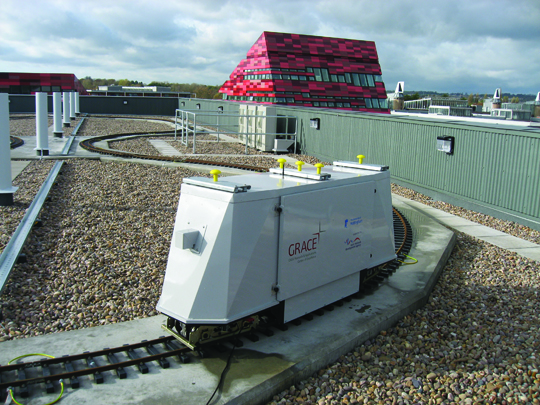
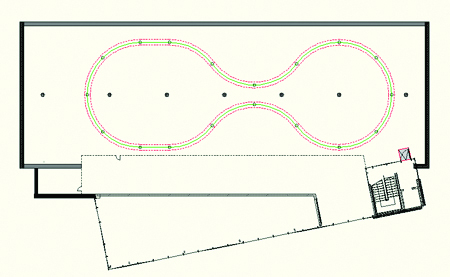
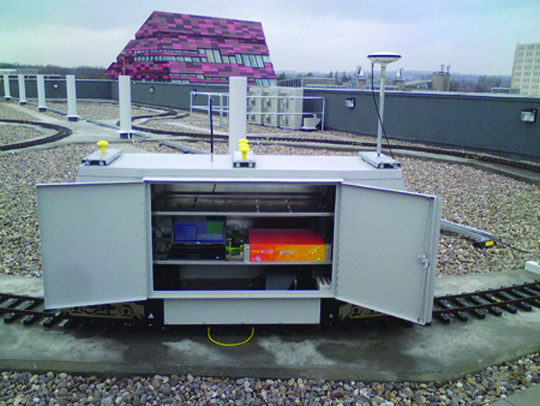
    One-hundred-twenty meters of test track, designed for repeatable dynamic position testing, run along the roof of the new Nottingham Geospatial Building at the University of Nottingham, UK. The figure-eight track provides an optimal controlled environment with test equipment aboard a remote-controlled, multi-sensor 7¼-inch gauge locomotive platform with a top speed of 7 kilometers per hour, a dedicated power supply, and five antenna mounts. Simulation of the track using Spirent GSS8000 hardware (GPS and Galileo) provides additional planning and testing capacity.

    The combination of these tools creates the ideal environment for our new project: augmentation of GNSS systems with ground-based Locata positioning technology. This pseudolite-like system, described in the March issue of GPS World, works in a GNSS-like fashion, using code and carrier phase. The major advantage, apart from utilization of the licensee-free 2.4 GHz frequency band, is the precise time synchronization of the network to the nanosecond level.

    The proposed integration addresses Locata’s weak vertical coordinates (due to relative coplanarity of transceivers) and GNSS’s requirement for a clear view of the sky and location-specific weak geometric distribution of the satellites. Prior research and analysis suggests considerable improvement in 3D positioning accuracy when combining ground-based positioning devices (pseudolites) with GNSS, but the current project pushes the research forward by attempting to create on-the-fly ambiguity resolution.

    track-2

    Combination of hardware and software simulation has provided an initial assessment of the proposed integration, optimization of equipment location, and test of the mathematical model to be used. Practical tests, using the roof lab on top of the NGB, will further verify the method and allow comparisons between the predicted and real-life results. This will aid the assessment of noise, multipath, and in-bound interference. The test design minimizes the tropospheric effect, while track flexibility and repeatability offer the possibility of implementing and simulating obstructions and areas of GNSS outage. This will provide a full assessment of the mathematical model and the integrated system’s capacity.

    This project offers new opportunities in civil engineering, specifically monitoring and machine control. GPS is currently widely used for those applications, with Locata also proven successful. The integrated solution can provide not only enhanced positioning capacity but lower the required number of visible GNSS satellites, and offer improved integrity and quality control, ultimately increasing the safety of life.

    The intended utilization is for positioning in dense urban areas and essential structures (airports, seaports, factory sites, bridges) where sky visibility or correct satellite distribution cannot be guaranteed.

    The track is available for other projects. Funded by East Midlands Development Agency, hosted by the Institute of Engineering Surveying and Space Geodesy, the Centre for Geospatial Science, and the GNSS Research and Applications Centre of Excellence (GRACE).

    track-3