Ness Czech will supply the Czech Railway Administration with a Digital Technical Railway Map (DTRM) with help from Hexagon’s Safety, Infrastructure and Geospatial division. The DTRM project has been underway since September 2022 and will be implemented by 2025.
DTRM is a railway-specific geographic information system (GIS), that provides access to transport and technical infrastructure information to better prepare investments and repair work. The basis of the DTRM project is the Technical Map Information System (ISTEM) developed by Ness and Hexagon.
The project includes digitization and consolidation of all available Czech Railway Administration data, covering more than 9,200 km of tracks, 27,000 km of technical infrastructure and an area of 21,000 ha. The delivery also includes three data centers.
The project is a legislative obligation of the Czech Railway Administration as the state is developing a national map, which will be fully operational by 2024. The Digital Technical Map of the Czech Republic is being built across the country by connecting regional digital maps, maps from the Railway Administration and maps provided by the Directorate of Roads and Highways. The connection is provided by the Czech Land Surveying and Cadastral Office.
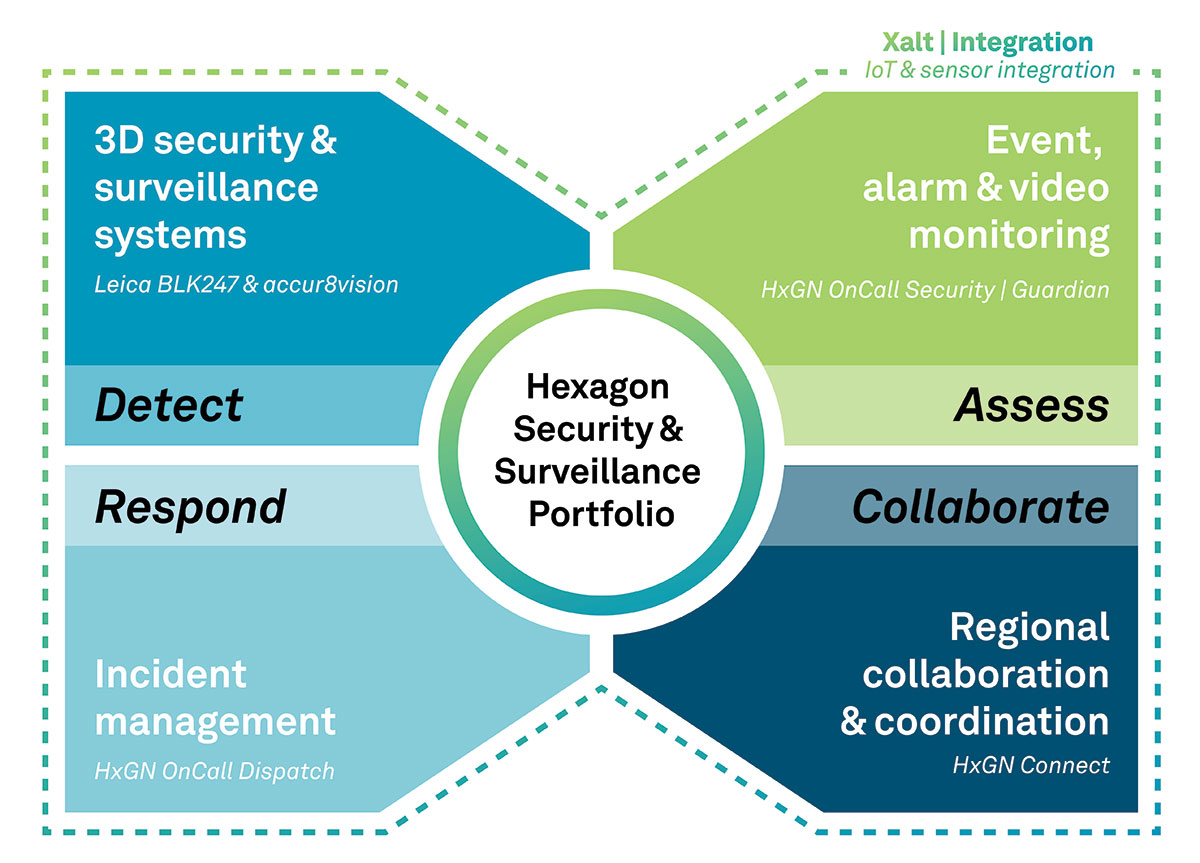
The Security & Surveillance portfolio for rail. (Image: Hexagon)
Hexagon’s Safety, Infrastructure & Geospatial division, in partnership with Hexagon’s Geosystems division, has introduced Hexagon’s Security & Surveillance portfolio for rail.
Comprised of an integrated set of solutions proven in rail operations around the globe, the portfolio unites 3D surveillance systems with best-in-class security, dispatching and collaboration software. It enables rail operators to better protect their assets, passengers and freight to reduce disruptions and improve safety and customer satisfaction.
The portfolio addresses the complete lifecycle of incident management, empowering operators to detect, assess and respond to threats and incidents and collaborate with outside organizations when needed. It includes:
Detect: Leica BLK247 and accur8vision 3D security and surveillance systems go beyond traditional 2D security cameras by integrating lidar, thermal sensors, video and 3D planning and tracking software for high-value areas, perimeters and zones, such as tunnels and rolling stock.
Assess: HxGN OnCall Security | Guardian provides a common operational picture for alarms, sensors, the internet of things, intrusion devices and video data to deliver situational awareness for real-time event monitoring.
Respond: HxGN OnCall Dispatch, a computer-aided dispatch solution with embedded assistive artificial intelligence, allows control room operators to dispatch resources to respond to incidents.
Collaborate: HxGN Connect facilitates collaboration and information sharing between internal teams and external entities to ensure stakeholders are informed and engaged during events.
“Globally, passenger and freight traffic are expected to double by 2050, which means rail operators must begin investing in safer rail operations now,” said Juergen Dold, President, GSI, Hexagon. “Rail networks have a broad spectrum of security needs, and Hexagon’s Security & Surveillance portfolio uniquely spans different hazards, capabilities and teams. It offers scalable solutions that seamlessly transition from simple security monitoring to emergency response to collaboration among diverse teams during complex operations.”
Hexagon’s Security & Surveillance portfolio builds on Hexagon’s capabilities for rail safety and security operations. Every year, Hexagon solutions protect more than 5 billion rail and transit passengers around the world. In North America alone, the company’s technologies help protect more than 56,000 miles of railways.
A train arrives at Tel Aviv University Station on the Israeli Railway in Tel Aviv. (Photo: svarshik/iStock Editorial/Getty Images Plus/Getty Images)
InfiniDome Ltd., a GPS security company, is joining with with Israeli partner Focus Telecom, in a new country-wide project with Israel Railways. The project involves deployment by Focus Telecom of GPS repeaters at more than 30 railway stations across Israel, providing accurate, location-based service indoors at all locations for a new Israel Railways ticketing app.
A critical component of the project is a monitoring service that detects and provides alerts of any GPS disruption or interference in real time, as they are identified. This is facilitated by infiniDome’s IoT GPSensors and its cloud-based GPS monitoring service, infiniCloud.
“Incorporating infiniDome’s proven resilient PNT capability to monitor and protect such a critical GPS service is a necessary enhancement for government designated critical infrastructures,” said Ehud Sharar, Focus Telecom CEO.
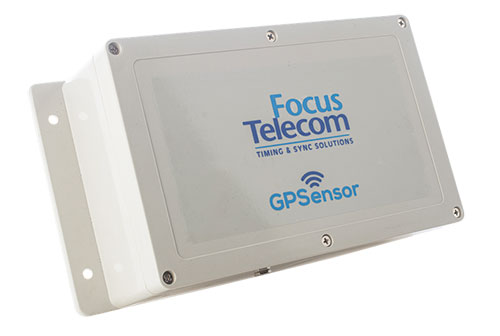
Photo: Focus Telecom
InfiniDome’s monitoring technology for critical assets detects and alerts operators of threats and disruptions of the essential GPS signals. These threats can originate from both malicious or natural causes.
“GPSensor IoT technology combined with our infiniCloud GPS security cloud assures real-time alerts about jamming attacks. All GPS signal data and its assured integrity are available as real time data so Israel Railways can react immediately and reduce downtime of the network,” said Omer Sharar, infiniDome CEO.
Israel Railways is the cornerstone of Israeli critical infrastructure. In 2018, Israel National Railway carried 68 million passengers. This same infiniDome GPS monitoring and protection technology is now available to defend critical infrastructure assets worldwide.
Innovate UK, the United Kingdom’s innovation agency, has selected Hexagon’s Geospatial division to conduct a research project that will result in faster and higher-precision mapping of railway infrastructure through the use of artificial intelligence.
The project is funded by Network Rail, the owner and operator of Great Britain’s railway infrastructure, under its R&D portfolio and delivered by Innovate UK through the SBRI competition, Innovation in Automated Survey Processing for Railway Structure Gauging, Phase One. A small group of teams was selected for this effort.
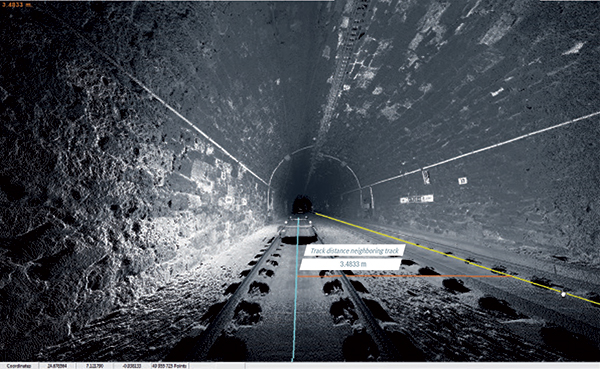
Image: Hexagon
The project will enable Network Rail to automatically identify and measure railway structures from lidar data, saving valuable time and resources, while also improving planning and operations across the rail network. The current, manual process takes analysts months or even years due to the size of the data and the labor-intensive tasks involved.
“The combination of cross-sectional area, shape, length and speed all place a space requirement on today’s railway,” said James Sweeney, senior engineer at Network Rail. “We anticipate this project will offer us a more efficient way to capture, analyse and measure railway features along 20,000 miles of track, which is important to railway safety and the growth and capacity of our network.”
Network Rail collects detailed information about its track and the surrounding features, such as bridges and tunnels. The data is then analyzed to assess clearances between trains and the infrastructure around them, which is key to safety.
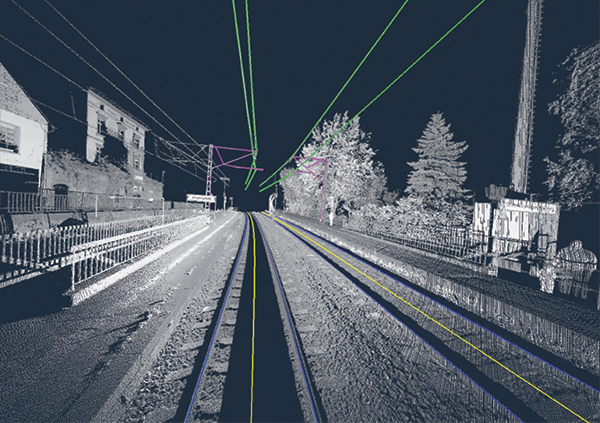
Image: Hexagon
The new project aims to automate the extraction and calculation of railway features from sensor data, leveraging AI to automatically analyze point-cloud data, identify different structure types, and perform measurements on the structures. The data will be collected from reality capture solutions from Hexagon’s Geosystems division.
“Network Rail, supported by Innovate UK, is leading the way in the use of AI to automate rail structure identification and measurement,” said Mladen Stojic, president of Hexagon’s Geospatial division. “We are excited to be part of a project that can help transform the gauging process for UK railways.”
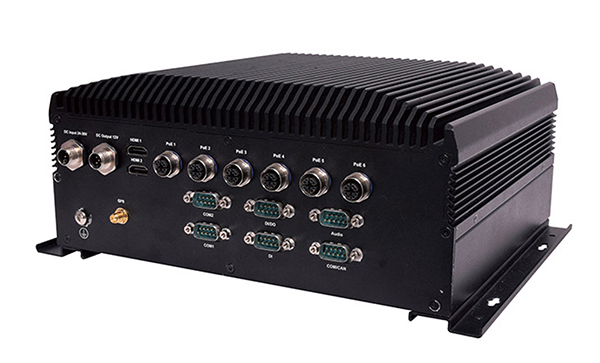
Lanner Electronics Inc., a designer and manufacturer of network appliances and intelligent edge computing platforms, has launched the R3S series of rugged, EN-50155-certified fanless vehicle/rail computers.
The R3S is equipped with a u-blox NEO-M8N module, which receives GPS, Galileo, GLONASS and BeiDou with the default set for GPS + GLONASS dual band.
Powered by Intel Atom x7-E3950 processor (formerly Apollo Lake) and Intel HD graphics 505 processor, R3S series offers power-efficient performance for consolidating the in-vehicle workloads such as video surveillance, control/monitoring, passenger information, and Wi-Fi hotspot sharing.
To ensure proper operations in moving vehicles, R3S series is certified with EN50155, EN50121-3-2, EN50121-4, EN50125-3 and EN45545 standard, E13 standard and has passed MIL-STD-810G shock and vibration resistance certifications. R3S series can operate under wide operating temperature range (-40~70° C) and 24~36/72~110 voltage input, indicating its excellent reliability in harsh railway settings.
Designed for in-vehicle surveillance, the new R3S series equip with 6x M12-protected PoE ports (any 3 or 4 ports can support IEEE 802.3at PoE+) for IP camera or wireless access point connection and one external removable 2.5-inch HDD/SSD drive bay for recorded footage storage.
For edge-to-cloud connectivity, R3S uses its internal GPS/GLONASS chipsets for GPS tracking and has two M.2 slots with up to 4x SIM card readers for failover LTE connection.
For consolidating the in-vehicle workloads such as in-vehicle control/monitoring and passenger information, R3S features a variety of I/O support, including 2x HDMI, DI/DO, 3x COM/CAN BUS and 4xUSB ports.
China’s National Reference Station Network. (Image: BeiDou)
A Russian law was approved July 26 that sets forth cooperation between Russia and China on using GLONASS and BeiDou for peaceful purposes.
According to the RosCosmos website, the law was approved at a meeting of the Council of Federation of the Federal Assembly of the Russian Federation. The law is officially named, “On ratification of the agreement between the Government of the Russian Federation and the Government of the People’s Republic of China on cooperation in the use of GLONASS and Beidou global navigation satellite systems for peaceful purposes.”
An intergovernmental agreement was signed on Nov. 7, 2018, in Beijing during the 23rd regular meeting of the heads of government of Russia and China. The agreement creates an institutional and legal framework for cooperation in the development and manufacture of civil navigation equipment using GLONASS and Beidou systems.
It also establishes cooperation in the development of Russian-Chinese standards for the application of navigation technologies using both systems — in particular, standards for the control and management of traffic flows across the Russian-Chinese border. The border is 4,200 kilometers (2,615.5 miles) long — world’s sixth-longest international border.
Under the agreement, the two countries plan to place in their own countries measuring stations for the other country’s GNSS, on a reciprocal basis.
The commuter rail industry is making progress installing and implementing positive train control (PTC), according to an analysis by the American Public Transportation Association (APTA), an advocate for the advancement of public transportation programs and initiatives in the United States.
The advancements reflect the commuter rail industry’s commitment to safety and implementing PTC by the Dec. 31 statutory deadline, APTA said in a statement.
PTC is a complex signaling and communications technology that commuter rail agencies are installing to offer a critical safety overlay on top of an already safe industry. In fact, rail is the safest surface transportation mode and traveling by commuter rail or intercity rail is 18 times safer than traveling by automobile.
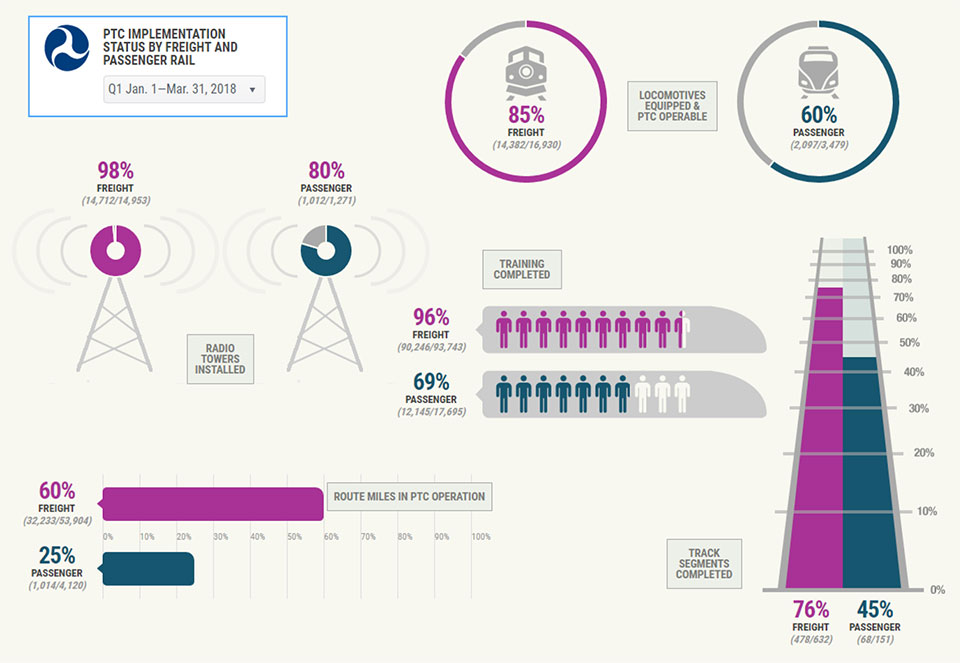
The Federal Railroad Administration issued a PTC progress report in July, with the infographic below.
Chart: Federal Railroad Administration, Jan-March 2018
This is in contrast to a previous PTC infographic, released in June 2016.
Chart: Federal Railroad Administration, June 2016
According to APTA, as of June 30, 2018:
91 percent of spectrum has been acquired;
85 percent of 13,698 pieces of onboard equipment have been installed on locomotives and cab cars etc.;
79 percent of 14,083 wayside (on track equipment) installations have been completed;
78 percent of back office control systems are ready for operation;
74 percent of 14,847 employees have been trained in PTC; and
34 percent of commuter railroads are in testing, revenue service demonstration, or are operating their trains with PTC.
“Every year, 30 commuter railroads across America safely carry passengers on 501 million trips,” said APTA President and CEO Paul P. Skoutelas. “With safety as our number one priority, the commuter railroads are making strong and continuous progress in implementing Positive Train Control.”
Under current law (49 U.S.C. 20157), commuter railroads are required to meet the following milestones by Dec. 31. As defined in 49 U.S.C. 20157(a)(3)(B), they are to have:
Installed all PTC hardware (wayside and onboard equipment);
Acquired all necessary spectrum for PTC implementation;
Completed all employee training;
Initiated testing on at least one territory subject to the PTC requirement (or other criteria); and
Submitted a plan and schedule to the Secretary of Transportation for implementing a PTC system.
Upon reaching these milestones by the end of 2018, the commuter railroads must implement PTC as soon as practicable and no later than December 31, 2020.
“Positive Train Control is a critical commuter rail safety enhancement,” said SEPTA General Manager Jeffrey D. Knueppel, general manager of the Southeastern Pennsylvania Transportation Authority (SEPTA). “Implementing PTC at SEPTA, during a challenging period of capital funding, has been an authority-wide commitment. Throughout this effort, our in-house team has been working continuously with Amtrak, our freight partners, and third-party contractors to address technical and interoperability challenges. SEPTA trains on all 13 regional rail lines are equipped and operating with PTC, and SEPTA is proud to have implemented this safety technology for our customers and employees.”
“Implementing Positive Train Control in Chicago’s dense and busy railroad network has been very challenging, but Metra is right where we said we’d be in terms of finishing the job,” said Jim Derwinski, CEO/executive director of Metra, the Northeast Illinois commuter rail system. “Working with our freight partners, we expect to have PTC implemented or in revenue service demonstration on six of our 11 lines by the end of 2018, and to complete the job by 2020.”
The commuter rail industry is moving aggressively to implement PTC as it faces considerable technical and financial constraints. At a time when the national transit state of good repair backlog stands at an estimated $90 billion, the commuter railroad industry’s cost to implement PTC will exceed $4.1 billion, diverting funds from other critical infrastructure priorities.
Since Congress mandated PTC, the federal government has awarded $272 million in PTC grants. Another $250 million was made available in May 2018.
PTC is an unparalleled technical challenge in scale, complexity, and time required. The challenges include:
a limited number of PTC-qualified vendors simultaneously in demand by both the passenger and freight railroad industries to develop, design and test this complex safety technology;
diagnosing and resolving software issues,
securing adequate access to track and locomotives for installation and testing, and
achieving interoperability, as commuter rail systems operate in mixed traffic with other freight and passenger railroads.
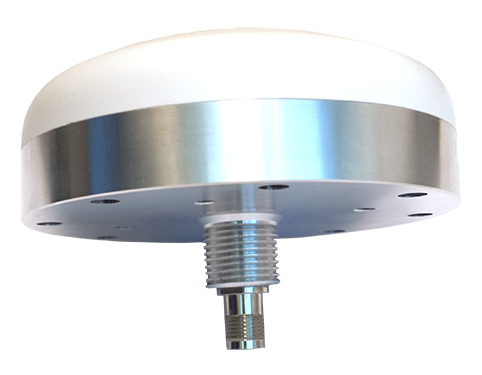
PCTEL Inc. has launched a new series of multi-GNSS L1/L2/L5 antennas for precision navigation and timing.
According to the company, the antennas combine aerospace-level precision with global satellite compatibility, in a highly durable package. They enable critical applications including vehicular automation, 5G network timing synchronization and Positive Train Control (PTC) systems.
The company made the announcement at the RSSI C&S Exhibition (Railway Systems Suppliers Inc.) being held this week in Omaha, Nebraska.
PCTEL’s multi-GNSS L1/L2/L5 antennas increase the accuracy of timing and location information by providing simultaneous access to multiple GNSS signals across multiple frequency bands. The antennas support all relevant GPS, GLONASS, BeiDou and Galileo frequencies with excellent multipath mitigation and high out-of-band rejection for greater signal clarity, the company said. Their robust AAR and IP67-compliant design makes them suitable for years of use on railways and in other harsh real-world environments.
“Precision navigation is crucial for the next generation of autonomous vehicle technologies, which could drive major improvements in safety and efficiency across a wide variety of industries,” said Rishi Bharadwaj, senior vice president and general manager of PCTEL’s Connected Solutions group. “PCTEL’s new antennas make precision navigation accessible for large-scale deployments in rail, public safety, agricultural and commercial fleets. They also enable commercial deployments of 5G networks, which have higher accuracy requirements for network timing.”
Earlier this month, PCTEL released its 900-MHz MIMO Yagi antennas with dual polarization., designed for use with MIMO or diversity radios in advanced supervisory control and data acquisition (SCADA) systems and other industrial internet of things applications. PCTEL’s dual polarized antenna technology improves data throughput and reliability on both licensed and unlicensed spectrum.
PCTEL is displaying its new multi-GNSS antennas along with other antenna solutions for the rail industry, May 22-23 at the RSSI C&S Exhibition, booth #1109. The new antennas will be available for purchase in mid-July.
The Dutch state-owned rail company NS Groep N.V. is deploying a real-time remote diagnostics monitoring system. As a core component of NS’ overall real-time monitoring architecture, the system allows railway operators to streamline maintenance costs and provide efficiencies across their fleet by automating manual tasks.
NS in the Netherlands will join a growing number of large rail operators that have implemented GNSS solutions, in this case the Trimble R2M system. Others using R2M include South West Trains in the United Kingdom, Irish Rail, SNCF France, SBB Switzerland and VR Finland.
R2M processes diagnostic data from rail vehicles in real time. It provides a comprehensive view of the overall fleet’s status including specific vehicle faults. The system also identifies potential faults that may arise while analyzing and detecting anomalies in on-vehicle component behavior to identify component issues and the possible impact this behavior may have on the vehicle and overall fleet.
With the R2M software, NS will be able to aggregate data from a range of on-train and wayside sources and provide real-time information to the NS Train Helpdesk to monitor the fleet status. Information will also be available to fleet analysts, work-planning engineers and mechanics to support the operational repair process of NS in real time.
Railway technology company Buckeye Mountain and Trimble are working together to provide the railroad industry with advances in GPS solutions such as the Trimble PG200 GNSS receiver.
The PG200 is a rugged, lightweight and portable receiver to use in rail and intermodal yards to identify safety zones. It also includes auto tracking on critical assets.
Trimble has also been working with Buckeye Mountain to provide the railroad industry with mobile computing and AEI (railcar automatic equipment identification tags) products.
Trimble’s Juno T41 R-AEI, an all-in-one rugged AEI reader, is a compatible platform for Buckeye Mountain’s AEI Quick Read application, a basic mobile application that reads AEI tags.
The T41 keeps workers the required safety distance from railcars while the read range is very responsive.
An automatic train control system — many of which use GPS — was not installed on the commuter rail route where an Amtrak train left the track on Tuesday, according to the National Transportation Safety Board. The advanced safety technology, known as positive train control, is designed to prevent high-speed derailments.
Seven people were killed and more than 200 injured when Amtrak Northeast Regional Train 188 with seven cars derailed while rounding a curve at more than double the 50-mph speed limit.
An Advanced Civil Speed Enforcement System (ACSES) was due to be installed on the route before the end of the year.
The U.S. Department of Transportation describes these methods of positive train control, most of which use GPS:
ACSES (Advanced Civil Speed Enforcement System). A transponder-based system, in use on Amtrak’s Northeast Corridor originally put into use on the Northeast Corridor by the specific requirements of an Order of Particular Applicability. This type of positive train control system has been approved and certified by the Federal Railroad Administration (FRA).
ETMS (Electronic Train Management System). A GPS- and communications-based system being deployed by BNSF Railway.
I-ETMS (formerly called Vital Electronic Train Management System). A GPS- and communications-based system, not yet ready for deployment. It is the system of choice for CSX Transportation, Norfolk Southern Railway and Union Pacific Railroad. BNSF Railway is to upgrade to it when software is available; various passenger/commuter and other railroads are adopting it for compatibility and interoperability.
ITCS (Incremental Train Control System). A GPS- and communications-based system used by Amtrak on its Michigan line, authorized for passenger train speeds up to 110 mph, originally put into use by the specific requirements of an FRA-approved waiver. ITCS certification through Amtrak’s request for expedited certification process is pending successful resolution of a few remaining issues before FRA approval for certification.
The Rail Safety Improvement Act of 2008 mandates that positive train control be implemented across a significant portion of the nation’s rail industry by Dec. 31, 2015.