Tag: RFP

  • RNT Foundation proposes attributes for resilient timing RFP

    RNT Foundation proposes attributes for resilient timing RFP

    Image: RNT Foundation
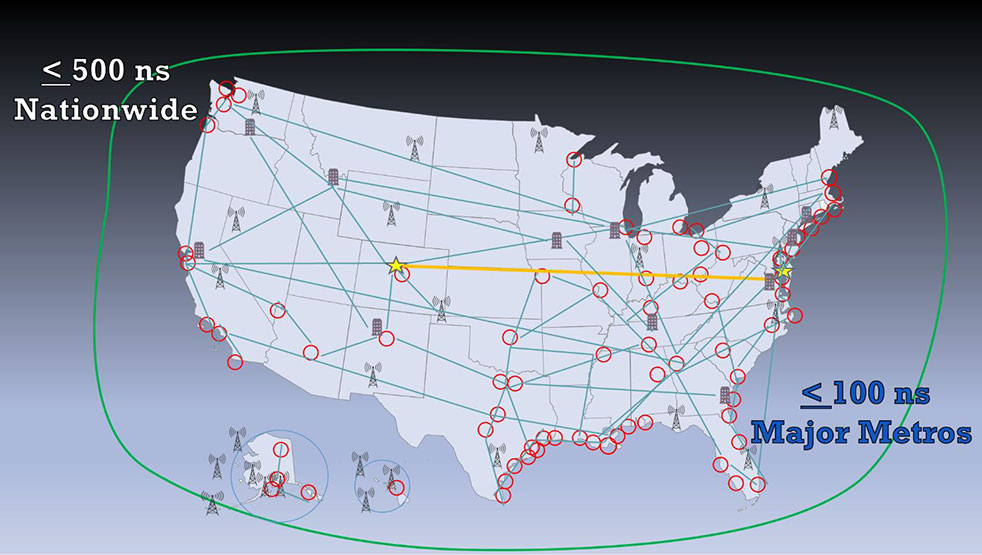
    A National Resilient Timing Architecture should include delivery by fiber and RF along with space-based, according to the RNT Foundation. (Image: RNT Foundation)

    The Resilient Navigation and Timing (RNT) Foundation has published a white paper proposing attributes for a government Request for Proposal (RFP) to acquire timing services.

    A National Resilient Timing Architecture – Now for an RFP!” builds upon the foundation’s October 2020 white paper “A Resilient National Timing Architecture.”

    Timing services, most of which are now sourced directly or indirectly from GPS, are essential for myriads of network, transportation, financial, industrial, and other applications. The National Timing Resilience and Security Act of 2018 (NTRSA) requires establishment of one or more systems to serve as alternatives and back up GPS timing.

    The RNT Foundation’s October 2020 white paper discusses how a national timing architecture fulfilling the requirements of NTRSA could be established relatively easily and inexpensively. It proposes that, rather than building its own system, the government contract for services with commercial providers.

    The new white paper outlines some of the requirements and evaluation criteria the government might use when acquiring timing services.

    Goals

    The paper postulates that the goal of such a procurement should be to establish a federal timing “backbone.” This would fulfill the requirements of NTRSA, which recognizes that timing is critical for many applications and is also the basis for most electronic positioning and navigation systems.

    Establishing this backbone will provide users with an alternative and a safety net for GPS disruptions, and at other times enable more resilient and reliable services. As a backbone, it would provide basic, foundational services upon which others would be able to build. The new services would be expected to:

    • support a wide variety of public and private applications across the nation
    • be entirely independent from and have minimal or no common failure modes with GPS and other GNSS
    • provide multiple and diverse methods of timing delivery
    • serve both fixed and mobile users.

    Regarding this last point, the paper notes that mobile devices must know their location before they can make use of timing signals. Thus, the selected system or combination of systems also will have to provide GPS-independent location information at a basic level to mobile users.

    Requirements

    Successful proposals, the paper envisions, will need to meet a number of requirements including

    • serving the entire U.S. land area, airspace, and coastal waters to about 200 miles offshore
    • enabling all fixed and mobile users to access at least one non-space-based source (to ensure no common failure modes with GPS/ GNSS)
    • timing accuracy in all locations to within 500 nanoseconds of universal coordinated time (UTC); this accuracy should be within 100 nanoseconds of UTC for the 50 largest metropolitan areas
    • one or more integrity measures to provide users confidence in system(s) accuracy
    • a very high rate of continuity and availability, similar to that of navigation beacons for aircraft
    • a performance monitoring and control system.

    Evaluation Criteria

    Fortunately for the government, numerous systems and companies are already able to provide the needed services. Deciding which to select will likely be a significant effort. Some of the evaluation criteria suggested by the RNT Foundation white paper are:

    Annual Cost – While cost will not be the only consideration in this acquisition, the government always has a responsibility to taxpayers to weigh it as an important factor.

    Infrastructure Required Per Unit of Coverage Area – This has been cited by the Department of Transportation as a very important consideration. Not only does the amount of infrastructure affect cost, but it also has implications for environmental and community impacts.

    Spectrum – Signal disruption by in-band and out-of-band transmissions has been a significant issue for GPS. New PNT wireless and radio-frequency services should pose as few spectrum concerns as possible. Spectrum band reservations, licenses, pre-allocated bands, other bands and adjacent band uses will all be given consideration.

    Penetration – While the government may not list this as a requirement, the ability of a service to reach underwater, underground and indoor locations will likely be desirable and part of proposal evaluation.

    Resilience – The vulnerability of GPS signals to disruption will undoubtedly make the resilience of potential backup and complementary systems a major issue. The RNT Foundation paper discusses two kinds of resilience – operational and recovery.

    Operational resilience is defined as “the ability of a system, combination of systems, or service to resist disruption (e.g.: jamming, spoofing, physical damage negatively impacting service).” One measure of resilience might be the energy needed to disrupt signals.

    Recovery resilience is described as “The speed and ease with which a service can return to normal operation” after a disruption.

    Cybersecurity – Similarly, cybersecurity is seen as having two components. The first is network security, defined as the degree to which systems are isolated from or connected to networks. Second is signal security, and is how well signals can be protected from infiltration and imitation.

    Endorsements for GPS Alternative Timing

    Since the “National Resilient Timing Architecture” white paper was issued in 2020, calls for GPS alternatives have intensified, and the white paper itself has received an important endorsement.

    On May 7, the telecommunications industry standards group Alliance for Telecommunications Industry Solutions (ATIS) vigorously supported federal funding for GPS alternatives. In letters to leaders in both houses of Congress, ATIS cited “the urgent need for funding the deployment and adoption of Alternative Positioning, Navigation, and Timing (PNT) Systems in U.S. critical infrastructure, including the U.S. telecom industry.”

    The need for federal support for timing and positioning backups for GPS was also supported by a two-year old study released by RAND Corporation in May. While the paper went to great lengths to argue against a duplicate GPS-like capability (something no one has supported to the best of our knowledge), it quietly suggested federal support for both a national timing system and location services to serve E-911 systems.

    Numerous recent media releases from U.S. Space Force have revealed serious military threats to GPS and other space-based systems. A variety of killer-satellites, lasers and other weapons have turned space from a sanctuary into a potential battle ground. While not specifically calling for alternatives to GPS, the Space Force announcements have made it clear the nation needs to “get the bullseye off GPS.” Establishing at least one terrestrial alternative system similar to those operated by our adversaries will make U.S. satellites and signals much less attractive targets, according to Greg Winfree, former assistant secretary at the U.S. Department of Transportation.

    Federal Funding Needed

    Federal funding for improving national timing was specifically supported by a group of CEOs and senior executives from major telecom companies. Acting as the National Security Telecommunications Advisory Committee (NSTAC), the group’s May report to President Biden discussed GPS vulnerabilities and threats, and urged establishment of a capability

    “…similar to that reflected in the Resilient Navigation and Timing Foundation’s paper entitled A Resilient National Timing Architecture. Further, to enhance the ability of commercial entities to afford leveraging this architecture, the Administration should appropriate sufficient funds to lay the foundation for creating this timing architecture, with the Federal Government being the first customer for what will ultimately become a resilient, interconnected network for PNT delivery.”

    Federal funding support is necessary, according to NSTAC, because free GPS services greatly suppress market demand for alternatives.


    Dana Goward is president of the Resilient Navigation and Timing (RNT) Foundation.

  • Boeing won’t bid on GPS III Follow On contract

    Boeing has decided to not submit a proposal to build up to 22 GPS III satellites for the U.S. Air Force. The GPS III Follow On (GPS IIIF) program will supply additional upgraded satellites to replace ones now in the constellation.

    “We have not put in a proposal for GPS III,” said Rico Attanasio, Boeing’s director of Department of Defense and civil navigation and communications programs, to Space News.

    Lockheed has been the only producer of GPS III satellites, and is now under contract to build the first 10. Boeing built earlier versions of GPS satellites.

    Lockheed Martin has submitted a proposal for the Follow On contract.

    In February, the U.S. Air Force Space Command (AFSC) released its request for proposals (RFP) to build the 22 GPS III satellites, called the GPS III Follow-On Phase 2 contract. The estimated dollar value of the acquisition is $10 billion including all options.

    Phase 2 is planned as a single, predominantly fixed-price incentive-type contract awarded via full and open competition for production of 22 GPS III satellites. Deadline for proposals is April 16. Construction is to begin in fiscal year 2019 (Oct. 1, 2018), with delivery of the first satellite in 2026.

    Boeing thought it could compete based on “innovation, resilience [and] a new payload, but that wasn’t emphasized,” Attanasio told Space News. “It wasn’t a good fit for us.”

  • U.S. Air Force seeks builder for 22 more GPS III satellites

    U.S. Air Force seeks builder for 22 more GPS III satellites

    Photo: LMCO

    The U.S. Air Force Space Command (AFSC) has released its request for proposals (RFP) to build 22 new GPS III satellites, called the GPS III Follow-On Phase 2 contract.

    The contract will be awarded to a single bidder, the Air Force Space Command stated in the announcement posted on FedBizOpps.gov. The estimated dollar value of the acquisition is $10 billion including all options.

    Phase 2 is planned as a single, predominantly fixed-price incentive-type contract awarded via full and open competition for production of 22 GPS III satellites. Deadline for proposals is April 16. Construction is to begin in fiscal year 2019 (Oct. 1, 2018), with delivery of the first satellite in 2026.

    For Phase 1,  AFSC awarded in May 2016 three fixed-price contracts to Boeing Network and Space Systems, Northrop Grumman Aerospace Systems and Lockheed Martin Space Systems Company, which is building the first 10 GPS III satellites. According to the Air Force, “Phase 1 has determined that viable, low-risk, high-confidence sources exist to conduct a full and open competition for Phase 2, the production of 22 GPS III SVs starting in the FY19 timeframe.”

  • U.S. Air Force plans to release GPS III Follow-On RFP next week

    The U.S. Air Force plans to release a request for proposal (RFP) for the second phase of GPS III Follow-On satellite production “on or about” Feb. 13, according to a report by Inside Defense.

    The RFP was expected in December 2017, but was held up as officials worked to solidify requirements.

    The solicitation is expected to result in a contract for up to 22 GPS III Follow-On satellites in the 2019 time frame.

    Lockheed Martin is on contract to build the initial 10 GPS III satellites, the first of which is expected to launch this year. Besides Lockheed, Boeing and Northrop Grumman  have both expressed interest in competing to produce the next batch of satellites.

  • US Air Force releases GPS III-3 launch services RFP

    US Air Force releases GPS III-3 launch services RFP

    The Air Force has released a Request for Proposal (RFP) for launch services for the GPS III-3 mission, scheduled to launch in 2019. Proposals are due Sept. 19; the contract will be a standalone contract for a single GPS III launch.

    The United Launch Alliance (ULA) and SpaceX are expected to compete for the contract. In April, SpaceX was chosen to launch the GPS III-2 satellite in May 2018. ULA chose not to compete.

    The RFP seeks an Evolved Expendable Launch Vehicle (EELV) Launch Service. The draft RFP was released on June 14 to obtain industry feedback to inform the Final RFP.  After extensive industry engagements, the Final RFP was released on Aug. 3 with proposals due back to the Air Force no later than Sept. 19 in accordance with the solicitation instructions.

    After evaluating proposals through a competitive, best-value source selection process, the Air Force will award a firm-fixed price contract that will provide the government with a total launch solution including launch vehicle production, mission integration and launch operations for the GPS III-3 satellite.

    Artist's concept of the nextgen GPS III satellite (courtesy of the USAF).
    Artist’s concept of the nextgen GPS III satellite (courtesy of the USAF).

    The Air Force’s acquisition strategy for this solicitation achieves a balance between mission success/operational needs, and lowering launch costs, through reintroducing competition for national security space missions, the Air Force said in a press release.

    “Launch system certification is a key element (high technical bar) within this solicitation to provide insight into the technical capabilities and rigorous processes that demonstrate a launch vehicle contractor’s ability to design, develop, manufacture, and launch national security space missions and contributes to the overall flight worthiness process,” said Lt. Gen. Samuel Greaves, Space and Missile Systems Center commander and Air Force program executive officer for Space.  Prior to contract award, the contracting officer will verify that the Offeror has a certified launch system as part of a responsibility determination resulting in a high technical bar.

    “Through this competitive solicitation for GPS III launch services, we hope to continue fostering competition in order to promote innovation and reduce cost to the taxpayer while maintaining our laser focus on mission success,” Greaves said.

    GPS III is expected to provide improved anti-jamming capabilities as well as improved accuracy for precision, navigation, and timing. It will incorporate the common L1C signal which is compatible with the European Space Agency’s Galileo global navigation satellite system and compliment current services with the addition of new civil and military signals.

    The first GPS III satellite undergoes system-level thermal vacuum testing. (Photo: Lockheed Martin)
    The first GPS III satellite undergoes system-level thermal vacuum testing. (Photo: Lockheed Martin)

    This is the second competitive launch service solicitation under the current Phase 1A procurement strategy. The Phase 1A procurement strategy reintroduces competition for national security space launch services.  Under the previous Phase 1 strategy, ULA was the only certified launch provider. In 2013, ULA was awarded a sole-source contract for launch services as part of an Air Force “Block Buy” of 36 rocket cores that resulted in significant savings for the government through FY 2017.

    In May 2015, Space Exploration Technologies (SpaceX) was certified for EELV launches resulting in two launch service providers that are qualified to design, produce, qualify and deliver a launch capability and provide the mission assurance support required to deliver national security space satellites to orbit.

  • GPS III Launch Services RFP Released by Air Force

    The U.S. Air Force released a final Request for Proposal (RFP) for GPS III Launch Services on Sept. 30. Launch services include launch vehicle production, mission integration and launch operations for a GPS III mission scheduled to launch in 2018. Proposals are due back to the Air Force no later than Nov. 16 in accordance with the solicitation instructions.

    After evaluating proposals through a competitive, best-value source selection process, the Air Force will award a firm-fixed price contract that will provide the government with a total launch solution for the GPS III satellite. The Air Force’s acquisition strategy for this solicitation achieves a balance between mission success, meeting operational needs, lowering launch costs, and reintroducing competition for National Security Space missions, according to a statement by the Air Force.

    “Through this competitive solicitation for GPS III launch services, we hope to reintroduce competition in order to promote innovation and reduce cost to the taxpayer while maintaining our steadfast laser focus on mission assurance and assured access to space,” said Lt. Gen. Samuel Greaves, Space and Missile Systems Center commander and Air Force Program Executive Officer for Space.

    This will be a standalone contract for one GPS III launch, the Air Force said. This is the first of nine competitive launch services planned in the FY 2016 President’s Budget Request under the current Phase 1A procurement strategy, which covers awards with FY 2015-2017 funding. The next solicitation for launch services will be for a second GPS III mission.

    The Phase 1A procurement strategy reintroduces competition for national security space launch services. Under the previous Phase 1 strategy, United Launch Alliance (ULA) was the only certified launch provider. In 2013, ULA was awarded a sole-source contract for launch services as part of an Air Force “block buy” of 36 rocket cores that resulted in significant savings for the government through FY 2017.

    In May, Space Exploration Technologies (SpaceX) was certified for EELV launches resulting in two launch service providers that are qualified to design, produce, qualify and deliver a launch capability and provide the mission assurance support required to deliver national security space satellites to orbit.

    “With the recent certification of SpaceX, we now have multiple launch service providers that can service critical NSS missions. Reintroducing competition into EELV will ultimately save taxpayer dollars and increase assured access to space. ” said Claire Leon, director of SMC’s Launch Enterprise Directorate.

    “As part of this reintroduction of competition, we’ve been working with our industry partners to develop and finalize this RFP,” said Leon. “Their feedback has been critical to developing the criteria for this source selection and how we are innovating government processes to better match commercial processes as directed by OSD’s Better Buying Power 3.0. This is an exciting time in NSS launch acquisitions.”

    GPS III is the next generation of GPS satellites that will introduce new capabilities to meet the higher demands of both military and civilian users. GPS III is expected to provide improved anti-jamming capabilities as well as improved accuracy for precision navigation and timing. It will incorporate the common L1C signal which is compatible with the European Space Agency’s Galileo global navigation satellite system and compliment current services with the addition of new civil and military signals.

    The Air Force Space Command’s Space and Missile Systems Center, located at the Los Angeles Air Force Base, Calif., is the U.S. Air Force’s center of excellence for acquiring and developing military space systems.  Its portfolio includes the Global Positioning System, military satellite communications, defense meteorological satellites, space launch and range systems, satellite control networks, space based infrared systems and space situational awareness capabilities.