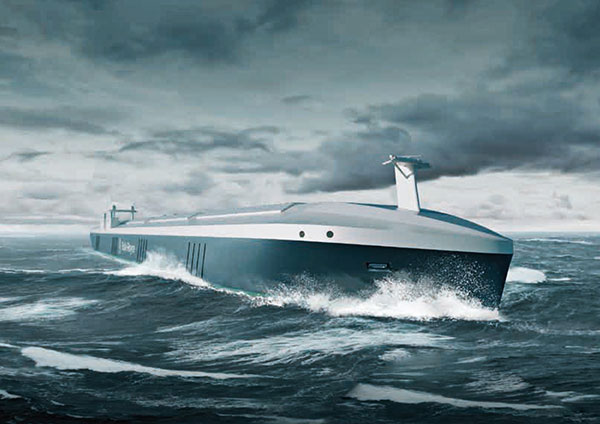
Tag: Rolls-Royce

  • Rolls-Royce and Finferries demonstrate fully autonomous ferry

    Rolls-Royce and Finnish state-owned ferry operator Finferries have successfully demonstrated a fully autonomous ferry in the archipelago south of the city of Turku, Finland.

    The car ferry Falco used a combination of Rolls-Royce Ship Intelligence technologies to successfully navigate autonomously during its voyage between Parainen and Nauvo. The return journey was conducted under remote control.

    Finnish ferry Falco uses Rolls-Royce ship intelligence to dock. (Photo: Rolls-Royce)
    Finnish ferry Falco uses Rolls-Royce ship intelligence to dock. (Photo: Rolls-Royce)

    During the demonstration, the Falco, with 80 invited VIP guests aboard, conducted the voyage under fully autonomous control. The vessel detected objects utilizing sensor fusion and artificial intelligence and conducted collision avoidance. It also demonstrated automatic berthing with a recently developed autonomous navigation system. All this was achieved without any human intervention from the crew.

    The Falco is equipped with a range of advanced sensors which allows it to build a detailed picture of its surroundings in real time. The situational awareness picture is created by fusing sensor data and it is relayed to Finferries’ remote operating centre on land, some 50 kilometres away in Turku city centre. Here, a captain monitors the autonomous operations, and can take control of the vessel if necessary.

    During the autonomous operation tests in Turku archipelago, Rolls-Royce has so far clocked close to 400 hours of sea trials. The Rolls-Royce Autodocking system is among the technologies that have been successfully tested. This feature enables the vessel to automatically alter course and speed when approaching the quay and carry out automatic docking without human intervention. During the sea trials, the collision avoidance solution has also been tested in various conditions for several hours of operation.

    Earlier this year Rolls-Royce and Finferries began collaborating on a new research project called SVAN (Safer Vessel with Autonomous Navigation), to continue implementing the findings from the earlier Advanced Autonomous Waterborne Applications (AAWA) research project, funded by Business Finland.

    “Today marks a huge step forward in the journey towards autonomous shipping and reaffirms exactly what we have been saying for several years, that autonomous shipping will happen,” said Mikael Makinen, president – Commercial Marine at Rolls-Royce. “The SVAN project has been a successful collaboration between Rolls-Royce and Finferries and an ideal opportunity to showcase to the world how Ship Intelligence technology can bring great benefits in the safe and efficient operation of ships.

    “This is a very proud moment for all of us and marks our most significant milestone so far. Today’s demonstration proves that the autonomous ship is not just a concept, but something that will transform shipping as we know it.”

    “We are very proud that maritime history has been made on the Parainen-Nauvo-route once again,” added Mats Rosin, Finferries’ CEO. “First with our world-renowned hybrid vessel Elektra and now Falco as the world’s first autonomous ferry. As a modern ship-owner, our main goal in this cooperation has been on increasing safety in marine traffic as this is beneficial for both the environment and our passengers. But we are also equally excited about how this demonstration opens the door to the new possibilities of autonomous shipping and safety.”

    The Falco is a 53.8 metre double-ended car ferry, which entered service with Finferries in 1993. It is equipped with twin azimuth thrusters from Rolls-Royce.

  • Rolls-Royce, ESA collaborate on autonomous shipping

    Rolls-Royce and the European Space Agency (ESA) have signed a cooperation agreement aimed at pursuing space activities in support of autonomous, remote-controlled shipping and promoting innovation in European digital logistics.

    The collaboration with Rolls-Royce aims to study the applications of various space assets to autonomous shipping, such as satellite-based positioning, better situational awareness using Earth observation data, and satcom services for improved onboard connectivity. It aims to develop and validate new solutions for communication between vessel systems and shore-based systems in addition to ship-to-ship communication.

    This will pave the way for the operation of commercial remote and autonomous shipping, innovative cargo logistics, smart ports and future commercial marine vessels.

    The partnership will enable satellites to serve navigation, ship intelligence, marine operations, cargo logistics, maritime safety, healthcare, passenger and crew communications.

    The next generation of 5G communications will rely on seamless integration of telecom networks and services, and ESA’s Satellite for 5G Initiative supports the technical and supply chain progress required, and will support development of 5G commercial services.

    The Memorandum of Intent (MOI) forms part of ESA’s wider strategy. In its new navigation research and technology programme, called the Navigation Innovation and Support Programme (NAVISP), ESA is studying and testing technologies for smart ships.

    NAVISP is investigating the integration of satellite navigation with non-space technologies and complementary positioning and communication techniques. NAVISP will apply ESA’s expertise from Galileo and EGNOS to new satellite navigation and, more widely, positioning, navigation and timing (PNT) challenges.

    ESA already serves the maritime community with many satellite capabilities. SAT-AIS (Satellite Automatic Identification System) permits identification and global tracking of ships using cutting-edge space and ground technology, using low Earth orbiting satellites to act as information relays to serve the whole globe. This results in more efficient use of existing infrastructures, a tangible reduction in cost and a decrease in the environmental impact.

    The ESA developed Sentinel-1 satellite, part of the European Union’s Copernicus programme, is establishing a pivotal role in the sector. Last August, Sentinel-1 Earth observation data helped the U.S. Coast Guard vessel Maple navigate through the legendary Northwest Passage, showcasing the enormous potential that satellite earth observation can have across the industry, particularly in ship-to-ship data transmission.

    Rolls-Royce and ESA also plan to cooperate in harnessing the power of big data. Data analytics, Machine Learning and Artificial Intelligence (AI) can improve operational efficiency, reliability and safety.

    Sensor data will inform augmented and virtual realities, or “digital twins.” A digital twin is an AI copy of a ship, including its systems, that synthesises the information available about the ship in a hologram.

    “It allows any aspect of an asset to be explored through a digital interface, creating a virtual test bench to assess the safety and performance of a vessel and its systems, both before its construction and through its lifecycle,”  said Karno Tenovuo, SVP ship intelligence at Rolls-Royce. “By creating ships and ship technology in a virtual environment, new ideas and technology can be realized and tested in a shorter time frame.”

  • Rolls-Royce joins partnership to develop autonomous ships

    Rolls-Royce joins partnership to develop autonomous ships

    Rolls-Royce and VTT's vision of  futuristic land-based control center, known as the Future Operator Experience Concept or oX. (Concept: Rolls-Royce)
    Rolls-Royce and VTT’s vision of  futuristic land-based control center, known as the Future Operator Experience Concept or oX. (Concept: Rolls-Royce)

    Rolls-Royce and VTT Technical Research Centre of Finland Ltd. have signed a strategic partnership to design, test and validate the first generation of remote and autonomous ships.

    The partnership, established in November 2016, combines and integrates the two company’s expertise to make such vessels a commercial reality.

    Rolls-Royce is pioneering the development of remote controlled and autonomous ships and believes a remote controlled ship will be in commercial use by the end of the decade. The company is applying technology, skills and experience from across its businesses to this development.

    VTT is an expert in ship simulation and the development and management of safety-critical and complex systems in demanding environments such as nuclear safety. It combines physical tests, such as model and tank testing, with digital technologies, such as data analytics and computer visualization.

    They will also use field research to incorporate human factors into safe ship design. As a result of working with the Finnish telecommunications sector, VTT has extensive experience of working with 5G mobile phone technology and wi-fi mesh networks. VTT has the first 5G test network in Finland.

    Working with VTT will allow Rolls-Royce to assess the performance of remote and autonomous designs through the use of both traditional model tank tests and digital simulation, allowing the company to develop functional, safe and reliable prototypes.

    Two remote -controlled ship prepare to pass. (Artist's concept: Rolls-Royce)
    Two remote-controlled ship prepare to pass. (Artist’s concept: Rolls-Royce)

    “Remotely operated ships are a key development project for Rolls-Royce Marine, and VTT is a reliable and innovative partner for the development of a smart ship concept,” says Karno Tenovuo, vice president of ship intelligence for Rolls-Royce. “This collaboration is a natural continuation of the earlier user experience for complex systems (UXUS) project, where we developed totally new bridge and remote control systems for shipping.”

    “Rolls-Royce is a pioneer in remotely controlled and autonomous shipping. Our collaboration strengthens the way we can integrate and leverage VTT’s expertise in simulation and safety validation, including the industrial Internet of Things, to develop new products and in the future, enable us to develop new solutions for new areas of application as well,” says Erja Turunen, executive vice president for VTT.

    Ship Intelligence will make greater use of ship systems and sensors to enhance both crew and vessel operating efficiency. (Rolls-Royce)
    Ship Intelligence will make greater use of ship systems and sensors to enhance both crew and vessel operating efficiency. (Rolls-Royce)
  • PNT Roundup: Remote and autonomous ships coming to high seas

    PNT Roundup: Remote and autonomous ships coming to high seas

    Remote and Autonomous Ships

    Coming Soon to the High Seas Near You

    Image courtesy of Rolls-Royce.

    The Advanced Autonomous Waterborne Applications Initiative (AAWA) published a white paper in June as part of presentations at the Autonomous Ship Technology Symposium 2016 in Amsterdam. The white paper outlines the Project’s vision of how remote and autonomous shipping will become a reality.

    Oskar Levander, Rolls-Royce vice president of Innovation – Marine, said, “This is happening. It’s not if, it’s when. The technologies needed to make remote and autonomous ships a reality exist. The AAWA project is testing sensor arrays in a range of operating and climatic conditions in Finland and has created a simulated autonomous ship control system which allows the behaviour of the complete communication system to be explored. We will see a remote controlled ship in commercial use by the end of the decade.”

    The AAWA white paper explores the research carried out to date on the business case for autonomous applications, the safety and security implications of designing and operating remotely operated ships, the legal and regulatory dimensions and the existence and readiness of a supplier network to deliver commercially applicable products in the short to medium term.

    Positioning Technologies. The proposed system draws on a range of sensors (see Figure 1) including GPS, inertial, lidar, cameras, short-range radars, and electronic charts. “When combined witha global or local positioning reference such as GNSS, and with wind sensors and inertial measurement units, the ship is able to keep its position even in rough weather conditions,” states the report. “The main question is therefore not whether the implementation of autonomous ship navigation is technically possible, but what is the combination of technologies and methods that provides the level of performance and reliability that is required for practical operation of large vessels, and at a reasonable cost.”

    The white paper draws on a wide range of expertise from academic researchers at some of Finland’s leading universities. Industry input has been provided by leading members of the maritime cluster including Rolls-Royce, Brighthouse NAPA, Deltamarin, DNV GL and Inmarsat.

    The project also has the support of shipowners and operators. The tests of sensor arrays are being carried out aboard Finferries 65-metrer double ended ferry, the Stella, which operates between Korpo and Houtskär. ESL Shipping Ltd is helping explore the implications of remote and autonomous ships for the short sea cargo sector.


    Iran Reiterates Loran Effort

    Researchers at Iran’s Malek-Ashtar University have developed a 1-megawatt transmitter with half-cycle technology for a national project announced as a replacement for GPS, which is currently employed for all positioning, navigation and timing services across the country. Given the lack of control on the GPS’s accuracy and quality and a possible outage of the system in critical conditions, the country’s defense ministry has set out to develop a local positioning system (LPS) for positioning and timing.

    Experts at the U.S.-based Resilient PNT Foundation say the description of the system make it appear to be a variant of Loran, probably similar to those operated in Russia and China. If it is such a Loran variant and if it complies with international standards, it should complement Saudi Arabia’s Loran signals in the Persian Gulf, they said.

    Iran will establish five stations with powerful transmitters in appropriate locations to provide navigation, positioning and timing services in compliance with international standards, according to the country’s defense minister.

    Iran made a similar announcement about a land-based navigation system in December 2013. The country’s military experts and technicians have reportedly logged significant progress in manufacturing a broad range of indigenous equipment.


    U.S. eLoran August demonstration

    The Wildwood, New Jersey, eLoran transmitter will continuously broadcast from July 29 through 12 p.m. Eastern time on Aug.15. Wildwood will broadcast as 8970 Master and Secondary most of the time but occasionally may operate at other rates.

  • Rolls-Royce Wraith Selects Gears Using GPS

    Rolls-Royce Wraith Selects Gears Using GPS

    The 2014 Rolls-Royce Wraith coupe is using GPS to make a smooth ride even smoother.

    Unveiled at the 2013 Geneva Motor Show, the Wraith is the fastest, most powerful car Rolls-Royce has ever made at $320,000 ($245,000 euros). The Wraith’s eight-speed automatic transmission is linked to a GPS receiver. The car uses satellites to constantly determine what road you’re driving on and in what conditions, then uses the data to anticipate when to shift gears.

    For example, it can downshift the moment a hill or curve is approached, which helps with both performance and fuel economy, Rolls said. The nav system also compiles real-time traffic data from cellphones in commercial vehicles and taxis, and uses the data to update the travel route every three minutes.

    The debut of Satellite Aided Transmission technology takes the power train to a new level of effortless delivery, the automaker said, allowing the car to “see into the future.”

    According to the Rolls, Satellite Aided Transmission uses GPS data and the navigation system to scan the road. It anticipates his next move based on location and current driving style, then automatically chooses the optimum gear on the eight-speed transmission. “Power is delivered effortlessly for you, so you can surge through every corner, round every roundabout and into every slip road smoothly,” Rolls-Royce said.

    The high-tech doesn’t stop with GPS. The Wraith has a heads-up display, voice command support and an infotainment system with multi-touch trackpad and 10-inch screen.

    Start saving your pennies. The Rolls goes on sale this fall.