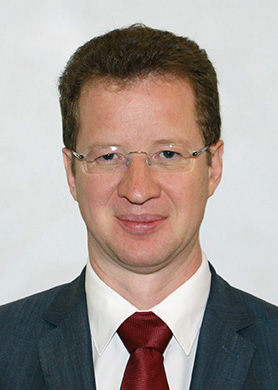
The first GLONASS-K2 spacecraft will be launched into orbit in 2018, said Nicholas Testoyedov, the CEO of Information Satellite Systems Reshetnev, as reported by the Assotsiatsiya GLONASS/GNSS Forum.
“In 2018, we are preparing to launch the first satellite of the series GLONASS-K2,” Testoyedov said. “This satellite has advanced features. In the development of the navigation functions, new code division signals will be emitted, so it will provide more accurate positioning for users and more accurate tethering in those systems where important accurate time reference is required, such as in computer systems, connected devices, and so on.”
Testoyedov added that the GLONASS-K2 satellite will have equipment installed that makes it compatible with the international search and rescue system Cospas–Sarsat.
Budget Cuts. The budget of the GLONASS federal target program (FTP) for 2015 will be cut by more than 5 billion rubles, according to Russian news reports. After spending cuts, the budget for the current year will amount to 42.5 billion rubles, a cut of more than 10 percent, which is the average size of cuts for the entire “Space activities of Russia for 2013-2020” budget group.
On June 2, GPS World reported that GPS tracking stations co-sponsored by U.S. interests but located in Russia had stopped making their data available to scientists and others.
Now, “It looks like the tap has been turned back on, at least at slow flow,” reports Richard Langley, GPS World Innovation editor and University of New Brunswick professor. “Hourly and daily data files from the affected stations are once again being sent to IGS data archive centres. Grigory Steblov of the Geophysical Survey of the Russian Academy of Sciences has reported that ‘the transmission of the data from NEDA [North Eurasian Deformation Array] GPS sites [had] been temporarily suspended due to technical reasons.’
Now, after reorganization, the data flow is being resumed on hourly basis.”
Langley stresses, however, that the real-time flow of data from the NEDA stations has not been turned back on, which is important for some applications.
As announced by Russian Deputy Prime Minister Dmitry Rogozin on May 13, 2014, GPS tracking stations co-sponsored by U.S. interests have stopped making their data available to scientists and others.
The tap on the flow of data from 11 stations was turned off starting on May 31. The data flow included hourly and daily data files from the stations as well as the real-time flow of data over the Internet.
In an item entitled “On Execution of the Instructions of the Government of the Russian Federation,” the website of Roscosmos, the Russian Space Agency, reported:
“In accordance with the instructions of the Government of the Russian Federation, the Russian Space Agency in conjunction with the Federal Agency scientific organizations on June 1, 2014, implemented measures to avoid the use of information from the global seismographic network stations operating on the signals of the GPS system and located in the Russian Federation, for purposes not covered by existing agreements, including military uses.” (As translated by Google Translate.)
It should be pointed out that none of the affected stations contribute to the day-to-day running of GPS; that is, they are not part of the GPS command and control network. They are stations participating in the work of the International GNSS Service, which provides data and products to scientists and other researchers for different purposes including geodesy, geodynamics, orbital mechanics, and atmospheric studies.
It is believed that the Russian move is a tit-for-tat exercise in response to sanctions by western countries following recent events in Ukraine. However, the Russians say that the action was initiated by the refusal of the U.S. to enter into negotiations on the placement of Russian-operated GLONASS tracking stations on U.S. territory. Russia wishes to expand its global network of differential correction and monitoring stations, which could conceivably be also used to supply data for GLONASS command and control purposes.
What isn’t widely known is that Roscosmos already uses sites on U.S. territory for monitoring the availability and health of the GLONASS satellites as the map below clearly shows.
By Denis Lyskov, Deputy Head of the Russian Space Agency, Roscosmos
The fundamentals of Russian government policy in satellite navigation are defined in Presidential Decree #638 of May 17, 2007, and specify that:
GLONASS services are provided globally and free of any user fees;
GLONASS is used as a basis of the National Positioning, Navigation and Timing System.
To efficiently implement the government policy in satellite navigation, in March 2012 the Government approved the dedicated Federal Program focused on GLONASS sustainment, development, and expansion of applications. This program covers activities aimed at:
improving the accuracy and integrity of navigation;
ensuring conditions for guaranteed positioning, navigation, and timing solutions in restricted visibility, interference, and jamming environments;
enhancing current application efficiency and broadening application domains.
This year, the extensive efforts aimed at development of new generation GLONASS satellites, augmentations, and performance monitoring facilities were taken. The results obtained help to define the main directions of GLONASS development for the upcoming years.
Space Segment
The new navigation satellite will ensure navigation services for all categories of users using current frequency-division multiple access (FDMA) signals in L1 and L2 as well as new code-division multiple-access (CDMA) signals in L1, L2, and L3 bands. The full set of GLONASS signals will be transmitted using two separate phased antenna arrays — one for FDMA signals, and the other for CDMA signals. Introduction of new signals broadens the possibilities of improving the GLONASS orbital constellation configuration, structure and composition of navigation message data, as well as accuracy, reliability, and integrity of navigation solutions in various conditions. The constellation sustainment plan includes the launch of GLONASS-M-55 satellite in 2014. This satellite, similar to GLONASS-K-11 launched in February 2011, will carry an L3 navigation payload and transmit a CDMA signal in L3.
The L3 CDMA signal will also be transmitted from seven more GLONASS-M satellites planned for launch in 2014–2015.
The implementation of a GLONASS modernization program will produce a more than four-fold improvement of accuracy. This will be made by means of:
ground control segment upgrade;
introduction of a new on-board atomic frequency standard, based on different technologies;
introduction of advanced technologies of satellite control, based on intersatellite links in radio frequency and optical bands;
transition to PZ-90.11 Geodetic Reference System aligned to the International Terrestrial Reference Frame (ITRF) at the millimeter level;
synchronization of the GLONASS time scale with Coordinated Universal Time UTC (SU, for Soviet Union) at the level of less than 2 nanoseconds while keeping the UTC (SU) own long-term stability at 10-17.
Augmentations
Augmentations play an important role in improving GLONASS performance. With the launch of Luch-5V into an orbital position of 95° E in 2014, the first phase of the System of Differential Correction and Monitoring (SDCM) constellation deployment will be completed. SDCM will provide satellite-based augmentation services (SBAS) in L1 (1575.42 MHz). Simultaneously, the deployment in the Far East of the Russian Federation of uploading and monitoring facilities for Luch-5A positioned at 167° E will be completed. Special attention is being paid to ensuring compatibility of Luch-5B satellite (16° E) and Inmarsat-3F2 satellite (15.5° W) carrying a European Geostationary Navigation Overlay System (EGNOS) payload.
The future transition to using heavier satellites carrying L1/L5 transponders will present an important stage of SDCM development. The first launch of such satellites is tentatively planned for 2018.
With the purpose of improving the quality of SDCM services, the ground network consisting of several dozen sites will be deployed over the Russian territory, and more stations will be deployed along the Russian border to improve the accuracy of generating the vertical ionospheric delay map.
Apart from SBAS technology development, a system for ensuring Precise Point Positioning (PPP)service is planned for development. PPP service will be provided using geostationary Earth-orbit (GEO) satellites transmitting in L1/L3 GLONASS bands. The L1/L3 transponders are planned to be installed on board future GEO satellites. Considering the common parameters (carrier frequency, pseudorandom noise pulse rate, data rate) of PPP and GLONASS’ own signals, the informative capacity of the former is an order of magnitude greater to ensure rapid broadcast of high-precision orbits and clocks.
For PPP technology development, the global network of measuring facilities is of extreme importance. The global network ensures global monitoring of navigation signals and generation of initial data for high-precision determination and prediction of orbits and clocks.
International Cooperation
Cooperation with GNSS providers focuses on protecting the spectrum allocated to radionavigation satellite service, pursuing compatibility and interoperability of GLONASS and SDCM with other GNSSs and augmentations, creating an international GNSS monitoring system.
One of the priority directions of international scientific cooperation is the cooperation with the International GNSS Service through the exchange of measurement information between its members. At the same time, GLONASS measuring and monitoring facilities will receive and monitor all open navigation signals of all GNSSs.
A lot of attention is paid to enhancing GLONASS awareness. Since 2009, the International School on Satellite Navigation has been held annually in the Russian Federation. The Russian Federation has been preparing to host the United Nations Workshop on the Applications of Global Satellite Navigation Systems.
Denis Lyskov is state-secretary, deputy head of the Federal Space Agency of Russia (Roscosmos). He started his carrier in the Russian space industry after graduation from the Moscow Aviation Institute in 1996. He has been working in Roscosmos for the last two years and supervising the GLONASS program since June 2013.