Tag: SA.45s

  • Microchip offers new chip-scale atomic clock for defense

    Microchip offers new chip-scale atomic clock for defense

    New SA65 CSAC provides wider operating temperatures, faster warm-up and improved frequency stability in extreme environments
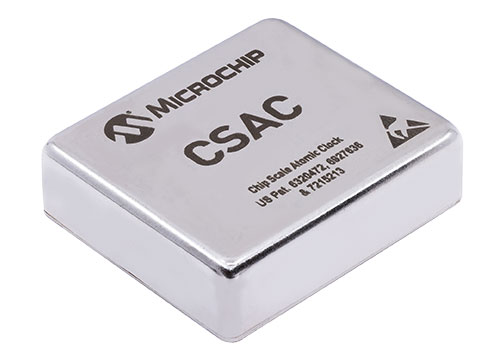
    Photo:
    Photo: Microchip Technology

    Microchip Technology Inc. is offering the new SA65 chip-scale atomic clock (CSAC), providing precise timing accuracy and stability in extreme environments. Designed for military and industrial systems, the Microchip’s SA65 CSAC features ultra-high precision and low power consumption

    Advanced military platforms, ocean-bottom survey systems and remote-sensing applications all require precise timing. CSACs ensure stable and accurate timing even when GNSS time signals are unavailable, thereby helping industrial and military system designers to meet timing requirements.

    Microchip’s SA65 CSAC is an embedded timing solution with improved environmental ruggedness, delivering higher performance than the previous SA.45s CSAC, including double the frequency stability over a wider temperature range and faster warm-up from cold temperatures. The SA65 has an operating temperature range of –40 to 80 °C and a storage temperature range of –55 to 105 °C. The warm-up time of two minutes at –40 °C is 33% faster than that of the SA.45s.

    These performance improvements benefit designers of highly portable solutions for military applications such as assured positioning, navigation and timing (A-PNT) and C5ISR (command, control, communications, computers, cyber, intelligence, surveillance and reconnaissance). It meets precise frequency requirements of a low size, weight and power (SWaP) atomic clock. Improvements such as fast warm-up to frequency after cold start, temperature stability over a wide operating range, and frequency accuracy and stability enabling extended operation while GNSS is denied help to ensure mission success in conflict environments.

    The SA65 CSAC provides precise timing for portable and battery-powered applications requiring continuous operation and holdover in GNSS-denied environments. The SA65 is form-, fit- and function-compatible with the SA.45s, which minimizes risk and redesign costs for the system developer while improving performance and environmental insensitivity.
  • Microsemi debuts chip-scale atomic clock for space

    Microsemi debuts chip-scale atomic clock for space

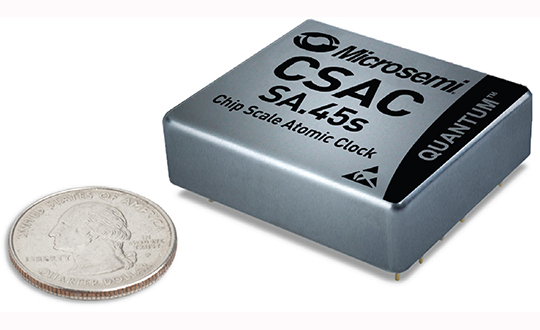
    Microsemi Corporation has launched its SA.45s Commercial Space Chip-Scale Atomic Clock (CSAC), a commercially available radiation-tolerant CSAC suitable for low Earth orbit (LEO) applications.

    The device provides the accuracy and stability of atomic clock technology while achieving significant breakthroughs in reduced size, weight and power (SWaP) consumption, the company said.

    As the newest member of Microsemi’s CSAC product family, the Commercial Space CSAC provides excellent drift performance and built-in 1 pulse per second (PPS) input for GPS disciplining, making the device well-suited for holdover applications.

    It is targeted at several other commercial space and space research applications, including:

    • satellite timing and frequency control;
    • satellite cross linking;
    • assured position, navigation and timing; and
    • Earth observation.

    With many spacecraft manufacturers turning to commercial off-the-shelf (COTS) parts to meet performance, schedule and cost requirements, the Commercial Space CSAC offers a solution for many satellite missions.

    “With the introduction of the Commercial Space CSAC, we now offer a space-deployable atomic precision clock reference with radiation tolerance in support of the space market’s desire to reduce mission costs and design times using COTS devices,” said Peter Cash, director of the clock business unit at Microsemi. “As the first atomic reference clock with low SWaP available for space, our new device is well-suited to applications requiring precise clock synchronization, including a variety of existing and emerging LEO applications.”

    According to a market intelligence report by Euroconsult titled, “Satellites to be Built & Launched by 2026 World Market Survey,” the total revenue for satellite manufacture and launch is expected to be $304 billion between 2017-2026. With revenues of $102 billion, LEO is expected to account for a third of the total market, with 82 percent derived from satellite manufacturing.

    “Harris provides the world’s most advanced sensors, payloads and communications technologies; receiving and information processing systems; and analytics, which provide our customers with the integrated information and actionable intelligence they need for mission and business success,” said Tim Lynch, general manager, Mission Solutions at Harris Corporation’s Space and Intelligence Systems segment. “Microsemi’s latest atomic clock will support Harris in delivering complete mission solutions to our customers.”

    As a stand-alone atomic clock with a 10-megahertz CMOS-compatible output, Microsemi’s Commercial Space CSAC is a timing module providing an impressive short-term stability (Allan Deviation) and frequency stability across the operating temperature (TempCo), the company added.

    A standard CMOS-level RS-232 serial interface is built into the device, which is used to control and calibrate the unit and provide a comprehensive set of status monitors. The interface is also used to set and read the CSAC’s precise internal time-of-day clock.

    Microsemi’s radiation-tolerant ruggedized oscillators also include OCXOs and EMXOs for applications that require higher accuracy and can support higher power consumption.

    Other key features include:

    • Power consumption of less than 120 milliwatts (mW)
    • Less than 17 cubic centimeters volume (1.6 in. × 1.39 in. × 0.45 in.)
    • Radiation-tolerant: 20 krad
    • Single event latch-up (SEL) and single event upset (SEU) tested to 64 megaelectron-volts per square centimeter/milligram (Mev-cm2/mg)
    • Short-term stability (Allan Deviation) of 3.0 × 10⁻¹⁰ at TAU = 1 sec
    • Frequency stability across temperature range (TempCo) less than 5×10⁻¹⁰
    • 1PPS output and 1PPS input for synchronization and time-keeping
    • RS-232 interface for monitoring and control