Tag: SAP

  • Esri location intelligence to integrate with SAP HANA Spatial Services

    Esri location intelligence to integrate with SAP HANA Spatial Services

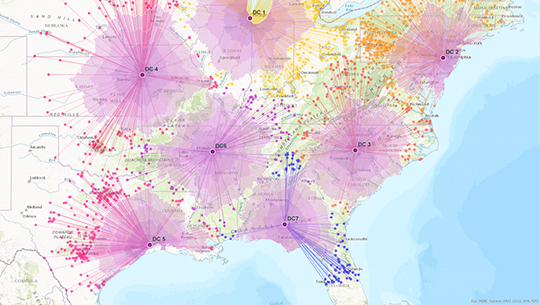
    Esri’s ArcGIS software is being integrated into SAP’s latest cloud-based offering, SAP HANA spatial services, to help customers create location-aware business applications faster, according to spatial analytics company Esri.

    Based on SAP Cloud Platform, the new offering enables businesses to process location data such as complex imagery, as well as visualize and analyze their authoritative data in a geospatial context.

    The new geo-enabled solution from SAP will allow users to deliver their data through consumer-friendly maps and integrate the results into custom business applications, the company said. Customers using SAP software will also be able to create custom models that efficiently process streams of Earth observation data such as water content or soil temperatures and see this data on high-quality basemaps provided by Esri’s ArcGIS Online.

    Most business objectives — such as increasing revenue growth, reducing operational costs or improving customer service — rely on some sort of location data. Unfortunately, many executives lack an accurate and up-to-date understanding of where performance is going well and where improvements need to be made.

    This new offering from SAP, which leverages Esri technology, lets organizations extract high-value business information from satellite, drone and open data sources and then easily discover and share location-based insights.

    “As an SAP global technology partner, we are very excited about this offering, as it demonstrates that SAP and Esri products work better together,” said Chris Cappelli, director of strategic business development at Esri. “Users of SAP HANA spatial services can now achieve native integration of spatial and enterprise data across all business processes. By putting the power of location information into the hands of key stakeholders, businesses can make better-informed decisions with their own data.”

    The integration follows SAP’s announcement on Jan. 24 that Esri supports SAP HANA as an enterprise geodatabase with the release of ArcGIS 10.6 and ArcGIS Pro 2.1.

    Esri and SAP customers can benefit from enhanced performance and scalability as well as full integration of both enterprise and spatial data. Both Esri and SAP continue to deliver new innovations that help lower total cost of ownership and administration costs brought on by the tight integration of IT and geospatial landscapes, Esri said.

    Esri will showcase its new integration of location intelligence technology with SAP HANA spatial services at SAPPHIRE NOW and ASUG Annual Conference in booth #1239.

  • SAP offers connected vehicles technology with Concur, Hertz, Nokia and Mojio

    SAP SE demonstrated new technology to make life easier for drivers and rental car users through an Internet of Things (IoT) collaboration with Concur Technologies, Hertz and Nokia.

    The announcement was made at Mobile World Congress, being held Feb. 27–March 2 in Barcelona, Spain.

    Also, Mojio — a connected vehicle platform and app provider for Deutsche Telekom and T-Mobile USA — has joined SAP Vehicles Network and will provide parking and fueling through its app in the United States and Europe.

    A part of the SAP Leonardo portfolio, the SAP Vehicles Network solution creates an intelligent, automated experience — from car rental to parking and fueling location and payment, to integrated navigation and expense management for business travelers.

    SAP-vehicle-network

    SAP Vehicles Network, built on SAP Cloud Platform, enables participating network companies to provide mobility services to drivers and passengers. By standardizing the business processes, SAP Vehicles Network enables integration and collaboration to facilitate new revenue streams and business opportunities for network members.

    Through the network, member companies can offer secure, convenient services — independent of devices or vehicles — such as parking, fueling and location-based food services, tailored for the business traveler or the individual consumer.

    The new collaboration showcased at Mobile World Congress draws on the strengths of each participating vendor:

    • Concur, Hertz, SAP and other members of the Nokia-founded IoT Community, a worldwide ecosystem of companies collaborating on the development of innovative IoT solutions, drove the development of the connected rental car experience.
    • Nokia provided its Intelligent Management Platform for All Connected Things (IMPACT) to securely control and manage devices and sensors in the vehicle, including the personalization of driver settings and entertainment systems, as well as the automatic configuration of in-vehicle communications without Bluetooth paring, which ensures data privacy for drivers. The Nokia IMPACT IoT Platform works in conjunction with payment systems in SAP Vehicles Network for parking and fueling authorization to create a seamless and driver-optimized experience.
    • Hertz, one of the world’s leading rental car companies, is developing new products and services for its next 100 years of meeting customers’ needs. By exploring the use of connected-car technology in collaboration with leading technology and travel players such as SAP, Nokia and Concur, Hertz is evaluating the opportunity to integrate travel and itinerary planning, along with in-car personalization, through its customer apps as part of an elevated car-rental experience.

    https://youtu.be/CmMoPUgEXS8

    With the connected car prototype, business travelers can automate route guidance through Concur TripLink integration with other Concur solutions in addition to accessing seamless trip reporting capabilities for all travel-related expenses, including parking and fueling transactions. All in-trip payment transactions can be reported in Concur Expense in real time and be ready for the traveler to submit by the time the trip is complete.

    Mojio’s cloud integration with SAP Vehicles Network takes the guesswork out of parking, enabling drivers to plan and reserve a parking spot based on calendar events or search, as well as to find and pay for a spot in real time based on the connected vehicle’s location. A “tap” inside Mojio’s app toggles between personal and business, allowing for automated expense reporting to Concur solutions. Together, Mojio and SAP plan to bring automated parking and fueling services to a growing base of connected drivers around the world.

    SAP Vehicles Network makes any car smart and transactional by providing drivers with cashless access to on- and off-street parking and connected fueling stations. It minimizes unnecessary drive time and fuel expenditures and helps reduce traffic and emissions caused by drivers searching for open spaces.

    “With leading partners like Hertz and Nokia and new customers like Mojio, SAP is delivering new levels of value for businesses and end consumers based on SAP Cloud Platform, SAP Leonardo and tight integration with Concur solutions,” said Tanja Rueckert, executive vice president, IoT and Digital Supply Chain, SAP. “SAP Vehicles Network puts the end consumer in the driver’s seat by transforming the vehicle into the ultimate digital wallet and making car rental into a seamless, intelligent experience.”

    For more information on SAP Vehicles Network, including videos, see here. For video on collaboration with Hertz, see here, and Mojio, see here.

  • SAP debuts Geographical Enablement Framework

    SAP debuts Geographical Enablement Framework

    SAP-geo-framework-W
    Insurance company Munich Re uses spatial data-processing capabilities in SAP HANA with predictive analytics to assess risk and identify natural hazard profiles for millions of locations around the globe, so that it can efficiently coordinate loss adjustors after a major catastrophe or calculate hospitals, schools and roads impacted by an impending hurricane or flood. (Image: SAP)

    SAP SE unveiled its SAP Geographical Enablement Framework, powered by SAP HANA, at the 2016 Esri User Conference, held June 27 to July 1 in San Diego, California.

    SAP Geographical Enablement Framework helps organizations enrich business applications with geographic data from geographic information systems (GIS), such as Esri ArcGIS.

    “In many asset-intensive industries such as energy, transportation and public sector, the ability to visualize business objects on maps is critical to improving efficiency and decision making,” says Irfan Khan, GM and global head, database and data management, SAP. “SAP Geographical Enablement Framework, powered by SAP HANA, can help organizations streamline the processing of both enterprise and spatial data for greater location awareness across business processes.”

    To develop spatially enabled business applications, organizations can use the framework to:

    • Enable smooth integration and bidirectional navigation between SAP applications and Esri ArcGIS. Developers can use application programming interfaces published by GIS to fetch geospatial data. Also, business data augmented with geometric attributes can be published as a service, so that GIS users can access SAP business data from within their GIS tools.
    • Embed a responsive map user interface in a business application to display both business and spatial data simultaneously to provide greater insight.
    • Store the geometry of any SAP business object in the SAP HANA platform and accelerate spatial data processing in memory to deliver real-time insights, enriched with spatial context, to improve decision making.
    • Visualize, filter and search for business objects — such as functional location, equipment, linear assets, notifications or work orders — on a map from within a spatially enabled application. From a desktop or a tablet, users can also drill down through multiple map layers to gain better insight.

    With continued collaboration between SAP and Esri, organizations can gain contextual insight from business and spatial data, enabling business and GIS users to work within the same multiuser access and editing environment, the company says.

    “At EDF Renewable Energy, we have built a truly innovative enterprise business intelligence and data warehouse platform that combines Esri geospatial data along with asset sensor data and ERP transactional data in SAP HANA,” says Devang Shah, manager of database and business intelligence, EDF Renewable Energy. “This provides us with near real-time insights to help us operate more efficiently.”

    As an open platform, SAP HANA is certified with the Open Geospatial Consortium, enabling organizations to easily consume spatial data from third-party spatial solutions that also adhere to the standard. SAP HANA also supports synchronous and asynchronous imports of data from any spatial reference system or coordinate reference system to ease access to local, regional or global geographic entities.

    Native geocoding delivered by SAP HANA smart data quality helps rapidly convert addresses to latitude and longitude within SAP HANA, the company says.

    “Munich Re is one of the leading reinsurance companies in the world,” says Andreas Siebert, head of geospatial solutions at Munich Re. “We use spatial data processing capabilities in SAP HANA, in conjunction with predictive analytics, to assess risk — such as to identify natural hazard profiles for millions of locations around the globe, to efficiently coordinate loss adjustors after a major catastrophe or to calculate how many hospitals, schools and roads may be impacted by an impending hurricane or flood.”

  • SAP debuts Geographical Enablement Framework at Esri UC

    SAP-geo-framework-W

    SAP SE unveiled its SAP Geographical Enablement Framework, powered by SAP HANA, at the 2016 Esri User Conference, which is being held June 27 to July 1 in San Diego, California. SAP Geographical Enablement Framework helps organizations enrich business applications with geographic data from geographic information systems (GIS), such as Esri ArcGIS.

    “In many asset-intensive industries such as energy, transportation and public sector, the ability to visualize business objects on maps is critical to improving efficiency and decision making,” says Irfan Khan, GM and global head, database and data management, SAP. “SAP Geographical Enablement Framework, powered by SAP HANA, can help organizations streamline the processing of both enterprise and spatial data for greater location awareness across business processes.”

    To develop spatially enabled business applications, organizations can use the framework to:

    • Enable smooth integration and bidirectional navigation between SAP applications and Esri ArcGIS. Developers can use application programming interfaces published by GIS to fetch geospatial data. Also, business data augmented with geometric attributes can be published as a service, so that GIS users can access SAP business data from within their GIS tools.
    • Embed a responsive map user interface in a business application to display both business and spatial data simultaneously to provide greater insight.
    • Store the geometry of any SAP business object in the SAP HANA platform and accelerate spatial data processing in memory to deliver real-time insights, enriched with spatial context, to improve decision making.
    • Visualize, filter and search for business objects — such as functional location, equipment, linear assets, notifications or work orders — on a map from within a spatially enabled application. From a desktop or a tablet, users can also drill down through multiple map layers to gain better insight.

    With continued collaboration between SAP and Esri, organizations can gain contextual insight from business and spatial data, enabling business and GIS users to work within the same multiuser access and editing environment, the company says.

    “At EDF Renewable Energy, we have built a truly innovative enterprise business intelligence and data warehouse platform that combines Esri geospatial data along with asset sensor data and ERP transactional data in SAP HANA,” says Devang Shah, manager of database and business intelligence, EDF Renewable Energy. “This provides us with near real-time insights to help us operate more efficiently.”

    As an open platform, SAP HANA is certified with the Open Geospatial Consortium, enabling organizations to easily consume spatial data from third-party spatial solutions that also adhere to the standard. SAP HANA also supports synchronous and asynchronous imports of data from any spatial reference system or coordinate reference system to ease access to local, regional or global geographic entities.

    Native geocoding delivered by SAP HANA smart data quality helps rapidly convert addresses to latitude and longitude within SAP HANA, the company says.

    “Munich Re is one of the leading reinsurance companies in the world,” says Andreas Siebert, head of geospatial solutions at Munich Re. “We use spatial data processing capabilities in SAP HANA, in conjunction with predictive analytics, to assess risk — such as to identify natural hazard profiles for millions of locations around the globe, to efficiently coordinate loss adjustors after a major catastrophe or to calculate how many hospitals, schools and roads may be impacted by an impending hurricane or flood.”

  • SAP Accelerates Geo-Enabled Access to Enterprise Data

    SAP-dashboard

    SAP SE is offering new capabilities to turbocharge spatial intelligence by simplifying, accelerating and geo-enabling access to enterprise data.

    In the era of the Internet of Things (IoT), proliferation of low-cost location-aware devices is augmenting enterprise data with the “where” component. The SAP HANA platform can help break the silos between enterprise and GIS systems, enabling companies to get more value from corporate data and uncover trends and patterns in a visually intuitive manner, the company said in a statement.

    The announcement was made at the Esri User Conference (Esri UC) being held July 21–23 in San Diego.

    Accelerating Spatial Processing for Real-Time Insights. The latest release of SAP HANA further enhances in-memory spatial processing capabilities to deliver faster responses for millions of data points, the company said. SAP HANA SPS10 brings new spatial features and enhancements, such as support for multidimensional geometries and on-the-fly spatial coordinate transformations, driven by customer innovation projects such as flight operations for Lufthansa Systems.

    Case Study: Lufthansa

    Lufthansa Systems is using the spatial capabilities in SAP HANA for tracking global flight operations. Changes in airport, meteorological and fleet data are monitored in real time and used to reroute flight trajectories in split seconds while optimizing fuel and crew costs. Lufthansa Systems believes that this innovative technology for dispatching, monitoring and visualizing air traffic by providing instant insights and real-time decision support will help change the face of its business.

    “Together with SAP, we built a prototype of a future operational database for commercial flight support,” said Christoph Krüger, lead architect, Lufthansa Systems. “The spatial engine in SAP HANA has given us the ability to track thousands of flights per day on a rich 3D mapping interface that includes both spatial and temporal coordinates. At the same time, we were able to uncover breakthrough application scenarios that would not have been possible without the SAP HANA platform.”

    Deeper Integration of SAP HANA and Esri

    In addition to the existing read-only query layer integration to SAP HANA released by Esri in 2014, ArcGIS for Desktop now supports feature services providing a method for users to create, read, update or delete spatial data directly in SAP HANA. This simplifies the access and use of spatial data in SAP HANA and provides powerful, transactional spatial data creation and editing capabilities to support real-time operational and analytic applications, opening a broad new range of use cases and workflows for both Esri and SAP users.

    The State of Indiana uses SAP HANA, SAP Lumira software and SAP Predictive Analytics software in combination with Esri for geo-spatial analytics to help ensure safer roads and traffic conditions and improve the lives of its citizens.

    “Our long-standing technical co-innovation with SAP has taken a major step forward with the introduction of the SAP HANA platform and its spatial capabilities,” said Jack Dangermond, founder and president of Esri. “We now have a single platform from SAP that simplifies both integration and the deployment of mapping and spatial analysis across the entire SAP application landscape.”

    Analytics Solutions from SAP Enhanced by Partner Extensions

    The native integration between Esri ArcGIS and data visualization software from SAP, SAP Lumira, provides new capabilities for customers. It includes a rich library of charts and visualizations, overlay charts with geo-spatial data for location-based insight, support to visualize multiple layers of business data on top of Esri base maps and support to embed and create custom extensions with software development kits (SDKs). SAP partners such as Galigeo use these SDKs to extend the value of analytics solutions from SAP with new options for visualizing and analyzing information in SAP Lumira and SAP BusinessObjects Design Studio using Esri cloud and on-premise resources. A free version of SAP Lumira is currently available for download.

    Geo-Enablement of SAP Business Suite powered by SAP HANA

    SAP is delivering geospatial enablement of SAP Business Suite powered by SAP HANA software with a geo-enabling services offering. Geo-enabling allows SAP Business Suite powered by SAP HANA to store spatial data directly on SAP HANA instead of on a third-party database, resulting in faster response times and a simpler architecture.

    Spatial Enhancements in SAP Work Manager

    The SAP Work Manager mobile app has added Esri feature layer integration and offline mapping capabilities. These improve user interaction on mobile devices and enable mobile technicians servicing clients in the field to access their maps and associated information without Internet connectivity.

    For more information, visit the SAP News Center. Follow SAP on Twitter at @sapnews, or view the video below for a demonstration from the 2015 Esri UC.