Tag: SCAN

  • NASA advancing GNSS capabilities for spacecraft

    NASA advancing GNSS capabilities for spacecraft

    NASA’s Space Communications and Navigation (SCaN) program is developing capabilities that will allow missions at high altitudes to take advantage of GNSS signals for timing and navigation, including the Artemis missions to the Moon.

    Interoperability of the GNSS constellations will be key for spacecraft at higher altitudes where GNSS signals are less plentiful. The program will rely on the four global constellations (GPS, Galileo, GLONASS and BeiDou) and the two regional systems operated by India and Japan.

    SCaN is supporting flight experiments that will help develop multi-GNSS capabilities for spacecraft, such as Bobcat-1, developed by NASA’s Glenn Research Center in Cleveland and Ohio University.

    Bobcat on the Prowl
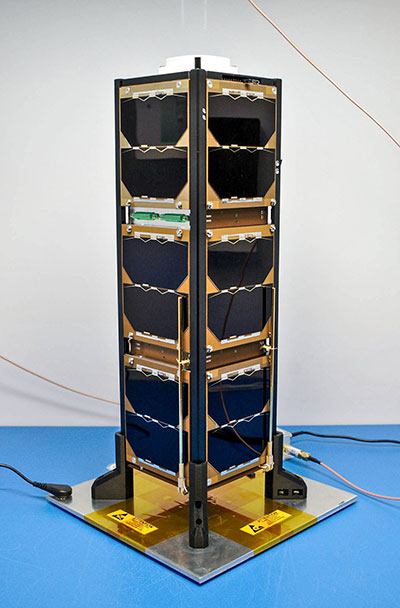
    Bobcat-1, shown with its deployable antenna stowed, will experiment with the GNSS inter-constellation time offset from low-Earth orbit. (Photo: NASA)
    Bobcat-1, shown with its deployable antenna stowed, will experiment with the GNSS inter-constellation time offset from low-Earth orbit. (Photo: NASA)

    Bobcat-1 was selected by the CubeSat Launch Initiative in 2018 to study GNSS signals from 250 miles overhead. The small satellite launched to the International Space Station aboard a Northrop Grumman Cygnus spacecraft on Oct. 2, 2020.

    On Nov. 5, the space station released the CubeSat to begin its mission. The spacecraft will orbit for about nine months, measuring signals from different GNSS constellations. Engineers will use these measurements to better understand GNSS performance, specifically focusing on timekeeping variations between the constellations.

    “GNSS users at high altitudes see fewer satellites,” said Bobcat Co-Principal Investigator Frank Van Grass of Ohio University. “Time offsets between the constellations can be measured by the CubeSat and provided to these users to improve their positioning performance,”

    SCaN Testbed

    Bobcat-1 builds on the legacy of the SCaN Testbed, which demonstrated multi-GNSS capabilities on the space station from 2012 to 2019. The GPS and Galileo Receiver for the International Space Station (GARISS) — an instrument developed in collaboration between NASA and ESA (European Space Agency) — received signals from both GPS and Galileo, the GNSS constellation operated by the European Union.
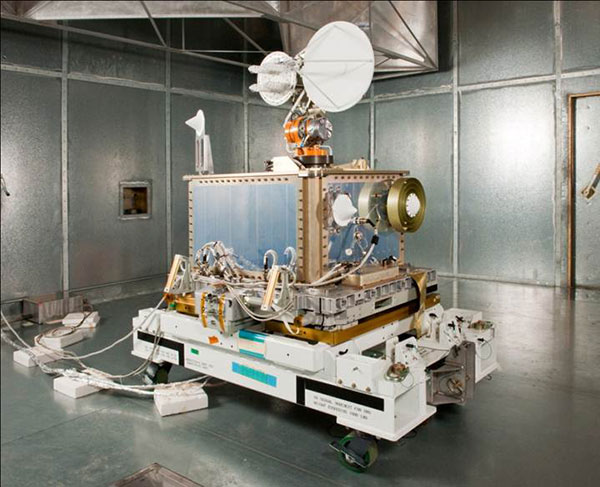
    The SCaN Testbed prior to launch to the International Space Station. (Photo: NASA)
    The SCaN Testbed prior to launch to the International Space Station. (Photo: NASA)

    The SCaN TestBed also laid the foundation for the Lunar GNSS Receiver Experiment (LuGRE), a Commercial Lunar Payload Services payload being developed in partnership with the Italian Space Agency. The payload will receive signals from both GPS and Galileo and is expected to obtain the first-ever GNSS fix on the lunar surface.

    GNSS PNT Policy and Advocacy

    While NASA engineers develop the technologies necessary for multi-GNSS navigation at ever-higher altitudes, the SCaN team works with stakeholders in the U.S. government and internationally to advance GNSS interoperability in the policy sphere. They consult on the United Nations International Committee on GNSS, helping develop additional capabilities in the Space Service Volume and beyond.

    NASA recently worked to publish GPS antenna patterns from GPS satellites that launched between 1997 and 2000, collaborating with the U.S. Space Force, the U.S. Coast Guard and Lockheed Martin, who built the satellites. The PNT team is also working to facilitate publication of antenna patterns for more recent GPS satellites.

    With this data, mission planners can better assess the performance of GNSS in high-Earth orbit and lunar space. This forthrightness also encourages other GNSS providers to be similarly transparent.
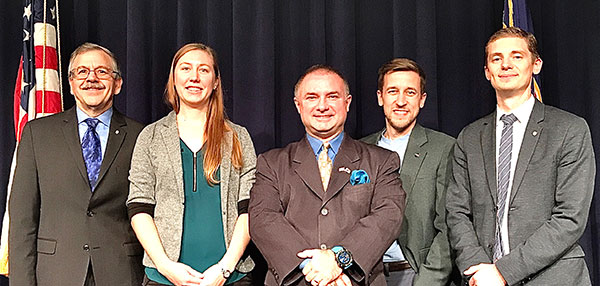
    The Goddard PNT policy team received a 2019 Agency Honor Award for their advocacy of NASA’s interests in GNSS. From let are Frank Bauer, Jenny Donaldson, J.J. Miller, Ben Ashman and Joel Parker. Not pictured, Lauren Schlenker. (Photo: NASA)
    The Goddard PNT policy team received a 2019 Agency Honor Award for their advocacy of NASA’s interests in GNSS. From let are Frank Bauer, Jenny Donaldson, J.J. Miller, Ben Ashman and Joel Parker. Not pictured, Lauren Schlenker. (Photo: NASA)

    “GNSS capabilities continue to revolutionize the ways spacecraft navigate in near-Earth space and beyond,” said NASA navigation engineer Joel Parker. “NASA’s longstanding relationships with the GNSS providers have advanced these capabilities to new heights and support the Artemis missions on and around the Moon.”

  • Agriculture moving to customized nitrogen fertilization

    Agriculture moving to customized nitrogen fertilization

    Photo courtesy of Effigis.
    Photo courtesy of Effigis.

    By Yacine Bouroubi
    Effigis Chief Scientist, Earth Observation Division

    Canadian agriculture has an international reputation for being highly productive and modern. It plays a major role in the country’s economy, and contributes to 8 percent of GDP and 12 percent of jobs.

    Everyone involved in Canada’s agricultural sector is aware of the environmental issues associated with farming. To optimize performance and revenue while respecting the environment, for the past few years producers have been counting on a new ally: precision agriculture.

    Using technologies such as GPS, auto-guidance, variable rate technology, yield sensors, satellite images and drones, precision agriculture is now part of the day-to-day life of farmers. The application of agricultural inputs based on the four Rs (the right source at the right rate, in the right place at the right time) must be based on scientific knowledge and technical know-how. Such knowledge and know-how are based on reliable, accurate and complete information, which is often necessary on a global scale, but with a rather fine spatial resolution. Satellite images are the ideal tool to provide much of the information required.

    The SCAN program
    The SCAN program extracts agronomic knowledge related to nitrogen fertilization to make more accurate models. (Image: Effigis)

    Using Satellite Images. For about 15 years now, sensors on very high spatial resolution (VHR) Earth observation (EO) satellites have been offering a source of data that can provide information on soils and crops at adequate spatial scales (around 2 meters using multispectral imagery) with an unbeatable price/quality ratio. Products derived from satellite images for estimating the quantity of nitrogen fertilization to meet plants’ nutritional requirements are a concrete example of an operational use of this data.

    Determining the optimal dose of nitrogen is not easy, since it depends on complex interactions between plants, the soil, weather conditions and management practices. By wanting to avoid performance loss due to nitrogen deficiencies, current practices favor overfertilization, which leads to unnecessary costs as well as serious environmental problems.

    Agriculture and Agri-Food Canada developed a model based on statistical analyses for understanding the direct relationship between the properties that influence nitrogen requirements (soil, growth, weather and management) and the response to nitrogen fertilization, based on a large number of fertilization trials. These relationships were implemented in a system called SCAN (Soil, Crops and Atmosphere for Nitrogen). Satellite imagery acquired at a specific growth stage provides information required for the operation of SCAN.

    SCAN includes two major innovations: extracting agronomic knowledge related to nitrogen fertilization and modeling this knowledge in the form of inference rules in a fuzzy logic system. Work is ongoing to advance these two aspects of SCAN and validate it for various agricultural regions, as well as adapt it to various types of crops.

    A SCAN web platform will be tested by 100 users starting in the summer of 2016, in anticipation of its commercial use in 2017.

    To read Yacine Bouroubi’s full blog, go to www.effigis.com/blog.