Tag: scanner

  • Highway scanning/GNSS system moves forward in Germany

    Highway scanning/GNSS system moves forward in Germany

    Germany’s Federal Highway Research Institute (BASt) is using a specialized semi-truck to analyze and map road surfaces. The research vehicle uses GNSS, scanner and camera equipment to record the condition of road surfaces and the substance of the asphalt surface, providing the basis for optimum maintenance planning.

    The truck is part of the BASt’s MESAS program, which began in 2018. The unique measuring vehicle is a multi-functional assessment tool for fast-moving substance detection, such as for structural evaluation and design of pavements.

    For the MESAS program, innovative measurement technology was installed on a single-axle semi-trailer, with all measurement systems synchronized and georeferenced using a GNSS system.
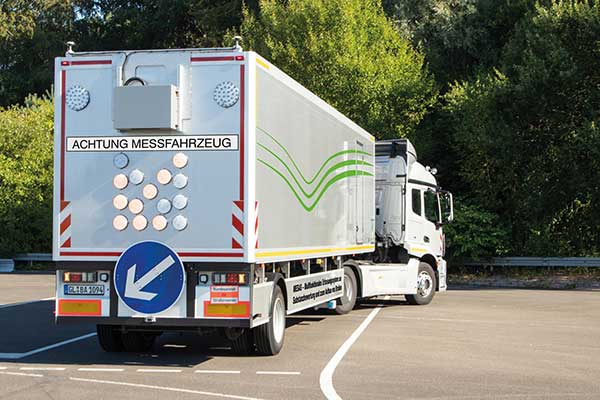
    The MESAS measuring vehicle is 14.5 meters long and weighs 22 tons. At speeds of up to 80 km/h, MESAS records road condition parameters with high precision. (Photo: BASt)
    The MESAS measuring vehicle is 14.5 meters long and weighs 22 tons. At speeds of up to 80 km/h, MESAS records road condition parameters with high precision. (Photo: BASt)

    The vehicle includes:

    • the Pavement Profile Scanner PPS-Plus from Fraunhofer IPM
    • a laser-based Traffic Speed Deflectometer (TSD) that measures short-term reversible deformations of the road surface
    • a georadar that detects layer thicknesses and inhomogeneity of the road superstructure
    • ambient cameras that provide images for interpreting the georadar measurements

    During test runs, the vehicle system successfully measured more than 11,000 kilometers of the country’s trunk-road network. Now it begins regular operation.

    “MESAS is a globally innovative measuring system,” said Dirk Jansen, department head, BASt. “Here we have a really powerful tool at our disposal with which we can make an innovative and significant contribution to the further development of conservation planning.”

    Millimeter precision. The Pavement Profile Scanner PPS-Plus records the transverse evenness of the road surface with high precision. The scanner, the size of a shoe box, is mounted on measuring vehicles and scans the road surface with an eye-safe laser beam over a width of about 4 meters. The distance to the road surface is determined with sub-millimeter accuracy using phase-shift technology.

    The laser scans the surface with the aid of a rotating polygon mirror perpendicular to the forward movement of the vehicle and generates 800 profiles per second. Each profile consists of up to 900 measuring points, depending on the selected measuring frequency. In this way, the PPS generates a detailed 3D height profile of the road surface.

    At traveling speeds of 80 km/h, the measuring point distance in the longitudinal direction is approximately 28 millimeters; in the transverse direction it is 4.5 millimeters. It also provides photorealistic grey-scale images of the road surface that show millimeter-thin structures, such as small repairs and patches.

     

  • Epson displays SureColor T5470M at Esri UC 2019

    Epson’s Matt Kochanowski offers an overview of the company’s SureColor T5470M printer and scanner at the 2019 Esri User Conference in San Diego. According to the company, the SureColor T5470M, which combines a 36-inch printer and integrated scanner, can produce accurate A1/D-size prints in as fast as 22 seconds.

  • Viametris launches new version of urban and road scanner

    Photo: Viametris
    Photo: Viametris

    Viametris has launched the second-generation version of the vMS3D, its urban and road lidar scanner.

    The second-generation version of the 3D mobile vehicle scanner has been redesigned to be more compact. The system has been simplified considerably in both electronic and ergonomic terms to make it more robust and stable in adverse conditions and challenging environments.

    Despite being lighter, the second generation offers the same technological capacities as its predecessor, but is simpler to use and can be mounted on a vehicle in minutes.

    The system component (including the sensors) and the element to affix the device to the vehicle (the frame) previously formed one unit, but are now separated.

    • The redesigned system is much lighter (9 kg) and more compact.
    • The mechanism to fix the scanner to the vehicle, which formed part of the system in the first-generation version, has been transformed. A rigid metal frame, fixed onto two roof bars, now holds the system, which fits into a dedicated compartment in seconds. As the frame is rigid, it limits vibrations between the system and the vehicle and prevents any strain on the mechanics during acquisition.
    • The second auxiliary antenna, which measures the heading by satellite, is discreet and non-removable, and fixed directly to the vehicle chassis.

    The new design makes it easier to mount and use the system, a task that can be accomplished by a single person in under three minutes. Alignment takes place the first time the system is mounted and does not need to be repeated, saving valuable time each start.

    Technological features

    The vMS3D comprises a new set of components that are more robust and stable in difficult conditions.

    • The integrated connectors are next-generation and embedded-grade.
    • The control box for power supply and communication with the tablet has been moved inside the vehicle to offer increased comfort to the user.

    Specifications

    Receiver: Septentrio AsteRx-m2a GPS+GLONASS+BeiDou+Galileo, 448 channels – L1/L2, B1/B2, E1/E5B, RAW

    IMU: SBG-Systems Ellipse2-D

    Scanner: 700,000 points per second

    Centimeter precision

    Panoramic 30MP FLIR Ladybug 5+ camera

    Double antenna

    SLAM compatible

  • Cepton unveils long-range lidar scanner for UAVs

    Cepton unveils long-range lidar scanner for UAVs

    Photo: Cepton
    Photo: Cepton

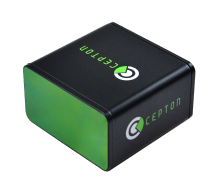
    Cepton Technologies Inc., a provider of 3D lidar solutions for automotive, industrial, security and mapping applications, has unveiled its newest lidar scanner, the SORA-P60L.

    Cepton unveiled the SORA-P60L at AUVSI Xponential 2019.

    Part of Cepton’s SORA family of lidar scanners, the new scanner is purpose-built to deliver long-range, high-resolution imaging for unmanned aerial vehicles (UAVs).

    The SORA-P60L offers a 400-Hz frame rate, enabling drones to fly faster while maintaining high point-cloud density. With a 550-gram payload, the SORA-P60L prolongs UAV flight time allowing more ground to be covered in a single trip, the company said.

    Cepton’s unique Micro-Motion Technology faces all lasers downward at all times, providing a dense, uniform point cloud that, in combination with the high scan rate, makes it suitable for fixed-wing and fast-moving rotary-wing UAVs.

    “Cepton’s SORA-P60L leads the lidar industry with its best-in-class point cloud density that provides superior imaging for UAVs,” said Neil Huntingdon, Cepton’s VP of business development. “With the affordable price point, long-range capabilities and high frame rate of SORA-P60L, UAVs can capture data faster and build more accurate maps. SORA-P60L is our first product from the SORA family that we have unveiled this year. We see a lot of opportunities for this unique sensor in other markets and have a number of products in development that will be revealed later this year.”

  • Lidar USA integrates Z+F scanners for mobile mapping

    Lidar USA integrates Z+F scanners for mobile mapping

    The Z+F Profiler is the latest addition to Lidar USA's HiWay Mapper series. Photo: Lidar USA
    The Z+F Profiler is the latest addition to Lidar USA’s HiWay Mapper series. Photo: Lidar USA

    Lidar USA has integrated Z+F scanners for mobile mapping into its product line.

    According to the company, the Z+F Profiler is a high-speed, 360-degree scanner that provides more than 1 million points per second at up to 200 profiles per second with a range of nearly 120 meters. This product is the latest addition to the company’s HiWay Mapper series.

    The company also integrated the Z+F Imager, which can be transformed into a mobile system to maximize the use of the scanner. This allows companies to provide mobile mapping services with the highest accuracy — at a reduced cost — while maintaining backward compatibility for static scanning, the company said.

    Lidar USA, also known as Fagerman Technologies and based in Huntsville, Alabama, specializes in laser scanning, photogrammetry, instrumentation and geomatics.

    Z+F USA, Inc. is the United States subsidiary of Z+F GmbH Germany. It manufactures high quality control equipment, wire ferrules and laser scanners.

  • Lidar USA showcases scanner at Intergeo 2017

    Lidar USA’s Daniel Fagerman discusses the company’s Snoopy A-Series multi-vehicle configurable scanner at Intergeo 2017, which took place Sept. 26-28 in Berlin, Germany. According to the company, you can use the Snoopy A-Series to scan almost anything with a click of a button.

  • Polaris scanner uses GNSS to go indoors, outdoors

    Polaris scanner uses GNSS to go indoors, outdoors

    Teledyne-Optech-Polaris-TLS-W
    Photo: Polaris

    Teledyne Optech has released its Polaris terrestrial laser scanner, which automatically detects its location with a built-in GNSS receiver and selects the planned survey parameters for the site. Alternatively, operators can set up surveys in the field and resection/backsight the system using the menu-driven graphical user interface (GUI) on its touchscreen.

    The announcement was made at the SPAR 3D Conference and Expo, being held April 3-5, in Houston, Texas. Visitors to SPAR 3D will be able to see the Polaris’ streamlined user interface in action at booth #400 along with the Optech Maverick, Eclipse and award-winning Galaxy.

    Bridging the gap between indoor and outdoor scanners, the Polaris can survey targets up to 1600 meters away in long-range mode or collect up to 500,000 measurements per second in short-range mode. Its 360 × 120-degree field of view captures indoor panoramas from a single site, while its rugged design, light weight and swappable batteries let it travel deep into the field, the company said.

    Also on display at SPAR is the Galaxy airborne lidar, which was awarded the MAPPS Grand Award for Innovation, and Teledyne Optech staff will be on hand to explain the SwathTRAK technology that earned it the prize. By dynamically adjusting the Galaxy’s scanner field of view in response to changes in the ground’s elevation, SwathTRAK keeps the swath width and point density on the ground consistent, even in hilly terrain. This technology saves clients time and money by reducing the number of flightlines required and ensuring homogeneous point density.

    Finally, visitors to the Teledyne Optech booth can also get hands-on time with the Maverick, Teledyne Optech’s first backpack-mountable mobile mapping system, and see the autonomous Eclipse airborne data-collection system and learn how a pilot can operate it alone, saving the cost of a dedicated operator.