Tag: scintillation

  • Research Roundup: Atmospheric effects on GNSS

    Research Roundup: Atmospheric effects on GNSS

    Photo: buradaki/iStock/Getty Images Plus/Getty Images
    Photo: buradaki/iStock/Getty Images Plus/Getty Images

    GNSS researchers presented hundreds of papers at the 2022 Institute of Navigation (ION) GNSS+ conference, which took place Sept. 19–23 in Denver, Colorado, and virtually. The following five papers focused on atmospheric effects on GNSS signals. The papers are available at www.ion.org/publications/browse.cfm. 

    Addressing Scintillation Error

    Mitigating the scintillation effect at low latitude is a complex matter: several kinds of experimental data must be collected, realistic models must be developed, and, most importantly, useful real-time indices and alerts must be made available.

    The authors introduce a prototype based on a patent owned by SpacEarth Technology to address scintillation error detection and mitigation, supporting precision GNSS-based services at low latitudes in any season and space weather conditions. The patent relates to a method of total electron content (TEC) and scintillation empirical forecasting, in particular short-term forecasting (seconds to minutes). The output of the method is necessary to feed mitigation algorithms aiming at improving accuracy on GNSS precise positioning techniques (RTK, NRTK, and PPP) under ionospheric harsh conditions.

    The prototype is designed with a Central Elaborating Facility, which collects the data provided by a network of GNSS monitoring stations detecting scintillation events, and broadcasts foreseen scintillation parameters. Users with a rover mitigation device can apply the parameters from the central facility for scintillation error mitigation. 

    Vincenzo Romano, INGV and SpacEarth Technology; Claudio Cesaroni, INGV; Luca Spogli, Alessandro Fiorini, INGV and SpacEarth Technology; Marco Fermi, Gter; Lorenzo Benvenuto, Gter and University of Genoa; Tiziano Cosso, Gter; Marcin Grzesiak, SRC/PAS; Joao Francisco Galera Monico, Italo Tsuchiya, UNESP; Gabriel Oliveira, Marcos Guandalini; “Ionospheric Scintillation Mitigation at Low Latitude to Improve Navigation Quality.”

    Ring of Fire GUARDIAN 

    Commonly, natural hazards release energy into the Earth’s atmosphere in the form of acoustic-gravity waves, which propagate up to the ionosphere. The resulting traveling ionospheric disturbances (TIDs) can be detected using GNSS signals, through the computation of the integrated total electron content (TEC) along the lines of sight between GNSS receivers and satellites. The global distribution of ground-based GNSS receivers constantly tracking multiple GNSS constellations (GPS, Galileo, GLONASS, BeiDou, and others) provides excellent spatio-temporal coverage around the world, including in areas of limited coverage by existing warning systems.

    The authors present the operational GNSS-based Upper Atmospheric Real-time Disaster Information and Alert Network (GUARDIAN). Based on dual-frequency GNSS data from the Global Differential GPS (GDGPS) network of the Jet Propulsion Laboratory, the GUARDIAN architecture computes slant TEC time series in near real time.

    As part of the GDGPS network, 78 stations around the Pacific ring of fire monitor the four GNSS constellations: GPS, Galileo, GLONASS and BeiDou. Cycle slips are corrected and the time series are filtered, both in real time. The resulting data stream is output live to a user-friendly public website, benefitting the general public and the scientific community. 

    The current GUARDIAN focuses on the Pacific region. However, the architecture can readily be extended to a worldwide coverage.

    Léo Martire, S. Krishnamoorthy, L. J. Romans, B. Szilágyi, P. Vergados, A. W. Moore, A. Komjáthy, Y. E. Bar-Sever, A. B. Craddock, NASA Jet Propulsion Laboratory, California Institute of Technology; “GUARDIAN: A Near Real-Time Ionospheric Monitoring System for Natural Hazards Early Warnings.”

    Civil Aviation Interference

    The authors provide a survey on GNSS receiver architectures with emphasis on new carrier-tracking techniques for mitigating the adverse effect of ionospheric scintillation within the context of civil aviation. The survey is complemented by results gathered from simulations on the impact of ionospheric scintillation in conventional receiver architectures. A review on scintillation mitigation techniques is carried out, covering several “technique families,” highlighting their potential for performance improvement, as well as their shortcomings and challenges in implementation.

    A semi-analytical simulation campaign is carried out for different modulations: L1, L5 for GPS, and E1, E5a for Galileo. Here, the performance of a standard receiver tracking a set of GPS and Galileo satellites affected by ionospheric scintillation is analyzed to pinpoint existing vulnerabilities to this effect.

    The simulation results show that ionospheric scintillations are responsible for large variations in carrier-to-noise ratio, which in turn can be responsible for losses of lock and large phase variations, increasing phase RMSE and in some cases leading to cycle slips of the phase estimation. Thus, the adopted solution must be robust to signal power fluctuations and the occurrence of cycle slips and able to maintain phase lock.

    António Negrinho, GMV-PT Pedro Boto, GMV-PT Marta Cueto, GMV-ES Mikael Mabilleau, EUSPA Claudia Paparini, EUSPA Ettore Canestri, EUSPA; “Survey on Signal Processing Techniques for GNSS Ionospheric Scintillation Mitigation.”

    Tonga Eruption Data Analyzed

    Extreme natural disasters, such as volcanic eruptions, can create visible pressure waves in the atmosphere and trigger observable ionospheric wave responses that can travel hundreds of kilometers in the ionosphere. The acoustic and gravity waves generated can cause ionospheric TEC perturbations and variations. The TEC determines the GNSS ionospheric delay and can cause significant positioning errors, which may affect the performance of GNSS-based applications.

    The researchers processed GNSS data collected from the Hong Kong Satellite Positioning Reference Station Network to analyze the ionospheric activity and positioning performance responding to the Tonga volcanic eruption on Jan. 15, 2022. To detect and repair cycle-slip jumps, the researchers applied theTEC rate and Melbourne Wubbena Wide Lane (MWWL) linear combinations. A Savitzky-Golay low-pass filter with a 30s window was used to improve the TEC accuracy.

    The team investigated the changes in TEC, Rate of TEC index (ROTI) and positioning errors in the eastward, northward and upward directions after the anomalous ionospheric propagation to Hong Kong between 11:30 and 14:30. The team found the ionospheric anomaly could generate large changes in the three parameters, with peaks up to three times the calm period. Their prompt research contributes to a better understanding of the coupling of extreme ionospheric activities and dynamics caused by volcanic eruptions. 

    Xiaojia Chang, Kai Guo, Zhipeng Wang, Kun Fang, Hongxia Wang, Beihang University; Hailong Chen, China Academy of Aerospace Electronics Technology; “Ionospheric Anomaly and GNSS Positioning Responses to the January 2022 Tonga Volcanic Eruption.” 

    Toolbox for Monitor Network

    The MONITORtoolbox is a set of Python-coded software tools to perform automatized large-scale processing of data from the Monitor network of the European Space Agency (ESA). The Monitor network aims to continuously monitor ionospheric scintillation events from multiple ground stations strategically located around the globe. It accommodates a repository with a large number of GNSS measurements containing scintillation events for users to analyze scintillation data or for research purposes.

    This paper shows the potential of the MONITORtoolbox for providing access to a large amount of data that otherwise, without a systematic processing, becomes practically useless. The software developed implements the means to collect data and store it in a local database for quick offline access. It detects the presence of scintillation events based on certain conditions and criteria defined by the user and identifies its properties in terms of duration, time of occurrence, intensity and satellite location. It implements the tools to compute relevant statistics, providing insights on ionospheric scintillation phenomena.

    Sergi Locubiche-Serra, Alejandro Pérez-Conesa, Diego Fraile-Parra, Gonzalo Seco-Granados, José A. López-Salcedo, Universitat Autònoma de Barcelona, IEEC-CERES; Juan M. Parro-Jiménez, Raúl Orús-Pérez, ESTEC, European Space Agency; “MONITORtoolbox — Software Tool for the Analysis of Ionospheric Scintillation Data from the ESA Monitor Network.” 
  • ESA app turns smartphones into space monitoring tools

    ESA app turns smartphones into space monitoring tools

    Image: ESA
    Image: ESA

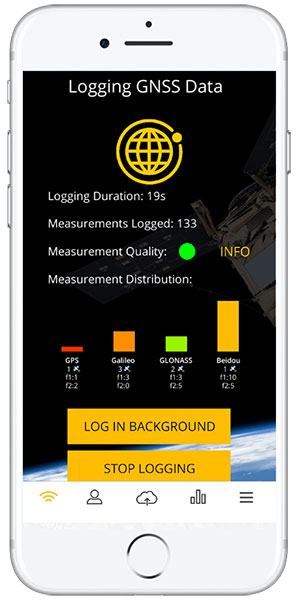
    A new Android app released by the European Space Agency (ESA) turns smartphones equipped with dual-frequency GNSS receivers into instruments for crowdsourced science.

    The CAMALIOT app, developed through ESA’s Navigation Innovation and Support Programme (NAVISP) with the support of the GNSS Science Support Centre, is suitable for more than 50 smartphone models.

    Using the CAMALIOT app, the phones will record small variations in satellite signals, gathering data for machine learning analysis of meteorology and space weather patterns.

    As well as helping to create new Earth and space weather forecasting models, participants are also in with the chance to win prizes including new phones and Amazon vouchers. This four-month “citizen science” campaign runs until the end of July.

    “The precisely modulated signals continuously generated by the dozens of GNSS satellites in orbit are proving a valuable resource for science, increasingly employed to study Earth’s atmosphere, oceans and surface environments,” said ESA navigation engineer Vicente Navarro. “Our GNSS Science Support Centre was created to help support this trend.”

    For instance, tens of thousands of permanent GNSS stations are continuously recording GNSS data. As the satellite signals travel down to Earth they are modified by the amount of water vapor in the lower atmosphere, helping to forecast rainfall in particular.

    GNSS signals also undergo delay and fading — known as scintillation — as they pass through irregular plasma patches in the ionosphere. This electrically charged upper atmospheric layer is continuously changing, influenced by solar activity, geomagnetic conditions and the local time of day. Dual-frequency GNSS receivers can compensate for this effect by comparing their two frequencies.

    “The combination of Galileo dual band smartphone receivers and Android’s support for raw GNSS data recording is what opened up the prospect of supplementing data from these fixed GNSS stations with tens of millions of smartphones, vastly increasing our density of coverage,” Vincente said. “We took inspiration from the famous ‘SETI@home’ initiative, where home laptops help seek out signs of extraterrestrial life.”

    The results can then undergo a Big Data machine learning approach, seeking out previously unseen patterns in both Earth and space weather.

    “This is our first step in enlarging GNSS data acquisition using an internet of things data-fusion approach, employing novel sources such as fixed sensors and drones as well as smartphones,” Vincente said. “A wide range of other applications are also possible for the system, including improving the performance of GNSS systems.”

    Formally known as the Application of Machine Learning Technology for GNSS IoT Data Fusion project, CAMALIOT is run by a consortium led by ETH Zurich (ETHZ) in collaboration with the International Institute for Applied Systems Analysis (IIASA).

    “The CAMALIOT effort was underpinned by Element 1 of our NAVISP research programme, spurring innovation in satellite navigation,” said Pierluigi Mancini, ESA’s NAVISP program manager.

  • Joint NASA-Brazil CubeSat mission will unlock equatorial phenomena that affect GPS

    NASA and a team of Brazilian space researchers have announced a joint CubeSat mission to study phenomena in Earth’s upper atmosphere — a region of charged particles called the ionosphere — capable of disrupting communications and navigation systems on the ground and potentially impacting satellites and human explorers in space.

    Two phenomena in the ionosphere — equatorial plasma bubbles and scintillation — have impacted GPS signals, radio communication systems and satellite technologies for decades, said Jim Spann, chief scientist for the Science and Technology Directorate at NASA’s Marshall Space Flight Center in Huntsville, Alabama.

    Equatorial plasma bubbles are regions of comparatively low density which may elongate into towering plumes during high-intensity periods.

    Scintillation is a unique type of atmospheric fluctuation that can interrupt radio frequencies, much like the “twinkling” effect seen in starlight when optical frequencies are disrupted.

    The Scintillation Prediction Observations Research Task (SPORT) mission, funded by NASA’s Science Mission Directorate in Washington, will observe these peculiar structures in order to understand what causes them, determine how to predict their behavior and assess ways to mitigate their effects.

    The joint U.S.-Brazilian team, led by Spann as principal investigator, will design and launch SPORT as a CubeSat, a compact satellite about the size of two loaves of bread. It will be launched in 2019 to an Earth orbit 217-248 miles high (350-400 km). Its operational phase is expected to last at least a year.

    “Degraded communications and GPS signals are known to be closely linked to these phenomena,” Spann said. It’s his goal to shed new light on these phenomena and inspire new operational solutions to contend with the disturbed conditions.

    Protecting Brazil’s aviation, agriculture

    The Brazilian SPORT team seeks targeted solutions as well. Otavio Durão, project manager for the team at Instituto Nacional de Pesquisas Espaciais (INPE) in São Jose dos Campos, a São Paulo municipality, said ionospheric responses to a space phenomenon called the South Atlantic Anomaly or the South American Magnetic Anomaly — where space radiation dips close to Earth — negatively impacts Brazil’s busy airports.

    “Our country is interested in refining GPS signal processing, making takeoffs and landings safer and more precise,” he said. “Because so many international flights come to and through Brazil, this should be a matter of concern for all countries.”

    Brazil’s strong agricultural industry also is concerned about the anomaly’s effects on GPS, said Durão’s colleague Luís Loures, the SPORT spacecraft manager at the Instituto Tecnológico da Aeronáutica in São Jose dos Campos.

    “Our agribusiness is always trying to increase crop productivity,” he said. “One way to accomplish this is by using automated tools. But being able to precisely position those automated tractors and field sprayers, without disruption from solar phenomena, is crucial.”

    “As society becomes more dependent every day on space-based technology — cell phones, self-driving cars, secure military communications — it’s critically important we first understand the environment in which our technology resides, then learn how to operate through and preserve it from potentially disruptive or damaging interference,” Spann said.

    Understanding the phenomena

    Building on decades of previous ground-based studies of plasma bubbles over equatorial regions, especially intensive research in Brazil and Peru, SPORT will help researchers determine what’s happening in the ionosphere to stir up the bubbles, why they form along the equator and what causes them to appear at night.

    Plasma bubbles and scintillation are global equatorial and mid-latitude phenomena, made worse by the South American Magnetic Anomaly, where Earth’s magnetic equator dips close to Earth.

    “Many of the discoveries to date have been confined to a limited number of longitudinal sectors,” Spann said. “SPORT will make a systematic study of the ionosphere at all longitudes around the planet, documenting the conditions that trigger formation of the bubbles, with particular focus on the South American sector.”

    As multiple instruments on the ground also record data, Spann said, SPORT will probe the ionosphere from above. During subsequent passes, it will study specific sectors to identify conditions favorable for developing plasma bubbles and ionospheric scintillations.

    These simultaneous satellite and ground-based studies will help researchers identify how the observations are related, providing a better understanding of the results at all longitudes.

    The team is confident the findings will enable researchers to use physics-based models to determine the physics of plasma bubble triggers, and thus identify the resulting scintillation of radio signals that propagate throughout the turbulent region.

    More about SPORT

    SPORT science mission data will be distributed from and archived at the EMBRACE space-weather forecasting center in Brazil’s National Institute for Space Research (INPE) and mirrored at the Space Physics Data Facility at NASA’s Goddard Space Flight Center in Greenbelt, Maryland.

    The SPORT mission management team is led by Marshall alongside its international partners, the Brazilian Space Agency in Brasília, and the National Institute for Space Research and Technical Aeronautics Institute, both in São Jose dos Campos, São Paulo.

    Spann’s team, which oversees the mission science, flight instruments and the CubeSat launch, includes researchers at Marshall; Goddard; Utah State University in Logan, Utah; The Aerospace Corporation in El Segundo, California; the University of Texas at Dallas; and the University of Alabama in Huntsville.

    NASA’s Brazilian partners are overseeing the development of the spacecraft; integration and testing; mission operations; data management and dissemination; and the ground observation network. The science analysis will be conducted by the entire team.

    SPORT is part of NASA’s Heliophysics Technology and Instrument Development for Science program. NASA’s heliophysics mission includes research into the effects of the sun on Earth, its atmosphere and the planets of our solar system.

  • Consortium records scintillation on Galileo signals in Antarctica

    At the end of 2016, the DemoGRAPE consortium observed, for the first time ever, ionospheric scintillations on Galileo signals in Antarctica, using Septentrio’s PolaRx5S GNSS reference receiver.

    DemoGRAPE investigates improvement of high-precision satellite positioning with a view to developing scientific and technological applications in Antarctica. At higher latitudes, GNSS signal degradation due to ionospheric activity is more pronounced.

    Septentrio’s PolaRx5S reference receiver.

    The more precise phase-based positioning modes are particularly vulnerable to ionosphere disturbance such as scintillations. Elevated ionospheric activity can cause a loss of precise-positioning mode or, in more extreme cases, a total loss of signal lock.

    Monitoring the movement and evolution of ice shelves and glaciers as well as geodetic prospecting require highly precise positioning. Besides this scientific interest, accurate positioning is important from a safety standpoint.

    When visibility is limited and travel is restricted, designated routes between remote locations have to be strictly followed to avoid dangers such as falling into a crevasse during a snowstorm.

    DEMOGrape is an international project lead by Istituto Nazionale di Geofisica e Vulcanologia (INGV), Rome, Italy in partnership with the Politecnico di Torino, the South African National Space Agency (SANSA) and the National Institute for Space Research, São Paulo, Brazil (INPE).

    Septentrio’s PolaRx5S is the benchmark for GNSS space weather applications. It provides data for scintillation analysis (I&Q correlations, phase, code and carrier-to-noise) at up to 100 Hz for all GNSS L-band frequencies. SBF, RINEX and BINEX data logging is possible on both a built-in 16 GB memory and on an externally connected device. Up to 24 independent data archives can be defined. Logged data can be accessed via the web UI server or automatically pushed to a FTP server.

    “We are really very happy of the fruitful collaboration with Septentrio colleagues that supported our measurements in the extreme environment of Antarctica,” the team said in an article published in Space Weather. “The first Galileo scintillations observed in the DemoGRAPE sites are attracting the attention of space weather communities, also beyond the European borders.” (Alfonsi, L., P. J. Cilliers, V. Romano, I. Hunstad, E. Correia, N. Linty, Fabio Dovis et al. “First Observations of GNSS Ionospheric Scintillations From DemoGRAPE Project.” Space Weather 14, no. 10 (2016): 704-709).

    “We are really proud to have enabled our colleagues and friends from INGV and the DEMOGrape consortium to make this first of a kind scintillation measurement on the Galileo signals,” said Bruno Bougard, director of R&D at Septentrio. “Galileo added value on high-precision application resides in its ability to increase the position availability and reliability compared to traditional GPS+GLONASS systems. Demonstrating its resilience to scintillation is key for operations at high latitudes.”

  • A Scintillating Project

    A Scintillating Project

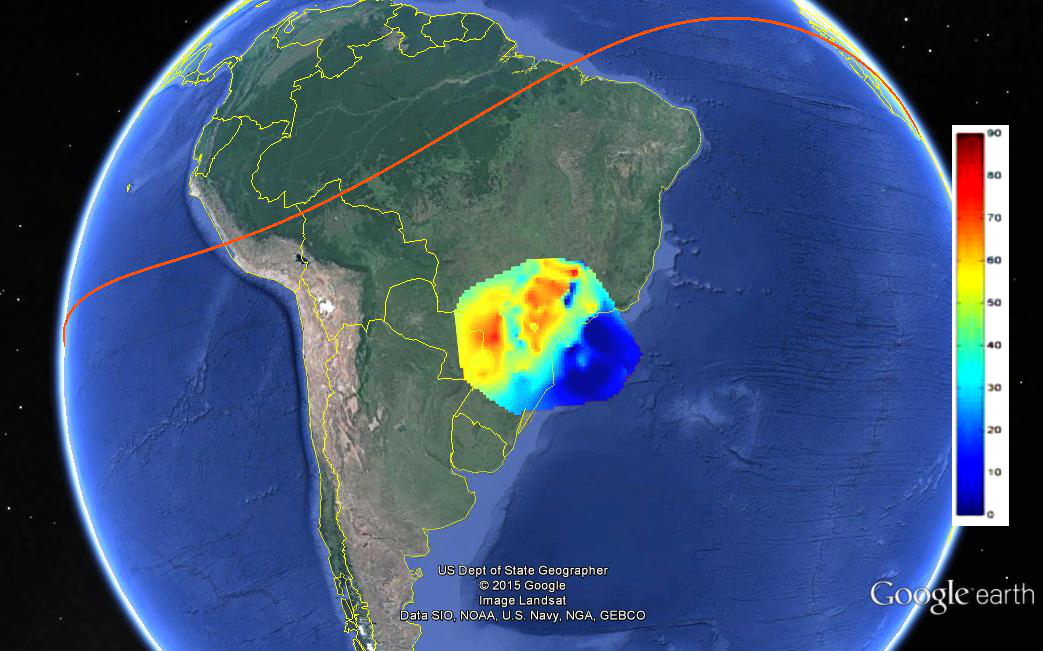
    FIGURE 2. TEC map over São Paulo state as forecast by the CALIBRA model on Sept. 26, 2012, at 2:00 UT. The range of the TEC in the image is from 0 to 90 TEC units (blue to red). The red line is the geomagnetic equator.
    FIGURE 2. TEC map over São Paulo state as forecast by the CALIBRA model on Sept. 26, 2012,
    at 2:00 UT. The range of the TEC in the image is from 0 to 90 TEC units (blue to red). The red
    line is the geomagnetic equator.

    Countering Ionospheric Disturbances Affecting GNSS in Brazil

    By Marcio Aquino

    After 27 months of intense research, the CALIBRA project ended successfully in February 2015, with the project team devising solutions to tackle the effects of perturbations typical of the Brazilian ionosphere on high-accuracy GNSS positioning. CALIBRA was funded by the European Union and the European GNSS Agency.

    Kicked off in 2012, CALIBRA first confirmed the vulnerability of GNSS high-accuracy techniques to ionospheric disturbances through a thorough user performance review, where degradation in GNSS Precise Point Positioning (PPP) and real-time kinematic (RTK) positioning was seen to correlate with the occurrence of ionospheric scintillation and high Total Electron Content (TEC) variability. This is especially so in Brazil, because of its geographical location extending across the magnetic equator in one of the most troublesome ionospheric regions of the Earth, qualifying the country as a test-bed for worst-case scenarios.

    The team established a suitable metric to characterize these disturbances, which was used in developing the new models and algorithms to counter their effects. The short-term empirical CALIBRA Forecasting Model (CFM) for TEC and scintillation was developed and tested.

    To counter scintillation, a number of approaches were proposed and their benefits demonstrated. Building on the project’s success, CALIBRA partner INGV (Istituto Nazionale di Geofisica e Vulcanologia) filed a patent for the CFM and a new spin-off company — SpacEarth Technology — was set up. SpacEarth aims to secure the software’s commercialization for potential applications and services, while also improving and adapting it to evolving market needs.

    Another outcome of commercial interest is that project partner Septentrio developed several rover-level mitigation approaches, notably a new model for ionospheric delay estimation.

    Monitoring Network. To support the research and operational activities of the project, a dedicated network of ionospheric scintillation monitor receivers (ISMRs) was deployed, forming the CIGALA-CALIBRA network of 12 monitoring stations equipped with PolaRxS receivers. A web interface for data analysis — the ISMR Query Tool  — was developed by project partner UNESP (São Paulo State University) and is available for public use, collecting and treating more than 10 million observations of GPS, GLONASS, Galileo, BeiDou and other augmentation systems on a daily basis. Data visualization and data mining techniques support users in data analysis and knowledge extraction.

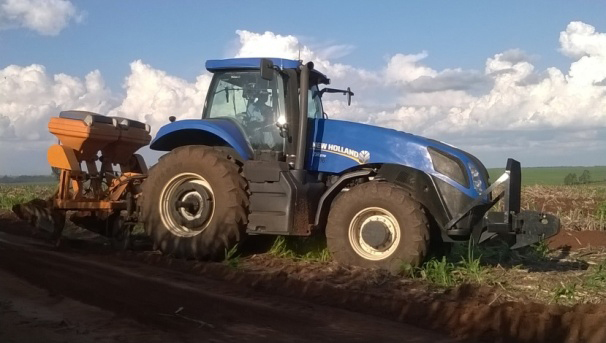
    Finally, two important field trials aiming to validate the new algorithms were carried out in Brazil, involving actual precision agriculture and offshore operations. For the precision agriculture trial, the Brazilian company Agro Pastoril Campanelli provided expert operational environment and support.

     The tractor used in the precision agriculture trial at Agro Pastoril Campanelli’s premises.
    The tractor used in the precision agriculture trial at Agro Pastoril Campanelli’s premises.

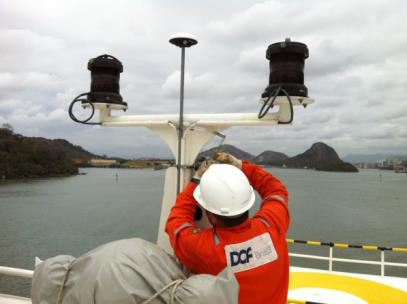
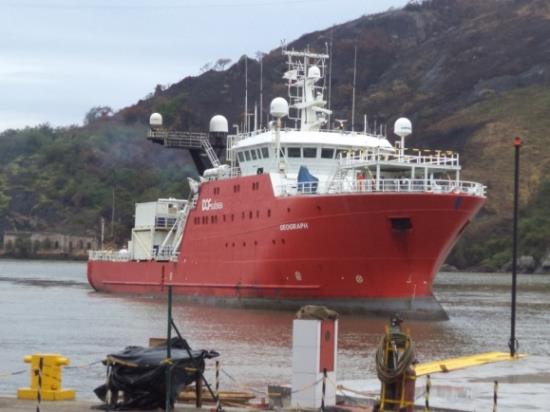
    For the offshore trial, the project counted on the collaboration of the DOF Brasil Group representing Norskan Offshore, a provider of high-end offshore services to the Brazilian oil and gas industry. Detailed results of both trials are in the project’s final report, which can be accessed through the GSA.

    The Geograph vessel is operated by DOF Brasil.
    The Geograph vessel is operated by DOF Brasil.
    Setting up the receiver antenna for the offshore trial on board the Geograph vessel.
    Setting up the receiver antenna for the offshore trial on board the Geograph vessel.

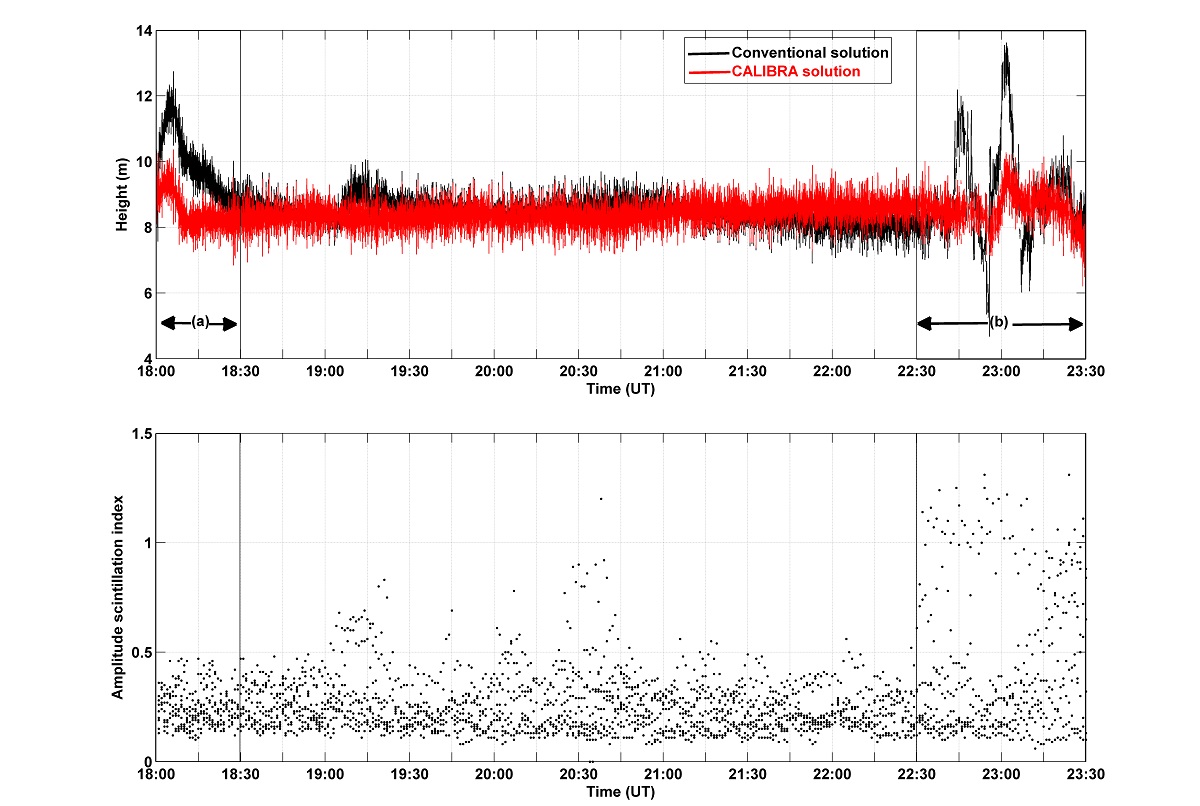
    To provide a glimpse of the performance of the CALIBRA algorithms during the offshore trial, in FIGURE 1 we selected a period when strong scintillation conditions were encountered. In the top plot, two height component time series for kinematic PPP processing are shown, respectively, for the case where no mitigation is applied (black time series) and the case where the CALIBRA algorithm is applied (red time series).

    FIGURE 1. Performance of CALIBRA algorithms in the offshore trial.
    FIGURE 1. Performance of CALIBRA algorithms in the offshore trial.

    The bottom plot shows the level of amplitude scintillation (S4 index) affecting the GPS satellites over a 10-degree elevation angle.

    The improvement obtained with the CALIBRA solution can be seen in particular during the PPP convergence period (18:00 to 18:30 UT) and during the period of strong scintillation (22:30 to 23:30 UT). As there was no accurate ground truth available, the RMS values with respect to the mean height, taken from the quiet period (between 19:00 and 22:00 UTC), along with the percentage of improvement when applying the CALIBRA mitigation approach are summarized in TABLE 1.

    TABLE 1. RMS values with respect to mean height, 19:00–22:00 UTC.
    TABLE 1. RMS values with respect to mean height, 19:00–22:00 UTC.

    Despite all the successful work carried out by CALIBRA, the team notes that research must be continued to accomplish further improvement in models and algorithms to finally develop processes for real-time operation. The challenge would be to counter these ionospheric threats in the scope of an operational service aimed to provide robust high-accuracy positioning to support user applications.

    Furthermore, there were strong indications that the addition of Galileo will assist in mitigating the problems addressed in the project when more signals are available in space.


    Marcio Aquino is a Principal Research Fellow at the Nottingham Geospatial Institute of Nottingham University and leader of CALIBRA.