Tag: seismic

  • Research project reveals Old Faithful secrets


    Photo: Old Faithful/National Park Service
    Photo: Old Faithful/National Park Service

    By Paul Gabrielsen, University of Utah

    Old Faithful is Yellowstone National Park’s most famous landmark. Millions of visitors come to the park every year to see the geyser erupt every 44 to 125 minutes. But despite Old Faithful’s fame, relatively little was known about the geologic anatomy of the structure and the fluid pathways that fuel the geyser below the surface. Until now.

    University of Utah scientists have mapped the near-surface geology around Old Faithful, revealing the reservoir of heated water that feeds the geyser’s surface vent and how the ground shaking behaves in between eruptions. The map was made possible by a dense network of portable seismographs and by new seismic analysis techniques. The results are published in Geophysical Research Letters. Doctoral student Sin-Mei Wu is the first author.

    For Robert Smith, a long-time Yellowstone researcher and distinguished research professor of geology and geophysics, the study is the culmination of more than a decade of planning and comes as he celebrates his 60th year working in America’s first national park.

    “Here’s the iconic geyser of Yellowstone,” Smith says. “It’s known around the world, but the complete geologic plumbing of Yellowstone’s Upper Geyser Basin has not been mapped nor have we studied how the timing of eruptions is related to precursor ground tremors before eruptions.”

    A portable seismometer used to map the geology beneath Old Faithful. (Photo: Paul Gabrielsen)
    A portable seismometer used to map the geology beneath Old Faithful. (Photo: Paul Gabrielsen)

    Small seismometers

    Old Faithful is an iconic example of a hydrothermal feature, and particularly of the features in Yellowstone National Park, which is underlain by two active magma reservoirs at depths of 5 to 40 km depth that provide heat to the overlying near-surface groundwater. In some places within Yellowstone, the hot water manifests itself in pools and springs. In others, it takes the form of explosive geysers.

    Dozens of structures surround Old Faithful, including hotels, a gift shop and a visitor’s center. Some of these buildings, the Park Service has found, are built over thermal features that result in excessive heat beneath the built environment. As part of their plan to manage the Old Faithful area, the Park Service asked University of Utah scientists to conduct a geologic survey of the area around the geyser.

    For years, study co-authors Jamie Farrell and Fan-Chi Lin, along with Smith, have worked to characterize the magma reservoirs deep beneath Yellowstone. Although geologists can use seismic data from large earthquakes to see features deep in the earth, the shallow subsurface geology of the park has remained a mystery, because mapping it out would require capturing everyday miniature ground movement and seismic energy on a much smaller scale. “We try to use continuous ground shaking produced by humans, cars, wind, water and Yellowstone’s hydrothermal boilings and convert it into our signal,” Lin says. “We can extract a useful signal from the ambient background ground vibration.”

    To date, the University of Utah has placed 30 permanent seismometers around the park to record ground shaking and monitor for earthquakes and volcanic events. The cost of these seismometers, however, can easily exceed $10,000. Small seismometers, developed by FairfieldNodal for the oil and gas industry, reduce the cost to less than $2,000 per unit. They’re small white canisters about six inches high and are totally autonomous and self-contained. “You just take it out and stick it in the ground,” Smith says.

    In 2015, with the new instruments, the Utah team deployed 133 seismometers in the Old Faithful and Geyser Hill areas for a two-week campaign.

    The sensors picked up bursts of intense seismic tremors around Old Faithful, about 60 minutes long, separated by about 30 minutes of quiet. When Farrell presents these patterns, he often asks audiences at what point they think the eruption of Old Faithful takes place. Surprisingly, it’s not at the peak of shaking. It’s at the end, just before everything goes quiet again.

    After an eruption, the geyser’s reservoir fills again with hot water, Farrell explains. “As that cavity fills up, you have a lot of hot pressurized bubbles,” he says. “When they come up, they cool off really rapidly and they collapse and implode.” The energy released by those implosions causes the tremors leading up to an eruption.

    One scientist’s noise is another scientist’s signal

    Typically, researchers create a seismic signal using an active source, such as swinging a hammer onto a metal plate on the ground or setting off an explosion. Lin and Wu developed the data analysis method that would help find useful signals among the seismic noise without disturbing the sensitive environment in the Upper Geyser Basin. Wu says she was able to use the hydrothermal features themselves as a seismic source, to study how seismic energy propagates by correlating signals recorded at the sensor close to a persistent source to other sensors. “It’s amazing that you can use the hydrothermal source to image the structure here,” she says.

    The model of Old Faithful’s hydrogeological system suggested by the study’s results. (Image: Sin-Mei Wu)
    The model of Old Faithful’s hydrogeological system suggested by the study’s results. (Image: Sin-Mei Wu)

    When analyzing data from the seismic sensors, the researchers noticed that tremor signals from Old Faithful were not reaching the western boardwalk. Seismic waves extracted from another hydrothermal feature in the north slowed down and scattered significantly in nearly the same area suggesting somewhere west of Old Faithful was an underground feature that affects the seismic waves in an anomalous way. With a dense network of seismometers, the team could determine the shape, size, and location of the feature, which they believe is Old Faithful’s hydrothermal reservoir.

    Wu estimates that the reservoir, a network of cracks and fractures through which water flows, has a diameter of around 200 meters, a little larger than the University of Utah’s Rice-Eccles Stadium, and can hold approximately 300,000 cubic meters of water, or more than 79 million gallons. By comparison, each eruption of Old Faithful releases around 30 m3 of water, or nearly 8,000 gallons. “Although it’s a rough estimation, we were surprised that it was so large,” Wu says.

    Further work

    The team is far from done answering questions about Yellowstone. They returned for another seismic survey in November 2016 and are planning their 2017 deployment, to begin after the park roads close for the winter. Wu is looking at how subsurface structure and hence the propagation of seismic waves can change with time. Farrell is using the team’s seismic data to produce even higher resolution subsurface images and predict how earthquake waves might reverberate through the region.

    Smith is looking forward to conducting similar analysis in Norris Geyser Basin, the hottest geothermal area of the park. Lin says that the University of Utah’s research program in Yellowstone owes much to Smith’s decades-long relationship with the park, enabling new discoveries. “You need new techniques,” Lin says, “but also those long-term relationships.”

    The full study can be found here. The research was funded by the National Science Foundation and by King Abdullah University of Science and Technology, the Brinson Foundation and the Carrico Fund. Fan-Chi Lin is the Principal Investigator.


    Paul Gabrielsen is a science writer at University of Utah Communications.

  • Harxon releases new GNSS + L-band antenna

    Harxon releases new GNSS + L-band antenna

    Harxon, a high-precision GNSS antenna manufacturer in China, has released a new GNSS + L-band antenna.

    The GPS1000 receives GPS L1/L2/L5, BDS B1/B2/B3, GLONASS L1/L2, Galileo E1/E2/E5a/E5b and L-band frequencies, which can be used in land survey, marine survey, channel survey, seismic monitoring, bridge survey, container operation and agriculture applications. Customers can use the same antenna for GPS only or dual-constellation applications.

    It has high gain and wide beam width to ensure the signal receiving performance of satellite at low elevation angle. The phase center of this antenna remains constant as the azimuth and elevation angle of the satellites change. Signal reception is unaffected by the rotation of the antenna or satellite elevation, so placement and installation of the antenna can be completed with ease.

    The GPS1000 is housed in a IP67 waterproof enclosure for permanent installation, and maintains good performance in a variety of harsh environments. Plus, it can be customized by Harxon for the best solution for customers. Orders can be placed at www.harxon.com.

    The new Harxon GPS1000 antenna.
    The new Harxon GPS1000 antenna.
  • Fugro awarded three-year positioning contract for seismic fleet

    Fugro awarded three-year positioning contract for seismic fleet

    Fugro has been awarded a three-year contract by PGS for the provision of precise satellite positioning systems for its seismic vessel fleet. PGS is a leading global provider of marine seismic and electromagnetic services, data acquisition, imaging, reservoir services and multi-client library data.

    Fugro, provider of precise satellite positioning to the offshore oil and gas industry, will supply PGS vessels with a number of independent GNSS. These systems include Fugro’s recently launched Starfix.G4 — a commercial GNSS service to utilize all available GNSS systems (GPS, GLONASS, Galileo and BeiDou), giving sub-decimeter accuracy — and Starfix.G2+, a global service offering centimeter accuracy in both position and height.

    In addition to precise vessel positioning, PGS will benefit from a new generation of positioning technology for their seismic sources and tailbuoys. Meeting the high demand for robustness and quality in the offshore industry, this proactive technology provides independent decimeter and centimeter positions and heights for remote (seismic source and tailbuoy) operations.

    Cerys James, vice president technical at PGS, remarked, ”Reliable, precise positioning technology is essential for modern seismic operations. The solution supplied by Fugro will ensure our entire fleet has highly accurate vessel positioning, along with precise source and streamer positioning.”

  • USGS Tests QuakeAlert App with 60-Second Warning

    Earthquake Alert ScreenSixty seconds may not sound like much, but if given advance warning of an earthquake, people could take cover, trains could stop, and oil rigs could be shut down before the shaking hits.

    The earthquake early warning app QuakeAlert, by Early Warning Labs, aims to provide that extra time. The app, with new technology developed in partnership the United States Geological Survey (USGS), will be tested by the USGS, the California Institute of Technology and other university researchers.

    QuakeAlert is designed to alert users with a countdown to when shaking will strike their exact location, and tell the user how severe the intensity is expected in their location. The app simultaneously delivers important safety instructions to the user on how to respond if indoors, outside or in a moving vehicle. QuakeAlert will be provided to users free of charge.

    The QuakeAlert app uses USGS seismic sensor network data, an Esri GIS backend and the Microsoft Azure cloud to deliver earthquake early warnings. The app is currently in private beta testing with university researchers at CalTech and USGS scientists, and will be available to the public for free once the USGS receives full funding of its early warning program and approves the technology for the public.

    Early Warning Labs (EWL) is an Earthquake Early Warning technology developer and integrator in Santa Monica, Calif., and an official research and development partner with the USGS. Early Warning Labs is collaborating with university partners including Caltech, Berkeley and the University of Washington, as well as Esri.

  • Trimble Offers GNSS Reference Receiver, Seismic Recorder

    Trimble Offers GNSS Reference Receiver, Seismic Recorder

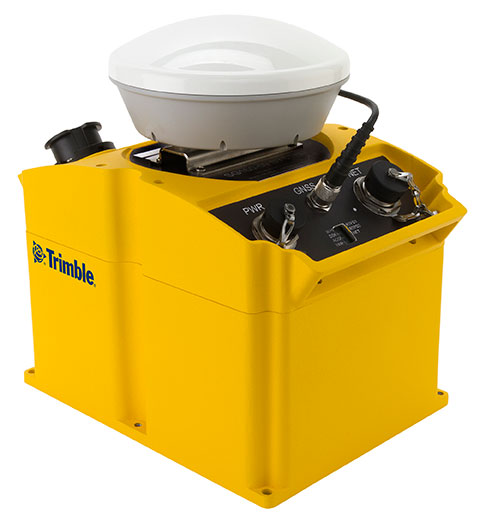
    The Trimble SG160-09 SeismoGeodetic system.
    The Trimble SG160-09 SeismoGeodetic system.

    Trimble has introduced an integrated GNSS reference receiver, broadband seismic recorder and a force-balance triaxial accelerometer for infrastructure and precise scientific applications.

    The Trimble SG160-09 SeismoGeodetic system provides real-time GNSS positioning and seismic data for earthquake early warning and volcano monitoring as well as infrastructure monitoring for buildings, bridges, dams, as well as other natural and manmade structures.

    The announcement was made at the Second European Conference on Earthquake Engineering and Seismology (2ECEES) in Istanbul, Turkey.

    The Trimble SG160-09 SeismoGeodetic system combines the innovation, reliability and data integrity of both the Trimble and REF TEK brands into a single instrument, Trimble said. The system integrates seismic recording with GNSS geodetic measurement in a single compact, ruggedized package. It includes a low-power, 220-channel GNSS receiver powered by the latest Trimble-precise Maxwell 6 technology and supports tracking of both GPS and GLONASS signals plus the Galileo E1 frequency.

    The system includes both the SG160-09 and utilization of Trimble’s CenterPoint RTX correction service, which provides on-board GNSS point positioning. Based on Trimble RTX technology, the service utilizes satellite clock and orbit information delivered over cellular networks or Internet Protocol (IP), allowing cm-level position displacement tracking in real-time anywhere in the world. The SG160-09 system will be available for purchase without the RTX correction service for those applications using real-time kinematic (RTK) positioning.

    The seismic recording sensor includes an ANSS Class A, low-noise, force-balance triaxial accelerometer with the latest, low-power, 24-bit A/D converter, which produces high-resolution seismic data. The internally built accelerometer has +/- 4g full scale output, large linear range, high resolution and sensitivity, which makes it ideal for both portable and permanent deployment. The SG160-09 processor acquires and packetizes both seismic and geodetic data and transmits it to system operators using an advanced, error-correction protocol with back-fill capability providing data integrity between the field and the processing center.

    The SG160-09 system is ideal for earthquake early warning studies and other hazard mitigation applications, such as volcano monitoring, building, bridge and dam monitoring systems. The SG160-09 system features a variable size industrial grade USB drive to support real-time telemetry data transmission. In the event of a telemetry link outage, the data is stored on the USB drive and can be re-transmitted to the centralized processing station as soon as the communication link comes back up, allowing no data loss during the system operation.

    The Trimble SG160-09 system is optimized for field use with instrument mounted or externally mounted GNSS antenna configurations. The lightweight yet rugged SG160-09 consumes very little power and can be used for projects with remote connectivity and in extreme weather conditions. Because the SG160-09 combines both GNSS and strong motion in a single instrument, site installation time is reduced, data communications flow through a single pathway, and station power infrastructure is streamlined, making the SG160-09 a cost competitive solution compared to other systems on the market today. It has an IP67 rating, which means it is sealed against dust and can be submerged in water up to a meter for approximately 30 minutes. The SG160-09 also meets MIL-STD 810F standard for drops, vibration and temperature extremes.

    “The SG160-09 is another example of Trimble’s on-going focus in GNSS and seismic technology for the scientific and engineering communities,” said Ulrich Vollath, general manager for Trimble’s Infrastructure Division. “Trimble has developed a combined state-of-the-art GNSS receiver with a high-dynamic range, low-noise accelerometer that provides dynamic monitoring with the flexibility required for today and tomorrow’s challenges.”

    The Trimble SG160-09 SeismoGeodetic system is expected to be available in the fourth quarter of 2014.