Researchers testing a satellite-based earthquake early warning system developed for the U.S. West Coast found that the system performed well in a “replay” of three large earthquakes that occurred in Chile between 2010 and 2015, reports the Seismological Society of America.
The results, reported in the journal Seismological Research Letters (SRL), suggest that such a system could provide early warnings of ground shaking and tsunamis for Chile’s coastal communities in the future.
The early warning module, called G-FAST, uses ground motion data measured by GNSS to estimate the magnitude and epicenter for large earthquakes — those magnitude 8 and greater. These great quakes often take place at subducting tectonic plate boundaries, where one plate thrusts beneath another plate, as is the case off the coast of Chile and the U.S. Pacific Northwest.
Using data collected by Chile’s more than 150 GNSS stations, Brendan Crowell of the University of Washington and his colleagues tested G-FAST’s performance against three large megathrust earthquakes in the country: the 2010 magnitude 8.8 Maule, the 2014 magnitude 8.2 Iquique, and the 2015 magnitude 8.3 Illapel earthquakes.
G-FAST was able to provide magnitude estimates between 40 to 60 seconds after the origin time of all three quakes, providing magnitude estimates that were within 0.3 units of the known magnitudes. The system also provided estimates of the epicenter and fault slip for each earthquake that agreed with the actual measurements, and were available 60 to 90 seconds after each earthquake’s origin time.
“We were surprised at how fast G-FAST was able to converge to the correct answers and how accurately we were able to characterize all three earthquakes,” Crowell said.
Most earthquake early warning systems measure properties of seismic waves to quickly characterize an earthquake. These systems often cannot collect enough information to determine how a large earthquake will grow and as a result may underestimate the earthquake magnitude—a problem that can be avoided with satellite-based systems such as G-FAST.
It’s difficult to test these types of early warning systems, Crowell noted, because magnitude 8+ earthquakes are relatively rare. “We decided to look at the Chilean earthquakes because they included several greater than magnitude 8 earthquakes, recorded with an excellent and consistent GNSS network. In doing so, we would be able to better categorize the strengths and weaknesses in G-FAST.”
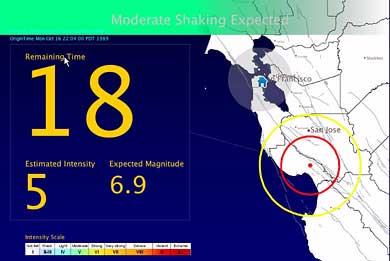
The Chilean tests will play a part in furthering developing G-FAST for use in the U.S., where Crowell and colleagues have been working to include it in the prototype earthquake early warning system called ShakeAlert, now operating in California, Oregon and Washington. The Chilean earthquakes, Crowell said, represent about half of magnitude 8 events in the recorded catalog of earthquakes that are used to test G-FAST and other geodetic algorithms for inclusion in ShakeAlert.
Ten magnitude 8 or greater earthquakes have occurred along the Chilean coast in the past 100 years, including the 1960 magnitude 9.5 Valdivia earthquake, which is the largest earthquake recorded by instruments. “The hazard due to these large events is well recognized and understood,” in Chile, wrote Sergio Eduardo Barrientos of the Universidad de Chile, in a second paper published this week in SRL. “Return periods for magnitude 8 and above events are of the order of 80 to 130 years for any given region in Chile, but about a dozen years when the country is considered as a whole.”
After the 2010 Maule earthquake, the country began installing a network of digital broadband seismic and ground motion stations, GPS stations, and GNSS stations to provide accurate information for tsunami warnings and damage assessment. Since 2012, the Centro Sismológico Nacional at the Universidad de Chile has operated more than 100 stations, and has recently begun to operate almost 300 strong-motion accelerometers that measure ground shaking.
In a third paper published in SRL, Felipe Leyton of the Universidad de Chile and colleagues analyze data collected from 163 of these strong-motion stations to learn more about the local site conditions of underlying rock and soil in these areas. Site conditions can modify the shaking of large earthquakes and control the damage to buildings and other infrastructure caused by the shaking.
The new study “gives us a unique opportunity to improve our knowledge of the behavior of soil deposits during earthquakes, especially in urbanized areas,” write Leyton and colleagues, who say the data could be used to help improve building designs and codes.

