Tag: sensor

  • SiLC launches coherent vision solution

    SiLC launches coherent vision solution

    Photo:
    Image: SiLC

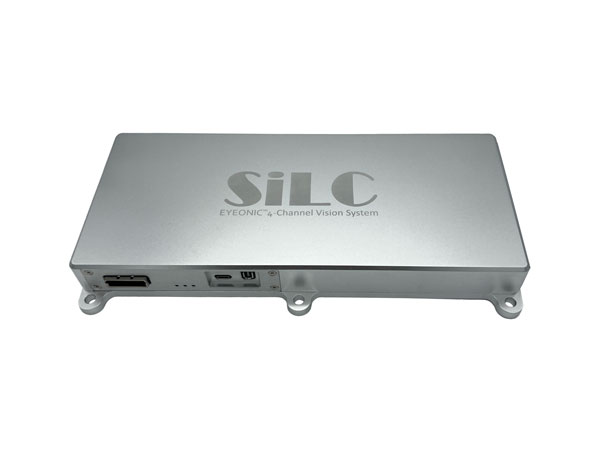
    SiLC Technologies has launched the Eyeonic Vision System. This system is a frequency-modulated continuous wave lidar solution, which delivers high levels of vision perception to identify and avoid objects with low latency.

    At the core of the Eyeonic Vision System is SiLC’s fully integrated silicon photonics chip. It provides more definition and precision than legacy lidar solutions, with roughly 10 milli-degree of angular resolution coupled with millimeter-level precision. These features enable this solution to measure the shape and distance of objects with high-precision and at a large distance.

    The system combines the Eyeonic Vision Sensor and a digital processing solution based on a powerful field-programmable gate array. The flexible architecture enables synchronization of multiple vision sensors for unlimited points per second.

    SiLC demonstrated the Eyeonic Vision System at CES 2023. It was named by the CES award committee as an honoree for the CES Innovation Award.

    The compact, powerful, vision solution is suitable for autonomous vehicles, smart cameras, robotics and other advanced products. It is available now. Pricing varies depending on configuration.
  • IMU offers low-noise performance for high dynamic applications

    IMU offers low-noise performance for high dynamic applications

    Higher rate, higher acceleration applications benefit from SWaP-C advantages of MEMS-based inertial systems.

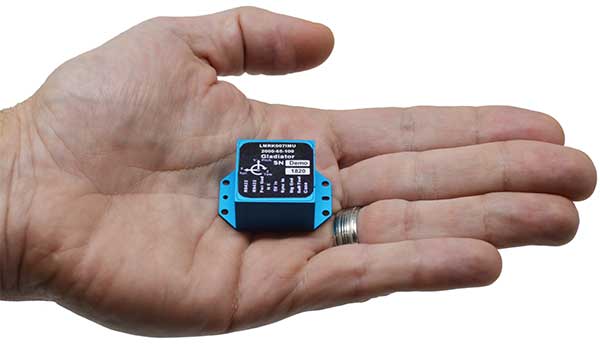
    Gladiator Technologies’ LandMark 007 inertial measurement unit (IMU) combines low noise, high range sensors and Velox high-speed output in a rugged IMU package measuring 0.7 inches square. With rate ranges up to 2000°/s and acceleration ranges as high as 200 g, the LandMark 007 IMU provides demanding, precision performance for a range of high dynamic, rugged applications.

    Photo: Gladiator Technologies
    Photo: Gladiator Technologies

    All LandMark 007 IMUs feature Velox high-speed message timing to minimize digital message phase lag. They also include high-speed output data rates (up to 10 kHz) for measurement accuracy and flexibility.

    These high-speed features are complemented by low-noise gyros with a gyro angle random walk (ARW) of <0.0035°/s/√Hz (0.15°/√hr) and low-noise accelerometers with a velocity random walk (VRW) of <6 mg/√Hz.

    “The LandMark 007 IMU is uniquely designed to meet the industry’s need for a compact, rugged and high performance, cost-effective IMU. Extensive conditioning and testing ensure reliable, stable measurements for our customers with high dynamic applications,” said Eric Yates, Gladiator Technologies’ sales manager.  “We are seeing strong interest in the LandMark 007 and LandMark 007X IMUs from applications which otherwise have been limited to highly specialized, and therefore expensive, IMU solutions.”

    IMUs with less than or equal to 98 g linear acceleration range are designated as LandMark 007 IMUs. IMUs with greater than 98g linear acceleration range are designated as LandMark 007X IMUs. The LandMark 007 IMU is exported categorized as ECCN7A994 and the LandMark 007X is export categorized as ECCN7A103.

    A LandMark 007 IMU development kit is available for set-up, configuration and data collection.

  • UAV sensor package detects methane

    Pergam gas sensor aboard the Microdrones md4-1000 UAV.

    The professional aerial methane detector mdTector1000 CH4 from Microdrones makes it easy to detect methane gas via a fully integrated aerial package for professionals responsible for methane gas infrastructure.

    The mdTector1000 CH4 has a Pergam gas sensor, mounted and integrated with the Microdrones md4-1000 UAV. In real time, users can see aerial shots of detection with the laser sensor, the company said. The carbon-fiber built UAV goes into dangerous areas unsuitable for workers.

    The mdTector1000 CH4 can be used for natural gas line surveys, tank inspections, gas well testing, plant safety and landfill emission monitoring.

    The mdCockpit Android App allows users to maintain visualization in flight. A special mdTector app allows users to visualize and present all post-flight data on one map.

  • Topcon releases compact digital sensor for construction

    LS-100D_Topcon-WTopcon Positioning Group has released the latest addition to its line of compact digital laser sensors — the LS-100D. The sensor digitally displays the offset value to on-grade, which is designed to help make elevation and vertical alignment control easier and faster for any application.

    “The LS-100D features an extra-wide beam capture sensor that also rejects annoying interference from strobe-light exposures,” said Kris Maas, director of construction product management. “The large and bright LCD displays (front and back) feature nine channels of grade information and digitally display the distance to on-grade. By pressing the hold button, the display is locked so the user can conveniently read the results.”

    The sensor offers three colored LED’s and a magnet mount for vertical operation, which is designed to be useful for steel erection or operator grade-checking while excavating. Alert icons appear on the LCD if the accompanying Topcon rotating laser instrument is disturbed (HI alert) or when the laser battery is low.

  • Eric Gakstatter Gives InterGeo 2014 Synopsis

    Eric Gakstatter, contributing editor for GPS World and Geospatial Solutions, gives an overview of InterGeo 2014, held October 7-9 in Berlin.

  • Star Sensor for GLONASS Satellites to Undergo Testing

    RIA Novosti is reporting that German firm Jena-Optronik GmbH has delivered an advanced star sensor to Russia’s Reshetnev Information Satellite Systems company (ISS), which will test and integrate it on a GLONASS navigation satellite, Reshetnev said on Wednesday.

    The Astro APS sensor is part of the satellite’s altitude and orbit control system. It will help ensure that the GLONASS satellites maintain an accurate attitude in space.

    The sensor will be installed on a GLONASS-M satellite under a 2011 agreement signed between Reshetnev ISS and Jena-Optronik GmbH. It has a single box design with low mass and low power consumption. If tests are successful, it will be integrated on other ISS spacecraft.