Tag: sensors

  • FLIR to join Teledyne in big sensing acquisition

    FLIR to join Teledyne in big sensing acquisition

    logosTeledyne Technologies will acquire FLIR Systems in a cash and stock transaction valued at $8 billion, both companies announced on Jan. 4.

    Teledyne is a provider of sophisticated instrumentation, digital imaging products and software, aerospace and defense electronics, and engineered systems. Its operations are primarily in the United States, Canada, the United Kingdom, and Western and Northern Europe.

    Founded in 1978, FLIR is an industrial technology company focused on intelligent sensing solutions for defense and industrial applications.

    Under the terms of the agreement, FLIR stockholders will receive $28 per share in cash and 0.0718 shares of Teledyne common stock for each FLIR share, which implies a total purchase price of $56.00 per FLIR share based on Teledyne’s five-day volume weighted average price as of December 31, 2020. The transaction reflects a 40% premium for FLIR stockholders based on FLIR’s 30-day volume weighted average price as of Dec. 31, 2020.

    As part of the transaction, Teledyne has arranged a $4.5 billion 364-day credit commitment to fund the transaction and refinance certain existing debt. Teledyne expects to fund the transaction with permanent financing prior to closing. Net leverage at closing is expected to be approximately 4.0x adjusted pro forma EBITDA with leverage declining to less than 3.0x by the end of 2022.

    Teledyne expects the acquisition to be immediately accretive to earnings, excluding transaction costs and intangible asset amortization, and accretive to GAAP earnings in the first full calendar year following the acquisition.

    “At the core of both our companies is proprietary sensor technologies. Our business models are also similar: we each provide sensors, cameras and sensor systems to our customers. However, our technologies and products are uniquely complementary with minimal overlap, having imaging sensors based on different semiconductor technologies for different wavelengths,” said Robert Mehrabian, executive chairman of Teledyne. “For two decades, Teledyne has demonstrated its ability to compound earnings and cash flow consistently and predictably. Together with FLIR and an optimized capital structure, I am confident we shall continue delivering superior returns to our stockholders.”

    “FLIR’s commitment to innovation spanning multiple sensing technologies has allowed our company to grow into the multi-billion-dollar company it is today,” said Earl Lewis, chairman of FLIR. “With our new partner’s platform of complementary technologies, we will be able to continue this trajectory, providing our employees, customers and stockholders even more exciting momentum for growth. Our board fully supports this transaction, which delivers immediate value and the opportunity to participate in the upside potential of the combined company.”

    “We could not be more excited to join forces with Teledyne through this value-creating transaction. Together, we will offer a uniquely complementary end-to-end portfolio of sensory technologies for all key domains and applications across a well-balanced, global customer base,” said Jim Cannon, FLIR president and CEO. “We are pleased to be partnering with an organization that shares our focus on continuous innovation and operational excellence, and we look forward to working closely with the Teledyne team as we bring our two companies together to capitalize on the important opportunities ahead.”

    Fourth-quarter financial results. In a separate press release issued today, Teledyne announced improved preliminary financial results for the fourth quarter and full year 2020. The Teledyne press release is available on www.teledyne.com. FLIR noted today that it expects to meet or exceed the full year fiscal 2020 guidance it provided on Oct. 30.

    Approvals and timing. The transaction, which has been approved by the boards of directors of both companies, is expected to close in the middle of 2021 subject to the receipt of required regulatory approvals, including expiration or termination of the applicable waiting period under the Hart-Scott-Rodino Antitrust Improvements Act, approvals of Teledyne and FLIR stockholders and other customary closing conditions.

    Advisors. Evercore is acting as exclusive financial advisor and McGuireWoods LLP is acting as legal advisor to Teledyne in connection with the transaction. Goldman Sachs & Co. LLC is acting as exclusive financial advisor and Hogan Lovells US LLP is acting as legal advisor to FLIR in connection with the transaction. Teledyne has entered into a 364-day senior unsecured bridge facility credit agreement with Bank of America as sole lead arranger and administrative agent.

    Conference call and webcast. Teledyne and FLIR hosted a conference call to discuss the acquisition. ​A replay is available and will be available for one month.

  • Research: Infrasound direction-finding, positioning system

    By John P. McIntire, Duy K. Nguyen, Eric T. Vinande, and Frederick C. Webber
    U.S. Air Force Research Laboratory / Presented at ION ITM, January 2017

    Detection of artillery blasts at a near distance (0.15 miles or 0.24 km) using a single infrasound sensor, with the sensor amplitude trace over time shown on Infiltec’s Amaseis software data and visualization package, and using some basic bandpass filtering (5 to 25 Hz). The spikes are clearly visible as high amplitude impulses in the traces, confirming sensor detection.
    Detection of artillery blasts at a near distance (0.15 miles or 0.24 km) using a single infrasound sensor, with the sensor amplitude trace over time shown on Infiltec’s Amaseis software data and visualization package, and using some basic bandpass filtering (5 to 25 Hz). The spikes are clearly visible as high amplitude impulses in the traces, confirming sensor detection.

    Infrasound refers to sound frequencies below the threshold of human hearing, around 20 Hz or less. There are a variety of natural sources of infrasonic emissions, including thunderstorms, avalanches, meteors, earthquakes, volcanos, and windstorms as well as manmade sources of emissions, such as aircraft, heavy machinery, artillery, missile testing and road traffic. Infrasound is especially attractive from a sensing perspective due to its ability to propagate long distances while suffering little from atmospheric or environmental attenuation.

    Blasts detected at 5.22 miles (or 8.4 km) are still detectable, but additional signal processing or wind-filtering techniques may make these impulsive signals more prominent above the noise.
    Blasts detected at 5.22 miles (or 8.4 km) are still detectable, but additional signal processing or wind-filtering techniques may make these impulsive signals more prominent above the noise.

    In this work, we describe the development of a man-portable “tactical” infrasound field sensor array that is small, lightweight and can be rapidly set-up and torn-down as needed. The system is able to provide direction-finding capabilities to infrasound impulse sources with a directional accuracy of +/–3 degrees. Such information could be used for alternative positioning schemes, described in detail, or perhaps for direction-finding (homing) to acoustic sources of interest. Possible users could be military or search-and-rescue teams operating in GPS-denied environments; field researchers studying volcanology or seismology; or other geo-acoustic scientists and engineers.

  • Research: RTK with tight coupling of 6 low-cost sensors

    Presented at ION GNSS+, September 2016

    A tight coupling of GNSS and inertial measurements is needed for both accurate and reliable positioning. The use of multi-GNSS is recommended to obtain a sufficient number of visible satellites in any outdoor environment.

    We perform a joint GPS/GLONASS ambiguity fixing and a tight coupling of GNSS, 3D accelerometer, 3D gyroscope, 3D magnetometer, barometer and thermometer measurements. As GLONASS uses FDMA, double difference ambiguities are no longer integer-valued. We derive a transformation for the GLONASS double difference ambiguity term, that recovers the integer property and maintains a full-rank system. The obtained transformation maps the real-valued double difference ambiguity terms into integer-valued double difference ambiguity terms and a common single difference ambiguity term, that is treated as a real-valued parameter.

    ANavS Multi-Sensor Module with GNSS receiver (green), 3D accelerometer/ 3D gyroscope and 3D magnetometer (red) and barometer (yellow).
    ANavS Multi-Sensor Module with GNSS receiver (green), 3D accelerometer/ 3D gyroscope and 3D magnetometer (red) and barometer (yellow). Photo: ANavS

    Low-cost GNSS antennas cannot suppress multipath and, therefore, require an estimation of multipath errors. We provide a precise model for multipath that considers an individual amplitude, code delay, phase shift and Doppler shift for each reflected signal, and include it in our sensor fusion. The magnetometer measurements provide rough attitude information, which makes them very valuable for robust GNSS attitude ambiguity fixing.

    We verified the performance of our sensor fusion in a test drive on a parking lot. The fixed phase residuals were in the order of a few centimeters for both GPS and GLONASS, which indicates a very precise position estimation. The proposed algorithms reduced the horizontal 95th-percentile error from 8.49 meters (for a standard GPS-only solution) down to 3.96 meters — a 66 percent improvement. In order to combine the GPS and VIO measurements as described in the last paragraph, the data need to be brought into the same reference frame. We develop a novel method to perform this change of reference frame. The proposed approach combines a quaternion reformulation of the problem together with a semidefinite relaxation technique.

  • Riegl features airborne, UAV segments at Intergeo 2016

    Riegl‘s James Van Rens discusses the company’s airborne and UAV solutions at Intergeo 2016, which was held Oct. 11-13 in Hamburg, Germany. Riegl unveiled its VQ-1560i dual lidar channel airborne laser scanning system and miniVUX-1UAV lidar sensor.

  • U-blox, Wirepas partner on industrial IoT module

    NINA-B1-ublox-module
    NINA-B1

    Wirepas and u-blox have partnered on an advanced decentralized radio communications solution, the NINA-B1 module, for industrial Internet of Things (IoT) applications. The goal of the partnership is to make large scale, decentralized industrial IoT networks easy to deploy for the companies’ customers.

    The small NINA-B1, which the companies say is comparable to advanced mesh technology,  is a stand-alone Bluetooth low energy module with the latest power performance. It can be used for applications such as healthcare, connected buildings, manufacturing and telematics. The module has been certified for a range of countries world-wide, according to the companies.

    “The NINA-B1, in combination with the Wirepas Connectivity software, enables short time to market for easy-to-install, large scale, decentralized industrial IoT applications in segments such as lighting, sensor, asset tracking and beacons,” says Hakan Svegerud, head of product strategy, short range radio, at u-blox.

    “We believe that technology should never be the starting point; instead, we should concentrate on business and application needs,” says Wirepas CEO Teppo Hemiä. “As needs evolve over time, so should the technology. Wirepas and u-blox share this core value and that is what makes us stronger together.”

  • Ohio UAS Center Forwards Precision Ag, Sensor Research

    Ohio UAS Center Forwards Precision Ag, Sensor Research

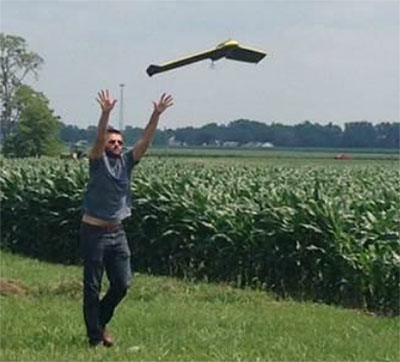
    Flying at Molly Caren Agricultural Center in the Ohio State project.
    Flying at Molly Caren Agricultural Center in the Ohio State project.

    Clark State Community College in Springfield, Ohio, now includes flying unmanned aircraft systems (UAS) as part of its new precision agriculture program, according to the Ohio/Indiana UAS Center (UASC). The new program is designed to prepare students for employment with companies using geospatial technologies, including geographic information systems (GIS) and GPS applied to agricultural production or management activities, such as pest scouting, site-specific pesticide application, yield mapping, or variable-rate irrigation.

    Clark State will process and analyze the UAS-collected data. Students will learn how fly and use UAS-gathered data to determine the overall health of crops and manage a range of farming issues, including how to spot early diseases, identify specific pest infestations, and determine fertilization requirement.

    The Federal Aviation Administration (FAA) approved the Certificate of Authorization (COA) for UASC earlier this year. The center is working to expand the number of FAA-approved Certificates of Authority for research across Ohio, and operates 11 COAs in support of public entities and universities with an additional 17 COAs pending at the FAA.

    Ohio State Sensor Research

    In another UASC project, UASC and The Ohio State University initiated regular flight operations in July at Molly Caren Agricultural Center to research various types of UAS sensors to improve agricultural productivity and enhance environmental management practices through improved nutrient use efficiency.

    3D Aerial, a UAS business in Dayton, Ohio, pilots the small 1.5-lb fixed-wing aircraft for this project. Data gathered is part of a research and development effort focused on noninvasive assessment of crop health.

    “This data will be analyzed and results will be used in support of research on cropping systems and assessment of environmental factors affecting crop growth,” said Scott Shearer, professor and chair of the Food, Agricultural and Biological Engineering at Ohio State. “In addition to precision agriculture experiments, this research will help enhance water quality by better understanding how best management practices may impact surface and ground water quality.”

    The UAS market is projected to be an $82 billion industry with a potential to create approximately 100,000 jobs nationally over the next 10 years.

  • Topcon Acquires Agriculture Sensing Company NORAC

    Topcon Positioning Group has acquired NORAC Systems International, a developer of ultrasonic sensing and boom control technology for agricultural equipment, in a private transaction.

    NORAC provides advanced automated boom height control technology for the global agricultural marketplace. Its current product line includes systems to precisely maintain a spray boom height above the top of the crop or the ground to ensure optimum application of needed fertilizers and plant protection products.

    The agreement marks the third precision agriculture-related purchase Topcon has made since November 2014.  It adds an additional engineering and manufacturing facility in Canada and raises the total number of Topcon employees dedicated to precision agriculture solutions to more than 700.

    “For more than 40 years NORAC has created innovative solutions to improve efficiency on the farm,” said Ray O’Connor, president and CEO of Topcon Positioning Group. “Its automated boom height control technology has transformed the use of agricultural sprayers. We are excited to unite with another precision agriculture leader, especially one that has established its leadership in a way that mirrors the growth of Topcon — by being the first to bring best-in-class technology to the market.”

    “It’s another example of our optimism for investing in the agricultural marketplace,” said O’Connor. “Topcon is committed to developing automation and management solutions that bring the power of the Industrial Internet of Things (IIoT) to every farm.”

    “We are thrilled to have the opportunity to join the Topcon family,” said Bill Strelioff, president and CEO of NORAC Systems International. “NORAC and Topcon have collaborated well in numerous precision agriculture development projects and know that our synergistic technologies and distribution channels make this a great fit. But just as importantly, we recognize that our company cultures are very closely aligned. That’s the real key to multiplying the benefits of this union.”

    Founded in 1974, NORAC pioneered automated boom leveling, and currently enjoys a leading market share within the agricultural industry. In addition to the headquarters in Saskatoon, Saskatchewan, Canada, three branch offices include NORAC, Inc. (Minnesota, U.S), NORAC Europe sarl (Guéreins, France) and NORAC Trading (Shanghai, China).

    “We are excited to welcome the skilled employees at the world-class facilities of NORAC to the precision agriculture team at Topcon,” said Albert Zahalka, president of Topcon Precision Agriculture. “As a global leader for boom leveling, NORAC will add considerable strength to our original equipment manufacturer (OEM) offering, and is an ideal complement to our extensive portfolio of innovative precision agriculture solutions.”

  • GPS Sensor

    GPS Sensor

    CW46S-ConnorWinfield-W
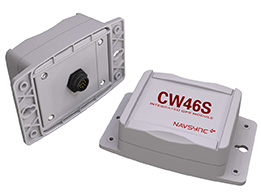
    The CW46S GPS sensor by NavSync.

    The CW46S GPS sensor by NavSync is a fully integrated module that includes a CW25 GPS receiver, DC/DC converter, RS232 or RS422 interface options, and active GPS antenna housed in a small weatherproof (IP67-rated) enclosure.
    When mounted with a good sky view, the CW46S receiver can provide high-quality timing and synchronization. The 1 pulse per second (PPS) timing signal can provide accuracies to within 30nS RMS of Coordinated Universal Time (UTC).

    The 1PPS is transmitted via RS422 signal format; this two-wire method allows the pulse to be transmitted with cable lengths exceeding 100 meters.

    The CW46S utilizes the CW25­TIM GPS receiver, which allows the CW46S to act as a complete timing module capable of outputting a GPS-disciplined 10-MHz frequency.