Tag: severe weather

  • Severe Weather Study Shows Potential of GNSS-RO Satellites

    Severe Weather Study Shows Potential of GNSS-RO Satellites

    Constellation Roll-Out to Begin This Year

    GeoOptics, a satellite-based environmental data services company, in cooperation with Atmospheric and Environmental Research (AER), an environmental research and development company, has announced the initial results of an Observing System Simulation Experiment (OSSE) showing the reliability of radio occultation data in improving predictions of severe weather and flash flood events.

    Using weather prediction models and data assimilation techniques, AER evaluated the potential benefit of observing Earth’s atmosphere with a vast future constellation of many hundreds of orbiting GNSS – Radio Occultation (GNSS-RO) receivers. As a case study, the model used the convective system that brought severe weather to Oklahoma in 2013, which included an Enhanced Fujita Scale-3 tornado and heavy rains.

    “The improved characterization of moisture in the lowest 4-5 km of the atmosphere is very significant and, working with our colleagues at AER, we believe quite a rigorous scientific conclusion,” said Conrad Lautenbacher, GeoOptics CEO. “We see commercial provision of GNSS-RO as a valuable complement to public sector systems and a reliable, low-cost way to achieve the levels of scale tested. We are very excited by the results.”

    Through collaboration begun in 2014, the two companies set out to assess the impact of vastly increased numbers of GNSS-RO profiles on regional weather forecasting within the context of a global weather satellite system. Oklahoma was the region of focus of the study, an area with a history of severe weather phenomena. Today’s total global GNSS-RO profiles number approximately 1,800 per day, of which 0.64 profiles per day are readings taken over Oklahoma.

    In the study, AER and GeoOptics modeled from 50,000 to 2,000,000 global profiles per day through the deployment of the planned CICERO satellite constellation. Such large scale would correspondingly increase the profiles per day over Oklahoma to between 17 and 700.

    GPS World discussed the use of GPS for radio occultation in its March 1994 Innovation column, “Monitoring the Earth’s Atmosphere with GPS,” by Rob Kursinski.

    “We see commercial remote sensing and particularly the GNSS-RO technology as a paradigm change in developing and maintaining a cost-effective, next-generation operational observational infrastructure for environmental prediction,” said AER President Ron Isaacs. “The superb GNSS-RO technology knowledge base at GeoOptics provides an ideal and exciting complement to AER’s decades-long experience in today’s operational remote sensing and weather prediction practices, which include the current use of GNSS-RO sensing.”

    GNSS-RO profiles provide measurements of atmospheric temperature, moisture, and pressure with a precision unrivaled by other space-based techniques. The RO sensor gathers this information by precisely observing perturbations imposed on ubiquitous GPS radio signals as they pass through the atmosphere. Today, nearly 3,000 organizations in more than 80 countries use RO data in Numerical Weather Prediction (NWP) and research. NOAA’s own studies show that more accurate mid- to long-term forecasts can be made up to 15 hours sooner using the data collected from the current limited set of experimental GPS-RO sensors.

    GeoOptics plans to launch an array of powerful GNSS-RO sensors on its CICERO constellation of low-Earth-orbiting satellites. The rollout of the constellation will begin in the third quarter of 2015 and will deliver more than 50,000 global profiles per day when fully deployed. As demand grows, the 24-satellite CICERO constellation will be expanded to carry additional and complementary instruments, such as scatterometry and gravity sensors.

    “GeoOptics will advance a small satellite observing model that starts with GPS radio occultation,” Lautenbacher added. “We believe an integrated private company like ours can deploy such systems for a fraction of current costs to the government.”
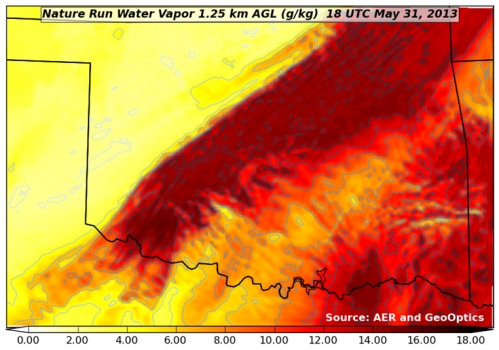
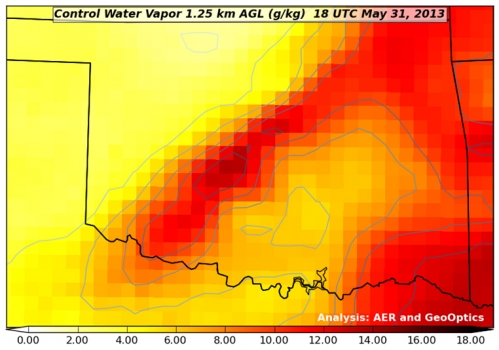
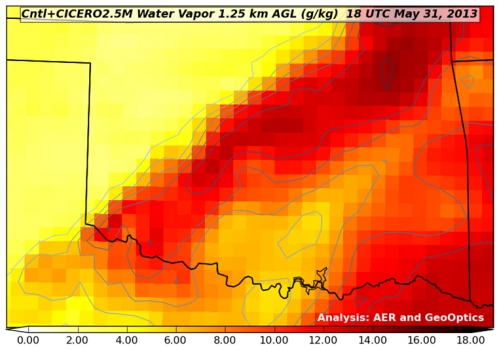
    Figure 1. "Nature Run" atmospheric water vapor at about 4,000 feet above the ground.  The yellow-to-red color scale (bottom of figure) indicates how much water vapor is present, i.e., yellow is dry and red is moist.  This realization of atmosphere moisture during an Oklahoma severe weather outbreak in May 2013 is the yardstick against which our assimilation experiments are compared for realism.  It has a horizontal resolving power of about 1 1/4 mile (i.e., 2 km).
    Figure 1. “Nature Run” (the truth reference) atmospheric water vapor at about 4,000 feet above the ground. The yellow-to-red color scale (bottom of figure) indicates how much water vapor is present, i.e., yellow is dry and red is moist. This realization of atmosphere moisture during an Oklahoma severe weather outbreak in May 2013 is the yardstick against which our assimilation experiments are compared for realism. It has a horizontal resolving power of about 1 1/4 mile (i.e., 2 km).
    Figure 2. Atmospheric water vapor analysis using conventional observing system.  Valid time, vertical level and color scale are the same as in Figure 1.  Note that the data fusion experiments use a bigger grid than the Nature Run (Figure 1) with a horizontal resolving power of about 11 miles (i.e., 18 km).
    Figure 2. Atmospheric water vapor analysis using conventional observing system. Valid time, vertical level and color scale are the same as in Figure 1. Note that the data fusion experiments use a bigger grid than the Nature Run (Figure 1) with a horizontal resolving power of about 11 miles (i.e., 18 km).
    Figure 3. Atmospheric water vapor analysis using conventional observing system + CICERO radio occultation observations.  The distribution of water vapor in this analysis is much closer to the Nature Run (Fig. 1) in pattern and magnitude than the Control result (Fig. 2).
    Figure 3. Atmospheric water vapor analysis using conventional observing system + CICERO radio occultation observations. The distribution of water vapor in this analysis is much closer to the Nature Run (Fig. 1) in pattern and magnitude than the Control result (Fig. 2).


  • GPS Network Shows Drought in the U.S. West

    GPS Network Shows Drought in the U.S. West

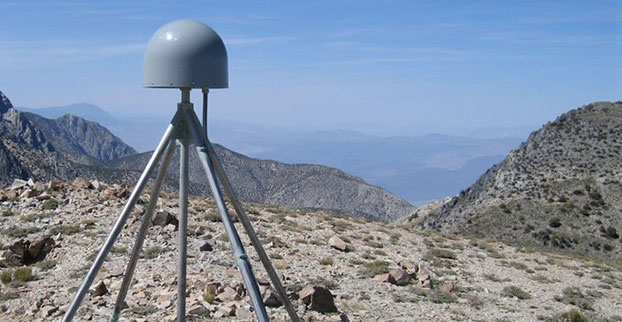
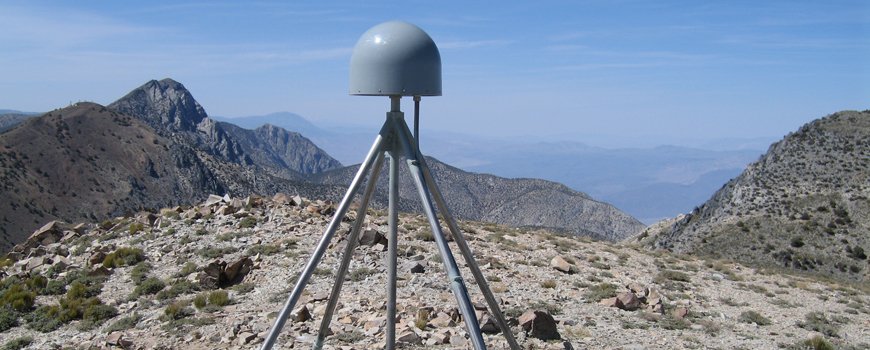
    A GPS station in the Inyo Mountains, Calif. Credit: Shawn Lawrence, UNAVCO.
    A GPS station in the Inyo Mountains, Calif. Credit: Shawn Lawrence, UNAVCO.

    A network of GPS stations in the western United States is revealing the severity of the drought in that region.

    Compared to the nine years before the drought, the GPS data show that the western United States has lost 240 gigatons of water, which is enough to flood the entire region in 10 centimeters of water.

    Investigating ground positioning data from GPS stations throughout the west, researchers at the Scripps Institution of Oceanography at the University of California, San Diego, found that the water shortage is causing an uplift effect up to 15 millimeters (more than half an inch) in California’s mountains and on average four millimeters (0.15 of an inch) across the west.

    Results of the study, which was supported by the U.S. Geological Survey (USGS), appear in the August 21 online edition of the journal Science.

    The measurements have a much better resolution — 200-300 kilometers — than data provided by NASA’s GRACE satellites, which shows how the water mass has changed on and below the Earth’s surface.

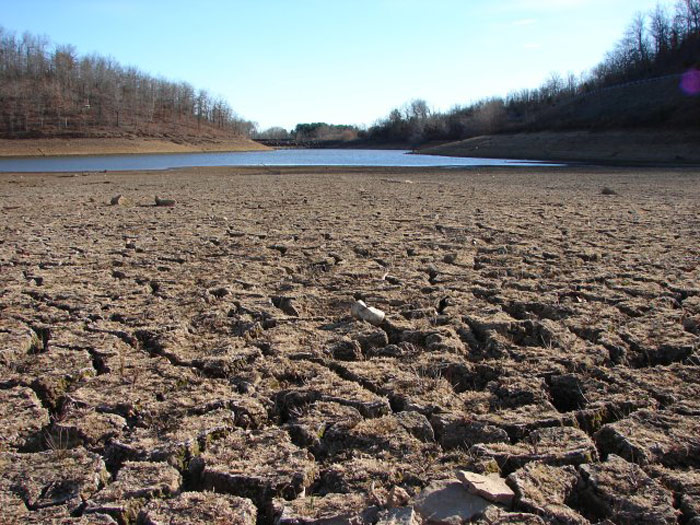
    California_Drought_Dry_Riverbed_2009
    A dry riverbed in California.

    Researchers Adrian Borsa, Duncan Agnew, and Dan Cayan used data from more than 700 GPS stations in the National Science Foundation’s Plate Boundary Observatory to measure the rising and falling of Earth’s surface due to the presence of water. Water in lakes or aquifers weighs down on the Earth causing the surface to sink, while during a drought the surface rises. Each station provides time and position information that is used to calculate the station’s location to within 1-2 millimeters horizontally and 3-5 millimeters vertically.

    The current drought began in 2012, when data shows that in general, the ground rose by about four millimeters. The rise in the Sierra Nevada mountain range was 15 millimeters.

    While poring through various sets of data of ground positions from highly precise GPS stations within the National Science Foundation’s Plate Boundary Observatory and other networks, Borsa, a Scripps assistant research geophysicist, kept noticing the same pattern over the 2003-2014 period: All of the stations moved upwards in the most recent years, coinciding with the timing of the current drought.

    Agnew, a Scripps Oceanography geophysics professor who specializes in studying earthquakes and their impact on shaping the earth’s crust, says the GPS data can only be explained by rapid uplift of the tectonic plate upon which the western U.S. rests (Agnew cautions that the uplift has virtually no effect on the San Andreas fault and therefore does not increase the risk of earthquakes).

    For Cayan, a research meteorologist with Scripps and USGS, the results paint a new picture of the dire hydrological state of the west.

    “These results quantify the amount of water mass lost in the past few years,” Cayan said. “It also represents a powerful new way to track water resources over a very large landscape. We can home in on the Sierra Nevada mountains and critical California snowpack. These results demonstrate that this technique can be used to study changes in fresh water stocks in other regions around the world, if they have a network of GPS sensors.”

    The study was supported by USGS National Earthquake Hazards Reduction Program.

  • GPS Tracking Used to Honor Storm Chasers

    The storm chasing and weather community is honoring three storm chasers killed in an Oklahoma tornado on Friday. Tim Samaras, his son Paul Samaras, and Samaras’s chase partner Carl Young are being honored via the Spotter Network, where their initials are being spelled out.

    The Spotter Network is a website used by storm chasers to follow weather movements. Users have been adding position locations to spell out the initials TS, PS, and CY, shown here in an image at sfgate.com.

    The Samarases were well known to TV viewers, having been prominent subjects of the Discovery Channel series “Storm Chasers” and frequent contributors to The Weather Channel. They weren’t working for either channel last week, both networks said.