Tag: SkyTraq Technology

  • Skytraq Technology modules meet market needs

    Skytraq Technology modules meet market needs

    SkyTraq Technology, a fabless semiconductor company, develops GPS/GNSS chipsets and modules for meter-level accuracy vehicle navigation and tracking applications and for centimeter-level accuracy real-time kinematic (RTK) surveying and precision guidance applications.
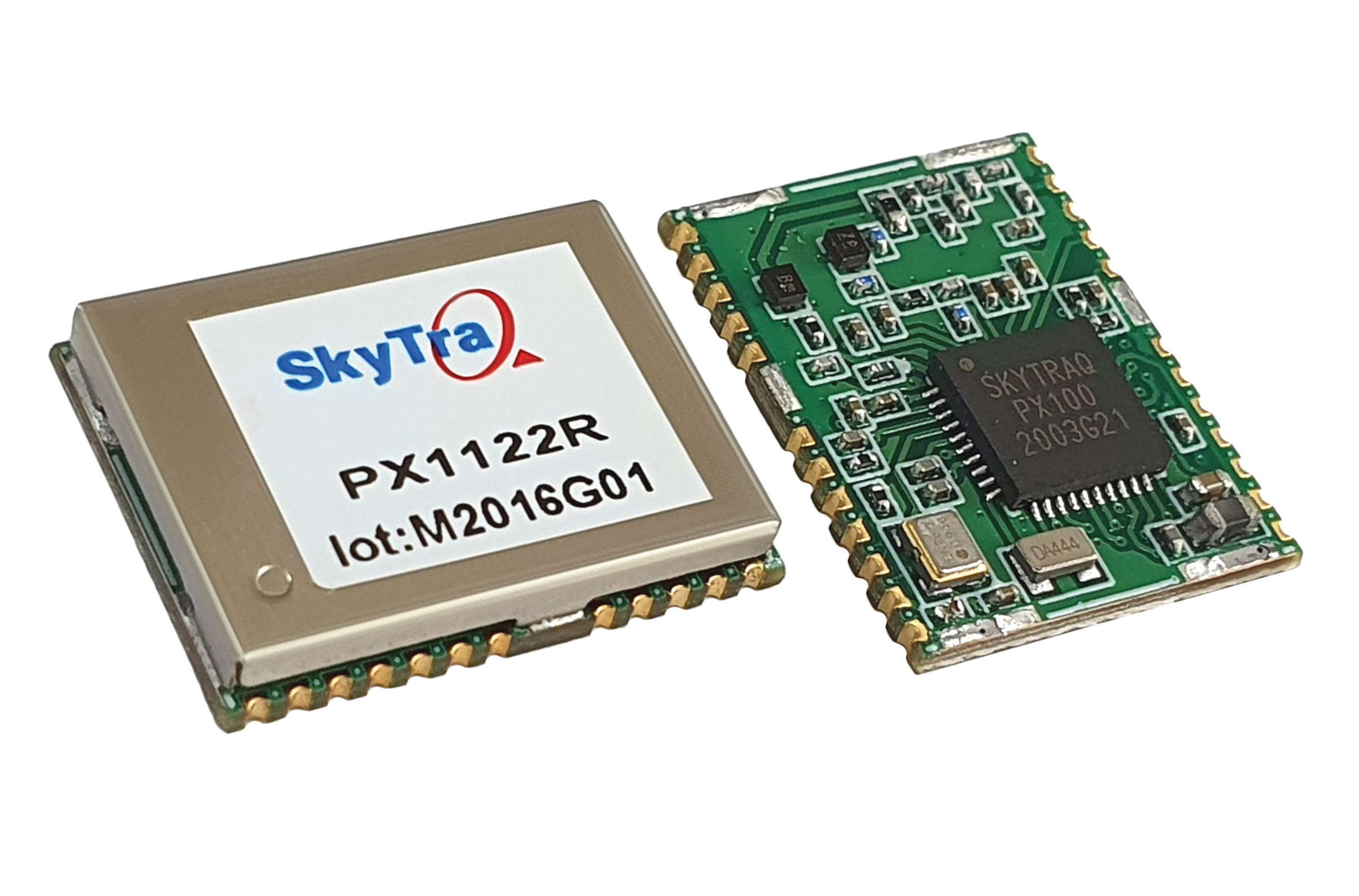
    Photo: SkyTraq
    Photo: SkyTraq

    The company’s chipset design is driven by market trends, said Oliver Huang, the company’s general manager. He explained the company has moved from single-frequency to dual-frequency devices.

    SkyTraq’s chipset is designed to be common hardware for different target applications enabled by customized software. Traditionally, in the automotive market, vehicle navigation systems have relied on fusing GNSS receivers with dead-reckoning technology that uses micro-electromechanical (MEMS) inertial measurement units (IMUs) and wheel-tick data.

    “We are now seeing more aftermarket vehicle tracking applications that take advantage of superior GNSS/DR performance using untethered dead-reckoning technology that uses sensor fusion of GNSS receiver and MEMS IMUs without the need for wheel-tick data,” Huang said. “GNSS receivers with decimeter or better accuracy, combined with dead-reckoning that uses low drift IMUs, will be important in emerging autonomous vehicle applications.”

    SkyTraq’s PX100 chipset for L1 meter-level accuracy applications and centimeter-level accuracy RTK applications uses L1 and L1/L2 signals from all four major GNSS constellations (GPS, GLONASS, Galileo and BeiDou).

    Because of the trend toward high-precision, which requires good carrier-phase raw measurement data, the biggest challenge in receiver design is with the antenna, Huang explained. “Using an advanced semiconductor process, one can have low power, small size chipsets taking advantage of all the available GNSS signals, yet there is no small antenna capable of producing high-quality carrier phase data for high-precision GNSS applications. So far, we have only seen bulky RTK antennas capable of generating high-precision results.”

  • GNSS dead-reckoning receiver offered by SkyTraq

    GNSS dead-reckoning receiver offered by SkyTraq

    SkyTraq Technology Inc., a fabless GNSS positioning technology company, has introduced the S1722DR8 GNSS dead-reckoning receiver, integrating a 3-axis gyroscope/accelerometer and barometric pressure sensor with a GNSS receiver.

    Using wheel/speed data from vehicle to perform sensor-fused solution, S1722DR8 achieves 100-percent coverage. It is designed for vehicles applications requiring high performance and reliable uninterrupted positioning.

    The S1722DR8 can be flexibly mounted in any orientation, and does not have to be placed horizontally as in conventional dead-reckoning solutions using single-axis gyroscope. The auto-calibration feature of S1722DR8 greatly simplifies installation procedure; the short calibration time upon first use also improves user experience.

    The S1722DR8 GNSS dead-reckoning receiver, compared to a U.S. penny.
    The S1722DR8 GNSS dead-reckoning receiver, compared to a U.S. penny.

    The on-board barometric pressure sensor provides highly accuracy altitude information, useful for differentiating floor levels of multi-story parking garages or stacked highways.

    The S1722DR8 is compact, measuring 17 x 22 millimeters. It offers continuous navigation even in GPS-signal-denied environments such as tunnels or underground parking lot. Augmented by gyroscope and accelerometer sensor data, it is also designed for vehicle insurance accident-reconstruction applications.

    An S1722DR8 engineering sample, evaluation kit and datasheet are available now. Volume delivery to customers begins in June. The S1722DR8 is manufactured in ISO/TS 16949 automotive-certified factory.

  • SkyTraq launches low-power RTK receiver

    SkyTraq Technology Inc.Photo: SkyTraq Technology Inc., developer of high-performance chipset and module solutions for the GNSS market, unveiled its new S2525F8-RTK low-power, single frequency RTK receiver for applications requiring centimeter-level accuracy positioning.

    S2525F8-RTK is a multi-constellation GNSS RTK receiver that can use 12 GPS, eight SBAS, six BDS, and one QZSS signal. In situations where an RTK fix is not possible, a Float RTK mode can be used for decimeter-level accuracy positioning.

    A moving-base mode supports a precise heading GPS compass application. The receiver is 25 millimeters by 25 millimeters form factor, weighs 3 grams and consumes 250 milliwatts of power for any outdoor mobile applications requiring high precision RTK positioning, SkyTraq reported in a news release.

    S2525F8-RTK supports both base station and rover modes. As a rover, it receives RTCM (Radio Technical Commission for Maritime Services) 3.0 or 3.1 data from a base station — or raw measurements from another S2525F8-RTK receiver serving as base station — and performs carrier phase RTK processing to achieve relative positioning with 1 centimeter plus 1 part-per-million position accuracy with 10-kilometer baseline. Decimeter-level accuracy for over 10-kilometer baseline can be achieved using the Float RTK mode. Two S2525F8-RTK receivers can be used to form a GPS compass that provides better accuracy and more reliable heading solution than conventional digital magnetometers that’s affected by changes in the magnetic environment, according to SkyTraq.

    A $50 NS-HP evaluation board is available for evaluation and integration into portable survey equipment, unmanned vehicles, machine control applications and robotic guidance applications. The standard NMEA-navsat-driver package of Robot Operating System (ROS) works directly with NS-HP, enabling accessible centimeter-level accuracy positioning for robotic applications, SkyTraq says.

    S2525F8-RTK is now in mass production.