Tag: small cells

  • Optical Zonu offers ‘GPS at the Edge’ for 4G/5G small cell deployments

    Optical Zonu offers ‘GPS at the Edge’ for 4G/5G small cell deployments

    The huge current investment in deploying 5G mobile networks is promoted by setting high expectations for significantly increased throughput and reduced latency.

    This can only be realized by deploying the network radios close to the users, especially for the millimeter-wave frequencies with their short propagation distance.

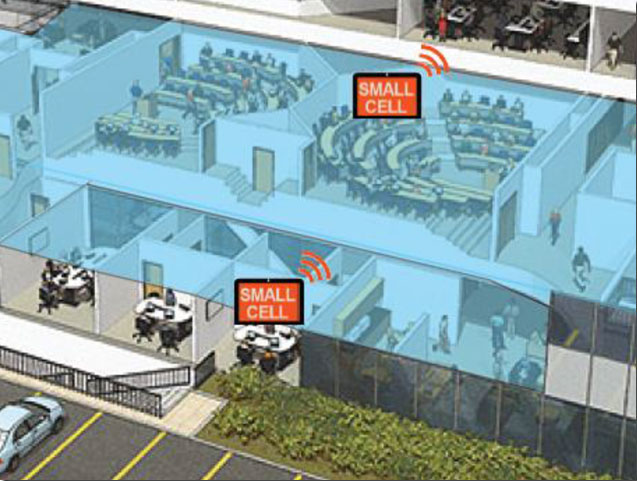
    This also means a high density of radios, often imbedded within macro coverage.

    To coordinate seamless functioning, network synchronization accuracy must be much higher than with legacy deployments, according to Optical Zonu. The greatly enhanced data throughput with advanced features such as aggregation, massive multiple-input/multiple-output (MIMO) and beam steering require highly accurate network timing and phase coordination.

    Small cells close to a network’s edge are usually far from the hub where the grandmaster timing server generates the PTP timing signal and sends it to the network edge over the Ethernet backhaul. The long runs require multiple hops through routers and switches. Each of these adds dynamically changing packet delays depending on network loading. Also, there are inevitable asymmetries between the upstream and downstream packet delays. These timing errors can result in a drastically reduced network performance.

    One way to correct these timing errors is to connect an edge grandmaster server at the small cell location connected to the local backhaul router. Connecting the GPS directly to each of the small cells is the other way.

    The GPS approach is simple in concept, but has been problematic since, with small cells distributed in the facility, many or all the units can be far from a window where a GPS antenna could be mounted.

    Optical Zonu, a U.S. carrier-approved supplier of RF-over-fiber transport solutions, has solved this problem with its GPS at the Edge kit. The GPS-over-fiber solution distributes GPS to each small-cell location alongside the backhaul.

    A compact GPS fiber antenna unit connects to a GPS antenna on the roof. A single cable connection to this unit provides power to the unit and brings the fiber-optic connection to an optical splitter, which is collocated with the local router for the small-cell backhaul.

    The fibers from this splitter are routed along with the backhaul cable to each small-cell location, where they each connect to a small fiber base unit that recovers the GPS signal and connects it to the auxiliary GPS port on each small cell.

    Optical Zonu offers two variants.

    Small cells with fiber-optic backhaul. Higher power cells typically use a fiber-optic backhaul and require local AC power. In this case, one of the fibers in the cable to each small cell is used for the GPS connection, and each base unit connects to the local AC power with an adapter. In this case, the only additional cable needed is the single run to the rooftop.
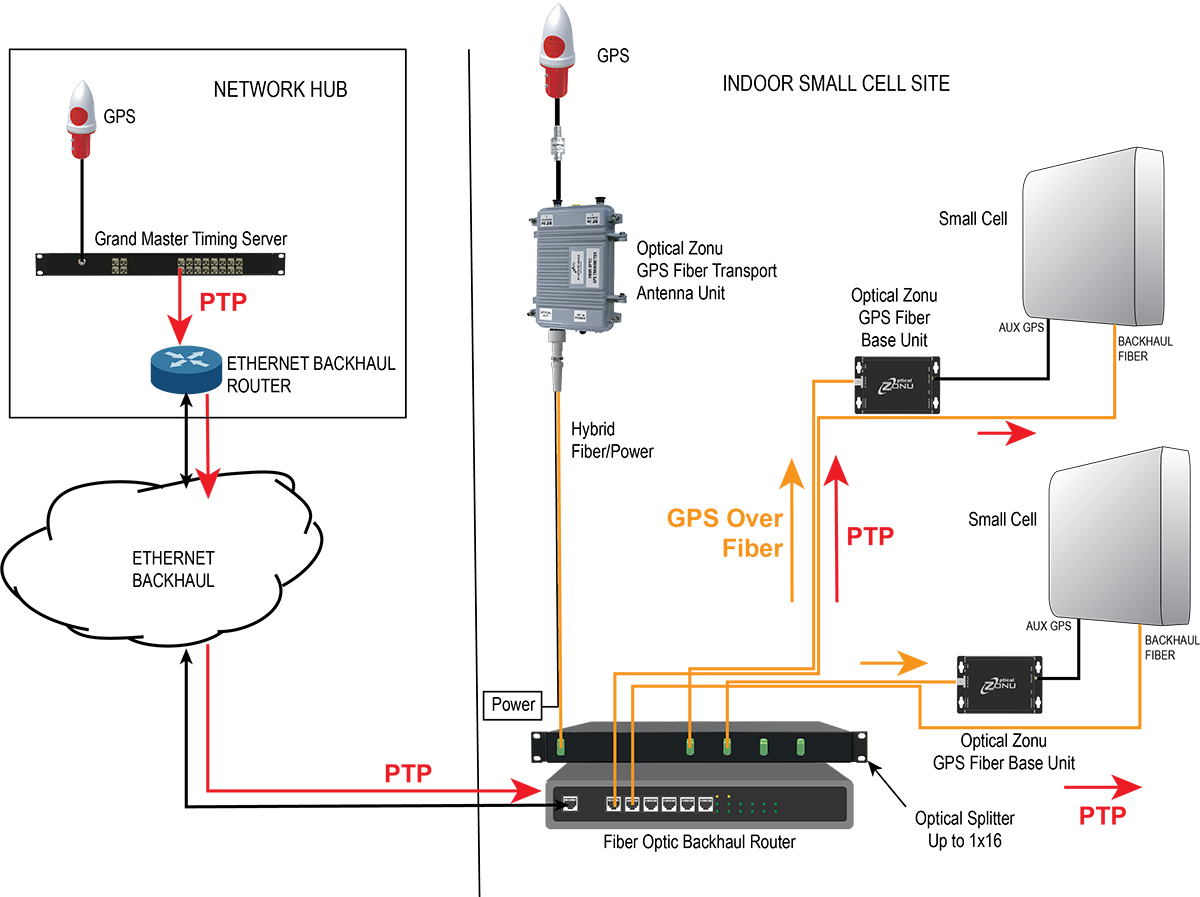
    Diagram: Optical Zonu
    Diagram: Optical Zonu

    Small cells with a CATx backhaul. This setup is typical for lower power small cells. In this architecture, a single fiber is pulled along with the CAT6 backhaul cable. A single hybrid fiber/CAT6 cable can also be used. The fiber is connected to a small fiber base unit at each small cell to recover the GPS signal, which is connected to the small cell auxiliary GPS port. The CAT6 is also connected to the fiber base unit. The backhaul is passed through from the small cell, and the PoE++ is tapped to power the base unit. Once again, the only additional cable pull is the single run to the rooftop antenna — local power isn’t needed at every small cell location.

    Diagram: Optical Zonu
    Diagram: Optical Zonu

    The Optical Zonu GPS at the Edge kit provides an easy-to-install and cost-effective solution that guarantees the highest timing and phase accuracy for a network that is vendor agnostic and, as with the edge grandmaster approach, still has the central PTP as a backup.

    For more information, visit Optical Zonu.

  • Oscilloquartz unveils dual-antenna GNSS SyncReach for small cells

    Oscilloquartz has launched the OSA 5405 SyncReach, an integrated PTP grandmaster and GNSS receiver with a patent-pending dual antenna and receiver to enable the mass roll out of small cells.

    The new technology has been specifically engineered to provide accurate and affordable phase synchronization for the rapidly growing small-cell market and meet the stringent timing requirements of 4.5G and 5G connectivity.

    With the OSA 5405, operators can migrate from legacy GNSS RF antennas and cables to standard, cost-effective copper and fiber Ethernet cabling, reducing capital expenditure and operating expenses, Oscilloquartz said.

    Available in both indoor and outdoor variants, the OSA 5405 can be deployed in challenging environments, including urban canyons where GPS signals fail. The OSA 5405’s miniscule form factor also enables it to be positioned on indoor windows to avoid multipath signal interference from objects within the building.

    The OSA 5405 uses a unique dual GNSS antenna and receiver algorithm to mitigate interference from multipath signals that can affect accuracy, particularly in urban canyons, according to the company.

    “We’re at the start of a new era. With the internet of things (IoT) connecting more wireless devices and 5G just around the corner, small cells will have a big role to play,” said Gil Biran, general manager at Oscilloquartz. “This market is set to grow exponentially in the next few years. Small cells will soon be everywhere and that makes precise synchronization essential. Operators urgently need a way to reliably and affordably deliver new levels of phase accuracy.

    “We’ve created our OSA 5405 to effectively deliver small cell synchronization in any environment and eliminate all restrictions,” Biran said. “Our new technology radically simplifies GNSS antenna installation. The use of PTP removes the need to compensate for cable delay and extends the reach of GNSS. It enables operators to forget about archaic and expensive RF cables and use simple copper cabling or optical fiber for longer distances. And, with variants that can be positioned in almost any location, it provides strictly accurate timing precisely where it’s needed.”

    The compact design and power-over-Ethernet capabilities of the indoor- or outdoor-mounted OSA 5405 enable synchronization at the edge of the mobile network. This creates dramatic reductions in complexity and power requirements as well as lower costs for installation and operation.

    Another feature of the new technology is IP connectivity, so that synchronization becomes another element of the internet of things.

    The OSA 5405’s highly precise GNSS-sourced synchronization is supported by network-based Sync-E and PTP backups. In high-rise buildings it can also deliver synchronization recovered from the GNSS smart receiver over optical fiber.

    The ADVA FSP Network Manager with comprehensive Syncjack assurance guarantees efficient operation.

    “Make no mistake; the launch of our OSA 5405 is a major milestone in the progress towards mass-scale small cell deployment,” said Nir Laufer, product line director at Oscilloquartz. “With its plug-and-play simplicity, miniscule form factor and multiple timing functions in a single device, this is a key technology for 5G networks and the IoT.

    “Currently deployed in trials with major carriers, it will shortly be available to all operators looking to harness next-generation synchronization precisely where it’s needed,” Laufer said.

  • Microsemi Enhances Software Capabilities for Integrated GNSS Master Portfolio for Mobile Edge Deployments

    Microsemi Corporation has enhanced its Integrated GNSS Master (IGM) software, expanding capabilities and key features in the new version 2.

    The company’s IGM product portfolio enables coverage and capacity at the edge of mobile networks to serve mobile operators preparing for 5G through densification, as well as enterprises seeking enhanced indoor capacity and coverage on LTE and LTE-Advanced (LTE-A) networks.

    “While the first version of our IGM software demonstrated innovative algorithms for indoor operation, the enhancements in v2 enable mobile operators to leverage enhanced management options, more reliability through GPS back up, better scalability with Internet Protocol (IP)v6 and increased client support to facilitate densification,” said Eric Colard, director of business development for Microsemi’s Frequency and Timing division. “By leveraging the newest software release on our entire IGM product portfolio, mobile operators can implement a wide range of deployment scenarios ― indoor, outdoor, in-building and in cabinets and huts ― with small form factor products which are also highly cost-effective.”

    Mobile operators are in the process of deploying phase for LTE and densifying their networks with small cells to enable 4.5G, 4.9G and 5G capabilities. LTE-A and video are driving the need for precise time requirements that are very stringent. The potential for interference in dense deployments also means strict phase specifications for mitigation.

    Finally, spectrum is a precious resource that requires usage optimization leading to a need for precise timing. The new IGM software enables mobile operators to deploy these smaller grandmasters at the edge of their networks, lowering associated costs and enabling them to serve customers with enhanced coverage and performance.

    According to the Global Mobile Suppliers Association (GMSA), LTE has experienced the fastest growth of any mobile infrastructure technology, with 503 networks launched to date in 167 countries and 550 networks expected by the end of 2016. It is estimated that 25 percent of LTE operators have already upgraded to LTE-A, driving the need for Microsemi’s leading phase synchronization technology.

    Market research firm IHS Infonetics forecasts 2.2 million small cell units in 2016, reflecting a growth rate of 54 percent compared to 2015 and totaling $1.6 billion for the market. The firm estimates the market to hit $2.6 billion in 2020 at a compound annual growth rate (CAGR) of 15 percent, with more than 5 million units.

    The new software can be loaded on any of the three hardware versions of Microsemi’s IGM product portfolio, the IGM-1100o (outdoor version), the IGM-1100x (with support from external antennas) and the IGM-1100i (indoor version), to support the latest requirements.

    Features include support for IPv6, support for the latest Precision Time Protocol (PTP) profiles (G.8275.2) and increased client count from 16 to 32. It also offers the unique ability to provide backup to GPS in case of outage or jamming by accepting a PTP (1588v2) input that will provide a source of time from the network timing infrastructure already deployed.

    Primary Reference Time Clock (PRTC) compliance is available for IGM 1100x and 1100o as required by ITU, and the system includes cable compensation to address the length of GPS cables.

    IGM-1100o Outdoor Version Availability

    In addition to the software update announcement, Microsemi also announces the availability of its IGM-1100o device to complement the IGM-1100i and IGM-1100x, available since May. IGM 1100o is a carrier-grade 1588 PTP GrandMaster integrated with a GNSS antenna in a form factor to deploy in outdoor environments. The IGM1100o is designed for outdoor deployment where extended temperature ranges of -40 degrees Celsius to 70 degrees Celsius and ruggedization are critical factors.

    The IGM-1100o can be installed at an outdoor location such as on top of a cabinet or hut to serve a cluster of eNodeBs or on locations such as a rooftop. IGM-1100o, like all models in the portfolio, is powered by Power-over-Ethernet (PoE). The integrated device is connected to the network through an Ethernet cable instead of a GPS cable to simplify deployments and lower costs. It also offers a high level of integration and plug-and-play capabilities.

    Microsemi’s new device adds to the recently launched indoor versions, IGM-1100x and IGM-1100i, and each delivers a solution when a cost-effective, precise timing master at the mobile edge is needed. The entire IGM portfolio leverages the same v2 software, delivering consistent behavior and performance for each form factor. The indoor versions of Microsemi’s IGM devices have been adopted and successfully deployed in the past six months by several top mobile operators, with numerous upcoming deployments worldwide.

    The IGM product leverages Microsemi’s broad portfolio for mobile deployment, which includes:

    • TimePictra, a modular web-based synchronization management system that scales and evolves with operational requirements, monitoring the IGM family as well as other Microsemi IEEE 1588 Grand Masters;
    • Indoor managed PoE midspans, which allow upgrading the network to support PoE with virtually no downtime. The family includes products with port densities of up to 24 ports and 60 watts per port, to power small cells and the IGM-1100i; and
    • Outdoor PoE switches, hubs, midspans and surge protectors, a complete outdoor PoE portfolio, essential for the deployment of the IGM-1100o.

    Microsemi’s IGM-1100o, IGM-1100x and IGM-1100i are available now with version 2 software.

  • Symmetricom Introduces Small Cells Category to SyncWorld Ecosystem Program

    Symmetricom, Inc., today launched a new small cells-focused category within its SyncWorld Ecosystem Program. Developed to support the integration with Symmetricom’s SCr/SCe NTP/ PTP and sGPS SoftClocks and interoperability between Symmetricom Grandmaster clocks and other small cells solutions, the category aims to facilitate validated deployments of timing and synchronization with various small cells products in 3G and 4G/LTE architectures. Current partners in the program include leading small cell players Alcatel-Lucent, Broadcom, Cavium, Contela, CS Corporation, Mindspeed, Node-H, Qualcomm Atheros, and Rakon.

    Small cells are a key component of 3G and 4G architectures as they add capacity to the mobile network and allow service providers the maximum leverage of scarce spectrum resources. Successful HetNet deployments require small cells to synchronize seamlessly with the macro base stations irrespective of backhaul type. Also, small cell design cycles need to be short to meet the fast evolving market needs. SyncWorld brings together all players in the ecosystem including semiconductors, oscillators, software, test equipment and system vendors to drive cost effective and shortened design cycles by enabling architectural harmony and interoperability.

    Analyst firm Infonetics forecasts the global small cell market to grow to $2.1 billion in 2016 as small cells have emerged as a key solution to deliver increased network capacity. Symmetricom has delivered a number of solutions with partners along with the introduction of the industry’s first small cell synchronization solution, SCr/SCe NTP/ PTP and sGPS SoftClocks for residential and enterprise small cells. The small cells segment within the SyncWorld Ecosystem Program will ensure that interoperability needs are met as service providers accelerate their deployment plans.

    “The small cells category represents leaders across the entire value chain,” said Manish Gupta, vice president of marketing and business development for Symmetricom. “Working together, SyncWorld small cell members will be able to give service providers a comprehensive, integrated and simplified solution that is interoperable and supports the specifications required to support 4G/LTE networks.”

    The SyncWorld Ecosystem Program enables vendors to cooperate with the goal of providing complete solutions that interoperate with the most recognized timing and synchronization solution provider in the industry. Vendors that produce silicon, small cell access point, software and oscillators are invited to apply for the program online.

    With solutions deployed globally in more than 150 networks, Symmetricom is committed to partnering with trusted end-to-end technology providers which deploy and maintain networks on behalf of operators.