Tag: Space Symposium

  • 36th Space Symposium rescheduled due to COVID-19

    36th Space Symposium rescheduled due to COVID-19

    Logo: 36th Space Symposium

    The Space Foundation has decided to reschedule the 36th Space Symposium for Oct. 31 to Nov. 2. It will still take place at The Broadmoor in Colorado Springs.

    According to the Space Foundation, the 36th Space Symposium will gather leaders, innovators and entrepreneurs from the civil, commercial, military, research and international sectors to share, explore and partner on efforts that will impact our lives beyond Earth and upon it.

    “Working with our partners, The Broadmoor, the City of Colorado Springs, our corporate members and other key stakeholders, we look forward to welcoming everyone back to Colorado Springs to celebrate one of the world’s most inventive and impactful communities,” said Rear Admiral Tom Zelibor, CEO of the Space Foundation. “We will continue to monitor all of the public health reports and adhere to all of the federal, state and local orders regarding public assemblies but we have confidence in planning ahead for a future that brings our community safely back together in Colorado Springs.”

    As a result of the date and timing changes for this year’s symposium, attendees will find a revamped agenda from what was originally scheduled for this spring, the Space Foundation said. Scheduled changes can be found here.

    In addition, registration fees paid to attend the 36th Space Symposium will be automatically transferred to the rescheduled program. Those choosing to not attend the rescheduled Symposium are requested to notify [email protected] to receive a full refund of registration fees paid.

  • Registration open for 35th Space Symposium

    Registration open for 35th Space Symposium

    Logo: Space FoundationRegistration has opened for the 35th Space Symposium, sponsored by the Space Foundation and taking place April 8-11 in Colorado Springs, Colorado. The Space Symposium provides a forum to discuss, address and plan for future achievements in space.

    According to show organizers, the event represents all sectors of the space community from multiple spacefaring nations, including space agencies; commercial space businesses and associated subcontractors; military, national security and intelligence organizations; cyber security organizations; federal and state government agencies and organizations; research and development facilities; think tanks; educational institutions; space entrepreneurs and private space travel providers; businesses engaged in adapting, manufacturing or selling space technologies for commercial use; and media that inspire and educate the general public about space.

    The event will feature a number of speakers from NASA, Raytheon, the U.S. Air Force, the Canadian Space Agency, the Mexican Space Agency, the Korean Aerospace Research Institute and more.

    Attendees can also choose from a number of sessions, as well as purchase tickets for a variety of networking opportunities, including the Corporate Partnership Dinner, General James E. Hill Lifetime Space Achievement Award Luncheon, Women’s Global Gathering Luncheon and Space Technology Hall of Fame Luncheon.

  • New players trigger new space race, GPS III update

    New players trigger new space race, GPS III update

    Robin Wrinn
    Robin Wrinn

    This month, we bring you a guest column on the 33rd Space Symposium in Colorado Springs, Colorado. Robin Wrinn, a communications professional based in Atlanta, gives her perspective on the premier annual space event, held in early April. Among her findings: new players in space race, new capabilities afforded by 3D printing and virtual reality, and insights into the GPS III program from Lockheed Martin’s VP for navigation systems.

    — Alan Cameron, editor


    Blue Origin spacecraft.
    Blue Origin spacecraft.

    A host of new entrepreneurial and government players entering the space sector created an underlying sense of excitement that a new “space race” has begun. Visitors attending the 33rd annual Space Symposium first encountered the imposing, reusable Blue Origin spacecraft displayed prominently in front of the Broadmoor Hotel Exhibit Hall. It seemed to symbolically punctuate a statement that the space industry landscape is changing — and putting long-experienced government players and government contract monopolies on notice.

    Hosted by the Colorado Springs-based Space Foundation, this year’s Symposium featured more than 180 exhibitors, including 38 new international partners and space, government and defense officials from more than 30 countries. In addition to the United States, other notable space nations attending included China, Germany, South Korea, Japan, high-level members of Russia’s ROSCOSMOS, and for the first time, the European GNSS Agency (GSA).

    Space Recognized as a Security Asset

    A primary theme throughout the speaker lineup was development of missions and programs to shore up national cyber and space security. Japan, for example, had previously banned all military use of space assets, but according to Shuzo Takada, director general of Japan’s National Space Policy Secretariat, the country has established new laws in part due to growing threats from countries such as North Korea.

    Europe also has joined the club of providers of navigation services and has formally acknowledged the need to defend its member countries against cyber threats. In a keynote session, EU Commissioner for Internal Market, Industry, Entrepreneurship and SMEs, Elżbieta Bieńkowska, the first European Commissioner to address the Space Symposium, noted that Galileo, Europe’s GNSS, went live last December. In 2016, six Galileo satellites were launched building on the six the year before. Today, 17 leading chipset companies, representing more than the 95% of global supply, all produce Galileo-compatible products.

    Bieńkowska also outlined a three-point space strategy for Europe that incentivizes innovation, including investment in R& D projects, but also prompts Europe to officially view space as a security asset. “We for the first time recognize that space is a strategic asset and a central element of Europe’s strategic autonomy. Europe must ensure its own security,” she said.

    In his conference remarks, U.S. Congressman Jim Bridenstine welcomed addition of Galileo’s capabilities to the global satellite infrastructure, noting that GPS capabilities make it as important to our way of life as the electrical power grid. (Indeed, GPS actually enables key capabilities of the power grid through its precise timing, although Bridenstine did not mention this aspect.)

    “There are very strategic risks to our satellite systems and we need to make sure the GPS, GLONASS and Galileo signals provide back0up to one another and are supported in bilateral ways. “

    New Private Investment Sparks Change in Costs and Bidding

    The growing presence of private investment in the space economy was very notable at this year’s Symposium. Jeff Bezos’ Blue Origin is among several entrepreneurial companies — Elon Musk’s SpaceX (Space Exploration Technologies) and Richard Branson’s Virgin Galactic, to name two others — that are challenging the traditional drivers. These new players are upsetting the standard government agency inclination to prefer longstanding relationships over price. Now the bid price gaps are too big to ignore.

    Case in point: SpaceX has twice now in two years won bids to launch GPS III satellites, with price as a major factor. According to a March 2017 U.S. Department of Defense press release, SpaceX will provide the Falcon 9 launch vehicle production, mission integration and launch operation for support of the GPS III mission. The contract awards break a nearly 10-year monopoly held by United Launch Alliance, a joint venture of Lockheed Martin Space Systems and Boeing Defense, Space & Security.

    Previously, Claire Leon, launch enterprise director for the Air Force Space and Missile Systems Center had been quoted as saying the service views the entrance of competition as a good step that will help the government over time. “You’ll see a lot of innovation between multiple contractors to invest in the rocket systems for the United States,” she said.

    Lockheed Martin Touts Digital Tapestry Savings

    Collaborative Human Immersive Laboratory (CHIL).
    Collaborative Human Immersive Laboratory (CHIL).

    During the Symposium, Lockheed Martin Space Systems invited attending media to tour its expansive Littleton, Colo. campus where it is assembling and testing both the next-generation GPS III satellite constellation and the Orion spacecraft. Lockheed Martin is the prime contractor on the GPS III program and is under contract the U.S. Air Force to build eight position, navigation and timing satellites. The contract includes options for up to four more vehicles. In September 2016, the Air Force announced it had exercised the option for Lockheed Martin to build the ninth and tenth satellites, which will include additional hosted payloads to increase accuracy.

    Throughout the tour, Lockheed Martin’s hosts emphasized the company’s cost and time efficiency innovations. We first saw the Collaborative Human Immersive Laboratory (CHIL), where Lockheed is using virtual reality (VR) technology to plan the design and manufacture of nearly all its aerospace components. In one of the largest VR laboratories of its kind, engineering teams review 3D models of product designs, tooling and facilities. Instead of paper, virtual prototyping enable Lockheed’s engineers to inspect holographs of the engineered designs, as well as become avatars to examine designs in virtual environments in full scale and in an immersive way. The lab also is used to conduct virtual dry runs of systems once products get to the shop floor.

    Collaborative Human Immersive Laboratory (CHIL).
    Collaborative Human Immersive Laboratory (CHIL).

    According to Darin Bolthouse, manager of the CHIL, Lockheed Martin began virtual prototyping in 2010 with an initial focus on the GPS III and the Orion space capsule programs. Now the company uses the CHIL across the enterprise for all programs. It also is looking for ways to shrink the large lab footprint with newer commercially available VR equipment to create more VR pods at other locations and a site-to-site VR environment network with other facilities, including Sunnyvale, Calif., Kennedy Space Center and Johnson Space Center.

    Again, time and cost savings were emphasized with a primary narrative that “inserting virtual modeling and model-based engineering helps from the ground up.” Touted benefits included recouping an initial investment of $5 million per year since its construction in 2010 through cost avoidance in rooting out specific engineering problems in VR that otherwise would have been discovered on the shop floor. A specific example served up was using the CHIL to virtually redesign the top deck of the Orion spacecraft three times to work out human-machine ergonomic issues.

    Parts made with a 3D printer.
    Parts made with a 3D printer.

    In another leg of the tour, Lockheed Martin showcased how it uses 3D printing to make parts for both Orion and military satellites: tubing routings, bottles and attachments. This has reportedly reduced lead time to manufacture a single part from six months to 1.5 months, with assembly time reduced from 12 hours to just three. Another added benefit is accessibility and costs of replacement parts down the road. 3D printing provides the roadmap and means to recreate a part 20 years later even if Lockheed Martin or a sub-contractor should have ceased operation.

    GPS III Vehicle Rundown

    The highlight of the tour was Lockheed Martin’s top secret clean room, where the next-generation GPS III satellite constellation is being assembled and tested. The expansive space included areas for integrating the parts of each satellite vehicle, as well as environment testing chambers for acoustics and thermal vacuum, which simulate space conditions with extreme temperatures, including the near and far side of Earth solar temperatures. No phones, cameras or recorders were allowed, and even then parts of the satellite vehicles were draped off from visitors’ view.

    3-D printer.
    3D printer.

    Prominent placards gave the GPS III Program Production Status:

    Vehicle 01

    Completed Factory Functional Qualification Testing

    Placed in Storage since February 2017

    Vehicle 02

    Space vehicle integration forecast completion – May 2017

    Environmental testing to begin – May 2017

    Available for launch – 2018

    Vehicle 03

    Navigation Payload forecast delivery – Spring 2017

    Space vehicle integration – Fall 2017

    Begin environmental testing – Early 2018

    Available for launch – 2019

    Vehicle 04

    Navigation Payload forecast delivery – Fall 2017

    Space vehicle integration – Early 018

    Satellite Delays Resolved

    According to Lockheed Martin spokesperson Chip Eschenfelder, who spoke with GPS World during the media tour, previously reported GPS III engineering delays related to the payload have been resolved.

    Lockheed Martin's GPS III clean room in Littleton, Colorado
    Lockheed Martin’s GPS III clean room in Littleton, Colorado

    Lockheed subcontractor Harris Corporation provides the critical mission data unit (MDU) and other components of the navigation payload, including atomic clock timing systems, radiation-hardened computers and powerful transmitters to deliver accurate, robust navigation signals for the GPS III constellation. Last year it was discovered that a ceramic capacitor had not been subjected to all the program’s required qualification tests. Once the issue was discovered, Harris deployed a dedicated team to complete the required tests by December 2016. The issue caused a delay of four months. The part was among the more than 28,000 used in the navigation payloads for the GPS III vehicles. The company announced in February 2016 that it plans to offer a fully digital navigation payload for the GPS III’s space vehicle 11 and beyond.

    According to Harris Corp. spokesperson Ellen Mitchell, the company has so far delivered two full payloads to Lockheed Martin and has delivered some of the hardware for the third space vehicle.

    Another potential GPS III delay presented itself in March 2017 when the U.S. Air Force opened a review of the propulsion systems used for Lockheed Martin’s GPS III and other military satellites, following a problem during an attempt to boost one into orbit. According to Eschenfelder, the review is a standard process and was out of an abundance of caution. Lockheed is“confident that this review will not delay the Air Force’s planned spring 2018 Initial Launch Capability (ILC).”

    Further comments on the GPS III program came in a subsequent conversation I held with Mark Stewart, Lockheed Martin’s vice president for Navigation Systems:

    Q: GPS III has extensive military applications. What differences will it bring to the civil, end-user experience as compared to today’s?

    A: Millions of commercial and civilian users rely on GPS every day. GPS III begins a new era of improved Positioning, Navigation and Timing (PNT) performance for these civilian users in that it will be the first GPS satellite transmitting a new L1C civil signal designed to be compatible and interoperable with other international Global Navigation Satellite Systems (GNSS), like Galileo and QZSS. In the near future, civilian GPS receivers – like those found in smart phones — will be looking for L1C and compatible signals from satellites from multiple GNSS constellations, including GPS III. With more opportunities for GPS receivers to maintain “line-of-sight” L1C connections, civilian users will have much improved connectivity.

    Q: What is the impact of the OCX/ground segment delay? Won’t that impact realizing GPS III’s full capabilities on time?

    A: The first GPS III satellite, GPS III Space Vehicle 1 (GPS III SV01), was placed in storage on Feb. 27 and is now awaiting call up for launch from the Air Force. GPS III SV01 will need the Next Generation OCX Block 0 to launch. We are working closely with the Air Force and Raytheon to demonstrate GPS III SV01 operating on orbit as soon as possible. It is more appropriate for the U.S. Air Force and Raytheon to comment about OCX’s capabilities and what it will bring to the overall GPS III enterprise.

    OCX Block 1 is the baseline program under development to command and control GPS III satellites.  As a temporary gap-filler until OCX Block 1 is available, the Air Force placed Lockheed Martin under contract for “GPS III Contingency Operations” (COps), which will enable the current GPS Operational Control Segment (OCS) to checkout and operate GPS III satellites prior to the delivery of OCX Block 1.  Lockheed Martin’s COps program successful completed a Critical Design Review in November 2016, on schedule for delivery in 2019.

    Q: How do you see the future of GPS in a multi-constellation environment (considering that soon in addition to GPS and the Russian GLONASS, the European Galileo and the Chinese Baidoo will be fully operational)? And what does that mean for the civilian end-user?

    A: Civilian multi-constellation users will significantly benefit from the new L1C signal, designed be compatible and interoperable with the Galileo E1 Open Service (OS) signal. In addition, GPS navigation messages include the GPS/GNSS-time offsets to enable a multi-constellation PNT solution.

    Q: Galileo will be implementing a Commercial Service already in the first generation. Do you think that such a service could be implemented in the future on GPS?

    A: Ultimately the capabilities of future GPS satellites will be determined by the Air Force. That said, Lockheed Martin’s GPS III was specifically designed to be flexible and modular so in the future the satellite could easily incorporate new missions if they are deemed necessary, and new technology as it becomes available.

    Q: What were and are the technology challenges Lockheed Martin faced during the GPS-Ill development?

    A: GPS III is the most powerful GPS satellite ever designed, with three times greater accuracy and up to eight times improved anti-jamming capability. That increased signal power comes from a revolutionary new navigation payload. Early in development our payload provider, Harris Corporation, had some design challenges. Those issues were eventually overcome and fully validated when GPS III SV01 successfully completed its Thermal Vacuum (TVAC) test in December 2015. We are excited to be bringing GPS III’s new capabilities to our warfighters soon.

    Q: How do GPS III satellites compare with Galileo FOC satellite constellation? Achieve parity (Galileo 2 frequency, current GPS 1)? or leapfrogging over Galileo technology?

    A: I cannot speak for Galileo’s capabilities but the U.S. Air Force’s Global Positioning System (GPS) has been the gold standard for PNT for more than 20 years. Lockheed Martin’s GPS experience includes more than 250 collective years of on-orbit operations for the 19 GPS IIR and IIR-M satellites that make up about 60 percent in today’s GPS constellation. With GPS III being the most powerful GPS satellite ever designed and built, I am confident GPS III will maintain that PNT gold standard ranking.

    Q: There were clock anomalies in Galileo. What are you doing to avoid similar issues? Are GPS III clock’s different or the same?

    A: GPS III Rubidium Atomic Frequency Standards (RAFS) have evolved from GPS IIR and IIR-M RAFS, which have collectively and reliably provided more than 250 years of on-orbit service, including significant time beyond their intended design lives. Our GPS III RAFS clocks undergo rigorous environmental qualification and life tests to assure performance over this next generation satellite’s 15-year design life.  In addition, each GPS III SV includes multiple RAFS for redundancy.  GPS III continually monitors the active RAFS to detect and mitigate clock anomalies.  This is just one way that GPS III provides increased signal integrity for GPS users.

    Galileo clocks utilize different suppliers than GPS III clocks. The GPS III clock supplier has produced reliable RAFS clocks for GPS satellites over the past several decades.

    [end of Mark Stewart interview]

    Ground Control

    The GPS III satellite program is heavily dependent on the GPS Next Generation Operational Control System (GPS OCX), which according to  government officials has experienced developmental issues and remains under General Accounting Office (GAO) scrutiny.

    In assessing the implications, it’s important to note that OCX’s development is delivered in blocks, with Block 0 comprising the Launch and Checkout System required to take GPS III satellites into early orbit. Block 1 is built on Block 0  and will deliver the full OCX capability, allowing the Air Force to transition from its current GPS ground controls to the modernized and secure GPS OCX master control station.

    According to the OCX prime contractor, Raytheon, all coding for Block 0 is complete and testing is wrapping up for delivery. Block 1 development is ongoing with the final iteration estimated to be completed in late 2018.

    Findings in a recent GAO report are prompting examination of the reasons for the cost overruns and delays in military development programs. Meanwhile, the Air Force is looking at ways to modify the existing GPS control system to enable the operational use of the GPS III satellites until delivery of the OCX Block 1. Regardless, the Air Force may need to delay the launch of multiple GPS III satellites, according to the GAO.

    Mr. Bezos, Mr. Musk, Mr. Branson … are you out there?

  • What to Do, Who to See at the 31st Space Symposium

    What to Do, Who to See at the 31st Space Symposium

    Logo: 31st Space Symposium

    As I write this, the 31st Space Symposium (SS) will kickoff in just 5 days, on April 13 at the incomparable Broadmoor Resort in Colorado Springs, Colo., at the foothills of the beautiful Rocky Mountains.

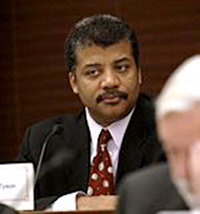
    Neil deGrasse Tyson (courtesy of PBS)
    Neil deGrasse Tyson (courtesy of PBS)

    If you haven’t figured it out already, the 31st SS is not a WWII German unit designation, but the 31st Space Symposium, which Dr. Neil deGrasse Tyson, famed astrophysicist, bestselling author, director of the Hayden Planetarium and host of the hugely successful television series Cosmos: A Spacetime Odyssey, simply calls “the most awesome symposium in the world.” Very high praise indeed, and a sentiment with which I totally agree.

    Breaking Records

    This year’s Space Symposium, which is sponsored by the Space Foundation, will be the largest ever held in terms of venue, size (number of exhibitors and speakers) and attendance. Approximately 10,000 space enthusiasts are expected to attend, and I hope you are one of them. My sources tell me the classified sessions (Cyber 1.5 and classified space sessions) are filled to overflowing — no new registrations allowed there. The exhibitor space at the Ball Aerospace Exhibit Center and Pavilion is bursting at the seams. The organizers are turning exhibitors away, so better luck next year. But if you just want to attend the greatest space symposium in the world, bar none, there is still time to register.

    By the way, if you haven’t figured it out already, this is a truly international event. My sources at the Space Foundation stated that the 31st Space Symposium will have more international participation than ever, including more than 150 exhibits of the world’s latest space technology, products and services. The Ball Aerospace Exhibit Center will host more than 30 first-time exhibitors with more than a dozen countries represented, including: Austria, Canada, Denmark, France, Germany, Japan, New Zealand, Norway, Scotland, Sweden, Turkey, the UK and the U.S. The symposium is expected to attract space leaders from more than 25 countries, representing all sectors of the global space community.

    Everyone who is anyone in the space world will probably be there or be represented. Consequently, the networking capabilities are unparalleled. Not to mention just being able to avail yourself of the world-famous Broadmoor Resort hospitality, plus the crisp, clean and cool mountain air at 6,000 feet.

    Event Preparation

    For many years, the event was known as the National Space Symposium. It outgrew that moniker many years ago, and is now simply known as the Space Symposium.

    Every year before I attend the Space Symposium, I make a “ToDoToDay” list of topics I want to explore, both as a journalist and in my senior space analyst profession. Plus, of course, I make a list of people I definitely want to talk with or interview. This year, I thought I would share some of those to-dos with you, because you may indeed have some of the same interests.

    GPS III

    Mark Stewart, Lockheed Martin GPS III program manager (Courtesty of Lockheed Martin)
    Mark Stewart, Lockheed Martin GPS III program manager (courtesy of Lockheed Martin)

    Wearing my subject matter expert (SME) hat, so to speak, I recently had the honor of touring the Lockheed Martin (LMCO) Space Systems facility in Waterton Canyon (far West Denver), Colorado, where the GPS III satellites are built, integrated and otherwise readied for launch. I took the opportunity to chat with Mark Stewart and his crew. Mark is vice president for manufacturing and space systems and program manager for GPS III.

    I learned that the first GPS III space vehicles (SVs) is much farther along than most everyone thinks. The problematic MDU (Mission Data Unit — the heart of the system) from Exelis has been fully tested and integrated into the payload. GPS III SV1 was only three days from being totally integrated or mated, as they say, with the on-orbit propulsion portion of the payload (the remainder of the LMCO A2100 bus) and beginning its months-long testing, certification and verification process. According to Mark, GPS III SV-01 — which powered on initially in February 2013 — now is in integration and test flow leading up to final delivery to the Air Force.

    While it was thrilling to see everything finally coming together, I will also tell you candidly that the next milestone everyone is asking about, the first GPS III launch date, is probably as fluid as the Snake River in Spring. So, while I do not feel comfortable quoting a first launch date, and LMCO would not give me a firm date for delivery of the first GPS III SV, I do feel comfortable making this prediction: Barring any unforeseen major issues during testing, LMCO will be ready to deliver to the U.S. government the first ready-to-launch GPS III satellite by the end of this calendar year. That’s right, in my humble opinion the first GPS III SV will be ready to deliver to the Air Force by December 2015. When it will actually be launched is anybody’s guess; obviously, the sooner the better. Apropos of the Boeing IIF initial launches and critical on-orbit anomalies, the sooner the LMCO GPS III is put into orbit for full-scale operational and mission analysis tests the better.

    LADO and OCX

    The critical question of course is: Will the U.S. Air Force (USAF) have a ground control system that can successfully and reliably launch and support a full-up GPS III SV by the end of 2015? Certainly not if they stay the course with OCX, but there are alternatives, and you know who you are! Can you say LADO, Launch/Early Orbit, Anomaly Resolution, Disposal and Operations System?

    Consider that LADO has been utilized to launch GPS satellites as far back as the GPS IIR-M family of satellites, also produced by LMCO, one of which was successfully launched on October 17, 2007, using the then-new LADO system. That milestone ensured the GPS program continued to provide superior space-based navigation for billions of users, military, civilian and commercial, around the globe using industry-leading highly modified (Aces Premier) commercial launch technology. This significant achievement was the culmination of outstanding teamwork between the USAF, Braxton Technologies, the engineering firm and the prime contractor.

    The LADO system formed and is still the backbone of the new GPS Command and Control (C2) functionality implemented by the prime contractor. It known today as the Advanced Architecture Evolution Plan (AEP). Subsequently, LADO is now the primary launch system for all current and future (IIR-M, IIF and possibly GPS III) satellites, which should allow the U.S. Air Force to retire some outdated legacy GPS ground support and command and control systems.

    The first successful 2007 LADO launch and control of an operational GPS IIR-M satellite, and the 1SOPS and 2SOPS operators’ acceptance of the GPS LADO system, was proof that commercial software can be deployed effectively even in a militarily critical mission system, saving the government both cost and schedule without sacrificing mission-unique capabilities.

    In my humble opinion, that is where we need to go today. Let’s return to the tried-and-true LADO and prime contractor partnership and launch the first GPS III SV by the end of this year, or certainly by early 2016. Please notice I have not made any statements concerning scrapping the hugely expensive, 100-percent-over-budget-and-schedule (years behind) OCX program of record. Under Secretary of Defense for Acquisition, Technology and Logistics (USDATL) Frank Kendall recently announced the controversial decision that OCX as the program of record would go forward under strict scrutiny with definite milestones that must be met. Scrutiny is a fickle mistress, and historically on the OCX program, milestones are there to be missed. Meanwhile, the USAF requires a tried, proven and utterly reliable capability to launch GPS III SVs as soon as the first few become available. The USAF must place several GPS IIIs on orbit for a full checkout to ensure there are no major anomalies. Currently, LADO had an eight-year proven track record with no failures, and it remains the only program that can initiate, control and dispose of residual GPS satellites — including the IIAs, which are the longest lived GPS satellites on orbit today.

    Beware, there will be many naysayers in government circles, and you may meet some of them at the symposium, that will tell you it is just not possible. But just stop by and talk candidly with LMCO Space Systems and Braxton Technologies personnel, and see what they have to say. You may be surprised by what you hear.

    Then stop by the Raytheon booth and check on the status of OCX.

    Lynn Dugle (courtesy of Raytheon)
    Lynn Dugle (courtesy of Raytheon)

    Female Executives in the News

    Speaking of OCX and Raytheon, Lynn Dugle retired from Raytheon on March 2, 2015. Historically, Lynn has been a very capable executive. She is the former president of Raytheon’s Intelligence, Information and Services (IIS) business, which handles several key U.S. Air Force space contracts, including OCX, the current program of record for the next-generation ground system for GPS III. Dugle served as president of the division beginning in 2009.

    David Wajsgras (your guess is as good as mine), Raytheon’s former senior vice president (SVP) and chief financial officer (CFO), has replaced Dugle. Wajsgras served as SVP and CFO of Raytheon Company from March 2006 to March 2015.

    David Wajsgras (courtesy of Raytheon)
    David Wajsgras (courtesy of Raytheon)

    As a member of Raytheon’s senior leadership team, he directed Raytheon’s overall financial strategy. In my humble opinion, he has his work cut out for him. He will need all of his financial expertise and acumen to make OCX a success — financially and, hopefully, operationally. The program is grossly over budget, several years behind schedule, and reportedly, my sources tell me, far less capable than originally planned. Good luck, David. 

    As long as we are still speaking primarily of female executives with great track records, USAF Lieutenant General Ellen Pawlikowski, who I have had the honor of knowing and working with for the past 25 years, was recently nominated for her fourth star. General Pawlikowski successfully commanded the SMC (Space and Missile Systems Center) and served as Program Executive Officer (PEO) for Space for three years at Los Angeles Air Force Base in California. Among her many successful space acquisition programs, she was responsible for GPS procurement during her tenure.

    Lt. Gen. Ellen Pawlikowski, USAF (Courtesy of the USAF)
    Lt. Gen. Ellen Pawlikowski, USAF (courtesy of the USAF)

    Currently, General Pawlikowski serves on the East Coast in the Pentagon as the military deputy to William LaPlante, Ph.D., the assistant secretary of the Air Force for acquisition. In other words, LaPlante is the Air Force’s Service Acquisition Executive, responsible for all Air Force research, development and acquisition activities. Previously, just to add to her mystique, General Pawlikowski spent more than one tour at the super secret National Reconnaissance Office.

    When confirmed, General Pawlikowski will be only the third female four-star general in U.S. Air Force history. A well-deserved honor and one that certainly merits acknowledgement. General Pawlikowski is scheduled to speak several times at the Space Symposium, so when you see her, congratulate her on a job well done and on being nominated for her fourth star, and wish her luck in her new assignment as the head (four-star commander) of Air Force Materiel Command.

    Before we leave the female leader category, my sources tell me that USAF Colonel DeAnna Burt, commander of the 2nd Space Operations Squadron (2 SOPS, the GPS squadron) from 2008 to 2010, will in June 2015 become only the third female commander of the 50th Space Wing at Schriever AFB, Colorado — home to 2 SOPS. She follows in the very capable footsteps of then-Colonel Suzanne (Zan) Vautrinot, who was the first female wing commander at the50th Space Wing followed by then-Colonel Teresa (Terry) Djuric. Note that both Suzanne and Terry, who are now retired from active duty, went on to become general officers in the USAF.

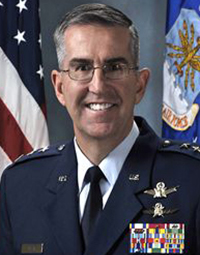
    Commander AFSPC – Gen. John Hyten (Courtesy of the USAF)
    Commander AFSPC – Gen. John Hyten (courtesy of the USAF)

    Currently, Colonel Burt serves as director of the Air Force Space Command (AFSPC) Commander’s Action Group for General John Hyten. General Hyten, the current commander of AFSPC, is himself a former 50th Space Wing commander, and he will also be speaking several times at the space symposium. Here’s a big hint: As a four-star general, General Hyten has morphed into quite a forceful, informative, entertaining and engaging speaker. You won’t want to miss any of his presentations.

    If you see Colonel Burt at the Space Symposium, please congratulate her on her new assignment, and you might offer her your prayers for the incredible amount of responsibility she is about to assume. I’m betting she can handle it.

    GPS Directorate

    Another USAF general officer you are sure to run into at the Space Symposium is a newly minted brigadier general known by some as Wild Bill Cooley. General Cooley, who is currently the director of the GPS Directorate at SMC, was pinned on just a few weeks ago and will be speaking several times at the symposium. Wild Bill also deserves your congratulations. By all accounts, he is doing a great job and has more stars in his future.

    The Place to Be

    So, while there are several points to be made, a key one appears to be that if you are heavily involved with the GPS program inside and outside the USAF and you do a good job, it can work wonders for your career. If you want to hear from those who have been successful, the 31st Space Symposium is the place to be.

    I hope to see you at the Broadmoor April 13-16. Come early and wear your walking shoes. Please stop by the GPS World booth and say hello to everyone. I will be there for sure.

    As I wind up this to-do list, I will tell you about another Space Symposium event where it is important, even critical, to be seen. Everyone who is anyone will be attending the Connecting Colorado private function on Wednesday evening, April 15. The event is hosted by the Braxton Science and Technology Group; this is the third year for the coveted event. As I have stated before, I have attended 26 of the 31 Space Symposiums, and I have never been to an after-hours function during that time that even approaches the quality and class that Connecting Colorado exudes. It is a first-class event in a visually stunning venue, where private access passes are required to enter and guards are serious about keeping out gatecrashers. If history is any guide, it promises to be an amazing evening of fine wines, sumptuous food, quality cigars, roaring fireplaces and professional camaraderie that can’t be beat. Plus, the networking opportunities are endless. In other words, the Connecting Colorado event is what all the other after-hours Space Symposium events long to be or wish they could emulate. I can’t wait. I hope to see you there, and at the 31st Space Symposium. By the way, April in the Rocky Mountains means dress appropriately — warmly works for me.

    Until next time, Happy Navigating, and remember: GPS is brought to you courtesy of the United States Air Force.

    Don Jewell
    Don Jewell
  • 30th Space Symposium Plus: A Truly Global Event

    30th Space Symposium Plus: A Truly Global Event

    The 30th Space Symposium offered a lot to see and do.
    The 30th Space Symposium offered a lot to see and do.

    I have said before and will undoubtedly say again, there is absolutely no space-related event in the world today that approaches the sophistication and professionalism of the Space Symposium held annually in Colorado Springs, Colorado, at the five-star Broadmoor Resort. The Space Symposium, carefully engineered and meticulously overseen by the Space Foundation, is truly the premier, must-attend space event of the year on a global basis.

    I have been honored to attend 27 of the 30 symposiums, and I hope to attend many more before I shuffle off this mortal coil. Believe me when I say this; it is not merely an oblique reference to health issues. I was hospitalized for four days afterwards with exhaustion among other issues, and the chairman of one of the key companies in space today now has walking pneumonia. So, while this is a major event, you can overdo it, but that is a personal issue and not by any means the fault of the Space Foundation or the event sponsors. Instead, it is an affirmation of the quality and necessity of the event. Indeed, the Space Symposium, with an average attendance of 9,000+, has grown to the point that a single individual just cannot take it all in. It is just not physically possible, whether you are 25 or 65 — believe me, I tried.

    Therefore, planning your time at the Space Symposium is essential. Unlike many symposiums where you are able to “play it by ear” and take events as they come, at the Space Symposium if you don’t plan well you will truly miss some crucial space-related event. Plus, it is difficult to relate the quality of the networking opportunities. You have access to space professionals and company VIPs at the Space Symposium that you would never be able to contact in normal daily business circumstances, and the beauty of it is they don’t have an office to escape to. There are so many additional cultural and social events that most VIPs attend, so if you don’t contact your target company VIP, it is probably just for lack of trying. Having said that, it is always good to have your elevator speech polished, because your quantity of time may be limited. You must take advantage of every opportunity. And no matter how well you plan, there are always those chance encounters, which is one of the aspects that make the Space Symposium so worthwhile. Sometimes just the opportunity to rub shoulders and discuss space matters with other professionals is all that’s required; those opportunities were abundant at this year’s symposium.

    May Day versus April Fool’s Day

    This year circumstances prevailed, and the 30th Space Symposium was held 30 days later than normal. The events that led to that scheduling change are significant in their own right. For instance, I will list just a few events and names; they might initially seem random, but they are intricately related:

    • Phil Anschutz
    • Broadmoor Resort
    • Construction
    • Renovation
    • Colorado weather
    • School schedules
    • Graduation dates
    • Space legislation
    • Sequestration
    • Colorado governor
    • Ambiance
    • Consistency
    • Education

    OK, the list could go on and on, but the point is that the Broadmoor Resort, as a resort, has been around since 1918, or 96 years. The property history actually goes back as far as 1871 and the founding of Colorado Springs by Spencer Penrose, but that is another story for another time.  The most recent important facts are that in October 2011, Mr. Philip Anschutz, a local Denver-based billionaire, purchased the Broadmoor, a place he fondly remembered from his childhood. He decided that it needed renovating in the best style of the early 1900 Italian Renaissance — which was always reflected in the older  resort buildings on the eastern side of the lake, but was not reflected in the newer western side, with a lack properties. Consequently, the two-plus-year renovation certainly impacted the dates and availability of rooms and services available for the annual Space Symposium. In 2012-13, the event took place in spite of construction, but the 2014 date needed to be moved from April to May to ensure all facilities would be available. Indeed, the formal completion and grand opening after renovations took place was on the Friday preceding the Sunday opening of the Symposium. But then, close only counts in love and horseshoes.

    So this accounts for a few words on the list, but the rest are definitely related to the conference itself. For years, many of the non-Colorado space companies and sponsors of the symposium wondered aloud if the second week in April in the foothills of the Rocky Mountains might be a bit early for such an event, since it invariably snowed, usually more than once, on participants sometime during the week-long event. However, the Space Foundation held firm on the dates for many reasons, one of which was the belief that flatlanders just don’t understand that the foothills of the Rocky Mountains are eligible for snow 12 months out of the year. Seriously, we have lived here for going on 25 years now, and we always said we were eligible for snow 11 months out of the year until a couple of years ago, when it snowed ten inches in August. It had been 80+ degrees the day before. So the Space Foundation pretty much ignored the clueless flatlanders and stuck to their guns on the date issue.

    But, in all honesty, there is much more to the date debate. The Space Foundation prides itself on education and fostering interest in all things space related. It helps fund numerous space-related institutions, scholarships ands organizations. The future of space and our national heritage as it relates to our future space professionals is a consuming force in the Space Foundation’s mission. In May, most schools in the Rocky Mountain region have been dismissed for the year, and quite frankly, as they discovered this year, the space symposium is significantly diminished if the students, teachers and professors cannot attend. This year the attendance was down almost 2,000 attendees, from 9000+ to 7000+, simply because schools and educators from grade school to graduate school found it difficult to participate. Be that as it may ,the Space Foundation could not ignore Philip Anschutz and the multimillion-dollar Broadmoor renovation, nor the major inconvenience to the guests and attendees. So they reluctantly agreed to move the date to May as a one-time experiment.

    The results of that experiment were definitely mixed. On the plus side, the renovations were complete and the transformation was phenomenal — if you had never visited the Broadmoor before, you would not be able to tell anything was changed. Facilities and buildings on both sides of the lake look like they were built in the early 1800s, but with all the modern conveniences of the 21st Century — a truly amazing accomplishment and tribute to Phil Anschutz’s vision. I visited the Broadmoor at least once a month during the two-year renovation, and I was still amazed at the transformation.  Nineteenth-century Italian ambiance and 21st-century convenience, what a combination.

    Now to the weather. Indeed, there were only a couple of small snow showers in the early morning hours during the week at around 0500, which most everyone missed. But Wednesday’s monstrous mega-hailstorm happened in the middle of the afternoon and was not to be missed, visually, aurally or physically. I was enroute to a meeting with Dr. Mark Crews and company from Ball Aerospace on the East side of the lake when the meteorological freight train struck. Fortunately I was under a huge Broadmoor umbrella at the time, or would have surely suffered a concussion, and that is no exaggeration. Golf-ball-sized hail appeared in biblical proportions (Moses would have been proud), and insurance companies executives, many who were in attendance, could be seen talking rapidly on phones and groaning visibly. Indeed, USAA, my insurance company for the last 50+ years, reported more than 800 automobile and 400 property insurance claims in a 24-hour period following the storm, and many insurance companies sent in their disaster and catastrophe teams. So, all in all, I vote for the occasional light snow in April versus the icy rocks raining from heaven in May. I know it is an anthropomorphic illusion, but it is as if Mother Nature were thumbing her nose at those flatlanders who dared be critical of a few snowflakes in April. On the plus side, the added moisture ensured the fireworks display could take place as planned this year, and it is always a spectacular event over the Broadmoor Lake.

    Politically Speaking

    Politically, the timing could not have been better for the Governor of Colorado, the Honorable John Hickenlooper, who came south of the Mason-Dixon line and attended the event where he ceremoniously signed significant Colorado State tax legislation that — bottom line — makes it more profitable for all space-related companies to operate in Colorado. Colorado currently ranks third in the nation for space-related income. Many believe it will return to the Avis, or number-two, spot that it held for many years, after this legislation has time to take effect. Current rankings are California first, Florida second, and Colorado third.

    Social Events

    And last but not least, let’s not forget about the entertainment and social gatherings. There are more breakfasts and luncheons than you could possibly attend. Of course you have to be invited, but if you have something somebody wants, the invites flow. The evening dinners and some social events are much more restricted in nature, but are in truth where much of the real “marketing” and work — read deals — are accomplished.

    This year just as last year there is one event that stole the show. Strictly invitation only — last year only 200 select individuals were invited, and this year although the number doubled (word got out), it was still very much the exclusive event. I am speaking of highly coveted invitations to the Connecting Colorado Gala hosted by Braxton Technologies at the Cheyenne Lodge at the Broadmoor, several miles from the main event. There were CEOs, company presidents, CFOs, politicians and wanna-be senators and congressmen. A small chamber music group  played quietly in the background, and you could actually talk in a normal tone of voice and be heard. Delicious delicacies streamed out of the world-class kitchen for hours. There were huge roaring fireplaces on the wrap-around deck, lit with torches, and of course lugubrious cigars, champagne and other fine wines and brandy in abundance. The weather cooperated and the stars put on a fine show. Security was clearly evident, and it worked. Because parking is extremely limited and buses provided the majority of the transportation, you could not board the bus without an invitation. There were no gatecrashers at this event. As my highly prized pass to the event clearly stated — Non-Transferrable — some names were checked against photos at the door. It was truly a classy evening, one that will be long remembered and one that absolutely works from a networking point of view, and if you are not networking, then why be there? My hat is off to the O’Neil brothers, Kevin and Kenny, as well as their CEO Frank Backes. It was a class act, the place to be, and they literally showed every other company at the symposium how it should be done.

    We haven’t even discussed all the announcements and events that took place at the 30th Space Symposium, and yet if you were there, you saw seamless million-dollar renovations at a major five star resort, all of your closest buddies in the space world, as well as VIPs you have been trying to get in to see for years, and meteorological and man-made fireworks second to none — along with networking opportunities that frankly only occur once a year at this prestigious event.

    I was able to meet with and have lengthy conversations with many VIPs from major space companies, and there are some exciting announcements to come. Believe it or not, some companies want to get out of the government space business — frankly, seques-castration has scared them away. They no longer want to bet the future of the company on congressional budgets. Certainly understandable. Then there are companies that have been out of or momentarily unsuccessful in the GPS/PNT business and are anxious to get back in the game. There are groups of companies that briefed me on proposals that will simply amaze you, and be assured I am doing my best to obtain permission to write about those opportunities. These stories and conversations with VIPs are just too important to give short shrift,  so I will be reporting on them in future columns.

    Now let’s address the huge shift in Who’s Who in Military Space. The national military space landscape is changing dramatically and is being led by the imminent retirement, in August, of my long time friend and colleague General William Shelton. Willie will retire in the Colorado Springs area and be replaced as the Commander of AFSPC by Gen (S) John Hyten, who I have also had the pleasure of knowing and working with for the past 20 years. Indeed, almost all the major space players in Air Force Space Command and at SMC are changing and those that remain are in the most part good guys, like Colonel Wild Bill Cooley and Mr. David Madden at SMC who understand this business and can be trusted to do the right thing. However, be advised the changes are still pervasive. A friend emailed me just this week and asked me for info on all the significant changes in the Command that I knew about, that affected the continuity of the national security space mission. Just off the top of my head, I came up with 14 moves and retirements — so you get the point.

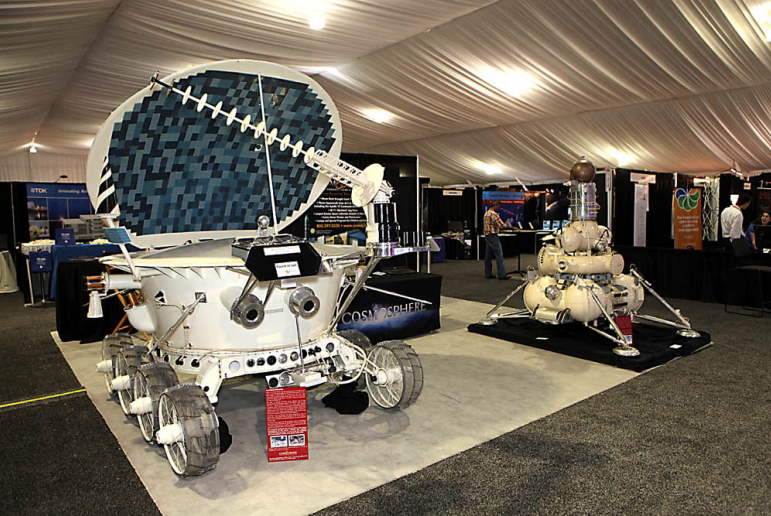
     A Lunokhod Rover from the Kansas Cosmosphere and Space Center on display at the Space Symposium.
    A Lunokhod Rover from the Kansas Cosmosphere and Space Center on display at the Space Symposium.

    One of the major changes concerns the GPS IRT (Global Positioning System Independent Review Team), which John Darrah and I co-founded in the Chief Scientist Office at HQ Air Force Space Command just over 19 years ago in May. We decided that in order to operate totally independently, the IRT needed to be administered by a truly autonomous organization, so the IRT was designated to be tasked by the commander of AFSPC. For a time, this was the Undersecretary of Defense for Space through the auspices of an FFRDC (Federally Funded Research & Development Corporation) think tank, known as the Institute for Defense Analyses or IDA. During the last 19 years the IRT conducted studies and helped solve thorny space issues, mostly related to GPS and PNT, for eight commanders of Air Force Space Command and for key officials in the Department of Defense. Our first chairman was none other than the late Dr. James Schlesinger, who previously served as chairman of the Atomic Energy Commission, director of the CIA, U.S. Secretary of Defense, and the U.S. Secretary of Energy. He also served and advised eight presidents, and at the time of his passing was serving (since 2007) as the chairman of the National Space-based Positioning, Navigation, and Timing (PNT) Advisory Board. The PNT Board is composed of recognized GPS experts from outside the U.S. government that advise the deputy secretary level PNT Executive Committee in its oversight management of the GPS constellation and its governmental augmentations.

    No sooner was the IRT formed under Dr. Schlesinger’s leadership than it was given a non-GPS or PNT-related task, and it proved to be a major task indeed. The task was to form a Broad Area Review panel for space launch and determine why the U.S. had, over the period of a few months, put more than $4 billion worth of space hardware into saltwater versus the vacuum of space. Since that original and subsequent BAR, the U.S. has not had a single complete launch failure in over 120+ launches, a record that cannot be claimed by any other space-faring nation and testament to the value of world-class, truly independent review teams that tell it like it is, warts and all.

    Dr. Schlesinger represented the caliber of people that serve on the IRT, which still exist today as an independent panel led by Major General (USAF, Retired) Robert Rosenberg under the auspices of the Independent Strategic Assessment Group, also administered by IDA and chaired by former Chief of Staff of the USAF and former head of IDA, General Larry Welch (USAF, Ret).

    The landscape and leadership are changing, but the National Security Space mission remains the same. Hopefully the national leadership will be able to adapt and perceive the current changes as opportunities – because while brilliant and intelligent leaders matter, people matter. Success should never be about personalities but rather about integrity, professionalism, and dedication – about doing the right thing and making the right decision every time.

    What Is Don Reading?

    Lindbergh_bookThis month I only have room for one important tome: Lindbergh by A. Scott Berg.

    I initially read this wonderful volume several years ago and enjoyed it very much. I read it again recently because of the Time and Navigation display at the Smithsonian that piqued my interest in all things related to time and navigation through the ages. Lindbergh’s first solo flight across the Atlantic Ocean was not a flight of fancy, but rather a flight of daring as well as one of historical significance from a world-class aviator. He did not take any over-water navigation classes until after the event! As the jacket states, “…here at last is the definitive life of one of the most legendary, controversial, and enigmatic figures in American history.” I hope you enjoy it as much as I did. Highly recommended.

    Until next time, happy navigating, and please make your plans now to attend the 31st Space Symposium in 2015. I hope to see you all in Orlando, Florida, at the ION JNC (Institute of Navigation Joint Navigation Conference) event later this month (June 16-19, 2014).


  • Space Foundation Report Shows Growth in Global Space Economy

    The global space economy grew to $314.17 billion in commercial revenue and government budgets in 2013, reflecting growth of 4 percent from the 2012 total of $302.22 billion, according to The Space Report 2014. The report was issued this week by the Space Foundation during the 30th Space Symposium being held this week in Colorado Springs, Colorado. GPS World Defense Editor Don Jewell is providing coverage from the symposium.

    Commercial activity — space products and services and commercial infrastructure — drove much of the increase. From 2008 through 2013, the total has grown by 27 percent. Commercial space products and services revenue increased 7 percent since 2012, and commercial infrastructure and support industries increased by 4.6 percent.

    Government spending decreased by 1.7 percent in 2013, although changes varied significantly from country to country. Substantial space budget cuts in the United States outweighed gains in Canada, India, Russia, South Korea, and the United Kingdom, all of which increased budgets by 25 percent or more.

    These new global space economic numbers come from the Space Foundation’s publication, The Space Report 2014:The Authoritative Guide to Global Space Activity, which was released today. Data was compiled from original research and a wide variety of public and private sources, and analyzed by Space Foundation researchers.

    Key Findings

    The 160-page book contains worldwide space facts and figures and is illustrated with photographs, charts and graphs. Within are myriad examples of the benefits of space exploration and utilization, the challenges facing the space sector, the opportunities for future growth and the major factors that shape the industry. In addition, The Space Report includes an overview of each sector, definitions, and up-to-date information on space infrastructure, facilities, launches and programs.

    Following are just some of the many interesting facts and analyses found in The Space Report 2014: The Authoritative Guide to Global Space Activity:

    Launches and Satellites

    • 81 launch attempts took place in 2013, an increase of 4 percent from the 78 launches in 2012 (and above the five-year average of 79 launches per year).
    • The majority of these launches were conducted by Russia (32 launches), the United States (19), China (15), and Europe (7).
    • After two years of conducting fewer launches than China, the United States rose again to second place, partly due to an increased operational tempo as U.S. commercial providers launched cargo resupply missions to the International Space Station.
    • New launch vehicles made their first flights (or first successful flights) in five countries–the Antares and Minotaur V in the United States, Soyuz 2.1v in Russia, Kuaizhou in China, Epsilon in Japan, and KSLV-1 (also called Naro-1) in Korea.
    • The number of satellites launched during 2013 increased by nearly two-thirds compared to 2012. This was largely due to a significant uptick in the number of satellites with masses below 91 kilograms (200 pounds). These microsatellites constituted more than half of the 197 satellites launched in 2013.
    • Many of the microsatellites were short-lived technology demonstrations, but there is a considerable degree of interest in future possibilities for constellations of small satellites that provide valuable services on an ongoing basis.


    Workforce

    According to U.S. Bureau of Labor Statistics (BLS) data, the size of the U.S. space workforce declined for the sixth year in a row, dropping 3.5 percent, from 242,724 in 2011 to 234,173 in 2012 (the most recent full year for which data is available) – a decrease of about 8,500 workers. However, the changes varied by sector, with some portions of the space industry growing while others contracted.

    The United States’ National Aeronautics and Space Administration (NASA)’s civil servant workforce remained essentially flat, declining by less than 1 percent to reach 18,068 in FY 2014. Although the workforce continues to become more concentrated at higher ages, NASA has experienced moderate success in recruiting and retaining young workers below the age of 35 during the past five years.

    Both Europe and Japan saw increases in space workforces; the European industry workforce grew by 1.5 percent in 2012, adding approximately 500 employees; in Japan, the overall workforce grew by 11 percent, while employment at the Japan Aerospace Exploration Agency (JAXA), Japan’s government space agency, dropped.

    The Space Foundation Index

    As of December 2013, the Space Foundation Index was 94.22 percent above its value at inception in June 2005. The Space Foundation Infrastructure Index outperformed the S&P 500 and the NASDAQ during 2013, while the main Space Foundation Index and Space Foundation Services Index did not perform as well as the NASDAQ, but substantially better than the S&P 500. These indexes, which are updated daily on the Space Foundation website, are easy-to-understand mechanisms for gauging the financial performance of space industry companies listed on U.S. stock exchanges.

    The Space Report is published annually by the Space Foundation, which works with a leading aerospace consulting firm, Futron Corporation, to research and analyze government and industry trends in space activity. The stock market analysis is provided by ISDR Consulting, LLC, a management consulting firm specializing in the space, satellite and technology sectors.

  • Governor Signs Colorado Space Bill at 30th Space Symposium

    Governor Signs Colorado Space Bill at 30th Space Symposium

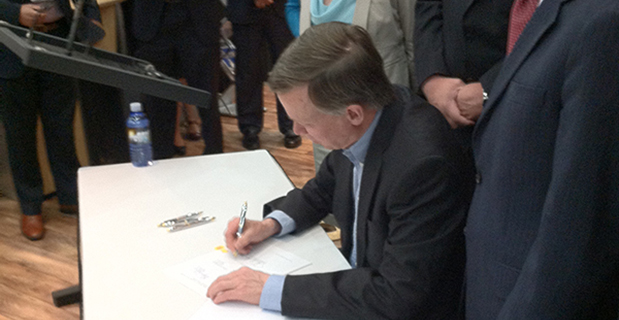
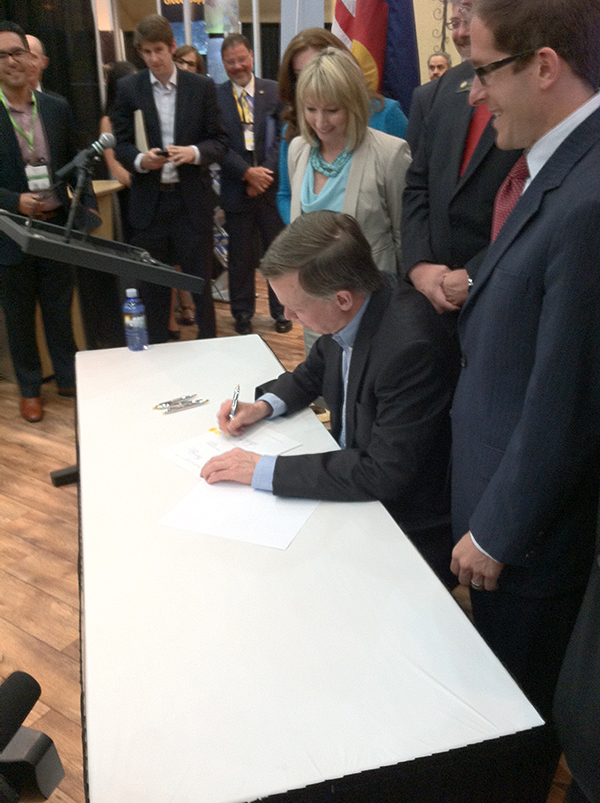
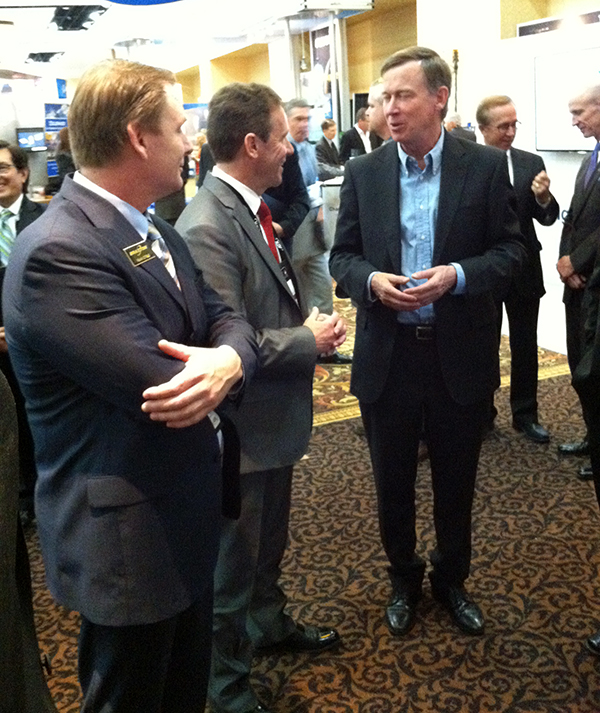
    Colorado Governor John Hickenlooper signs a space-friendly bill at the 30th Space Symposium in Colorado Springs.
    Colorado Governor John Hickenlooper signs a space-friendly bill at the 30th Space Symposium in Colorado Springs.

    Colorado Ranks Third in Space-Friendly States

    Governor John Hickenlooper (D) of Colorado made the trek from the statehouse in Denver yesterday to sign key space-friendly Colorado legislation at the 30th Space Symposium in Colorado Springs. The world’s largest annual space symposium takes place at the famed Broadmoor Resort in Colorado Springs and nominally draws a crowd of space aficionados and professionals, government and civilian alike, approximately 9,000 strong. Colorado House Bill #1178 is titled the “Sales And Use Tax Exemption for Qualified Property Used in Space Flight,” and it is hoped this legislation will help expand aerospace industry growth in Colorado. Spokesmen from the governor’s office and Tom Clark from the Colorado Space Coalition stressed that Colorado currently has the nation’s third-largest aerospace economy, and the new tax-exemption bill is part of Colorado’s strategic initiatives to support and grow one of its strongest industries. Indeed, Colorado Springs is known in government circles as the Home of Military Space. Several key space industry experts (both government and civil) present at the bill signing stated that the new tax exemption will add an important boost to keep Colorado ahead of the competition and further stimulate the state’s massive aerospace economy. Colorado is known as a national hub for geospatial technologies, remote sensing and satellite-based services. The space services and technology providers comprise the largest category of the state’s space economic activity, bringing in $6.3 billion in annual revenue. Currently, the Colorado space-based revenue is growing at a steady 8 percent annual rate. In conversation with Tom Clark, he admitted that in years past, Colorado has actually occupied the number-two raking for a state’s space-based economy, but was recently surpassed by Florida, which has similar tax-friendly legislation on the books. Clark was confident that with the new legislation Colorado would, like Avis, soon be number two again.

    Colorado Gov. John Hickenlooper discusses space matters at the 30th Annual Space Symposium with Braxton Chairman of the Board Kevin O'Neil and Braxton CEO Frank Backes.
    Colorado Gov. John Hickenlooper discusses space matters at the 30th Annual Space Symposium with Braxton Chairman of the Board Kevin O’Neil and Braxton CEO Frank Backes.
  • Cyber Warfare: Report from the 30th Space Symposium

    Report from the 30th Annual Space Symposium, May 19-22, Broadmoor Resort, Colorado Springs, Colorado

    For the past five years, the first day of the National Space Symposium — now known simply as the Space Symposium, the largest symposium of its kind in the world — has started with an entire day dedicated to discussions of the cyber domain as it pertains to the DoD and civilian industry. The annual event highlights presentations from the major civilian cyber players and the senior cyber commander for the DoD, military services and government agencies. Several of the now-senior military officers worked for or with me as junior officers at some point in the past, and while that is an age-related humbling experience, it also makes me proud of them at the same time.

    One major talking point, among many, is crystal clear: the U.S. government and civilian enterprises alike understand that cyber security is a critical mission and that cyber warfare, especially from a nation-state point of view, is a credible and viable threat to every government and civilian program and and to everyone today.

    Major General Kevin McLaughlin, currently the commander of 24th Air Force and AFCYBER, the major command that takes cyber warfare to heart as a major mission, is one of those young officers in my past that make me proud today. Kevin was the luncheon speaker, and he put the Air Force role for cyber warfare in perspective as well as explaining how the Air Force role is integral to the overall Defense Cyber Enterprise. This integration role may seem like a small matter, but General McLaughlin’s explanation of Air Force and DoD cyber and IA (Information Assurance) synergy is critical to the success of his organization and mission.

    This is critical because throughout my Air Force career and even today I constantly encounter commanders that are quick — too quick in my book — to explain, usually with great passion, why their particular mission(s) are critically important and “unique” to the Air Force writ large enterprise. Unfortunately, history shows us that “unique” organizations within services do not always fare well in budget scenarios, especially seques-castration budgets.

    In my humble but experienced opinion, the senior officers commanding these “unique” organizations, be they cyber or otherwise, would fare far better if they conformed to Air Force budget requirements and still conducted their day-to-day unique missions just like a fighter pilot and fighter sortie. By that I mean you never know what you will encounter on a fighter sortie. You never know what the enemy will throw at you but you can rest assured that any plan, no matter how well conceived, will not survive initial contact with the enemy. The plan always changes and will hopefully be successful, but only because of flexibility, which has been described as the key to air power, and certainly not because of the “plan.”

    So, I was assured when Gen. McLaughlin described “A Day in the Life of a Cyber Warrior” just as I would a fighter sortie. Prepare for the known threat and expect the unexpected. Be innovative and flexible, and you may win the battle and live to fight another day, because make no mistake about it, cyber warfare is a life-and-death struggle.

    Fortunately, there do seem to be solutions that work, and a key point that was made numerous times by various speakers is that the small, small, usually local cyber warrior company is often times much more successful than the security behemoths that tend to get bogged down in their own administrative minutia. One of the companies mentioned was NDP, a small cyber and IA company in Boulder, Colorado, known for its work slaying the cyber dragons attacking the well-known SBIRS (Space Based Infrared System) program. The story goes that NDP, with only 50 employees, took on major global SBIRS cyber and IA issues and made it look simple. It is always the real experts that make it look simple. The chairman of one of panels really put it in perspective when he opined, “Would you really want Raytheon or Boeing providing anti-virus software for your home computer? Probably not! No slight to the mega companies intended, but I would go with the local, flexible and responsive small company, like NDP, every time.”

    Thankfully, a lot of what I heard this year, as opposed to years past, conforms to the scenario I just described. Bad cyber actors (villains), local or nation state, are anticipated, and while the white-hat cyber warriors win more times than they lose, it is clear there is currently no panacea for cyber and IA threats — just hard work, diligence and flexibility to hopefully win the conflict.

  • The 29th Annual National Space Symposium: Better Every Year

    Neither rain, sleet, snow, hail, wind, nor dark of night will deter…

    Loosely Translated, Herodotus, Histories (8.98)

    …attendees at the 29th National Space Symposium from their appointed rounds.

    Seriously, folks, with apologies to postal workers everywhere, here in the Rocky Mountains it was 72 degrees on the eighth of April, the first day of the largest space symposium in the world. This morning, the ninth, the startled thermometer hovered around eleven degrees with snow, high winds and attendees searching for any outer wear they could find. And except for NASA (National Aeronautics and Space Administration) personnel, everyone braved the weather and soldiered on.

    NASA, of course, one of the few government agencies with space in its name, decided they did not need to attend the National Space Symposium this year. But that is NASA’s loss and a story for another time, because more than 9,000 other dedicated space professionals did attend, and more than 170 companies provided major exhibits that filled to capacity the largest pillar-less exhibition hall west of the Mississippi. Just writing this makes my feet hurt. And the best part is this all takes place at the five-star Broadmoor Resort in the foothills of the Rocky Mountains, hence Mother Nature’s raucous spring weather shenanigans.

    This is truly a watershed event for the global space community, and it improves every year. I have had the honor of attending 25 of the 29 National Space Symposiums, and as usual there are always a few major topics of interest that everyone wants to discuss. This year I can literally not walk ten feet without someone stopping me to discuss:

    1. The error-plagued GAO (Government Accountability Office) OCX (Next Generation GPS Operational Control System) report and subsequent regrettable sensationalized news reports
    2. The actual status of the OCX program
    3. Lockheed Martin’s GPS III program
    4. NavSat – Nee Parkinson’s NibbleSat – real or imagined
    5. Software-defined GPS receivers and GPS user equipment in general

    When it comes to opinions, informed or otherwise, concerning each of these topics, the resulting litany reminds me of the old saw about asking three psychologists to comment on a patient’s diagnosis, and you will invariably wind up with four opinions. But have no fear: I spoke directly with the prime companies developing each of these programs, and the following is straight from the horse’s mouth, or some other part of their anatomy as the case may be. You be the judge.

    GAO and OCX

    The Government Accountability Office, which historically is anything but, released a report on March 28titled “Defense Acquisitions: Assessments of Selected Weapon Programs,” in which it seems to claim that the original $886 million GPS OCX program awarded to Raytheon Information Systems in Aurora, Colorado, in February 2010, has grown by 43 percent and ballooned to $3.695 billion. In fact, the report does not actually say that exactly, but you have to dig deep to determine that. Most readers won’t take the time to do that and will assume that the OCX program is grossly over budget. It is not. In fact, to reach that extraordinary number, OCX cost overruns would need to have grown by 43 percent for each year since it was awarded, and that is ludicrous. According to Raytheon VP and OCX Program Manager Ray Kolibaba, the $3.695 billion number probably comes from including “…programmatic costs beyond OCX development costs and pessimistic projections from the government” that in my experience no acquisition agency, nor Congress for that matter, would ever include when determining true program cost adherence parameters. Such ancillary costs would certainly never be included in a Nunn-McCurdy-Sarbanes-Oxley-Graham-Rudman-Harry Potter fiscal responsibility evaluation.

    Speaking from personal experience, in 1990 I was appointed the very first Legislative Liaison Director for Headquarters Air Force Space Command. I had a small office and staff and spent most of my time on Capitol Hill meeting with congressmen and senators, where I advocated the latest space programs, and/or sat in on congressional hearings and then advised senior U.S. Air Force space officials on what budget and policy decisions they could expect from Congress. And I can tell you now, using the methods the GAO concocted to compile this report, I could cause any space program to come under close and unwarranted scrutiny. However, using time-tested congressional oversight rules of engagement (ROE), OCX has not come close to triggering any of the automated congressional watchdog cost overrun tripwires. The truth of the matter is OCX has grown in scope and schedule due in part to government change requests, mainly in the cyber and information assurance areas, along with affordability mandates due to schedule slips and sequestration. According to Stephen Moran, Raytheon mission solutions director, the true cost of OCX today is approximately $967 million, which means the total program cost to date has grown by approximately 10 percent, a far cry from the fictitious annualized 43 percent increase claimed by the GAO. While the GAO goes to great lengths to justify its inflated numbers, it is comparing or rather sensationalizing apples and oranges.

    Some may say, so what? Who outside of Washington D.C. reads or believes GAO reports? Unfortunately, Congress, the congressional staff and congressional budgeters read these reports, since the GAO is officially the investigative arm of Congress. In fact the GAO is an independent, nonpartisan agency that works for Congress. Often called the “congressional watchdog,” GAO investigates how the federal government spends taxpayer dollars. And many times they do a great job. But in this case they are wide of the mark. It would be a shame if Congress cancelled OCX because of a flawed or, at a minimum, a poorly explained report.

    Ray Kolibaba and Stephen Moran assured me during our talks at the 29th NSS that OCX was alive and well and on track to meet a re-baselined time and costs schedule. OCX Block One RTO should occur as planned in the first quarter of 2017 and will include the ability to launch and control GPS IIF and GPS III satellites and payloads, but not GPS IIA satellites and payloads. That mission, along with the responsibility for maintaining residual satellites, still falls to the LADO (Launch Anomaly and Disposal Operations) contractor Braxton Technologies, which is an OCX subcontractor to Raytheon.

    The bottom line is the OCX schedule has slipped and the budget has grown, but within historically acceptable parameters; certainly, it is not even close to triggering congressional oversight. However, having said that, in this budget sequestration environment, the overall GPS budget has taken some significant hits so that even the slightest cost overrun is of concern. Still, let’s hope that Congress makes funding decisions using actual historically acceptable numbers and not overblown rhetoric.

    LMCO and GPS III

    Keoki Jackson
    Keoki Jackson

    Let me say right up front that I really like Keoki Jackson and what he has accomplished on the GPS III program at Lockheed Martin. Keoki is the vice president of Navigation Systems, and as such heads the GPS III program. Keoki has an honest and open demeanor and just oozes integrity. He runs a very open program and, indeed, has extended an open invitation to me, wearing multiple hats, to visit the LMCO GPS III facility in Waterton, Colorado, to discuss GPS III anytime. Believe me, I have and will continue to take him up on his offer. To someone in my line of work, that confidence speaks volumes. Keoki obviously has supreme faith in his people, and is assured the GPS III program is on the path to success. I spoke with Keoki on Monday, April 8, as I toured the GPS III facility with him. He was like a father with pictures of his children. Happy, smiling, engaging — he could not wait to show off their latest accomplishments.

    My bottom line is this is a rare attitude among senior execs and PMs on major space programs. And that may be because so many of them are under congressional scrutiny. Not the case for GPS III, however. The back-to-basics GPS III program is on schedule and budget, and is set to deliver GPS III SV-01in May 2014, exactly six years after program award. The USAF has said it may not launch the first GPS III until April 2015, but that is a separate ground support and commanding issue. It has nothing to do with the schedule and availability of the GPS III satellites.

    Historically, LMCO-built satellites are some of the best in the world. According to LMCO statistics, and verified by yours truly, LMCO GPS satellite vehicles have accumulated more than 175 operational years on orbit with a reliability record better than 99.9 percent. Keoki also proudly pointed out that the Lockheed Martin heritage dates back to the production of the Oscar and Nova Transit satellites — programs that paved the way for the current GPS gold standard on orbit today.

    Now, don’t let the back-to-basics approach fool you. That just means sound, solid, proven engineering and management practices are employed, but the technology is anything but basic. The kingpin of the LMCO GPS III approach is an artifact known as the GNST, or pathfinder spacecraft. The GPS III Non Flight Satellite Testbed (GNST) gives everyone confidence that Lockheed is on the right track. The pathfinder goes through all the rigorous steps a flight article goes through, only it completes them first and allows LMCO personnel to find all those schedule-busting, expensive glitches that show up in any program. As Keoki said, “Our endeavor is to find any anomalies now before the satellites and payloads are on orbit.” The GNST, along with cutting-edge 3-D motion studies with avatars (an amazing story and teaser for another time), will hopefully allow a smooth transition for SV-01 through SV-09 when the program plans to initiate programmatic and hardware changes to allow for the first-ever GPS dual launch.

    This is a far different approach from the Boeing GPS IIF spacecraft and payloads, which experienced major anomalies on orbit for the first two SVs. Changes were made to subsequent ground space vehicles before launch, but the first two SVs on orbit are stuck with those anomalies. The LMCO approach hopes to eliminate or at least minimize that risk. If the full LMCO GPS III program comes to fruition, there could eventually be as many as 32 GPS III satellites in various configurations on orbit. Which means Keoki will probably be referring to GPS IIIs not as children but grandchildren, and he will need a much bigger scrapbook. Bottom line, GPS III is alive and well, on schedule and budget.

    NavSat or NibbleSat

    For those of you who have not heard about the NavSat or NibbleSat, it is a small GPS satellite endeavor by AFSPC, SMC, and AFRL to determine the feasibility of building a GPS-only small satellite, one without NDS, SAR, or any other auxiliary payloads. However, this is not solely a Weight Watchers program — it is about far more than a slimmed-down GPS. It addresses technological aspects of the GPS program as well as SWAP (size, weight, and power) issues that have plagued the GPS program since its inception.

    Since 1978 when the very first GPS satellite was launched, the program has grown in complexity and size with ancillary payloads, more signals, more power, and more flexibility, which all add up to a heavier, more complex satellite — and in space, where weight and complexity equal greater costs. GPS III has finally reached the point that it will cost nearly $450 million to place a single GPS SV and payload in orbit.

    As I said earlier, the GPS III payload may last 30 years, which equates to a sizeable return on your investment (ROE) for space assets, but in this constrained sequestration budget environment Congress is not looking down the road 30 years; it is barely able to consider the FYDP or the next five years’ development plan budget. So $450 million per GPS III on orbit is a big number. Even with dual launch, according to Lockheed’s Keoki Jackson (see above, “LMCO and GPS III”), from SV-09 forward the savings will only amount to about $70M per launch because it will require a larger launch vehicle. Certainly, $70 million is not a number to disregard, especially if you could build and launch a small GPS-only SV for that same amount. I know it sounds nearly impossible, but that is what the NavSat program hopes to achieve. To date, no less than 20 companies, U.S. and European, have expressed an interest in making NavSat happen. Most companies I spoke with are convinced it is not a technological issue, but a commitment and funding issue on behalf of the U.S. government. So what else is new? In my book, NavSat is a real possibility, and the recent plethora of BAAs (Broad Area Announcements) from SMC (Space and Missile Systems Center), AFRL (Air Force Research Laboratory), and SPAWAR (Space and Naval Warfare Systems Command) attest to that fact. Stay tuned for more.

    GPS Payloads, Receivers: Software-Defined and Otherwise

    It is a fact of life where GPS is concerned that when you talk about GPS technology, you are talking about ITT Exelis. There is not a single U.S. GPS payload on orbit today that was not built in whole or in part by ITT Exelis. There are few companies in the world today that can claim such a prestigious record for space assets that are arguable the best in the world. The ITT Exelis record of providing proven GPS payloads for 35 years is unequaled in the space arena, and the company continues to innovate and grow. So, it should come as no surprise that Exelis provided LMCO with the GPS payload for the GNST pathfinder mentioned earlier. The bottom line is, when it comes to GPS payloads, nobody does it better than ITT Exelis.

    Therefore, I took the opportunity to sit down with Mark Pisani, a vice president and general manager in the geospatial systems business at ITT Exelis, to discuss the recent $2.15 million contract award from AFRL to research navigation payloads to support the current GPS program and the NavSat program specifically. Mark stated that the technologies being investigated could easily translate to the entire GPS program.

    Mr. Pisani stated that over the next 18 months, the company will conduct research into potential methods to reduce payload size, weight, and power, and improve GPS signal strength and reception for disadvantaged users, especially warfighters, in either urban canyons or mountainous terrain. ITT Exelis is also working on new methods of tamper-proofing for its GPS reference and monitor receivers, which will deployed around the globe to ensure GPS accuracy for all global users. So it appears that where GPS is concerned, you name it and ITT Exelis is working some aspect of the program.

    NSS Wrap-up

    29NSS_Leadership_TopImage
    Space Foundation Leadership Team.

    NSS 29 is still in full swing as I write this. Indeed, my old friend and colleague in uniform, General William (Willie) Shelton, just gave his state-of-the-military-space-community address, and he did it in his usual exemplary manner. Few generals can match his grace and style. But to paraphrase Robert Frost, “…deadlines, time and tides wait for no man,” so I will wrap up with a few personal observations.

    As many of you have heard me say, year after year, the National Space Symposium is like no other space event in the world. It gets bigger and better every year, and this year events extended all the way to LMCO in Denver and to Broadmoor properties that have never been used for this event previously. The NSS agenda and speakers are top notch and international in nature. Just a sampling are George Nield, associate administrator for commercial space transportation at the Federal Aviation Administration (FAA), Jean-Jacques Dordain, director general of the European Space Agency (ESA), and Yasushi Horikawa, chairman of the United Nations Committee on the Peaceful Uses of Outer Space. Officials from commercial space leaders such as LMCO, SpaceX, Boeing, XCOR Aerospace, Sierra Nevada Space Systems, and others will also speak, while actress Sigourney Weaver, star of the Alien films among others, is the featured speaker at the Space Technology Hall of Fame gala tomorrow night. So there is literally something for everyone.

    Sigourney Weaver
    Sigourney Weaver

    I have known Elliot Holokauahi (yes, it is a mouthful) Pulham (CEO), Chief Chuck Zimkas (USAF, Ret) who serves as president of the Space Foundation, and Holly Roberts, the CFO, for many, many years, and they are always striving to make the National Space Symposium better every year; in my book, they have succeeded beyond anyone’s wildest dreams. Their zeal is combined with the dedicated support of Steve Bartolin, CEO and president of the Broadmoor. I first met Steve more than 25 years ago when he ran the famed Greenbriar Resort in White Sulphir Springs, West Virginia, the playground of congressmen and senators. Steve has always had a penchant for living in places that ended in Springs, as well as for perfect service, while going to great lengths to make sure his employees are happy and enjoy their work. It shows at the Broadmoor, which is a Triple AAA Five Diamond Resort, and has been for more than 20 years. Together, Steve’s commitment to perfection and the vision of the Space Foundation make the National Space Symposium not only the world’s largest but by far the best space symposium in the world today.

    Braxton Technologies Sets the Example

    Personally, I enjoy the exhibit hall and tend to spend most of my time there. The event along with the Cyber presentations lasts for four full days, but you cannot see and do everything in that time, which leads me a personal observation. Many of the vendors and exhibitors in the past several years have begun to offer refreshments in their booth space, to help draw in the huge crowds always roaming the exhibition floor. Some offer ice cream, coffee, even beer and pretzels, but personally I like what Braxton Technologies has developed. Remember, this is a Space Symposium, so Braxton decided to mount small-scale full working models of various satellites above their booth space and allow attendees to actually send wireless commands to control the satellites. You can sit at one of their control stations, see a real spacecraft commanding (TT&C) screen, send commands to the scale-model satellites, and watch the satellites react in real time.

    Now, Fred (I call him the model builder and engineer extraordinaire) is the one who built the majority of the models, and they are an excellent example of fine craftsmanship. Indeed, the first night there were some issues with one of the older models, and Fred stayed in the booth working the problem from closing time on Monday evening until 0700 on Tuesday morning. And his hard work paid off, because there is always a crowd around the Braxton booth waiting to control or just watch the satellites respond. The Braxton folks are very good at and very proud of what they do, and it shows. They automated GPS scheduling, on their own nickel last year, and this year offer a glimpse at the future of GPS mission planning. Plus, they have an application for unimproved aircraft landing sites around the world that is simply amazing.

    But, in the end it is watching the children, the future space operators and astronauts, who gather in huge crowds around the Braxton booth, waiting with thinly veiled anticipation to send a command to a satellite. It has been a long time since I was a child, but you should have seen the smile on my face when Fred allowed me to send a command and I could see the satellite model respond. Both Frank Backes, Braxton CEO, and Kenny O’Neil, Braxton president, and most of the Braxton employees are former space operators, and they have not forgotten the thrill of actually commanding satellites. Now they have made that thrill available for our future space operators. I think they hit it out of the park.

    There’s still time. Drop by the Braxton booth, speak with Fred, and send a command to a satellite. Oh, and you are allowed to smile!

    Until next time, happy navigating, and go fly a satellite!

  • Space Symposium, Partnership Council Offer Valuable Information

    As it happens April, May, and June are watershed months for space and PNT geeks every year. In April I was honored to attend the National Space Foundation sponsored 27th annual National Space Symposium held at the incomparable five-star Broadmoor Resort in Colorado Springs, Colorado, and in May, just last week I attended the 10th annual GPS Partnership Council at SMC (Space and Missile Systems Center) in Los Angeles, California. Currently I am planning my strategy and greasing the chain on the mountain bike for the sixth annual Space and Cyberwarfare Symposium in the beautiful mountain village of Keystone, Colorado, which is followed later in June by the Joint Navigation Conference, also in Colorado Springs.  I know this is really an incredibly tough June schedule, but somehow I will manage.

    Seriously, my purpose in telling you about these wonderful events is two-fold: number one, they are important events and number two, they are events you should attend if you are the least bit interested in space and especially PNT or GPS. All the events this year had/will have maximum time built in for networking with colleagues and businesses you may not come into contact with any other time during the year. You know that Executive VP for Space you have been trying to see for months? He or she will probably be attending one of these events. Take a shot.

    National Space Symposium

    The 27th National Space Symposium (NSS) just gets better and better every year. Yes, I know I say that every year, but it is true. I have had the honor of attending 24 of the symposiums and have witnessed phenomenal growth. This year there were more than 9,000 participants and yet it never really seemed crowded because the event encompasses the entire Broadmoor resort. There is so much happening that I will have to say this year, for the first time, I did not make it to all the events I planned. But I was able to network, and for a journalist as well as a business executive that is key. I see people at the Space Symposium every year that I never see at any other event probably because there is no other event in the world quite like it. The National Space Symposium is truly unique in its scope and venue and frankly this year I thought, also for the first time, that it could have easily continued for one more day. Then maybe I just might have been able to take in everything, albeit on the run. When you consider that a great many of the attendees start and end their NSS journey with trips to the nearby Rocky Mountain ski slopes, attendees and businesses would not really experience any more downtime due to the symposium adding an extra day, but hitting the slopes is sure is a great and unique way to start and end a business conference.

    NSS Exhibits

    There were more exhibitors this year than ever before, and some of the exhibits, especially the static displays, were phenomenal. For example, as I mentioned in my NSS blog in GPS World, on the first morning I was able to see and actually touch (before I saw the “Please Do Not Touch” sign, of course) the X-37B, the U.S. Air Force autonomous space vehicle. The USAF says the X-37B Orbital Test Vehicle, or OTV, is a non-operational system (an adjective conveying minimal veracity in my opinion) that demonstrates a reliable, reusable, unmanned space test platform. Indeed, on March 5, just five weeks before the 27th NSS, the USAF launched the second X-37B from Cape Canaveral, Florida.x-37b-W
    The OTV-2 launch comes on the heels of the successful flight of OTV-1, which made an autonomous de-orbit and landing at Vandenberg Air Force Base, California, on December 3, 2010, after successfully logging 224 days in space, something for which the current NASA manned space shuttles were never designed  and are unable to accomplish. According to USAF officials, post-flight analysis of OTV-1 revealed OTV-2 needed no significant changes, and the second X-37B flight is aimed at helping Air Force scientists better evaluate and understand the vehicle’s performance characteristics and expand upon the tests from OTV-1.

    The spacecraft measures more than 29 feet long and nine-and-a-half feet tall. Its wingspan is 14 feet, 11 inches, and it weighs approximately 11,000 pounds at launch. The objectives of the OTV program include space experimentation, risk reduction, and a concept of operations development for reusable space-vehicle technologies.
    x-37BThe X-37B OTV is America’s newest and most advanced re-entry spacecraft. Based on NASA’s X-37 design, the unmanned OTV is designed for vertical launch to low Earth orbit (LEO) altitudes where it can perform long-duration space technology experimentation and testing. Upon command from the ground, or as preprogrammed, the OTV autonomously re-enters the atmosphere, descends, and lands horizontally on a designated runway. The X-37B is the first vehicle since NASA’s Shuttle Orbiter with the ability to return experiments and surveillance sensors to Earth for further inspection and analysis.

    The X-37B OTV is a military autonomous space vehicle, and that is where the excitement resides. It brings back memories, from around 1959, of the promised but unfulfilled capabilities of the early Boeing Dyna-Soar or X-20 (yes, I spelled it correctly) space and atmospheric skipping vehicle and, well… just use your imagination. Early estimates are the X-37B OTVs could actually stay on orbit for more than a year if necessary. That sounds like a real time, persistent space surveillance platform/sensor to me, just to name one option among a list of many valuable military missions. I suspect we will be hearing about many more amazing feats and record flights concerning the X-37B or not; and because I attended the NSS I actually got to see the real article up close and personal…that alone was worth the price of admission.

    NSS Presentations

    Certainly the presentations at the NSS are not to be missed, but you have to plan your time carefully since there is so much to see and do. Just roaming the halls of the multiple exhibition areas (four this year) is an education in itself, and you just never know who you are going to run into. Former and current astronauts abound, and senior officers from all services will freely stop and chat with you about the various exhibits and their pet programs. Treat them to beautifully hand scooped ice cream at AGI or a hot Italian Cappuccino at the LMCO booth and who knows what you may learn.

    National Strategic Infrastructure versus LightSquared
    480px-Gen_William_L_SheltonAs I mentioned in my NSS blog, the whole event, both the Cyber and the Space Symposiums, were kicked off by my old friend and colleague General William L. Shelton, the commander of Air Force Space Command. General Shelton tends not to be long winded — in other words, his
    speeches are brief and to the point, and historically right on target. His presentations at the Cyber and Space symposiums were no exception.

    General Shelton took on the new and emerging cyber threats, the future of space with a flat or declining national security space budget, and of course the imminent national GPS threat from LightSquared. As the steward of GPS and as a warfighter himself, General Shelton is the only four-star officer from any service that has manned up, stood tall, and been counted on the LightSquared issue, which is an ominous harbinger (pun intended) of a possibly disastrous future for our warfighters and first responders (see PDF report) — actually, it poses a threat for all GPS users in the U.S. The LightSquared debacle is led by a Luddite administration where no one has the guts to tell the commander-in-chief he has no clothes, or a clue for that matter, when it comes to military or first-responder PNT related technology. Just ask Seal Team Six how important GPS and all the capabilities that GPS enables was to their successful mission taking out Bin Laden. But of course this administration has a history of denying critical PNT-related support to the national strategic infrastructure. Just think back to the eLORAN fiasco, and now there is the LightSquared debacle with the potential catastrophic denial of GPS signals across the United States, or you may wish to refer to it as FCC-sponsored nationwide GPS jamming as I have often heard it described.

    In my opinion, the whole LightSquared issue is ludicrous and borders on the criminal. If LightSquared and inept FCC commissioners, who can’t spell space, have their way, our warfighters and first responders will not be able to train the way they fight in the U.S. or for that matter “… defend the United States against all enemies foreign and domestic…” which, to the best of my recollection, they are sworn to do, and LightSquared would cripple that ability. And this is how the loss of GPS signals across the United States applies to you and me on a daily basis. When you are having a medical emergency, say a major coronary, the short-staffed paramedics will no longer be able to find your home in time to save your life, and the undermanned fire department won’t arrive until your home has burned down or the over-burdened police department won’t arrive until the burglars are long gone, because they will be too busy looking at outdated paper maps trying to determine where you live. And don’t get me started on undermanned FAA control towers, the potential loss of next-gen, GPS enroute navigation, approaches, departures, and sleepy overworked controllers. The entire future of the FAA and our air travel in the U.S. is based on satellite navigation and in the U.S. that means GPS. That is now at risk plus the millions of dollars and jobs that will be lost because of LightSquared. GPS is and always has been a recognized force multiplier and without it critical service providers across our nation will become even more short-handed. and he U.S. could loose over $100B in revenue annually. All so young people, who are mostly too young to vote Mr. President, can have a broadband signal to browse the Internet and play games in the middle of Kansas, or of course the all-important ability to download, read, and comment on those Congressional Bills awaiting the President’s signature…just another promise by candidate Obama that has never materialized. Don’t hold your breath. Write your congressman now.


    LightSquared Webinar Set for May 26, 10 a.m. PDT

    A panel of experts will discuss findings contained in the May 15 status report by the FCC Technical Working Group on LightSquared/GPS Interference Issue. The TWG’s third report is anticipated to include at least some testing results of GPS receivers under LightSquared conditions: terrestrial transmitters in the L-1 Band (1525 MHz–1559 MHz) immediately adjacent to the band (1559–1610 MHz) where GPS and other GNSSs operate. Webinar panelists will represent the high-precision sector, aviation, consumer handsets, and timing infrastructure. Register today.


    NSS Speakers

    Alas, I digress, so let’s step off the soapbox momentarily and move on to more positive happenings at the NSS, but you haven’t heard the last of LightSquared. If only we were so fortunate. Onto the outstanding agenda of presentations… There were almost 100 speakers at this year’s Space Symposium, and if you count the Cyber Space presentations there were well over 100 speakers, some with topics more interesting than others of course, but all the presentations I attended were professional and at a minimum engaging and focused on the future of the space enterprise. Unfortunately you could not go more than five minutes without a speaker expressing his or her opinion, or someone asking your opinion, about the LightSquared debacle. At least I can say that regardless of the opinions, they were certainly passionate.


    Bottom Line At The End: BLATE

    So the bottom line on the NSS is if your interests, personal or business related, are in the National Security Space arena, then the NSS is the place to be. A time-sensitive agenda with interesting and high-level presentations, exhibits from the world’s leading space companies, networking opportunities that are second to none, and all in a venue that King Arthur would love. Truly the Broadmoor accommodations, the courteous and professional staff, the excellent cuisine, and the breathtaking views are second to none. Plan now and see what all the fuss is about at the “Premier Gathering of the Global Space Community,” the 28th National Space Symposium, in the foothills of the Rocky Mountains, April 16-19, 2012.

    GPS Partnership Council

    Fast-forward a mere two weeks and now we are attending the AFCEA (Armed Forces Communications and Electronics Association) sponsored 10th Annual GPS Partnership Council at SMC, Space and Missile Systems Center, at Los Angeles Air Force Base in California. This event, which was successfully and artfully resurrected four years ago by the then GPS Wing Commander, Colonel David Madden, has carried on under the auspices of Colonel Bernie Gruber, the current director of the newly designated GPS Directorate. Managerially sponsored by the local AFCEA chapter with funding provided in the most part by numerous GPS primes and their sub-contractors, this is a first-class event you need to attend if you are a hard-core GPS groupie. The folks at AFCEA ably aided by Colonel J.B. Borris (USAF Reserves), the indomitable event chairman for four years running, and his team — especially this year’s narrator extraordinaire, Captain Tiffany “Tupperware” Ware, who fortunately had a great sense of humor, which certainly comes in handy with this crowd — put on another memorable council. Frankly, even though I fondly remember the old GPS Partnership Councils, pre-Madden, they do not hold a candle to the content and professional first-class events of the last four years. If you are a military, civil, or commercial GPS/PNT professional, or work in a GPS-related industry, then the GPS Partnership Council in Los Angeles is where you needed to be last week, and it is never too early to plan for next year’s event in May 2012. One old-timer I overheard explaining this event to a newcomer said it this way: “Think of this as a joint military, inter-agency, civil, and comm
    ercial get-together of GPS subject matter experts.” That works for me.

    While the venue is two hours west by fast jet and about 6100 feet lower in altitude than the NSS, the same professionalism still prevails. Of course this event is GPS centric and since GPS is so ubiquitous in our everyday lives, we should all take note of the news coming from this important event. While it is only 1/45 the size of the NSS, it is no less important to those who depend on GPS as their raison de vivre. This years’ theme was “Executing Modernization…Enabling New Paths and Beyond.” However, I enjoyed General Robert Rosenberg’s comment, during his rousing remarks relating to the way ahead in a fiscally restrained environment, that the theme might more appropriately be taken from one of Winston Churchill’s famous quotes during WWII, “Gentlemen, we have run out of money. Now we have to think.”

    The speakers at this years’ event, especially General Rosenberg, were on the whole outstanding from the introductory comments by Lt. Gen. Tom Sheridan (USAF), SMC/CC, who will be hanging up his military spurs later this month, encouraged us all to have a good time and left us with a quote from the International Academy of Astronautics, which has declared that to date “GPS is the space program that has proven the greatest human benefit in the history of space.”

    Just after General Rosenberg’s wonderful invigorating and thought provoking lecture, and yes he included the LighSquared debacle, a very senior and well-known member of the audience, who was speaking to me as a colleague and friend and not as a journalist, so I will respect his wish for anonymity, expressed his dismay that… “a private for-profit company should be allowed to wreak such havoc on our critical national infrastructure… it is simply criminal. Why doesn’t someone in the military speak up? What is wrong with this administration? Do you think the President is not aware of the potential devastation he has wrought? This whole LightSquared issue just makes me ill.” I could not have said it better.

    Warfighter Panel

    While it was great to hear about the proclamation by the International Academy of Astronautics, the awesome warfighter panel presentation on the last day of the GPS Partnership Council was in my opinion the highlight of the event. To see and hear how the panel of Army Rangers, Navy SEALs, USAF Special Operators, and USAF aviators and others actually use GPS not only to accomplish their missions but to save lives every day is exciting. The warfighter panel provided feedback on how warfighters’ lives depend on GPS, and as a former warfighter the moving presentations made my chest swell with pride and brought a tear to my eye. These young men and women are going in harm’s way and they deserve the best equipment and support we can provide. At the end of the day the warfighter panel received a much-deserved standing ovation and I was proud to be in the audience. I hope they caught it on video so you can all experience it someday. Emotions were running high to say the least.

    Extras + Networking

    Just as during the NSS, the networking opportunities at the GPS Partnership Council were abundant and rife with potential. Plus fun was had at the biggest networking opportunity of all, the annual golf tournament, where you get to rub shoulders and compare bogies, with a who’s who of the GPS community; plus the now traditional libation-fueled networking event at “Shade” was a fun time for all who attended as well.

    Exhibits

    Certainly the exhibits at this event are at a minimum, but the companies that do exhibit have a very interested, attentive, and GPS-educated audience. If I were running a GPS/PNT/GNSS centric company, I would definitely want to be there as an exhibitor, because 100% of the audience is greatly interested in what you do. While current exhibit space is somewhat limited, there does appear to be room for expansion if needed. The biggest challenge at this event is a common one in California and that is parking, but there was a plan and it worked well as far as I could determine. I did not hear any complaints.

    Boeing II-F Factory Tour

    Since you are attending a GPS event at the home of GPS acquisition, opportunities for additional information abound with the large prime contractors in the area that support GPS, and this year as in the years past we were able to take advantage of that circumstance. This year wearing a slightly different hat I, and several of my think tank colleagues, visited with Ken Torek, the vice president for Navigation and Communications Systems & Space and Intelligence Systems, and his staff, which included Jan Heide, the new Boeing GPS Program Director, at the new Boeing GPS II-F facility in El Segundo, California. We were given the VIP treatment and were able to see IIF satellite vehicles three through seven, all in various stages of completion on the innovative, labor, and cost savings Boeing Pulse Line. In this configuration the satellite comes to you in a fashion that would make Henry Ford proud. While on our tour we learned that SV IIF-2 has already been shipped to Cape Canaveral, Florida, for a launch scheduled sometime in July. We also learned this will most likely be the only II-F launch in 2011. Since there are 31 active satellites on orbit, with three residuals and one in standby mode, the launch schedule has been moved to the right with the lack of urgency resulting in one GPS launch per year for the foreseeable future. Barring a catastrophic event on orbit, this will most likely be the future of GPS launches for the life of the II-F program. As previously predicted we will most probably witness several IIIA launches (built by LMCO) before the II-F launches are complete. My hat is off to Boeing for a great afternoon of briefings and tours, plus here’s hoping for a successful IIF-2 launch in July.

    PRNs and Accuracy

    During the council the USAF and DOT announced that they would be removing the PRN-1 number from SVN-49 (the one with spurious signals that has been placed in standby mode) and releasing the test PRN for use with IIF-2, that when launched in July will utilize PRN-1 while it is being checked out. Once operational, another PRN will be assigned that will be especially helpful for precision users (surveyors and such). Since the ground command and control system cannot currently handle more than 31 PRN’s, for reasons not appropriate to this venue, (a problem that will supposedly be fixed by OCX in 2015) this means that SVN-49 will be placed in residual status for now and in all likelihood also means another SV will be placed in residual status as well, bringing that total number to five SVs in residual status. When I checked this move with other sources they were quick to assure me that this does not mean they have given up on SVN-49 and indeed they hope to find a way to make it a fully functioning member of the GPS constellation in the years to come. No timetable for that move obviously. But I was assured they are still working the issues.

    Since the single on orbit instance of the II-F SV is proving to have an extremely accurate clock, hopes are that IIF-2 will follow by broadcasting a more accurate timing signal, which translates to more accuracy on the ground. Remember from MEO one nanosecond of timing accuracy equates to one foot of position accuracy on the ground.


    Another Civil Focus Day?

    Colonel Gruber announced that General Shelton, the current AFSPC/CC will more than likely follow in the footsteps of General Kehler, the former AFSPC Commander, and announce a follow-on Civil Focus Day most likely to be held at Air Force Space Command sometime this year. The first resurrected event of it’s kind in about ten-years, it was a big success in 2010.

    <e
    m>GPS-IIIA: OCX Updates and the Gap

    Colonel Gruber provided us with an update on the GPS-IIIA program by Lockheed Martin, which is on track for the first GPS IIIA launch sometime in 2014, and an update on the Raytheon OCX program, or new GPS ground Command and Control system, due to be operational sometime in 2015. While Colonel Gruber is happy with the way both contracts are progressing, in my opinion we still have the famous “gap” that everyone goes out of their way to explain is not really a gap, but in new government speak as proclaimed by a pundit from the stage during the National Space Symposium, what we really have is “negative operational margin.” But seriously it is still a gap, no matter how you characterize or spin it and one that still needs to be closed. And yes I know all about the plan to fill the “gap that doesn’t exist” with the new LCS (Launch and Checkout System). While I don’t object to LCS per se, I do object to the way ahead as currently envisioned by SMC. There is in my opinion an extremely clear way ahead for LCS; why not use the same incredibly reliable, low risk, and very affordable independent LADO (Launch/Early Orbit, Anomaly Resolution, Disposal, and Operations (LADO) System, built by Braxton Technologies, that the USAF used for the IIA, IIR, IIRM, and IIF SVs and is the only technology that allows us to operate residual satellites today? Can you say past performance matters? Can you understand excellence and low risk are key performance parameters? Alas, on this issue the acquisition community for some reason beyond my ken cannot, and now the politicians and cost accountants are involved. Indeed, it has become the dreaded forest for the trees sort of issue. I’ll do my best to keep you updated. And I would very much like to say that surely reason, logic, and common sense will prevail, but then I inevitably think about the LightSquared debacle and I am not at all sanguine about filling the gap, excuse me, the negative operational margin, in a logical or timely fashion with the current plan in place. For the same reason I am not sanguine about the U.S maintaining GPS as the Gold Standard for the world. Can you spell insanity? L I G H T S Q U A R E D or just abbreviate it as F C C, take your pick.

    Constellation Update

    Colonel Gruber’s constellation update read like this (comments are mine):

    Status of the Enhanced 24 GPS Constellation

    • 35 total GPS satellites on orbit (Most ever on orbit)
    • 31 total GPS satellites set healthy (Max for AEP)
    • 3 residual GPS satellites (enabled by LADO)
    • 1 standby GPS satellite (SVN 49)
    • IIA – 11 GPS satellites on orbit (average life 16 years, oldest 20 years)
    • IIR – 12 GPS satellites
    • IIR (M) – 7 GPS satellites
    • IIF – 1 GPS satellite

    It was a very uplifting and “good news” presentation right up to the point where someone in authority hinted that the entire GPS Modernization effort being briefed by Colonel Gruber was in danger due to the LightSquared debacle. Do you sense an underlying theme?

    GPS Hall of Fame

    At the end of Colonel Gruber’s presentation we all had a nice surprise when he inducted the distinguished aerospace engineer  William (Bill) Feess from Aerospace Corporation into the GPS Hall of Fame. Bill has been a stable and guiding force at Aerospace for the last 48 years with many of those years spent in the GPS arena dating from the 621B era. A well-deserved honor for Bill and the Partnership Council was the perfect venue for the award.

    Rockwell Collins

    During one of the numerous networking breaks I ran into Trevor Overton the Principal Program Manager for Surface Navigation Programs and Government Systems at Rockwell Collins, the company that produces the DAGR or Defense Advanced GPS Receiver. Rockwell Collins had a large booth and display, as they do every year and they were well represented in the DAGR and micro-DAGR arena by Gina Krug who serves as the Principal Account Manager for Precision Navigation and Government Systems. Mr. Overton is the one that got my attention however because somehow his title translates into the engineer who is in charge of the embedded side of the GPS operations at Rockwell Collins and he let me know rather quickly and in no uncertain terms that he had nothing to do with the handheld DAGR but worked solely with embedded systems. Then he showed me the fruits of Rockwell’s latest endeavor, the MicroGRAM, a new embedded GPS with GPS SAASM (v3.7) chip that area wise is about the same size as an SD chip, 19 mm sq, but about three times as thick since it is built with 90 nanometer technology. It has solder points for embedding on a systems board by OEMs (original equipment manufacturers) and is 12-channel capable. However, it was the near SD size that intrigued me. While embedded works and I hope they sell a ton of them, being able to slide this GPS + SAASM chip capability into an SD slot on any device with an SD slot, an antenna and a display is very appealing and constitutes a capability the war fighters have been asking for and could benefit from today; but Rockwell tells me there would be significant security issues with this approach. More on this chip in a later article when I have had a chance to visit Rockwell Collins and see what the future holds. Iowa in the Spring sounds doable.

    GPS and Seismology

    There was a very interesting briefing on what is now known as the Tohoku earthquake and tsunami in Japan. Seismologist have apparently settled on a 9.0 rating on the Richter scale, which is the fourth largest earthquake on record since 1900, with enough power was generated to power the entire planet for 40 years if someone could figure out a way to harness all that raw power. The Tohoku earthquake and tsunami are catastrophic events that Japan and the world will long remember. Undoubtedly there will be lessons learned, especially in the nuclear power plant protection arena. In the briefing at the GPS Partnership Council, we learned that Japan had prepared as best they could from a geodetic warning point of view by building more than 1,000-networked GPS receiver sites known as GEONET. It was hoped that GEONET would provide warnings of cataclysmic seismic events, but the system experienced a real-time telemetry failure, as in it is hard to transmit when your antennas are under a hundred feet of seawater. However, now critical GPS data from the event are being retrieved and processed so there are still valuable lessons to be learned even in a post-processing environment. One of the most impressive graphs of the data shows that just prior to the tsunami the GPS monitoring stations around the Sendai area of Japan actually shifted to the east by four meters. I was shocked by that information. You might expect four centimeters or four inches of movement but four meters represents an event of catastrophic proportions in the seismology world, and indeed we have all seen the results on the nightly news. Obviously the GPS seismology data is crucial to future earthquake planning and even to earthquake-proof building codes around the globe. Consequently, in the future in Japan and in the Unites States we can expect to see GPS used co-seismically as a real-time monitoring and warning tool. The question is how do you make the seismology warning system survivable to a four-meter (~12 feet) physical displacement and able to survive a 125-foot wall of seawater moving at jet speeds?

    Garmin Has a Deal for You

    During another of the networking breaks I was introduced to Rick Evans, a former Marine, who serves as the business development manager for government and law enforcement at Garmin, in Olathe, Kansas. Since Garmin does not have a designated military division, this is as close as it gets. It is a
    well documented fact (we have a database of more than 8,000 responses to surveys and interviews) that a huge majority (>95%) of our warfighters use Garmin or other civilian, commercial equipment in theater because it works, meets their needs in a non-jamming environment, and has a very user-friendly interface. I plan to follow up with Rick and possibly visit Garmin, but I want to pass on a bit of interesting and valuable information to our warfighters and first responders. If you fit in either of those categories, there is a website just for you that allows you to order Garmin equipment at a considerable discount. But again it is only for warfighters and first responders/law enforcement, and you can find it at Strohman Enterprises. More on this at a later date. Let me know how this works for you if and when you order from this site.

    Future Events

    I’m running out of airspeed and space but I do want to mention two upcoming Colorado events I will be attending in June and you should attend if you are interested in GPS and the warfighter or from a first-responder perspective. The first event is the Space and Cyberwarfare Symposium in Keystone, Colorado, June 14-16. This will be the sixth year for this up-close-and-personal gathering of space and cyber experts. This year’s theme is Space and Cyberspace Innovation: Leveraging the Enterprise to Win the Joint Fight. And of course today it is all about the joint fight. Even the Seal Team Six raid in Pakistan was a joint endeavor. I’m sure we will hear more about that at the Symposium.

    My favorite parts of this symposium are the small size and the access you have to senior decision makers who are far away from their office and phones and able to relax in the Rocky Mountains. There are extended networking sessions between briefings that provide you with plenty of opportunities to connect. Plus, do you know how much farther a golf ball flies at 10,000 feet? It really makes a difference. So you can probably predict my next favorite features are the venue and the people involved. This professional and educational yet relaxed atmosphere event is very well put together and you will be happy you attended. Come join me as I ride my mountain bike alongside the roaring Snake River — with GPS attached of course. Hope to see you there.

    ION

    The next event is the annual ION (Institute of Navigation) and JSDE or Joint Services Data Exchange co-sponsored Joint Navigation Conference (JNC), which will be held in Colorado Springs, Colorado, this year and next. This year’s FOUO events take place June 27-30 at the Crown Plaza Hotel, while the classified session on June 30 takes place at the Elkhorn Conference Center located on Ft. Carson in south Colorado Springs. According to ION officials, this year’s JNC will be the largest U.S. military navigation conference of the year, with joint service and government participation. The event will focus on technical advances in positioning, navigation, and timing (PNT) with emphasis on joint development, test, and support of affordable PNT systems, logistics, and integration. From an operational perspective, the conference will also focus on advances in battlefield applications of GPS, critical strengths or weaknesses of fielded navigation devices, warfighter PNT requirements and solutions, to include navigation warfare. Plus the classified warfighter panel on June 30 at Ft. Carson (USA) should be enlightening because the warfighters are free to speak in a classified environment (SECRET) and relate details and experiences that would not be possible in a public forum. So go online and register today and don’t forget to have your security manager send your clearances and join us for the warfighter panel.

    So June looks like it is a busy month for PNT professionals. I hope to see you all in the Rocky Mountains. Until next time, happy navigating.