Tag: Spectratime

  • Orolia delivers its first low SWaP-C miniaturized rubidium oscillator

    Orolia delivers its first low SWaP-C miniaturized rubidium oscillator

    Photo: Orolia
    Photo: Orolia

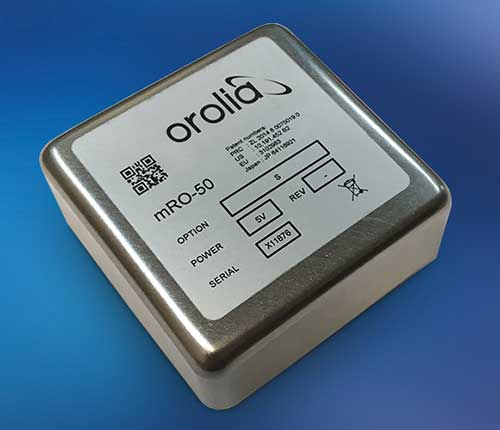
    Orolia has introduced a low SWaP-C miniaturized rubidium oscillator, the Spectratime mRO-50, designed to meet the latest commercial, military and aerospace requirements where time stability and power consumption are critical. The oscillator is low SWaP-C — size, weight, power and cost.

    The Spectratime mRO-50 provides a one-day holdover below 1 µs and a retrace below 1 x 10⁻¹⁰ in a form factor sized 50.8 x 50.8 x 19.5 millimeters. It takes up only 51 cc of volume — about one-third of volume compared to standard rubidiums — and consumes only 0.45 W of power.

    he Spectratime mRO-50 miniaturized rubidium oscillator provides accurate frequency and precise time synchronization to mobile applications, such as military radio-pack systems in GNSS-denied environments. Its operating temperature of -10°C to 60°C (military version extends to -40°C to 75°C) is also suitable for UAVs and underwater applications.

    Orolia is a leader in space-based atomic clocks and high-end crystal, rubidium, hydrogen maser and integrated GPS/GNSS clocks. The company also provides testing instruments for space missions that rely on high precision atomic clock technology.

    Orolia’s Atomic Clocks team received the 2019 PTTI Distinguished Service Award in January for advancing the state of the art in high-stability atomic clocks and producing the only space-based passive H-maser in the world, operating on all Galileo satellites. Spectratime mRO-50 is the latest technology solution from this award-winning team.

    “Through Orolia’s continuous commitment to innovation, we are proud to offer our customers more precise PNT data in a cutting-edge, lightweight form factor for mobile missions,” said Orolia’s Atomic Clocks Product Line Director, Jean-Charles Chen.
  • Orolia to acquire Talen-X to enhance Assured PNT offerings

    Orolia to acquire Talen-X to enhance Assured PNT offerings

    Orolia, a resilient positioning, navigation and timing (PNT) company, has entered into a definitive agreement to acquire Talen-X.

    Talen-X is a U.S. technology innovator with the ability to characterize, enhance and implement advanced techniques and products to solve real-world GNSS vulnerability problems. It has expertise in GPS/GNSS performance, requirements, testing, integration and threat mitigation.

    Orolia has completed 10 acquisitions since 2007, including Spectracom, Spectratime and McMurdo brands. The transaction is subject to customary closing conditions and approvals required by the U.S. Defense Security Service (DSS) and the Committee on Foreign Investment in the United States (CFIUS).

    Through this acquisition, Orolia said it will significantly enhance Assured PNT capabilities across the global company’s portfolio to support mission-critical applications. The additional resources also strengthen Orolia’s commitment to serving the U.S. government, with further expansion of domestic capabilities and a greater U.S. footprint. Toward that end, the companies will reinforce their commercial cooperation to maximize market awareness and access.

    “Military personnel know that accurate and trusted time and position information is a critical enabler for almost all warfighting functions and systems,” said Orolia CEO Jean-Yves Courtois. “Reliable PNT data are critical for communications, sensors, network synchronization, situational awareness, command and control or search and rescue missions. This acquisition reinforces Orolia’s position as a major supplier of Assured PNT technology and enhances our ability to offer unique end-to-end solutions.”

    Talen-X has extensive technology integration and PNT engineering resources that will enable Orolia to rapidly develop and offer new, superior products and services to the U.S. market.

    “Our culture of innovation, together with our demonstrated testing capabilities, will complement Orolia’s global technology expertise and significantly enhance the reliability, performance and safety of military operations,” said Tim Erbes, CTO of Talen-X.

    Key terms of the transaction were not disclosed.

  • Spectratime launches Force 2020 atomic clock for defense

    Spectratime launches Force 2020 atomic clock for defense

    The Spectratime Force 2020 Rubidium clock is designed for the defense market.
    The Spectratime Force 2020 Rubidium clock is designed for the defense market.

    Spectratime, a provider of high precision atomic clocks and a business of the Orolia Group, has launched the Force 2020.

    The Force 2020 is a rugged, anti-vibration, GPS/GNSS-lockable, ultra-low-noise Rubidium atomic clock for highly dynamic defense platform applications.

    According to Pascal Rochat, managing director of Spectratime, “Next-generation defense airborne radars, drones, helicopters, secure shipboard and radio communications systems use high K-band frequencies which require ultralow noise performance. In tactical missions, ultra-low-noise performance can only be minimally degraded during exposure to dynamic vibration and high-g environments to maintain the integrity of the battlefield systems. Spectratime’s Force-2020 rubidium atomic oscillator is perfect for such critical applications, and thus we are currently working with large defense contractors to integrate our new product into their highly dynamic defense platform systems.”

    Product features

    • Output frequency up to 500 MHz
    • Can use the patented SmarTiming+ technology, disciplining an external SAASM or a non-SAAMS GPS or GNSS 1PPS reference up to 100,000 seconds with an auto-adaptive loop time operating at 1-ns resolution
    • State-of-the-art frequency and timing signal stability performance
    • Integration of an ultra-low-noise OCXO oscillator with optional low g-sensitivity and a single or dual vibration-isolated tray for the OCXO and/or the Rb oscillator to meet various dynamic application requirements.
  • Spectratime Atomic Clocks Selected for Eight Galileo Satellites

    Spectratime, a provider of atomic clocks and a business of the Orolia Group, has announced it has been selected to provide the Rubidium atomic clocks and passive hydrogen masers for eight satellites for Europe’s Galileo GNSS. Spectratime expects this Authorization to Proceed will lead to a final contract for the manufacture of these two types of high precision clocks, estimated at 14 million euros, by summer 2012.

    “This new authorization to proceed, just a year after the signing contracts totaling nearly 20 million euros for the supply of the clocks for the first 14 operational satellites for the Galileo satellite navigation system, confirms Spectratime’s position as a world leading supplier of space atomic clocks,” said Jean-Yves Courtois, CEO of the group. “Each satellite carries on board two rubidium atomic clocks and a passive hydrogen maser, the most stable type of atomic clock in the world. In a few years, after the execution of the contract, which will be implemented in partnership with Astrium and Selex Galileo, we will have the most currently active atomic clocks in space, including 72 for the Galileo system alone.”

  • SpectraTime Awarded Contract to Improve Rubidium Atomic Frequency Standards

    SpectraTime, a business of the Orolia Group, today announced it has been awarded a 1M€ contract to improve rubidium atomic frequency standards (RAFS) as part of the European Global Navigation Satellite System Evolution Program.

    Pascal Rochat, SpectraTime Managing director and founder, said, “We are pleased to continue to push the performance limits of space-based precision clock technologies to enable new applications in the future. The knowledge gained through this investigation will be invaluable. As a result we expect all our customers to benefit from this work as our commercial products are derived from the same design and manufacturing process as our space-based clocks.”

    Atomic clock standards are critical for high-precision applications such as global navigation satellite systems. While the current Rubidium-based atomic frequency standards meet the requirements of current systems, future applications will demand a higher level of performance for short-term and long-term stability, SpectraTime said. Recognizing the need to continue to extend this technology to new performance levels, the European Space Agency (ESA) has turned to SpectraTime, the existing supplier of atomic clocks for the Galileo satellites and other GNSS satellite systems.

    “The award of this new development contract illustrates the European Space Agency’s confidence in our technology and confirms our global leadership role in the supply of precision atomic clocks for navigation applications,” said Jean-Yves Courtois, CEO of the Orolia Group. “Not only will this ensure our competitiveness into the future for the European space market, it will benefit our entire portfolio of programs and customers and secures our leading position in navigation applications.”

    The contract is for a detailed investigation of the current design, manufacturing, assembly and test techniques for fully integrated rubidium clocks in order to achieve a new standard for space within two years. It adds to SpectraTime’s wide portfolio of space-based precision timing projects.