Funding from SPRINT will enable Route Masters to collaborate with the University of Leicester on building a full suite of technology tools and algorithmic data models. This will help the company to achieve its aim of becoming the largest integrated public-transport platform for emerging African megacities.
Route Masters is developing an algorithm based on single-band GNSS positioning within cities. The solution will deliver transport flow models superimposed on satellite-based city maps. The technology utilizes applied mathematics to build digital route maps that will accurately deliver journey times and modes for city planning tools and mobile navigation applications for consumers.
This data fusion project will combine dual-band GNSS with single-band GNSS and satellite derived city maps. The solution will be leveraged to deliver planning and control intelligence services and consumer services and, after University of Leicester validation, it will be tested and deployed as an active prototype in Lagos, Nigeria.
The University of Leicester will provide Route Masters with expertise in algorithms and software development for data driven space projects as well as high-performance computational (HPC) facilities.
The project will be funded by a grant from the £4.8 million SPRINT programme that provides unprecedented access to university space expertise and facilities. SPRINT helps businesses through the commercial exploitation of space data and technologies.
“We’re a highly ambitious sustainable business with the goal of creating the largest technology-enabled data platform for transport on the African continent,” Meir Wachs, CEO of Route Masters, said. “The support of SPRINT will enable us to develop our technology in specific areas, working with the Leicester mathematics school to accelerate our development in certain key areas and to build a robust and rigorous solution that can make an actual impact on the world.”
“Projects such as this SPRINT one with Route Masters are of great benefit to the university as they enable us to engage with vibrant companies and transfer our knowledge into commercial innovative applications,” added Alberto Paganini, Lecturer in Applied Mathematics at the University of Leicester.
“We’re bringing advanced mathematical methods, data analysis and software development to the project, not only supporting the commercial development of Route Masters’ technology but also allowing us to integrate the insight gained into our curriculum to further enhance the employability skills of our students.”
Muyiwa Omopariola, Lead Transport Analyst at the Lagos Metropolitan Area Transport Authority (LAMATA) also expressed his support for the project, noting, “I greatly support technology innovation in the transport sector, especially in Lagos and across the emerging world. We look forward to seeing their continued progress.”
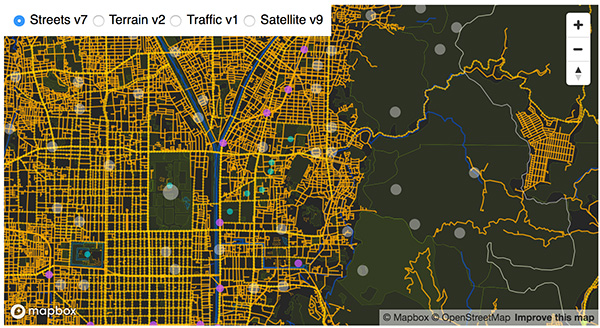
Location intelligence powers applications with data and “live maps” updated continuously.
According to Forbes, 70 percent of telecommunications companies consider location intelligence critical to their success. The intelligence data is provided by specialists such as Google, Esri, Here and PlaceIQ.
In January, Sprint and location intelligence startup Mapbox launched precision mapping technology with the Curiosity IoT network. The 5G network’s extreme bandwidth and low latency will allow Mapbox to collect higher volumes of richer data to create “live maps.” A live map is built not from traditional data surveys months or years before, but from data collected from hundreds of millions of location-enabled sensors that feed back information about the world in real time, including high-resolution video.
Mapbox uses artificial intelligence (AI) to turn the massive data flows into a picture of real time transit paths that can be used for precise, up-to-date routing.
Augmented Reality view from the Mapbox Vision SDK. (Image: Mapbox)
According to Mapbox CEO Eric Gundersen, maps that constantly update are essential to the internet of things (IoT). “As maps guide new smart machines on IoT networks, you remove the human in the middle that used to compensate for differences between the map and the real world,” he said. “Precision mapping services need to reflect the world as it is, at that precise moment so that those smart machines can travel safely and efficiently.“
According to Mapbox, smart machines such as drones and autonomous delivery carts will be able to make fast location and routing decisions using its detailed, updated maps.
Other companies that use Mapbox’s location services include IBM, Lonely Planet, Square, Tableau and The Weather Channel.
Advanced AI, robotics and autonomous vehicle services on Sprint’s dedicated IoT network will adapt to the real world using highly accurate, detailed and constantly refreshed maps.
Sprint and Mapbox are launching precision mapping technology with Curiosity IoT, allowing automated services that run on Sprint’s dedicated internet of things (IoT) network to move around the ever-changing world with pinpoint accuracy.
Smart machines, from drones to autonomous delivery carts, will be able to make fast location and routing decisions using highly detailed, accurate maps that are updated as the environment changes.
Sprint made the announcement this week at the Consumer Electronics Show being held in Las Vegas.
High Accuracy and Precise Detail with Live Maps. Mapbox offers what it calls a “live map”, a map built not from traditional data surveys months or years before, but from data collected from hundreds of millions of location-enabled sensors that feed back information about the world in real time.
Mapbox uses artificial intelligence (AI) to turn those massive data flows into a picture of real time transit paths that can be used for precise, up-to-date routing.
Image: Mapbox
Through its relationship with Sprint, Mapbox will leverage the inherent advantages of Curiosity IoT with 5G to take mapping to the next level. The network’s extreme bandwidth and low latency will allow Mapbox to collect higher volumes of richer data from the sensors, including high resolution video.
That data can be processed to identify and detect changes in the physical environment. Those changes are then incorporated into updated maps which can be distributed at scale to a wide variety of smart machines. The result is more accurate, more up-to-date maps that reflect the world in real time.
“Smart machine-based services need to be able to make immediate mobility decisions similar to the way a driver might react to construction, traffic or other obstacles on a street,” said Ivo Rook, senior vice president, IoT and product development at Sprint. “The launch of Mapbox’s precision mapping technology allows all intelligent machines to move at a level of precision never seen before. Our fully dedicated Curiosity IoT network and operating system — soon to be powered by Sprint’s mobile 5G connectivity makes this possible. From autonomous vehicles to advanced AI-based machines, precision mapping is a big step forward in making smart service models a reality for the immediate economy.”
“As maps guide new smart machines on IoT networks, you remove the human in the middle that used to compensate for differences between the map and the real world. Precision mapping services need to reflect the world as it is, at that precise moment so that those smart machines can travel safely and efficiently,” said Eric Gundersen, CEO of Mapbox. “Sprint’s Curiosity IoT network with mobile 5G provides platform services that make that real with high bandwidth, edge computing for object detection and data processing and super low latency.”
Curiosity IoT with 5G. Sprint 5G and Curiosity will create the new standard in IoT which features device data intelligence, over-the-air device management and chip-to-cloud security, the companies said.
When coupled with Sprint mobile 5G technology, Curiosity IoT’s dedicated, distributed and virtualized IoT core network is capable of supporting artificial intelligence, robotics, edge computing, autonomous vehicles and other IoT systems requiring extreme low-latency and high-bandwidth.
Sprint has announced that Telit is to start commercial deliveries of its LE910C1-NSLTE Cat 1 module upon conclusion of Sprint certification, expected this month. The product is an embedded industrial Internet of Things (IoT) LTE module delivering up to 10 Mbps download and 5 Mbps upload speeds.
Because of pin-to-pin compatibility with both CDMA and EV-DO versions of Sprint certified xE910 modules, Telit integration support, powerful development tools and resources, the new Cat 1 module allows Sprint IoT customers to realize significant reduction in time to market and savings for both new projects as well as upgrades from 2G and 3G to LTE.
The module will primarily be used for IoT applications, enabling cellular data communication in devices used in warehouse management, remote monitoring and control, robotics, traffic control, logistic services, supply chain management, fleet management and telemedicine.
“We are excited to certify this module because Telit is a world-class leader in the IoT,” said Mo Nasser, director of product development and marketing at Sprint. “Having this module commercially available and Sprint certified allows us to expand the number of applications we can provide new customers and has the added benefit of simplifying migration of current IoT customers to LTE.”
The Telit LE910C1-NS single-mode module operates in multiple bands including LTE B2, B4, B5, B12, B25 and B26. Features include a high-speed USB 2.0 port, industrial operating temperature range (-40°C to +85°C) and advanced power-saving modes (3GPP Release 12).
“We’re certain that supplying Sprint customers with this module will open doors to numerous new application areas requiring the longevity and speeds of LTE with the reliability and coverage of the Sprint nationwide network,” said Manish Watwani, vice president of global product marketing at Telit. “We believe that our technology is cutting-edge, enabling Sprint to continue delivering world-class customer experience in the IoT space.”
LAS VEGAS — About 30,000 attendees sweltered in Las Vegas for CTIA’s Super Mobility show this past week. Attendance was flat from last year, but the exhibit floor and meeting rooms bustled. The energy of the show focused on M2M and Internet of Things (IoT). In past years, the connected vehicle was a highlight, but not so this year. Wearable technology was scant. Those looking for the big product introductions of the past were disappointed. However, CTIA’s keynote speakers added focus and vision into the show, reminding us of the drive and vigor that built the industry.
In the past, the network operators (we once called them carriers) and device manufacturers owned the CTIA show, where they made their biggest product reveals. This year, AT&T had a flurry of announcements, including a partnership with car manufacturer Jaguar Land Rover North America. AT&T will supply connectivity to the cars for features such as Wi-Fi hotspots, connected navigation and a suite of apps. Customers will be able to share wireless data between phones, tablets and vehicles on its Mobile Share Value plan for an additional 10 dollars per month access fee. AT&T previously signed agreements with Audi, BMW, GM, Ford, Tesla, Nissan, Volvo and Subaru.
AT&T and Telogis announced a collaboration to offer solutions for companies with mobile workforces, a combination of AT&T’s network and Telogis’ telematics, compliance and navigation fleet solutions. AT&T was showing off ZTE Mobley, AT&T’s first plug-in vehicle Wi-Fi hotspot, which has just appeared in stores. Smaller announcements from AT&T included the formation of a dedicated smart city organization and a personal security app that provides live, OnStar-type professional monitoring (video and audio).
Verizon unveiled Go90, a streaming-video, social media service that works across carriers. Go90 is a free, ad-based service accessed only on a mobile phone and focused on short clips, viral videos and a social element, with crowdsourced recommendations and the ability to join groups. Go90 is targeted at Millennials, people younger than 30 years old. Although this seems like a minor announcement, obtaining the loyalty of Millennials and Generation Z (those still in their teens) is critical. With two-thirds of Millennials considering smartphones as their most important device for video, the strategy behind Go90 makes sense.
New Sprint CEO Marcelo Claure is never boring and used his time at the podium to continue trash- talking the competition. With cocky confidence, he pronounced that under his leadership, Sprint will enjoy “one of the biggest turnarounds in telecom history.” In July, Claure used Twitter to declare T-Mobile’s aggressive “uncarrrier” promotion to be “bullshit and a fake show.” He continued his rant at CTIA. “We spent the first year cutting AT&T or Verizon’s bills in half, which was fun. We’ve moved on today to offering all the DirecTV customers the choice to not be stuck with AT&T.”
One of the most pressing industry issues is spectrum. With wireless data forecast to grow ten-fold by the end of 2020, the industry is concerned that the 2016 spectrum auction will not be sufficient. Keynotes appealed for more spectrum to enable the U.S. to lead in 5G, just as it led in 4G. U.S. company-run operating systems are currently on nine out of ten smartphones, worldwide. FCC Chief Tom Wheeler was at CTIA to give assurances that the spectrum auction slated for March 2016 will be successful and occur as scheduled. He countered CTIA’s CEO Meredith Baker’s assertion that the FCC has no added plans beyond this auction for freeing up spectrum.
Freetel mobile products of Japan was one of several international companies participating in CTIA this year.
Location Players, M2M, IoT
TeleCommunication Systems (TCS), a stalwart of location-based services, beefed up its indoor location capabilities with the purchase of Loctronix. The platform, Sensorvision, aggregates and integrates location-positioning technologies, like Bluetooth, beacons and Wi-Fi, as well as content, such as mapping. Sensorvision is currently in beta testing and is aimed at wireless operators. With more stringent rules for 911, including indoor location requirements, TCS is positioned for both public safety and commercial needs. What’s next? In five years, Michael Mathews of TCS predicts, “We’ll be talking about the huge amount of information available from the road and the great impact on apps, including vehicles that are informing other cars of their actions, such as when they initiate traction control or start windshield wipers.”
u-blox, the maker of wireless and positioning modules and chips, announced a portfolio of new LTE low data rate cellular modules for IoT and M2M applications in the industrial and automotive markets. The portfolio consists of multi mode, multi carrier and of LTE only modules specific for large North American carriers. u-blox expects LTE Cat. 1 technology to become the future norm for M2M applications. And when asked about long-term success, Sven Etzold of u-box says, “The challenge for our industry is picking the right partners and being part of successful consortia. We need to partner with the right network operators and play with sensors’ companies.”
Janice visits with Chuck Moseley (center) and Don Wigglesworth (right) of Inmarsat.
Inmarsat unveiled its new machine-to-machine (M2M) and its IoT strategy, the “Internet of Everywhere.” The company is increasing use of VARs and OEMs to enable solutions that will provide more visibility and control of mobile assets throughout the world. “We are empowering existing and prospective VAR partners to offer unparalleled worldwide connectivity to their M2M and IoT customers through a single network and a single SIM,” said David Wigglesworth of Inmarsat. The company’s dedicated M2M services are IsatData Pro, a low-data-rate messaging service, and BGAN M2M, a two-way IP data service for monitoring and control of assets that require higher bandwidth capabilities.
Geotab, with one of the exhibit floor’s most crowded booths, showcased the development platform of a small form-factor GPS tracking device. The Geotab GO7 device plugs directly into a vehicle’s OBDII port. Developers create applications that are available on the Geotab Marketplace. The booth was crammed with developers who offer M2M and IoT solutions.
Geotab’s booth was crowded with developers interested in the Geotab Marketplace for M2M and IoT solutions.
Microsoft’s Start-Up Alley contained interesting ventures from the Microsoft Accelerator. One young company, Parknav, offered an app for finding parking spaces based on predictive modeling, and not sensors. Users are guided to street blocks with the highest probability of available parking spaces. The app uses a number of sources, including number of parking spaces, traffic flow and undisclosed data. Parknav enables searches for free, paid and permit parking in 30 cities in Germany and a few cities in the U.S.
On a charitable note, Jimmy Whales of Wikipedia fame was at CTIA to promote his phone business, a Sprint-based MVNO cellular service. Like Wikipedia, The People’s Operator (TPO) is not a profit driven enterprise. Ten percent of a subscriber’s monthly bill goes to a charity of her choosing, and 25 percent of the company’s profits are donated to non-profits. In talking about Wikipedia, Whales cited China’s current ban of the website. Wikipedia has recently made changes to its website that make it impossible for censors to ban specific Wikipedia pages, although the entire site can be blocked, as it currently is in China.
I have parting advice for the organizers of CTIA. This year’s show was disrupted by competing events that included the iPhone 6 announcement in Cupertino. Shame on Apple, who is a member of the CTIA board. Also, CTIA had organized a virtual co-conferencing with Internationale Funkausstellung Berlin (IFA), one of the largest trade shows for consumer electronics and home appliances. The IFA event was held in Berlin the prior week and stole attention from CTIA. It isn’t all about location. Timing matters.
Telit Wireless Solutions, provider of high-quality machine-to-machine (M2M) modules, services and solutions, has announced approval by Sprint for its CE910-DUAL cellular M2M module. A dual-band CDMA 1xRTT module, the CE910-DUAL allows Sprint M2M Solutions customers to deploy a wide range of M2M applications benefiting from reliable connectivity over Sprint’s nationwide network while enabling cost-sensitive business plans.
The CE910-DUAL packs high value features in its ultra-compact 28.2 x 28.2 x 2.04 mm Land Grid Array (LGA) package. USB 2.0 full-speed support and a rich set of drivers make it ideal for embedded applications requiring easy integration to platforms based on the latest desktop and mobile operating systems such as Windows and Linux. Full-duplex data rate of 153.6 Kpbs and extended operating temperature range of -30°C to +85°C make it a suitable platform for mobile and fixed applications such as vending, point-of-sale (POS), tracking, smart metering, and telematics devices.
“Sprint plans to maintain our CDMA 1xRTT network capability for the long term as part of our overall Network Vision strategy,” said Wayne Ward, vice president, M2M Group, Sprint. “We have been working with Telit for several years as a Sprint preferred provider and one of the leading module suppliers to the M2M industry and believe their xE910 form factor makes it easy for customers to deploy on either the EV-DO or 1xRTT CDMA Sprint networks.”
“With this approval, the cost-effectiveness, reliability and functionality of the CE910-DUAL module are accessible to Sprint M2M and Telit customers along with outstanding support and network connectivity from one of the nation’s top-rated cellular networks,” said Mike Ueland, senior vice president and general manager of Telit Wireless Solutions North America.
Part of the xE910 form factor family, the CE910-DUAL protects investments by offering complete compatibility with the DE910-DUAL, a Sprint-approved companion product for EV-DO Rev. A applications.
Sprint and u-blox have expanded their collaboration in support of Sprint’s commitment to the 2G (1xRTT) CDMA network. As a carrier committed to network choice, Sprint believes M2M customers should be able to choose or combine 2G, 3G and 4G LTE capabilities, depending on their particular requirements, u-blox said.
Sprint expects to maintain its 2G network capability for the long term as part of its overall network vision strategy. Both companies believe 2G remains an important network option for business customers, including those that deploy machine-to-machine (M2M) solutions as part of their service or product offerings.
This collaboration will allow business customers to extend the product lifetime of their existing 2G M2M devices by seamlessly migrating to the CDMA network with minimal effort. Those customers concerned about the continued availability of 2G GSM networks in the U.S., can now select from a variety of affordable u-blox modems tested for compatibility on Sprint’s CDMA 1xRTT network. The u‑blox FW75-C200 modem, a pin-compatible replacement for widely used GSM modem MC75i and its variants, is well suited to continue on 2G without having to migrate to much more expensive 3G and 4G modems.
“Now is the opportune time for any customers migrating off GSM or designing new products for telematics, telemetry, automotive, and security applications to take advantage of Sprint’s 2G platform,” said Wayne Ward, vice president, M2M Group, Sprint. “Sprint’s network vision strategy enables ongoing 2G connectivity with the security and performance advantages of CDMA, while also supporting a smooth path to CDMA 3G and LTE 4G for customers who choose that transition. We are pleased to collaborate with u-blox to bring these options to 2G-embedded M2M customers.”
Sprint’s network vision supports network choice for our customers nationwide. As with 3G, Sprint Network Vision is expected to improve Sprint 2G coverage, capacity, and reliability. M2M and other emerging solutions can involve widely varying data transmission speeds. Sprint expects to be able to provide all these network platforms for the long haul as part of a continuing portfolio of technology options.
“We are proud to have been selected as the preferred provider by Sprint. It will allow customers to leverage Sprint’s impressive CDMA coverage in the US. Forced migration from 2G GSM to HSPA can now be avoided, given Sprint’s commitment to 2G longevity of the CDMA network,” said Nikolaos Papadopoulos, president of u-blox America. “Should customers still want to offer their devices in 2G and 3G, we at u-blox have already prepared for this parallel track with our nested-design module philosophy for 2G/3G platforms, where customers can select the inexpensive CDMA SMT modem LISA-C200.”
u-blox CDMA module series consists of the FW75 CDMA 1xRTT module in an industry-standard package, as well as the LISA and PCI-express form factors. In addition to technical support, reference designs, evaluation kits, firmware and free module samples, Sprint and u-blox will soon announce nationwide hands-on seminars focusing on GSM to CDMA modem migration.