Tag: STEM

  • The women putting NV5 Geospatial GIS on the map

    Women make up more than half of NV5 Geospatial’s eGIS business unit, which collects and analyzes data to develop custom applications for government clients.

    Women make up more than half of the company's team. From left are Alexa Ramirez, Nicole Wigston, Danielle Comely and Cherie Jarvis. (Image: NV5 Geospatial)
    Women make up more than half of the company’s team. From left are Alexa Ramirez, Nicole Wigston, Danielle Comely and Cherie Jarvis. (Image: NV5 Geospatial)

    Even though women make up nearly half of the workforce, they are still highly underrepresented in the science, technology, engineer and math (STEM) field. In fact, the U.S. Census Bureau reports that while women have made gains since the 1970s, they still only account for about 27% of STEM workers.

    But one company bucking this trend is NV5 Geospatial, which was formed with the 2019 merger of global engineering firm, NV5 Global, and Quantum Spatial Inc., North America’s largest geospatial data firm. Quantum Spatial brought with it a long history of providing innovative remote sensing, acquisitions and analytics solutions that answer some of the toughest questions and deliver unique insights. It has become the go-to provider of geospatial services for a wide range of clients, including major government agencies, the military, utility companies, engineering and construction firms, and corporate organizations. These clients value the organization’s proprietary and ground-breaking approach of using geospatial information to plan, manage resources, mitigate risk and contribute to scientific understanding.

    Women make up more than half of NV5 Geospatial’s enterprise GIS (eGIS) business unit, which is responsible for collecting and analyzing data to develop custom applications for key government clients.

    In 2020, the company named Cherie Jarvis as director of the eGIS team, which has grown to include three female project managers and four analysts that bring diverse backgrounds – from marine biology and zoology to environmental science to geology – to their work.

    “Seeing so many women in GIS is not unusual for me because I think strong women attract other strong women,” Jarvis said. “The women on our team are not only experts in their field, but they are very detail oriented and have the technical, organizational and people skills to adeptly handle all the variables that come with the complex eGIS projects we manage.”

    Jarvis, a PMP, Scrum Master and Certified Scrum Product Owner, has led several award-winning projects, including a decision support tool to guide environmentally sound dredging of offshore sand shoals for the Bureau of Ocean Energy Management (BOEM) and the National Oceanic and Atmospheric Administration (NOAA), and a portal to access navigation-related data and tools for sediment and ecosystem management for the U.S. Army Corps of Engineers (USACE).

    Others on the team include:

    • Alexa Ramirez, senior project manager, PMP, GISP is a 13-year veteran of NV5 and its predecessor companies, where she previously specialized in lidar processing. She transitioned to the GIS team to create the data model for the BOEM Marine Minerals Information System (MMIS).
    • Danielle Comely, senior project manager, PMP, CSPO is an environmental scientist who recently joined NV5 from NOAA to work on BOEM, USACE and Southwest Florida Water Management District (SWFWMD) projects.
    • Ashley Reade, GIS analyst and one of the newest in the eGIS group, moved from the NV5 acquisition team to help manage MMIS and leverage her marine biology background to help assess fish habitat during dredging as part of the USACE South Atlantic Regional Biological Opinion (SARBO).
    • Liz Rodgers, senior GIS analyst, leveraged her degree in zoology to help build an environmental sensitivity index tool for NOAA and has been supporting work on USACE SARBO.
    • Emily Sandrowicz, GIS analyst, joined to work on MMIS, but moved to the geoESPIS (Environmental Studies Program Information System) project. She’s now pursuing her Master’s degree in GIS.
    • Maggie Satterfield, senior GIS analyst, brings a background in forestry to her work on the Bureau of Land Management (BLM) National Cultural Resources Information Management System (NCRIMS).
    • Nicole Wigston, senior project manager, PMP, CSM, brings a strong geography and technology background having previously worked for ESRI. She manages national data standardization projects for BLM and on projects automating NV5G internal data pipelines.
  • Northrop Grumman partners with San Diego Zoo for polar bear conservation project

    Northrop Grumman partners with San Diego Zoo for polar bear conservation project

    In late 2017, Northrop Grumman and San Diego Zoo Global planned and carried out a research mission to map Arctic sea ice formations to learn more about polar bear habitats — proving autonomous technology is making a name for itself as a key tool in conservation projects.

    The project began as a competition between teams of Northrop Grumman employees who aimed to find a way to map Artic sea ice formations, and the winning team — Team Polar Eye from Melbourne, Florida — earned the privilege of using its technology to map the area.

    “The project name is Wildlife Challenge,” said Charlie Welch, materials and process engineer at Northrop Grumman and technical lead of the Wildlife Challenge. “It’s a collaboration between San Diego Zoo Global and Northrop Grumman to help bring really high-level technology to the San Diego Zoo’s conservation efforts — specifically unmanned technology.”


    Polar bears have to wait for the ice to freeze to hunt, and the zoo wanted to repeatedly map the same area in the Artic to learn more about the ice, including how it’s freezing, where a polar bear is on the ice and what the ice looks like, such as its thickness. The zoo then planned to use this data to predict how changes in the ice — and overall climate change — will affect the polar bears.

    To carry out the project, the Northrop Grumman team developed a drone that could handle the freezing temperatures. The team then flew to Northern Canada to gather the ice data.

    “We had to take the drone out to the middle of nowhere, basically, and be confident that this could work and collect critical data on a really key, iconic species,” Welch said. “Half the engineering was designing the logistics of getting our team out there, getting every spare part we could think of and making sure that we could survive out there, along with the system.”


    Click on the icon in the top left hand corner to choose the video you’d like to watch.


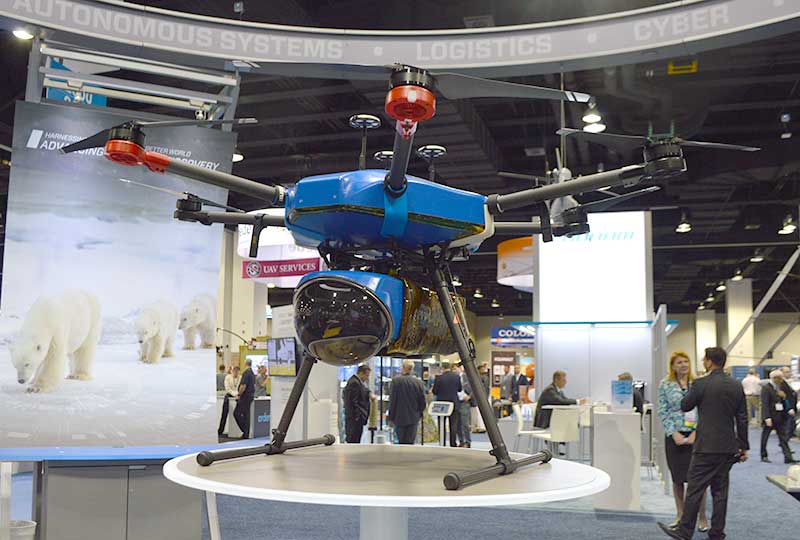
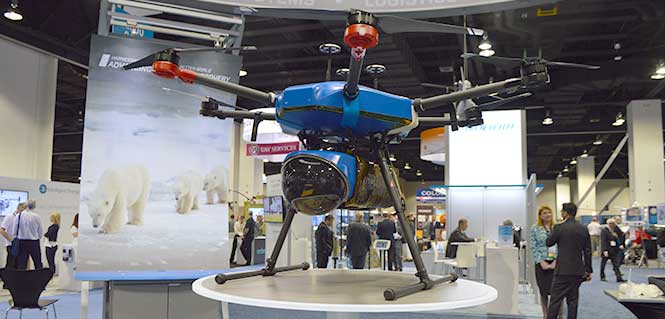
    During the 10-day mission, the team used its modified DJI M600 hexacopter drone to capture the data, as well as ground equipment to process the data and ensure the drone was operating correctly. According to the company, the hexacopter platform consisted of six rotors, a triple-redundant navigation system, high-voltage battery packs and a custom payload bay to hold a range of integrated sensors. It was also equipped with a ruggedized thermal shell, designed to withstand temperatures as low as minus-20 degrees Fahrenheit.

    “We had to make a few adjustments in the field, as we kind of anticipated,” Welch said. “So we designed the drone to be reconfigurable really easily.”

    The Northrop Grumman team used its modified DJI M600 hexacopter drone to capture the ice data. Photo by Allison Barwacz

    The team conducted several successful sea ice mapping missions and collected an array of habitat data, including 3D sea ice maps and multispectral data, both collected at sub-centimeter resolution, the company said. Northrop Grumman sent the data to zoo scientists, who are still closely working with the company. Northrop Grumman also donated its hexacopter drone to the zoo so that it be used for other conservation projects.

    “We’re keeping in collaboration [with the zoo] to try and figure out what they want to do next from a scientific perspective, and how the data we collected is working out for what their goals were,” Welch said. “We see these innovative projects as a good way to engage our employees and give them the ability to work on projects that are very science-based. We also want to make a positive impact toward STEM (science, technology, engineering and mathematics) and be able to show students how engineering and science fields can be applied in a variety of ways.”