Tag: Symmetricom

  • Microsemi Corporation to Acquire Symmetricom

    Microsemi Corporation has entered into a definitive agreement with Symmetricom to acquire the precision time and frequency company for $230 million. Microsemi is a provider of semiconductor solutions differentiated by power, security, reliability and performance.

    Microsemi, headquartered in Aliso Viejo, California, will pay $7.18 per share through a cash tender offer, representing a premium of 49 percent based on the average closing price of Symmetricom’s shares of common stock during the 90 trading days ended October 18. The board of directors of Symmetricom unanimously recommends that Symmetricom’s stockholders tender their shares in the tender offer. The total transaction value is approximately $230 million, net of Symmetricom’s projected cash balance at closing.

    Headquartered in San Jose, California, Symmetricom provides highly precise timekeeping technologies and solutions that enable next-generation data, voice, mobile and video networks and services. It provides timekeeping in GPS satellites, national time references, and national power grids as well as in critical military and civilian networks.

    “The acquisition of Symmetricom will create the largest and most complete timing portfolio in the industry today,” stated James J. Peterson, Microsemi president and chief executive officer. “From source to synchronization to distribution, Microsemi will offer an end to end timing solution for an expanded range of markets, driving increased dollar content opportunity and revenue growth.”

    “The acquisition of Symmetricom by Microsemi will create a powerful combination,” said Elizabeth Fetter, Symmetricom’s chief executive officer. “I believe Microsemi is the ideal company to leverage Symmetricom’s technology and capabilities further into the communications market along with the scale to accelerate the adoption of the company’s innovative new chip scale atomic clock (CSAC) technology into broader markets.”

    Microsemi expects significant synergies from this immediately accretive transaction. Based on current assumptions, Microsemi expects the acquisition to be $0.22 to $0.25 accretive in its first full calendar year ending December 2014.

    Microsemi reaffirms its fiscal fourth quarter guidance included in its fiscal third quarter earnings release issued on July 25. Microsemi currently intends to announce its fiscal fourth quarter results on November 7. Further details will be forthcoming.

    Tender Offer and Closing. Under the terms of the definitive acquisition agreement, Microsemi will commence a cash tender offer to acquire Symmetricom’s outstanding shares of common stock at $7.18 per share, net to each holder in cash. Upon satisfaction of the conditions to the tender offer and after such time as all shares tendered in the tender offer are accepted for payment, the agreement provides for the parties to effect, as promptly as practicable, a merger which would result in all shares not tendered in the tender offer being converted into the right to receive $7.18 per share in cash. The tender offer is subject to customary  conditions, including the tender of at least a majority of the fully diluted shares of Symmetricom’s common stock and certain regulatory approvals,  including the expiration or termination of the applicable waiting period under the Hart-Scott-Rodino Antitrust Improvements Act, and is expected to close in Microsemi’s fiscal first quarter, ending Dec. 29, 2013. No approval of the stockholders of Microsemi is required in connection with the proposed transaction. Terms of the agreement were unanimously approved by the boards of directors of both Microsemi and Symmetricom.

    Under the terms of the merger agreement, Symmetricom may solicit superior proposals from third parties for a “go shop” period that extends through November 8. It is not anticipated that any developments will be disclosed with regard to this process unless and until Symmetricom’s board of directors makes a decision to pursue a potential superior proposal. Jefferies LLC, which is acting as Symmetricom’s financial adviser, will assist Symmetricom with Symmetricom’s go-shop process. There are no guarantees that this process will result in a superior proposal.  The merger agreement provides Microsemi with a customary right to match a superior proposal. The agreement also provides for certain termination fees payable to Microsemi in connection with the termination of the agreement in certain circumstances.

    Conference Call. Microsemi will host a conference call, solely to discuss details of the transaction. A live webcast relating to the transaction will be available in the “Investors” section of Microsemi’s website at www.microsemi.com in advance of the conference call.

    Conference call date: Oct. 21, 2013
    Time: 1:45 p.m. PDT (4:45 p.m. EDT)
    Dial-in numbers:  U.S. 877-264-1110; international 706-634-1357
    Passcode: 90095902

    A webcast of the conference call will also be available in the “Investors” section of Microsemi’s website at www.microsemi.com.

  • Symmetricom Expands SyncWorld Program to Power Utilities

    Symmetricom Expands SyncWorld Program to Power Utilities

    SyncWorld will enable power utilities to react in real time to outages and alert users to contingency plans.
    SyncWorld will enable power utilities to react in real time to outages and alert users to contingency plans.

    Symmetricom has introduced a new category to its SyncWorld Ecosystem Program dedicated to the power utility industry. Developed to support integration and interoperability among power utility and Symmetricom solutions, the SyncWorld Power Ecosystem aims to facilitate unified deployments of timing and synchronization in substation modernization and synchrophasor applications.

    As power utilities shift to the Smart Grid, they gain the ability to monitor in real time, allowing for proactive operations control. Advanced synchronization and timing enable power equipment to operate more efficiently and closer to its operational limits.

    For example, one microsecond accuracy is required by the phasor measurement unit (PMU) for real-time network situational awareness and overall operational efficiency. Without accurate time stamps, PMU data has limited value. For power utility companies, that translates into enhanced network utilization rates as well as smarter management and mixing of renewable and traditional power sources.

    Symmetricom also introduced the SyncServer SGC-1500 Smart Grid Clock to provide power utility companies accurate, secure and reliable timing.

    The introduction of the SyncWorld power segment is expected to drive collaboration and innovation among the industry’s leading power utility vendors. To participate in the program, vendors work with Symmetricom to develop a joint solution, complete successful solution testing, and commit to ongoing technical and business activities to ensure joint success.

    Interoperability is a key requirement to join the program. Using various test cases with a defined standard for testing, Symmetricom focuses its assessment on the performance of a product’s IEEE 1588 power profile. During testing, Symmetricom clocks act as the master clocks, switches act as transparent clocks, and IED/PMU products act as slave clocks.

    Watch a video about the program here.

  • Symmetricom to Participate in New Products Panel Session at ION GNSS+

    Symmetricom_logoSymmetricom will be participating in a new products panel at ION GNSS+, which will be held September 16-20 in Nashville, Tennessee.

    Phil Bourekas, Symmetricom executive vice president of marketing, will take part in “New Products Panel: Legacy and Expertise in GNSS Timing” on Thursday, September 19, 8:30 a.m. to 12:15 p.m. in Grand Ballroom East of the Nashville Convention Center, Nashville, Tennessee.

    The presentation will focus on Symmetricom’s suite of GNSS-applicable timing products, ranging from precision time protocols to atomic clocks, and how they can be used by the government, communications, power and enterprise verticals.

    Symmetricom is also a sponsor of the exhibitor-hosted reception. In its booth (#619), Symmetricom will exhibit and demonstrate the following products:

    • GPS Time & Frequency Receivers (XLi and XLi SAASM GB-GRAM models)
    • Cesium Frequency Standard 5071A
    • Rubidium Frequency Standard 8040C
    • Ruggedized Rubidium Oscillator 8200LN
    • SA.45s Chip-Scale Atomic Clock (CSAC)
    • Ovenized Quartz Master Oscillator 9500
    • GPS Disciplined Oscillator GPSDO 300
  • Precision Timekeeping with Chip-Scale Atomic Clocks

    Broadcast Date: Thursday, March 7, 2013
    Speaker: Steve Fossi, Director of New Business Development, Symmetricom
    Panelist: Ravi Pragasam, Marketing Manager, Embedded Solutions, Symmetricom

    Webinar Topic/Abstract:  Precision timekeeping with all the benefits of Size, Weight and Power (SWaP) – Quantum(tm) SA.45c Chip Scale Atomic Clock (CSAC)

    Atomic clocks have enabled a world where ultra-precise timekeeping is now mandatory for communications, navigation, signal processing and many other applications critical to a modern functioning society. While smaller, lighter and more energy efficient solutions have been introduced to serve the above markets, the atomic clocks used in these systems have not kept in pace and continue to use more power and retain their large form factors. Symmetricom, the industry leader in precise time solutions, has utilized leading edge technology and multiple innovations in various disciplines such as semiconductor laser technology, silicon processing, vacuum-packaging and firmware algorithms to deliver the Quantum SA.45c CSAC (Chip Scale Atomic Clock). The CSAC is small in size, has low weight and consumes very little power. Such an atomic clock with excellent precision in time keeping is ideal for applications that have a constrained power budget and demand a very low-power clock.

    Attend this webinar and learn how the CSAC can address your requirements for a precise clock without consuming excessive power or taking up too much space in your application.

  • Symmetricom Enhances SSU 2000 Platform with GLONASS

    Symmetricom, Inc. today announced two new capabilities for its SSU 2000 Synchronization Supply Unit: a GLONASS timing reference that uses signals from the satellite navigation system operated by the Russian Aerospace Defense Forces, and Synchronous Ethernet (SyncE), an ITU-T synchronization standard that delivers frequency synchronization over the Ethernet physical layer.

    This enhanced version of the SSU 2000 will be the first in a series of forthcoming Symmetricom products that include GLONASS capabilities.

    Available as an integrated card for the Symmetricom SSU 2000, the GLONASS referencing feature will allow customers to support both GPS and GLONASS simultaneously, providing added protection should signals from one navigation system become unavailable. GPS has long served as the primary reference signal for timing and synchronization in telecommunications and other networks. Operators in some regions prefer to use the GLONASS system, either as the primary time reference or in conjunction with GPS signals. Symmetricom has enhanced the SSU 2000 satellite receiver functionality to meet this demand.

    “GLONASS signals have become an important primary reference for timing and synchronization systems,” said Laura Finkelstein, vice president of product management for Symmetricom. “The SSU 2000 is well-established as the synchronization platform for communication service providers globally. The integrated capability to simultaneously support both GPS and GLONASS provides our customers another way to improve the reliability of their network.”

    Timing and synchronization are a focal point technology in Ethernet and mobile carrier networks today. Synchronous Ethernet allows frequency signals to transfer at the physical layer over Ethernet, helping improve network reliability by offering synchronization services to Carrier Ethernet networks. Using SyncE to complement IEEE 1588 Precision Time Protocol (PTP) can enhance PTP services being delivered to mobile base stations deployed in radio access networks. The new SSU 2000 capability puts SyncE and PTP on the same output port, thus providing an ideal synchronization solution for the evolution of mobile networks as they extend coverage and increase capacity.

    Designed in a NEBS-compliant package, the SSU 2000 integrates intelligent functional modules into a flexible, fully redundant system. This enables telecom network operators to seamlessly satisfy current and future requirements for generating and distributing superior synchronization signals for advanced network services.

    The SSU 2000 has been deployed in more than 125 countries as a timing and synchronization distribution system for communications service providers.

  • Symmetricom Delivers Precise Time to Next-Generation Smart Grid

    Symmetricom, Inc., a precision time and frequency technologies company, today announced a new timing solution that meets the stringent microsecond accuracy requirements of Smart Grid substations. Specifically designed for substation operations, such as wide area measurement systems, traveling wave fault locators and sampled values, the Symmetricom SyncServer SGC-1500 Smart Grid Clock offers power utility companies accurate, secure and reliable timing and synchronization for their mission-critical operations. This means companies like Pacific Gas & Electric (PG&E) will be able to mitigate outages with real-time monitoring for grid stress, frequency instability, voltage instability and reliability margins.

    The Smart Grid has brought about power technology advancements that fundamentally change substation operations. Power equipment and their data networks are shifting from simple, reactive control and reporting to proactive, real-time management and operations control, making advanced synchronization and timing more critical than ever, according to Symmetricom. The SGC-1500 Smart Grid Clock is designed to address this need, enabling power equipment to operate more efficiently and closer to its operational limits. For example, one microsecond accuracy is required by the phasor measurement unit (PMU) for real-time network situational awareness and overall operational efficiency. Without accurate time stamps, PMU data has limited value. For power utility companies, that translates into enhanced network utilization rates as well as smarter management and mixing of renewable and traditional power sources.

    “Power and utility companies are increasingly looking to source the latest technology innovations in order to modernize their infrastructure,” said Greg Neichin, executive vice president, Cleantech Group. “Over the past three years, we have tracked more than $700 million in venture investment committed to companies developing smart grid products. These are all data-intensive applications that will rely heavily on precise timing and synchronization, as well as more advanced analytics to process these vast streams of new information.”

    “The Smart Grid architecture and related standards require a new approach to timing distribution across the overall network,” said Manish Gupta, vice president of marketing and business development for Symmetricom. “Symmetricom brings extensive experience in delivering precise time to the communications, government, and enterprise markets. Serving the power utility telecom network over the past 10 years, Symmetricom is ideally positioned to meet the emerging timing requirements of the Smart Grid.”

    The SyncServer SGC-1500 meets key requirements of Smart Grid substations, including:

    • Microsecond accuracy and resiliency — referencing GPS satellite signals, the Symmetricom Smart Grid Clock distributes timing with microsecond accuracy over the local area network (LAN) using the IEEE 1588 v2 Precision Time Protocol (PTP) Power Profile or IRIG-B time code.
    • IEC 61850 — the International Electrotechnical Commission’s (IEC) standards for the design of electrical substation automation, which requires microsecond timing to identify and mitigate a potential fault condition in real time. This standard also identifies important electrical hardening requirements for substation environments.
    • NERC CIP ― the North American Electric Reliability Corporation (NERC) reliability and security standards for Critical Infrastructure Protection (CIP), which calls for high strength security protocols.

    The SyncServer SGC-1500 comes with additional industry leading capabilities such as a built-in IEEE 1588 v2 Telecom Profile input option. This enables the Smart Grid Clock to derive time from the communications wide area network (WAN), thus eliminating the need to have GPS at every substation and PMU. The Rubidium atomic clock option offers holdover capability in the event of GPS disruption. These options result in a highly cost effective and resilient solution for power utilities.

  • Leadership Awards 2012: At the Frontiers of Time

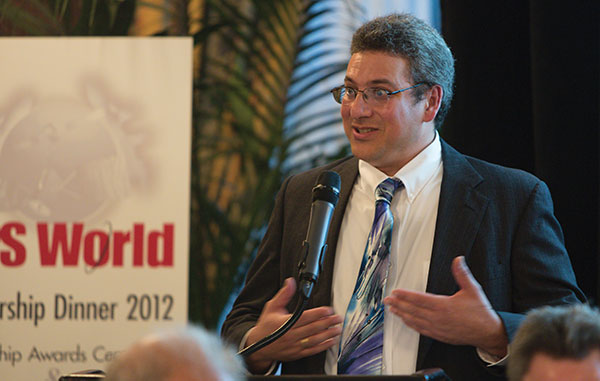
    Robert Lutwak, Symmetricom, winner in the Product category.
    Robert Lutwak, Symmetricom, winner in the Product category.
    New Advances in Receiver Performance and Reliability

    Editor’s Note: This article reproduces the acceptance speeches given by the winners of GPS World’s 2012 Leadership Awards, at the Leadership Dinner in Nashville in September. The Leadership Dinner was sponsored by Lockheed Martin and Deimos Space.


    Remarks by Robert Lutwak, Symmetricom; Chief Scientist, winner in the Products category. His expertise is practical advances to overcome the intrinsic physical barriers to affordable chip-scale atomic clocks, enabling precision time and time transfer in mobile GNSS and communications systems.

    Thank you to the awards committee and especially to the individual who nominated me.

    I would be remiss if anyone left here with the impression that the development of the chip-scale atomic clock was in any way a solo effort. On the contrary, while I have had the privilege of being the front man, the success of this program can be attributed entirely to the fantastic collaboration between three highly disparate groups, from very different industries and cultures: our Research Group at Symmetricom’s Technology Realization Center, in Beverly, Massachusetts; the MEMS group at the Charles Stark Draper Laboratory, led by Mark Mescher and Matt Varghese; and the optoelectronics group at Sandia National Laboratories, led by Darwin Serkland.  If any of these groups and people had been anything less than extraordinary, both technically and personally,I would not be standing here this evening.

    With this introduction I can say, with little loss of humility, that the chip-scale atomic clock (CSAC) is a really cool device. Depending on where you’re coming from, it’s either 100 times lower size, weight, and power (SWAP)  than traditional atomic clocks or it’s 100 times more accurate than quartz oscillators with comparable SWAP. Regardless of your perspective, it clearly represents a disruptive technology and a paradigm shift for portable battery-powered navigation, communication, and timing applications. For comparison, the CSAC can run for a day on a full cellphone battery charge, whereas the next lowest power clock of comparable performance will run down a car battery in an hour. The CSAC is not an evolutionary improvement in SWAP, it is revolutionary in that it enables previously untenable system architectures, mission scenarios, and network topologies.

    Since Symmetricom introduced the first commercial CSAC, roughly two years ago, the market response has been overwhelming. Despite having done our due diligence to predict the market demand and despite having nearly doubled our manufacturing output every quarter, our shipment backlog remains strong, and I am frequently surprised by innovative customer applications that we had not envisioned at the product launch. We have to date shipped many thousands of CSACs to more than a hundred different customers, representing vastly different markets and applications. While many of the novel applications are still in the early stages of prototype development and evaluation, it is clear that CSACs will be ubiquitous across diverse applications within the decade.

    I am fortunate, in my position, to interact directly with the technical integrators of the CSAC and learn the details of many of the applications. My general impression is that the timing and frequency stability performance of the CSAC is adequate for most of the emerging applications. The most common requests that I hear from customers are for reduced cost, power consumption, and size, in that order. It is not surprising that size is at the bottom of the list. In most applications, the batteries are still larger and heavier than the CSAC, so small improvements in power consumption are generally more valuable to reducing system SWAP than size reduction of the CSAC itself.

    As in any new technology, the cost will come down naturally with increased volume and improved manufacturing efficiencies, both at Symmetricom and at our vendors. While it is unlikely that you will get a CSAC in your next free cellphone, I do expect that the cost will progressively decrease over the next several years, and the technology will become cost-viable to an exponentially increasing spectrum of applications. Similarly, we continue to evolve our electronics and algorithms for improved power consumption, aided by external advancements in microwave and microprocessor electronics driven by the smart-phone industry. It is my expectation that a factor of 2X improvement in power consumption is likely within the next three to five years.

    To date, most of the commercial products that have emerged, based on CSAC technology, have been in the timing and frequency calibration space. It is not surprising to me that the time and frequency community was the first to adopt and exploit the technology, as many of them have been closely monitoring the development program and had the internal expertise and experience to rapidly exploit it.

    I admit, though, that I am a bit disappointed to see that there are no papers with “CSAC” in their titles at the 2012 ION-GNSS, but I am confident that this will change in the years to come. Adoption of CSAC by the navigation community has lagged behind the timing community in large part, I believe, because the technology has caught the community somewhat off-guard, and the benefits of the CSAC to INS and GNSS are just now beginning to be realized.

    The most obvious and straight-forward application of CSAC to GNSS is rapid P(Y) acquisition; we have demonstrated 15-second time-to-subsequent-fix (TTSF) after two hours of GPS denial. This was a fairly simple demonstration that consisted of jamming time into an unmodified GPS receiver, but I believe that this is just the tip of the iceberg. With access to the core navigation algorithms within the receiver, precise knowledge of time could improve the receiver performance and reliability on other levels, including (at least):
    ◾    Improved uncertainty of the navigation solution
    ◾    Navigation with less than four (or less than three) satellites
    ◾    Anti-spoof and anti-jam detection
    ◾    Seamless co-integration of GNSS and INS systems

    Another navigation area that I believe is ripe to benefit from CSAC technology is in self-assembling navigation systems, such as a local ad hoc GNSS-like network which self-assembles from handheld timing beacons/receivers. Such a system would have value for safety-of-life applications in GPS-denied environments, such as indoor firefighting and mine safety.

    Thank you again for the recognition and opportunity of this award.

  • Symmetricom Expands Test Set Portfolio with High-Performance Test Probe

    Symmetricom, Inc., has launched a high-performance, low-cost measurement solution, the Symmetricom 3120A Phase Noise Test Probe, which can be used to test reference clocks. The latest addition to Symmetricom’s state-of-the-art timing test set portfolio, the 3120A Test Probe comes in a convenient small form factor and measures phase noise and Allan deviation as part of the base hardware kit. Additional software options are available to measure AM noise floor and signal statistics such as HDEV, TDEV, MDEV and jitter, and for use as a frequency counter and for mask testing.

    Unlike traditional solutions that are desktop-bound due to size and weight, Symmetricom’s 3120A Test Probe is small enough to be carried around from location to location, and inexpensive enough to have at each bench. Whether used on a busy manufacturing floor, in a tight server closet or in R&D labs, the 3120A helps characterize reference clocks, used in high-performance applications, to achieve the highest accuracy without requiring calibration.

    The 3120A Test Probe comes with intuitive software to take measurements and conduct analysis, the company said. The 3120A Phase Noise Test Software displays results in seconds without the need for external data processing.

    “The Symmetricom 3120A is an excellent low-cost phase noise test probe that customers can use with their existing PC equipment to achieve state-of-the-art measurements,” said Sam Stein, chief scientist for Symmetricom. “It is an ideal extension to Symmetricom’s line of phase noise products.”

    Symmetricom will introduce the 3120A Test Probe at the Precise Time and Time Interval (PTTI) Systems and Applications Meeting, which takes place on November 26 – 29 in Reston, Virginia. Symmetricom will be at booth #6 conducting demonstrations and providing information about the 3120A Test Probe, in addition to Symmetricom’s other timing and synchronization products.

  • Symmetricom Introduces Small Cells Category to SyncWorld Ecosystem Program

    Symmetricom, Inc., today launched a new small cells-focused category within its SyncWorld Ecosystem Program. Developed to support the integration with Symmetricom’s SCr/SCe NTP/ PTP and sGPS SoftClocks and interoperability between Symmetricom Grandmaster clocks and other small cells solutions, the category aims to facilitate validated deployments of timing and synchronization with various small cells products in 3G and 4G/LTE architectures. Current partners in the program include leading small cell players Alcatel-Lucent, Broadcom, Cavium, Contela, CS Corporation, Mindspeed, Node-H, Qualcomm Atheros, and Rakon.

    Small cells are a key component of 3G and 4G architectures as they add capacity to the mobile network and allow service providers the maximum leverage of scarce spectrum resources. Successful HetNet deployments require small cells to synchronize seamlessly with the macro base stations irrespective of backhaul type. Also, small cell design cycles need to be short to meet the fast evolving market needs. SyncWorld brings together all players in the ecosystem including semiconductors, oscillators, software, test equipment and system vendors to drive cost effective and shortened design cycles by enabling architectural harmony and interoperability.

    Analyst firm Infonetics forecasts the global small cell market to grow to $2.1 billion in 2016 as small cells have emerged as a key solution to deliver increased network capacity. Symmetricom has delivered a number of solutions with partners along with the introduction of the industry’s first small cell synchronization solution, SCr/SCe NTP/ PTP and sGPS SoftClocks for residential and enterprise small cells. The small cells segment within the SyncWorld Ecosystem Program will ensure that interoperability needs are met as service providers accelerate their deployment plans.

    “The small cells category represents leaders across the entire value chain,” said Manish Gupta, vice president of marketing and business development for Symmetricom. “Working together, SyncWorld small cell members will be able to give service providers a comprehensive, integrated and simplified solution that is interoperable and supports the specifications required to support 4G/LTE networks.”

    The SyncWorld Ecosystem Program enables vendors to cooperate with the goal of providing complete solutions that interoperate with the most recognized timing and synchronization solution provider in the industry. Vendors that produce silicon, small cell access point, software and oscillators are invited to apply for the program online.

    With solutions deployed globally in more than 150 networks, Symmetricom is committed to partnering with trusted end-to-end technology providers which deploy and maintain networks on behalf of operators.

  • GPSWorldTV – Symmetricom at ION GNSS

    GPSWorldTV talks with Phil Bourekas of Symmetricom, Inc. at the ION GNSS 2012 conference.

  • Symmetricom Launches RoHS Compliant GPS Time Servers

    Symmetricom, Inc., has introduced new RoHS compliant versions of its existing SyncServer S200 and SyncServer S250 GPS Network Time Servers. Designed for large or expanding IT enterprises, the cost-effective SyncServer S200 and S250 with optional rubidium-based atomic clocks will reliably continue operational service for extended periods when primary time sources are impaired.

    Accurate network time-keeping is essential for modern data networks to support a number of key functions — including precision time stamping, scheduled data backups, network management and security. These functions all rely on networked clocks to stay synchronized with each other. By using enterprise owned servers, companies are better poised to ensure accurate, reliable and more simplified network timing and synchronization, Symmetricom said.

    The European Union’s Restriction of Hazardous Substances directive (or RoHS) assures environmental responsibility for the materials used in electrical and electronic equipment. The SyncServer S200 and S250 now offer network managers and engineers RoHS certified, entry-level time servers that still allow them to take advantage of rubidium-based clock technology. Unlike the more commonly deployed time servers that leverage temperature-compensated crystal oscillator (TCXO) and oven-controlled crystal oscillator (OCXO) technologies, the rubidium-based SyncServers provide superior holdover — technology that allows the network to continue to operate with accurate timing when the primary reference (usually GPS) is temporarily impaired due to events such as GPS jamming, antenna breakage, or solar interferences.

    Communications and information technology managers can now take control of their network timing and synchronization and be assured of very accurate timing in their network that will not degrade or disrupt services during long periods where holdover is necessary, Symmetricom said.

  • eLoran and UrsaNav: Timing Is Everything

    The first part of the recent UrsaNav press release says it best:

    This week for the first time since August 2010 advanced low frequency (LF) signals, including a new eLORAN, are on the air in North America! As a result of a Cooperative Research and Development Agreement (CRADA) between the United States Coast Guard (USCG) and UrsaNav, Inc. live testing of a wide-area precise timing solution has begun. These initial tests include a comprehensive pallet of signals, including eLoran, that are being evaluated for their ability to provide a robust, wide-area, wireless precise timing alternative that can operate cooperatively with GPS, or during periods of GPS unavailability.

    Why eLORAN

    Global government, industry, and academic experts recognize that advanced LF signals, of which eLORAN is just one example, can provide alternative timing — either as a stand-a-lone service, or as a component of an existing PNT service. The high power, virtually jam proof and spoof proof LF signals operate independently of GPS and GNSS, and provide a Universal Coordinated Time (UTC) time reference in the order of tens of nanoseconds. The recognition of the criticality of time to many aspects of our national critical infrastructure has led to establishment of the CRADA to evaluate the benefits of an LF wide-area timing system.

    UrsaNav on-air eLORAN tests continue at various sites throughout the United States (CONUS and Alaska). Broadcast demonstrations will test several different frequencies, waveforms, and modulation techniques using evolutionary state-of-the-art technology.

    Reception demonstrations of the eLORAN broadcasts are planned at both on- and offshore locations, and will include advanced LF data delivery techniques. Trial results will be presented at national and international conferences. Anyone interested in any part of the testing or interested in making their own measurements are invited to contact UrsaNav.


    UrsaNav eLORAN system. Arthur Helwig (UrsaNav) and
    Aaron Grant (Nautel) prepare the LF transmitter for the next
    set of on-air tests.

    Partnered with Symmetricom and Nautel, UrsaNav says it has the world’s most advanced LF alternate PNT and data solutions to include the world’s best high-performance eLORAN timing receivers. UrsaNav has partnered with two of the best in the business for timing and transmitters, and this alliance of expertise provides the foundation technology for the best wide-area terrestrial-based alternative to GNSS such as GPS, GLONASS, and Galileo.

    That being said, I would add that you should not only consider the UrsaNav LF system as an alternative, but during normal GPS operations as a complimentary and/or augmentation to GPS, and then as a back-up and integrity system when the situation warrants.

    As one of my professional colleagues, who is a retired USCG officer and once ran the USCG Navigation Center, stated, “This is a big deal! It is in fact the first and biggest piece of good news about a true PNT (position, navigation, and timing) backup for GPS since Loran-C was killed in the FY2010 budget.

    “Not only is this an independent timing backup, but the LF signals can also be used as pseudoranges mixed in with GPS, or if enough transmitters are available, as a fully independent PNT network. In other words, a true backup PNT capability for safety-of-life navigation, for dispatching first responders, and for supporting critical national infrastructures.”

    This is a pretty enthusiastic response, even from a LORAN aficionado, and it is indicative of the responses I received whenever I reached out for comments from knowledgeable PNT SMEs (subject matter experts) around the globe.

    The response nationally and internationally has been extremely positive as well — especially in light of the recent LightSquared debacle and the now better-understood vulnerabilities of the very low-power GPS signals.

    I hoped I would never have to type or have you read that word again, as a noun or a verb, but the whole LightSquared scenario did serve to point out a dire need and shortcoming in the U.S. PNT infrastructure. Fortunately, the proposed UrsaNav eLORAN system appears to be on track to fill that need perfectly.

    For the first 32 years that GPS signals were broadcast, LORAN-C served as a critical backup for timing and a less accurate but viable alternative for navigation. In fact, Loran-C, along with GPS and cesium clocks synchronized to UTC, were the only accepted Stratum 1 frequency sources at the time (Stratum 1 frequency sources provide a minimum frequency stability of 1 x 10-11 per day.). Then in 2010 the current U.S. administration was looking for government programs to cut and for some unknown reason they latched onto LORAN-C, which was in a critical state of transition at the time.

    LORAN-C has been around since World War II. I among many other aviators used it extensively in Vietnam, and frankly for many countries and users today it is still a totally adequate service. With USCG expertise and support for 52 years, LORAN-C provided unparalleled timing and navigation services around the United States and Canada until the pretender known as GPS came along and dethroned the aging monarch.

    Now, that may sound like a natural sequence of events, except that LORAN-C was in metamorphosis, 80% of the way through the process actually, of morphing into a new digital (1990s era technology) LORAN know as eLORAN or enhanced LORAN with better, more reliable transmitters, smaller receivers, and a virtually jam-proof signal structure. Many likened the legacy eLORAN to a strong ground-based GPS with coded signals for security. All that was in place and 80% complete when the whole process was killed by an administration with a strong Luddite orientation and subsequently the bean counters pulled the plug in 2010, despite recommendations to complete eLoran from both the Department of Transportation’s Positioning and Navigation (PosNav) Committee and the Department of Homeland Security Geospatial Committee and the strong personal support of the DOT Undersecretary for Policy and the DHS Deputy Undersecretary for Preparedness and National Protection and Programs. My sources tell me the Office of Management and Budget (OMB) was determined to do away with Loran-C and facilitated its ultimate demise. An unfortunate theme we have seen played out much too often: Non-technical people forcing ill-advised technical decisions. In a country whose greatness has always been its technical acumen, willingness to take risks, and self-assurance, OMB stands as a chilling element of focus today…but, that’s a subject for a future article.

    Since that time the U.S. Coast Guard spent more money dismantling the legacy LORAN-C infrastructure and antennas than it would have taken to complete the 20% upgrade for a full transition to eLORAN. Taking down the Port Clarence, Alaska, tower, the video of which was a YouTube favorite for many weeks, cost an estimated $8 million. The destruction of the towers in Attu (right), Shoal Cove and St. Paul were probably on average $5 million each. With the tower removal in Baudette, Minnesota, the cost of removing Loran towers to date cost close to $25 million. One could argue that the administration created some jobs in these “shovel-ready” tower tear downs, but I have no doubt that a better use of the funding would have been to deliver a robust positioning, navigation, and timing backup for the nation. But alas that is ancient history in the technology world, a whole 18 months to be exact.

    Then along comes the Lone Rang… I mean Chuck Schue, the CEO and president of UrsaNav, which is a small company originally founded by Charles “Chuck” Schue, because frankly he has always been interested in navigation. Chuck is a former ION (Institute of Navigation) Washington, D.C., Section Chair and is a current member of the ION Council. Chuck is also a retired USCG officer and his last job in the USCG was as Commanding Officer of the Loran Support Unit, providing direct support to a large portion of the functions supported by the USCG Navigation Center (NAVCEN). So it is no accident that Chuck and UrsaNav saw the gaping hole for GPS support that was created when LORAN-C and the legacy eLORAN programs were unceremoniously put on the chopping block. Now UrsaNav with their new 2012 version of eLORAN and the help of the USCG, through a CRADA, have stepped in to fill a very real need.

    In my opinion (pun intended) their timing could not have been better. LightSquared is hopefully behind us along with the threat of losing GPS capabilities and all GPS P&T (positioning and timing) enables without a viable backup. This is definitely not a scenario any sane person wants to see happen again and fortunately UrsaNav LF timing and eLORAN can provide a critical back-up, augmentation and integrity check while simultaneously providing the USG with a security blanket, as Linus would say.

    The USCG-UrsaNav CRADA

    Before considering reactions from other USG agencies and then international reactions to the UrsaNav program, maybe it would be best, in case any of you are wondering, to describe the function of the subject CRADA since it has been mentioned several times.

    In February 2012 the U.S. Coast Guard Research & Development Center (R&DCEN) announced it had entered into a Cooperative Research and Development Agreement (CRADA) with UrsaNav to research, evaluate, and document at least one alternative to the Global Positioning System (GPS) as a means of providing precise time. The alternative under consideration is a wireless technical approach for providing precise time using U.S. government facilities and frequency authorizations.

    While this is a very general statement and does not give much away, it is meant to be that way since it is, after all, an R&D effort and general statements give you the most leeway when considering options and trade space.

    CRADAs are authorized by the Federal Technology Transfer Act to promote the transfer of technology to the private sector for commercial use as well as specified research and/or development efforts that are consistent with the mission of the federal parties to the CRADA. The federal party or parties (USCG) agree with one or more non-federal parties (UrsaNav) to share research resources, but the federal party does not contribute funding.

    This means that the USCG and UrsaNav are sharing R&D efforts, data, and even non-monetary resources, but the USG is not providing any funding to UrsaNav for the project. So UrsaNav is footing the bill; at the same time, it has access to USG data and resources, to include buildings and transmitting towers, for example, and UrsaNav knows it has at least generated interest among government and commercial users for LF timing signals.

    DOT/FAA Reactions

    When I first saw the UrsaNav announcement, I immediately thought of the DOT and FAA, since they have been trying to think of ways to provide a common, non-GNSS, distributed timing backup for all their facilities and customers as part of their efforts to develop an alternate PNT (APNT) capability. One of the APNT alternatives is considering distributing time to air traffic control facilities and aircraft through their ground-based DME (distance measuring equipment) facilities. For the non-aviators among you, DME signals allow aircraft to determine their distance from a DME location. Properly equipped aircraft (primarily commercial and high-end general aviation) can use ranging from multiple DMEs to actually determine their position and follow area navigation (RNAV) procedures for more effective routing and flexibility. In order to utilize the DMEs as a ground-based, high-power (1000 W) equivalent of a satellite constellation will require each DME facility to be synchronized in time to around 30 nanoseconds or better. Now, with the possibility of an eLORAN time standard with a huge booming, virtually jam-proof and spoof-proof signal, across the CONUS and Alaska, this FAA alternative solution could be greatly facilitated. While the FAA also has the option to use GPS time, or time from its own WAAS ground-based clock ensemble, or WAAS retransmitted time combined with GPS time for remote locations and to back it all up and provide an integrity check, the availability of an eLoran alternative is certainly worthy of FAA APNT consideration. The FAA’s distribution problems would be solved, and since both GPS and eLORAN have the capability for encoded signals, the integrity (information assurance) and security problems are solved as well. Comparison of the vulnerable GNSS signal with the robust eLoran timing signal could alert an operator to possible spoofing or even a less sinister loss of integrity event. So this is a win/win for the FAA and several other critical national agencies and infrastructures that must remain nameless for security purposes.

    International Partners

    What makes the UrsaNav solution so promising and frankly exciting is that they are not conducting these experiments and demonstrations in isolation. For the past few months UrsaNav has been working with the Lighthouse Authorities of the United Kingdom and Northern Ireland as well as Chronos Technology, a world leader in GNSS jamming and interference detection, in Great Britain. To determine how the UrsaNav eLORAN program is progressing internationally, who are you going to call? Personally, if it concerns GPS, time, and the UK, there are two people who immediately come to mind: Dr. David Last and Martin Bransby.

    Professor David Last is a consultant engineer and internationally renowned expert witness specializing in radio navigation and communications systems. David is a Professor Emeritus (that means he is at least as old as I am) at the University of Bangor, Wales, and Past-President of the Royal Institute of Navigation (RIN), the equivalent of the U.S. ION, but RIN has only been around since 1947. David acts as a consultant on radionavigation and communications to companies and to governmental and international organizations worldwide and is active as an expert witness, especially in forensic matters concerning GPS.

    Both David and Martin are highly qualified SMEs and BLUF, or bottom line up front; their praise for the UrsaNav initiative could not be higher.

    According to Professor Last, “…a ‘sky-free’ timing service like the one UrsaNav will hopefully soon be radiating in the United States is already available across the British Isles and adjacent parts of Europe. The eLORAN system uses the GLAs’ prototype eLoran system plus GPS/eLoran timing receivers from UrsaNav and Chronos Technology.

    “The prototype eLoran service has been running 24/7 since January 2008, serving the eastern half of Britain and the North Sea. It now delivers 10-meter (~30 feet) navigation accuracy in the approaches to Harwich and Felixstowe, the UK’s major container ports, where a prototype full differential service has been in place since mid-2010.

    “In addition, the UK transmissions support a prototype robust, nationwide data channel that will benefit in future from the techniques currently being developed by UrsaNav to expand the data capacity of eLoran-compatible LF transmissions.

    “This is all part of the resurgence of terrestrial LF services in response to the vulnerability of GPS and all other GNSS (read LightSquared). The GLAs are leading this movement to adopt eLoran as the terrestrial complement at sea and supporting the use of the new eLoran transmissions for sky-free complementary navigation, timing, data, and tracking of land vehicles. And the neat thing about LF timing and data is that a single station serves a large area. So the UK station delivers data across the UK and timing even more widely. This appeals to all sorts of folks who aren’t interested in navigation. But once enough timing and data stations are on the air, you get back navigation!”

    Now, Martin Bransby is the R&RNAV (Research and Radionavigation) manager for the General Lighthouse Authorities (GLAs) of the UK & Ireland. Which simply means he is a senior engineering manager and program manager with extensive experience in R&D of highly technical assets, such as maritime aids to navigation, radar, C4ISTAR, and tactical data links, and he is the official GLA POC working the eLORAN program in the UK and Ireland, which he indicates is progressing extremely well. So well, in fact, the GLAs awarded a 15-year contract to provide a state-of-the-art eLORAN service to improve the safety of mariners in the UK and Western Europe. The service contract includes R&D work and the operation of an eLORAN service through 2022.

    Support: The Good News

    Back on this side of the pond, my sources at the USNO (U.S. Naval Observatory) our resource for Coordinated Universal Time or UTC are supportive of the UrsaNav eLORAN effort. A senior source, who prefers to remain anonymous, stated that the USNO will support any USG terrestrial time distribution system that may emerge from the UrsaNav eLORAN effort by providing the underlying timing reference “UTC (USNO).” However, to achieve true GPS independence, my source would like to see either fiber-optic or two-way satellite time transfer (TWSTT) utilized to sync the eLORAN ground transmitters. And in the end higher power, GPS independence, and good indoor reception are probably the greatest advantages. My source is looking forward to the results of this initial demonstration by UrsaNav and the USCG.

    According to Chuck Schue, UrsaNav, anticipated this USNO preference and is working with Symmetricom on a TWSTT while also developing a TWLFTT, or two-way low-frequency time transfer capability, which allows for time transfer from a UTC source such as USNO or NIST that is completely sky-free.

    The Bad News

    We’ve all heard the Biblical phrase that originated in Matthew concerning “the right hand not knowing what the left hand is doing.” In this instance, where eLORAN is concerned, the USCG may have adopted that as a program motto.

    Note: The real motto of course is Semper Paratus, and the brave men and women of the USCG live up to it everyday.

    Originally in the Unites States, CONUS, and Alaska, there were 24 LORAN-C transmitters with towers between 600 and 1350 feet tall; add the towers supporting the Joint U.S.-Canadian LORAN-C system plus the LORAN-C Support Unit tower, and there were a total of 30 huge LORAN-C towers with all the accompanying support structures for the transmitters, support crews, etc. Today, there are only 25 towers remaining — as the USCG engineers are in the process of dismantling the LORAN-C infrastructure — five towers in the last 18 months.

    As often happens in a large distributed organization, though Headquarters (CG-5) supports the eLORAN CRADA with UrsaNav and fully realizes that future eLORAN deployment depends on reuse of existing infrastructure, the civil engineering support organization gets its money and develops its project lists separately. Consequently the antenna towers at Attu (located at the end of the Aleutian chain) and Port Clarence (situated well north of Nome) have come down, as have the towers in St. Paul (in the Pribilof Islands, northern Bering Sea) and Shoal Cove (located in SE Alaska, near Ketchikan). Only two towers remain in Alaska; one in Kodiak (adjacent to the USAF-Alaska launch facility) and one at Tok Junction (on the ALCAN Highway, southeast of Fairbanks). Within CONUS, the USCG engineers are in the process of dismantling the facilities in Baudette — which is just about as isolated as some of the sites in Alaska.

    Operational Issues

    The operational problem is that while the much more powerful and economical energy-scavenging transmitters from UrsaNav’s partner Nautel, and new wave forms being produced by UrsaNav, probably only need to utilize 8-10 towers — the system is that much better and more powerful — no one knows where they need to be located until more tests are conducted. So how do the USCG engineers know which ones to dismantle? Obviously they don’t and there’s the rub, plus if the system is really successful and the data portion is a success, there could be a need for even more towers. Solution — the R&D guys (RH) need to coordinate with the engineering crews (LH) and put a hiatus on dismantling LORAN-C towers and the associated infrastructure, unless they pose a safety hazard, until the outcome of the CRADA and subsequent acquisition decisions have been made.

    Seriously, the USCG and UrsaNav are heroes for initiating the CRADA, and my hat is off to them for realizing the critical need for eLORAN, but seriously, somebody pick up a phone and call the engineers, call the Commandant, call somebody that can put the tower demolitions on hold.

    The bottom line is UrsaNav and the USCG are to be congratulated for their foresight and planning. Let’s hope the eLORAN demonstrations continue to be successful and that a contract is forthcoming quickly before we, and the powers that be, forget the LightSquared lessons learned…like we would ever let that happen.

    All in all, this is a win/win proposition for the USCG, the USG, and for GPS users everywhere. Stay tuned for more on this topic.

    While you are reading this I will be attending the Munich Satellite Summit in Germany, so guess what my topic will be next month?

    Until next time, happy navigating.