Tag: T-Mobile

  • Iridium gets USDOT contract for complementary PNT services

    Iridium gets USDOT contract for complementary PNT services

    Iridium Communications is working with T-Mobile to on a broad network deployment of positioning, navigation and timing (PNT) services, starting with live-site activations across the United States. The deployments will deliver 5G network complementary timing synchronization to strengthen the cellular network’s resilience and help ensure reliability for customers.

    The project follows Iridium’s selection by the U.S. Department of Transportation (DOT) for an award through its Complementary PNT Action Plan Rapid Phase Award II. 

    The U.S. Department of Transportation CPNT Action Plan is designed to evaluate mature and commercially available CPNT technologies to strengthen PNT resilience and enhance the safety of critical infrastructure, like 5G networks. DOT is the U.S. government’s civil lead for PNT.

    Under the contract, T-Mobile will expand its installation of Iridium PNT receivers to 90 additional live 5G network sites in geographically diverse locations. Iridium PNT will help protect against GPS disruptions that cause downtime and compromise the data integrity and performance of 5G networks, which rely on coordinated, precise timing to deliver the necessary speed, capacity and reliability of service to end-users.

    T-Mobile will also perform nominal and adverse user equipment exercises at its indoor testing range. It has the necessary wireless infrastructure for DOT, Iridium, and T-Mobile to observe and record results.

    Capable of sub-100-nanosecond accuracy — better than a millionth of a second — and secured using cryptographic techniques, Iridium PNT signals are 1,000 times stronger than GNSS systems like GPS and work inside buildings with no need for an outdoor antenna. The service is delivered by Iridium’s low-Earth orbit (LEO) satellite constellation, which provides global weather-resilient L-band connectivity.

  • MWC returns to Las Vegas

    MWC returns to Las Vegas

    Image: GSMA
    Image: GSMA

    The Mobile World Conference (MWC) returns to the Las Vegas Convention Center on September 26 to 28, 2023.

    The event will feature exhibition from major U.S. operators, including AT&T business, T-Mobile business, and Verizon business as well as new sessions dedicated to sports and entertainment, software developers and the GSMA’s SEC CON event.

    MWC, in partnership with the Cellular Telephone Industries Association (CTIA), invites industry leaders and attendees to connect and discuss topics such as the industry’s transition to a circular economy, the future role of artificial intelligence (AI) in society, and what comes after 5G.

    To reflect the United States’ position as a global technology hub and a market at the forefront of 5G innovation, the event is centered around four key themes:

    • 5G Acceleration, as adoption explodes to become the most common mobile technology in North America by 2025.
    • Age of AI, as the world awakes to the opportunities and challenges of generative AI.
    • Digital Everything, as the expansion of digital technologies is felt across every industry, from sports and entertainment to manufacturing, financial services and smart mobility.
    • Enterprise Mobility, as the revolutionary phase of 5G in enterprise is well underway.

    The event will feature a variety of keynote speakers, including Amanda Toman, the director for the Public Wireless Supply Chain Innovation Fund at the National Telecommunications and Information Administration (NTIA) within the U.S. Department of Commerce.

    For the first time, the GSMA will bring its SEC CON event to MWC Las Vegas on day two, welcoming leading security experts to explore the importance of keeping telecoms infrastructure secure in times of conflict.

    A full directory and registration can be found on the MWC Las Vegas website.

  • Drones key to Hurricane Ian response

    Drones key to Hurricane Ian response

    A photo taken in the aftermath of Hurricane Ian shows the massive destruction on Fort Myers Beach. (Photo: felixmizioznikov/iStock/Getty Images Plus/Getty Images)
    A photo taken in the aftermath of Hurricane Ian shows the massive destruction on Fort Myers beach. (Photo: felixmizioznikov/iStock/Getty Images Plus/Getty Images)

    Not to harp on an event that’s already passed out of the headlines and national coverage, but Hurricane Ian — a Category 4 storm that hit Florida in September — was full of destructive winds and caused major damage that could be with us for years before things get fixed. One source also indicated that so far we have lost 157 people, mostly from drowning — nothing will ever fix those losses.

    So harp on I will, especially about the role drones and drone pilots played in rescuing survivors, and determining and mitigating effects of the storm.

    The place that took the hurricane hardest was Fort Myers on the southwest Florida coast. The following video is from a security camera.

    While Hurricane Ian was making a mess of Cuba and crawling over the Caribbean and into the Gulf of Mexico, drones were already flying over areas where the storm could cross from the Gulf onto land — initially forecast around Tampa. But the forecast landfall continued to drift south, over where I live in Venice and 150 miles south of Tampa to Fort Myers.

    Before landfall, drone operators in Fort Myers were gathering video/geolocation information on buildings and streets in the path that the forecast 14-foot storm surge might take. They identified areas of potential damage and places people might need rescue.

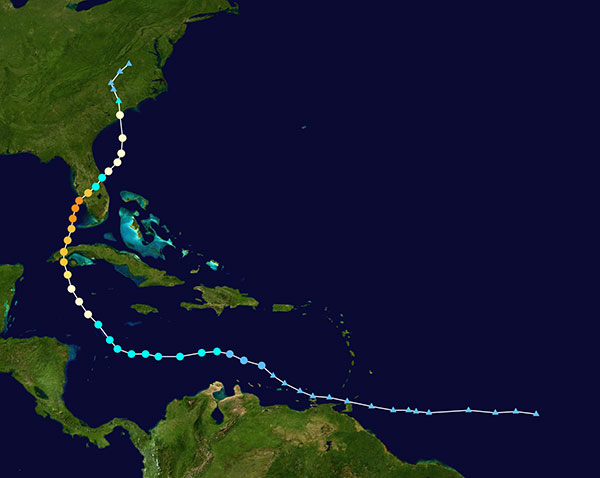
    Map plotting the storm's track and intensity using data from the National Hurricane Center and a NASA image. (Image: public domain/FleurDeOdile/Wikipedia)/
    Map plotting the storm’s track and intensity using data from the National Hurricane Center and a NASA image. (Image: public domain/FleurDeOdile/Wikipedia)/

    After the storm hit, first responders began searching more than 400 destroyed houses in Fort Myers, some using the pre-storm drone video to rescue any trapped survivors.

    The need was not only for access in difficult conditions, but also for communications. AT&T reportedly got cell coverage up quickly in a couple of areas, and Verizon flew tethered drones (capable of flying for up to 1,000 hours) to restore phone coverage over a circular radius area of five to seven miles. Verizon also hooked up generators and engaged satellite internet coverage for local use, and took a portable cell-site on a barge out to Sanabel Island, which had been cut off from the mainland. T-Mobile put generators at cell-sites that lost power and deployed satellite and ground-based portable cell coverage.

    Photo: Verizon
    Verizon tethered drones provided cellular service for first responders. (Photo: Verizon)

    Powerful Drone

    Loss of power was another issue. Florida Power and Light (FPL) flew its recently acquired fixed-wing FPLAir One drone to assess damage to its power distribution infrastructure, which supplies about 12 million people on Florida’s west coast.

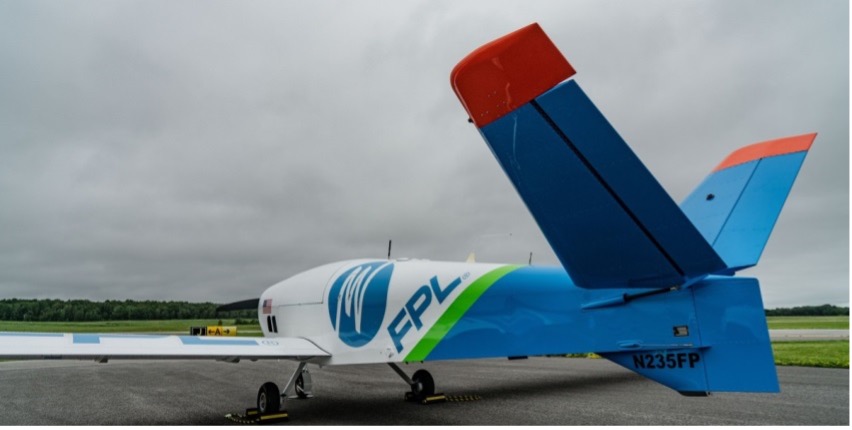
    FPL drone used in power loss assessment (Photo: FPL)
    FPL drone used in power loss assessment. (Photo: FPL)

    Using the drone in damage assessment efforts enabled FPL to get suitable crews to the right places early in the recovery effort.

    FPLAir One is a group 4/5 large UAV. It appears to be a Navmar Applied Sciences Corporation (NASC)/Sonex Aerospace TEROS unmanned aircraft, which is based on an earlier Sonex-powered glider design introduced in 2003. Because of this heritage and its rugged airframe, the TEROS is ideally suited for flights in high wind conditions — great for FPL’s long-range pre- and post-storm assessment application using FLIR and video cameras.

    The drone’s extensive prior airframe proving is assisting NASC/Sonex in its quest for certification of TEROS by the Federal Aviation Administration (FAA). FAA certification will ultimately support its integration into the National Airspace System (NAS) and allow operators to move on from the individual FAA approvals required for each operational drone scenario.

    Drones to the Rescue

    The principal application for hundreds of drone flights by several organizations was search and rescue for missing residents, mostly in the flooded area in and around Fort Myers. Drones also helped rescue people in North Port, where floodwater was as high as four feet, collapsing roofs and trapping people in their homes.

    Skydio provided drones for several search-and-rescue programs by police and other agencies, as well as coaching personnel who might lack experience in flying them. More than 500 drone flights were accomplished in the first days after the storm, a large number using autonomous flight capability, greatly assisting rescue efforts to locate trapped people. First responders were also able to determine whether access was possible, or what steps were initially needed to even enable access.

    Insurance companies are also using drone assessment video, determining the level of damage to homes and vehicles, in an effort to put assistance where it was most needed early on. Using artificial intelligence to align food-stamp users with badly damaged homes identified on satellite images in Lee, Collier and Charlotte counties, GiveDirectly offered immediate $700-assistance to many survivors. If all these offers were accepted, the cost could be as much as $2.4 million in no-strings-attached immediate aid for those worst hit.

    In the aftermath of the largest, most damaging hurricane to hit the United States since 1935, volunteers, first responders, drone pilots, aid agencies, and power, communication and insurance companies all made use of drones. These agencies and companies are still helping many thousands of people to survive and start the long task of picking up the pieces of their lives.

  • U.S. Department of Transportation selects drone Remote ID partners

    U.S. Department of Transportation selects drone Remote ID partners

    Photo: RyanKing999/iStock / Getty Images Plus/Getty Images
    Photo: RyanKing999/iStock / Getty Images Plus/Getty Images

    The U.S. Department of Transportation’s Federal Aviation Administration (FAA) announced the eight companies that will assist the federal government in establishing requirements for future suppliers of Remote Identification (Remote ID).

    Remote ID will enable unmanned aircraft systems (UAS), commonly called drones, to provide identification and location information while operating in the nation’s airspace.

    The FAA selected the following companies to develop technology requirements for future Remote ID UAS Service Suppliers (USS):

    • Airbus
    • AirMap
    • Amazon
    • Intel
    • One Sky
    • Skyward
    • T-Mobile
    • Wing

    These companies were selected through a Request for Information process in December 2018.

    “The FAA will be able to advance the safe integration of drones into our nation’s airspace from these technology companies’ knowledge and expertise on remote identification,” said U.S. Transportation Secretary Elaine L. Chao.

    This initial group will support the FAA in developing technology requirements for other companies to develop applications needed for Remote ID. The applications will provide drone identification and location information to safety and security authorities while in flight.

    The technology is being developed simultaneously with the proposed Remote ID rule. Application requirements will be announced when the final rule is published. The FAA will then begin accepting applications for entities to become Remote ID suppliers. The FAA will provide updates when other entities can apply to become qualified Remote ID USS on FAA.gov.

    Drones are a fast-growing segment of the transportation sector with nearly 1.5 million drones and 160,000 remote pilots now registered with the FAA. The agency’s ability to develop Remote ID technology simultaneously with the rule enables the FAA to continue to build on a UAS Traffic Management (UTM) system that has demonstrated global leadership through the small UAS rule and the implementation of the Low Altitude Authorization and Notification Capability (LAANC), which automates the application and approval process for most UAS operators to obtain airspace authorizations.

  • Eight Inches or Less: On the Road to High Accuracy for Automated Driving

    Eight Inches or Less: On the Road to High Accuracy for Automated Driving

    Janice Partyka
    Janice Partyka

    From CES to the Detroit Auto Show, it has been a big month for in-car connectivity that enables vehicle diagnostics, streaming entertainment, telematics and navigation. Ford, GM, Google and Audi unveiled new connected vehicle platforms and features, and AT&T stole the carrier limelight with LTE Connected Services.

    Plus, two industry giants announced that they are working to enable vehicles to continuously record road position at accuracies of eight inches or less. Shoppers are becoming more open to sharing their personal location with retailers. And the U.S. GAO issued a report on location privacy related to vehicle technology and applications. It has been a busy month.

    The first mass-marketed connected vehicle system was Ford Sync, which now boasts one million users and seems poised to grow rapidly with the release of an updated version. The Mustang will be the first of the company’s models with the new Ford Sync, which lets drivers use voice to activate iPhone and Android apps. New voice activated apps include Parkmobile, a parking space finder, and the Domino app, which lets me command my car to order a pizza, just the way I like it. GM announced its first LTE-enabled vehicles for about 10 of its models. Fast connectivity in vehicles will transform in-car experiences and hopefully not kill us.

    Carrier Ringmaster. AT&T wrangled itself into the center ring of car connectivity announcements. The carrier has won a multi-year exclusive agreement to enable Telsa with high speed connectivity. Despite Audi’s collaborative relationship with T-Mobile, AT&T was able to steal some work away from T-Mobile by getting a deal to supply connectivity for some Audi models. AT&T has also teamed up with Ericsson, Amdocs, Jasper Wireless and others to create AT&T Drive, a mobile platform for developing LTE connected vehicle services.

    Pathway to a Jetson Car. Two industry biggies, Continental and Here, are working together to create an end-to-end connected high-precision mapping and vehicle system offering for OEMs. The system will serve as the basis of highly automated driving functionality with the first objective of continuously determining road position to within three to eight inches. That’s quite a task. The maps will include road information that will feed vehicles with information to allow them to react to changing road conditions or speed limit changes, automatically. Continental was the first automotive supplier to be granted a test license for automated driving on public roads in Nevada.

    See Me Now. The percentage of consumers willing to share their current location via GPS with retailers nearly doubled year-over-year to 36 percent, according to a new IBM study of more than 300,000 global consumers. The study distinguished four distinct groups of consumers, differentiated by their interest in and use of social, location and mobile technologies while shopping. The largest group, 40 percent of shoppers, use social, location and mobile technologies, but don’t utilize them for buying products. The second largest group, almost 30 percent of shoppers, will use these technologies for making purchases. The rest of the shoppers sit on either pole of being tech laggards or hyper technology users.

    In-Car Privacy under the Microscope.  The U.S. Government Accountability Office (GAO) has looked into privacy issues for in-car location-based services. The GAO examined how 10 companies are using location data and if they share it, and how the policies and practices of these companies align with industry recommended privacy practices. Each of the companies stated that they do not share personally identifiable location data with marketing companies or data brokers. The GAO found that not all of the companies were following industry recommended privacy policies. The report was prepared for the Senate Subcommittee on Privacy, Technology and the Law of the Judiciary Committee. The companies that the GAO chose to examine included TeleNav (ScoutGPS Navigation), Google Maps (Navigation), TomTom (LIVE Services), Garmin Traffic, Ford Sync, Chrysler UConnect, Honda AcuraLink, GM OnStar, Toyota (Lexus Enform and Toyota Entune), and Nissan Infiniti Connection and CARWINGS.

    Retailers are Getting Closer. Qualcomm has made its Gimbal proximity beacons commercially available, which are reportedly accurate to one foot and work indoors and outdoors. Gimbal is a proximity platform for brands to engage customers’ mobile devices with contextual communication, using a combination of physical location, activity, time and personal interests. The intent is to increase the relevance of content delivered to end users’ devices to allow retailers, content providers and developers to send personalized high-value content to mobile devices.

  • Abaqus, 1Shop Wireless Launch myGeoTracking MRM Service for T-Mobile Business Customers

    Abaqus, Inc., developer of a device-neutral, cloud-based location and messaging platform, and 1Shop Wireless, national sales agent for T-Mobile USA, have teamed to provide the cloud-based myGeoTracking mobile workforce management service for T-Mobile customers.

    The Abaqus myGeoTracking platform provides a cloud-hosted solution that combines network-derived and phone-based GPS location information with fine-grained privacy control options, location-enhanced SMS, and a powerful rules engine to let companies quickly and easily manage their field-personnel and assets, the companies said. It does not require special devices or smartphones, expensive data plans, cumbersome applications, or software.

    Peter Giansante, director of Sales for 1Shop Wireless, called the service “an ideal device-neutral location-based-solution for companies that want to equip their employees with feature phones and smartphones, and want to avoid the deployment and training issues associated with mobile apps-based MRM services.”

    “Abaqus’myGeoTracking bizTeam service is a great fit for any field-force oriented T-Mobile customer that needs to deploy a mobile management solution,” said Gillian Foley, vice president of One Shop Wireless. “T-Mobile is constantly seeking innovative ways to meet customer demands. myGeoTracking fits the bill with its cloud-based approach that provides a lot of flexibility and choice to companies seeking a better way to affordably manage their mobile workforce.”

    Unlike smartphone-based applications that require special phones and client applications, the location-enhanced, SMS-based myGeoTracking mobile workforce management solution from Abaqus can locate any phone on a cellular network using either cell ID information, or a precise location using GPS inside the device. The platform provides fine-grained controls to the dispatcher or the employee in the field to pull or push location data using simple SMS commands.

    The myGeoTracking platform has a rich web API which can be used to integrate with a range of back-office Enterprise systems, the companies said. The service provides SMS-based messaging for team job status reports, and has a powerful rules engine that can use geofencing, time, device identity, workgroup, and other terms to integrate into a company’s mobile workflow needs on a day-to-day basis.

    • The myGeoTracking bizTeam service is an MRM solution which is completely cloud-based and does not require special GPS devices, special phones or any new software.
    • The myGeoTracking bizTeam MRM service can use any standard feature phone to send location and event information, and complies with USPS location standards.
    • The myGeoTracking bizTeam MRM service provides fine-grained privacy controls, which can be managed by the end-user from their mobile phones or from the web site
    • Location-enhanced SMS (myGeoText) lets mobile workers actively send the date, time, and location stamped status message from the field and trigger additional dispatch functions.
    • The myGeoTracking bizTeam MRM service provides geofencing, geo-corridors, and a variety of other events-based rules to enable easy integration of real-world alerts into a company’s workflow
    • The myGeoTracking bizTeam service provides rich reporting tools which can be exported to a company’s backoffice systems
    •  The myGeoTracking MRM bizTeam service provides an Enterprise SMS feature which lets customer’s enhance their dispatch and operations by messaging individuals, groups, or the whole company.
    •  The myGeoTracking Platform integrates with a range of back-office programs through a rich web API.

    “We’re thrilled to team up with 1Shop Wireless and T-Mobile to provide the myGeoTracking bizTeam service as a light MRM solution for small-to-medium business customers,” said Shailendra Jain, CEO/Founder or Abaqus, Inc. “We look forward to working with 1Shop Wireless and T-Mobile to grow the adoption of cloud-based location and messaging services with strong privacy controls, and help their customers achieve clear ROI and real bottom-line benefits from the service.”

  • Abaqus, 1Shop Wireless Launch myGeoTracking MRM Service for T-Mobile Business Customers

    Abaqus, Inc., developer of device-neutral, cloud-based location and messaging platform that enables high-quality, low-cost mobile workforce and asset management solutions, and 1Shop Wireless, a national business partner sales (BPS) master agent for T-Mobile USA, have teamed to provide the cloud-based myGeoTracking mobile workforce management service for T-Mobile customers.

    “We’re really excited to work with Abaqus to offer their myGeoTracking MRM service to T-Mobile customers,” said Peter Giansante, director of sales for 1Shop Wireless. “It’s an ideal device-neutral location-based-solution for companies that want to equip their employees with feature phones and smartphones, and want to avoid the deployment and training issues associated with mobile apps-based MRM services.”

    The Abaqus myGeoTracking platform provides a unique cloud-hosted solution that combines network-derived and phone-based GPS location information with fine-grained privacy control options, location-enhanced SMS, and a powerful rules engine to let companies quickly and easily manage their field-personnel and assets. It does not require special devices & smartphones, expensive data plans, cumbersome applications, or software.

    “Abaqus’ myGeoTracking bizTeam service is a great fit for any field-force oriented T-Mobile customer that needs to deploy a mobile management solution,” said Gillian Foley, vice president of One Shop Wireless.

    Unlike smartphone-based applications that require special phones and client applications, the location-enhanced, SMS-based myGeoTracking mobile workforce management solution from Abaqus can locate any phone on a cellular network using either Cell ID information, or a precise location using GPS inside the device. The platform provides fine-grained controls to the dispatcher or the employee in the field to pull or push location data using simple SMS commands. The myGeoTracking platform has a rich web API which can be used to integrate with a range of back-office Enterprise systems, Abaqus said. The service provides SMS-based messaging for team job status reports, and has a powerful rules engine that can use geo-fencing, time, device identity, workgroup and other terms to integrate into a company’s mobile workflow needs on a day-to-day basis.

    • The myGeoTracking bizTeam service is an MRM solution which is completely cloud-based and does not require special GPS devices, special phones or any new software.
    • The myGeoTracking bizTeam MRM service can use any standard feature phone to send location and event information, and complies with USPS location standards.
    • The myGeoTracking bizTeam MRM service provides fine-grained privacy controls which can be managed by the end-user from their mobile phones or from the web site
    • Location-enhanced SMS (myGeoText ™) lets your mobile workers actively send you a date, time and location stamped status message from the field and trigger additional dispatch functions.
    • The myGeoTracking bizTeam MRM service provides Geofencing, Geo-corridors, and a variety of other events-based rules to enable easy integration of real-world alerts into a company’s workflow
    • The myGeoTracking bizTeam service provides rich reporting tools which can be exported to a company’s backoffice systems
    • The myGeoTracking MRM bizTeam service provides an Enterprise SMS feature which lets customer’s enhance their dispatch and operations by messaging individuals, groups, or the whole company.
    • The myGeoTracking Platform Integrates with a range of back-office programs through a rich web API.
  • How Does the Potential AT&T Acquisition of T-Mobile Affect the Location Industry?

    Now that CTIA is over, and without a lot of location-based services news at the Orlando show, the time is ripe to examine the potential blockbuster AT&T acquisition of T-Mobile and how it affects the location industry. In the meantime, is Apple trying to get its mapping initiatives stronger to compete with other heavyweights? Does this include trying to be its own map database provider?


    The potential blockbuster acquisition of T-Mobile by AT&T raises some eyebrows in the location industry, not because of the consolidation of two major wireless carriers with navigation programs, but for spectrum availability issues. At least one analyst believes so.

    “I think AT&T has been very open in indicating that one of the major reasons for the acquisition of T-Mobile was a response to the spectrum crunch,” said Michael Dobson, TeleMapics president. “According to Ralph de la Vega, president and CEO of AT&T Mobility, their customers’ data usage has grown 8,000 percent over the last four years and is predicted to grow 8 to 10 times larger over the next five years. During the CEO Roundtable at CTIA, de la Vega indicated that the proposed deal will help to alleviate the spectrum crunch that both AT&T and T-Mobile are experiencing in key markets by allowing them to more efficiently use the allocated spectrum. I should note that details on how the spectrum would be used more efficiently as a result of the potential acquisition were not addressed at CTIA.”

    Dobson said Robert Roche of CTIA’s comment were illuminating. Roche indicated that data usage in 2010 grew by 110 percent compared to 2009 and totaled 388 billion megabytes of data. Note that this “data” total does not include the more than two trillion minutes of air-time generated by wireless users or the 2 trillion text messages sent by them during the same period, Dobson said.

    “In 2010 data accounted for approximately $50 billion of the total $160 billion, or services revenues realized by the wireless carriers. In 2000, data revenues for carriers were $211 million out of $55 billion in wireless service revenues,” he said. “In essence, data revenues have increased from less than one-percent of the revenue pie to almost one-third of present revenues over the last 10 years.”

    While it is impossible to ferret out the size of the data usage total that could be attributed to location services, Dobson says there is little reason to assume that it does not mirror the trend in data growth in general. “If AT&T can advantage itself by easing its spectrum crunch through the acquisition of T-Mobile, it could result in the company being more interested in navigation and LBS than in the past, especially if the action takes the heat off of them in the cellular call performance horse race with Verizon — for instance, fewer dropped calls,” he said.

    As an interesting side note, CTIA’s Roche indicated that texting has grown from an average of 14 million messages a month in 2000 to 187.7 billion messages during the 31 days of December 2010, Dobson said. “How many of these were related, in some manner, to location services or casual navigation — not a formal navigation service — remains unclear, but it is likely that many of these messages are about the user, where the user is, and where you can meet them,” he said. “Location and navigation are at the core of many social interactions, but finding the business strategy to unearth the value remains the problem for both the industry and the carriers.”

    Is Apple Trying to Improve Mapping?

    According to a number of recently published reports, Apple is starting to recognize that Google may have its stuff together on mapping technology and use. Recently, Apple had a job opening for an iOS Maps application developer — with rumors that it plans to redesign the iOS application — and even create its own maps database.

    “It is always difficult to know what Apple’s corporate strategy is in any area, much less one, like mapping, that is not in the limelight. While it is quite apparent that Apple will make some strategic move in mapping/location services, the nature of the strategy will likely be determined by Apple’s goals for its nascent advertising business aimed at mobile handsets,” Dobson said. “Those who use an iPhone have probably used the resident map app that is linked with a contact list. While the map data is provided by Google, the rest of the application was designed and developed by Apple. Clearly, they have experience in working with location data, as well as having augmented these skills through two modest acquisitions of companies who knew how to ‘munge’ data.”

    Dobson suspects that Apple will come out with some enhanced location software, featuring its usual slick interface and well-thought-out application. “However, the interesting question for the industry is whether or not Apple needs to be a map database provider in order to differentiate itself and its phones from the competition,” he said. “Android (Google) phones are powered by Google Maps, Nokia phones by Ovi Maps, and Windows phones by Bing Maps and soon by OVI Maps (Nokia) — although each of these is merely an instance of Navteq, which is, of course, owned by Nokia.”

    Dobson isn’t sure whether Apple needs to be a map supplier to be successful in the mobile advertising business. He said that the question, however, is whether or not Apple would be comfortable having a potentially substantial revenue streams dependent on the good will of a “foreign,” and possibly antagonistic, map supplier who is also a mobile competitor, or owned by one.

    “On the other hand, Apple is always upsetting the applecart. For example, I understand that one of the major traffic providers in the U.S. is developing a street-level database for the country’s top 20 urban areas,” he said. “When I first heard about this, it did not make much sense to me, since it is difficult to get into the navigation business with a piece of data here and a piece of data there. However, when I thought of this development as a strategy supporting an advertising play, it became a little more sensible. Unfortunately, there is no way of knowing what Apple intends until someone spills the beans, but it sure is fun speculating.”

    Is CTIA Becoming a Throw-away Show?

    Some industry observers have noticed the lack of real news at the CTIA conferences…and Dobson is one of those folks. “I have become disenchanted with CTIA and consider the show a throw-away. Anything interesting at CTIA must occur behind closed doors, because it certainly does not appear on the stage or on the exhibit floor,” he said. “On the other hand, perhaps I am too harsh; after all, these folks want to sell services and hardware and are not particularly interested in the details, as long as whatever it is, is hot,” he said. “My disdain for the lack of inquisitiveness at CTIA was sparked by a former Verizon President Denny Strigl, who has written a book about how to be a good manager.”

    At the conference Strigl said a manager needs to focus on four things — and only four things — to be successful as a manager. His recommendations: 1) grow your revenues, 2) add new customers, 3) retain old customers, and 4) cut costs. I realize that Mr. Strigl was generalizing, but it often seems that the CTIA audience sees data as a product to sell, but does not have a clear idea about the companies that provide quality data and the markets they serve, especially the location and navigation markets.

    “Please note that this is not sour grapes. Apparently unlike Mr. Strigl, I think that innovation in product development needs to be near the top of a manager’s to-do list. However,
    the innovation at CTIA seems to have come from Apple, Google, and others who decided how to take advantage of this weakness in the carriers’ philosophy,” Dobson said.

    In other LBS news:

    • I will be reporting at the O’Reilly Where 2.0 conference in Santa Clara, California, this month. If there are location topics you think I should know about and cover, please send me an e-mail.