Tag: Taking Position

  • How NASA captured high-resolution Moon imagery in 1960s

    How NASA captured high-resolution Moon imagery in 1960s

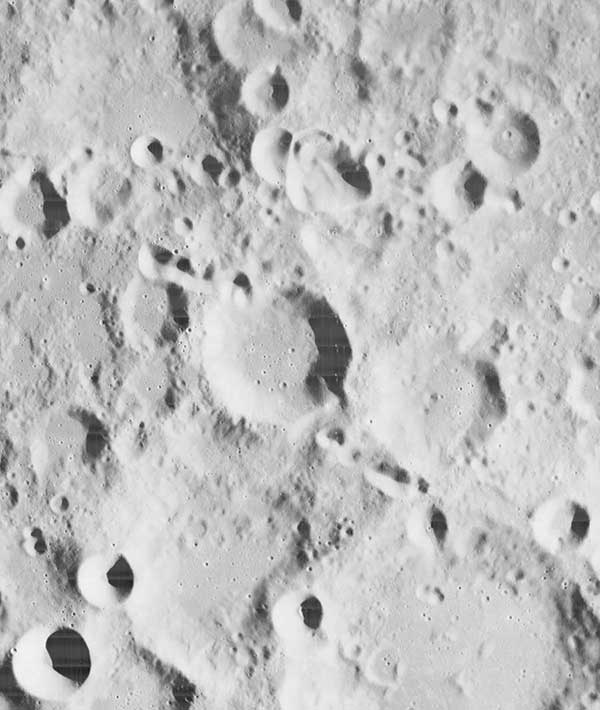
    Photo: NASA
    Photo: NASA

    I was inspired by the 50th anniversary of the Moon landing on July 16 and our focus on mapping this month to look into imagery of the Moon.

    Only recently have we learned that the lunar orbiters that photographed the Moon in the 1960s sent back images that were stunningly high resolution (HR), even by today’s standards. The actual resolution was presumably kept secret because the imaging technology was also used in our Cold War spy satellites.

    Under the Lunar Orbiter Program, satellites took photographs of the Moon’s surface to identify suitable landing sites for the Apollo Program. Managed by the Langley Research Center, five Lunar Orbiters were successfully flown in 1966 and 1967, mapping 99% of the Moon’s surface with a resolution of 60 meters or better.

    The first three missions were dedicated to imaging 20 potential landing sites, and were flown at low-inclination orbits.

    The fourth and fifth missions were devoted to broader scientific objectives and were flown in high-altitude polar orbits. Lunar Orbiter 4 photographed the entire nearside and 95% of the farside, and Lunar Orbiter 5 completed the farside coverage and acquired medium (20-meter) and high (2-meter) resolution images of 36 pre-selected areas.

    In that pre-digital era, the Lunar Orbiters had an ingenious imaging system, which consisted of a dual-lens camera, a film processing unit, a readout scanner and film-handling apparatus. Both lenses, a 610-mm narrow angle HR lens and an 80-mm wide-angle medium resolution (MR) lens, placed their frame exposures on a single roll of 70-mm film.

    The axes of the two cameras were coincident so the area imaged in the HR frames were centered within the MR frame areas.

    The film was moved during exposure to compensate for spacecraft velocity, which was estimated by an electric-optical sensor. The film was then processed, scanned, and the images transmitted back to Earth. Based on these images, the NASA Apollo Site Selection Board would name five candidate landing sites in February 1968.

    Through the dedication of volunteers, the images have all been digitized. The entire Lunar Orbiter atlas is online.

  • Did the chicken you’re eating live a happy life?

    Did the chicken you’re eating live a happy life?

    Portlandia Prediction: Fred Armisen and Carrie Brownstein have a few questions about their chicken dinner. (Screenshot: IFC)
    Portlandia Prediction: Fred Armisen and Carrie Brownstein have a few questions about their chicken dinner. (Screenshot: IFC)

    In 2011, the first-ever episode of a TV comedy called “Portlandia” debuted. In one sketch, concerned diners played by series stars Fred Armisen and Carrie Brownstein question their waitress about the origins of their chicken dinner.

    The waitress shows the couple the chicken’s papers and photo — Colin the Chicken lived a free-range life on a four-acre woodland farm only 30 miles away, dining on sheep’s milk, soy and hazelnuts, in the company of his chicken friends. Unconvinced even by these details, the couple decides to drive to the farm to see it for themselves.

    Enter GoGo Chicken

    In a case of comedy becoming reality, Chinese insurance company ZhongAn Online has outfitted more than a 100,000 chickens with GPS trackers. People who buy a chicken with a tracker strapped to its leg will know every step that that chicken has taken. Using a smartphone app called GoGo Chicken, customers can monitor the animal’s diet, exercise and environment.

    The company says its technology will be on 2,500 farms in China by next year. It is also working on facial-recognition technology so that consumers can make sure the organic chicken they saw on the farm is the same one that ends up on their plate.

    While this all sounds a bit much for many of us who grew up on Chicken McNuggets, there is a practical side. The company hopes GPS tracking will help prevent food safety problems, such as a 2014 crisis in China in which a supplier was caught selling rotting and expired meats to fast-food chains. In the event an issue does arise, the data tracked by the devices could help find the source of the problem.

  • Discover your inner GPS

    Discover your inner GPS

    O’Keefe (left). Grid cells form networks with the place cells in the hippocampus, a circuitry that creates a comprehensive positioning system — an inner GPS — in the brain. (Source: Nobel Committee)
    O’Keefe (left). Grid cells form networks with the place cells in the hippocampus, a circuitry that creates a comprehensive positioning system — an inner GPS — in the brain.(Source: Nobel Committee)

    The Institute of Navigation Satellite Division looked deeply inward for its keynote speaker at this year’s ION GNSS+ conference, held Sept. 12–16 in Portland, Oregon.

    Nobel Laureate John O’Keefe provided insight into how our brains determine position. In 1971, O’Keefe recorded signals from individual nerve cells in the hippocampus of rats roaming about a room. He found that a type of nerve cell in the hippocampus was always activated when a rat was at a certain place, and other nerve cells were activated when the rat was at other places.

    O’Keefe concluded that these “place cells” formed a map of the room. The place cells were not just registering visual input, but building an inner map of the environment. The hippocampus generates numerous maps, which can be seen by the activity of place cells activated in different environments. The memory of an environment can be stored as a specific combination of place-cell activities in the hippocampus.

    In 2005, co-laureates May-Britt and Edvard Moser discovered another key component of the brain’s positioning system. “Grid cells” generate a coordinate system and allow for precise positioning and pathfinding. Their research showed how place and grid cells make it possible for rats — and presumably us — to find our way around, determining where we are in the world and which way to go.

    Recent investigations show that place and grid cells also exist in humans. In patients with Alzheimer’s disease, the hippocampus is frequently affected, causing those afflicted to lose their way. Knowledge about the brain’s positioning system may help us understand the mechanism underpinning the disease.