Tag: Texas A&M

  • Balboa Geo demonstrates PNT system in GPS-denied environments

    Balboa Geo demonstrates PNT system in GPS-denied environments

    Balboa Geo, in partnership with the Texas A&M Engineering Extension Service (TEEX) and the George H.W. Bush Combat Development Complex (BCDC), completed a rigorous field testing campaign of its POINTER system, a “dual-use,” real-time alternative positioning, navigation and timing (A-PNT) technology designed for GPS-denied, degraded and disrupted environments, including indoor, subterranean and obstructed urban settings.

    The POINTER field test plan, led by Balboa Geo’s Andrew Aubrey, Ph.D., with technical support from TEEX and Texas A&M Professor Stacey Lyle, Ph.D., RPLS, involved 130 tests across seven challenging testing and training venues located at TEEX and the BCDC.

    Test venues included:

    • A three-story concrete structure with 10-inch-thick, rebar-reinforced concrete walls
    • A compartmentalized steel-hulled ship with three decks reaching approximately 25 ft high
    • A steel shipping container (CONEX)
    • A simulated collapsed structure and rubble pile composed of steel, concrete, and a 90° tunnel network
    • A simulated industrial oil refinery with processing equipment and complex, elevated steel piping
    • A six-story steel training tower with metallic siding throughout
    • The BCDC military-grade subterranean tunnel network, featuring a main tunnel at about 10 ft deep and a heavily shielded segment with Faraday cage properties simulating greater depth

    Rigorous test design and real-time A-PNT data collection

    The POINTER field test plan deployed a Base Station Laptop (BX) and a single Transmitter (TX) emitting an omni-directional Magneto-Quasistatic (MQS) field outside each venue. Two Receivers (RX) were introduced at various internal locations to capture multiple “XYZ” axis measurements within each GPS-denied setting. Tests were repeated to validate reproducibility, with highly precise measurements taken where possible for ground truth position references.

    The BCDC military-grade tunnel network testing consisted of “normal” and “inverted” configurations. The “inverted” test consisted of placing the TX at depth within the tunnel network, with the BX and RX units located externally.

    Highlights of the summary results and key findings:

    • MQS field penetration and position location were achieved at all seven test venues.
    • Real-time, three-dimensional distance measurements were obtained for all 130 tests.
    • The mean positional uncertainty across all venues was 12.62 cm.
    • Positional uncertainty ranged from 2.5 cm to 36 cm, depending on venue complexity, receiver location, and transmitter-receiver distance.
    • Vertical measurements at the concrete structure showed uncertainties as low as 2.5 centimeters at a distance of about 11 m, and up to 24 cm at about 30 m.
    • The POINTER system demonstrated penetration into and out of the BCDC military-grade tunnel network, including the shielded portion, indicating flexibility and performance in challenging subterranean environments.
  • U.S. Army partners with UT Austin, Texas A&M System for advanced PNT

    This month, the University of Texas at Austin became a major research hub for the U.S. Army Futures Command.

    On Oct. 12, the Futures Command broke ground on a $130 million research facility at the Texas A&M University System’s RELLIS Campus in Bryan, Texas. Efforts at both locations will include research on advanced and assured positioning, navigation and timing (PNT) systems.

    The Army Futures Command was established in Austin during the summer of 2018. It has been working to build long-standing partnerships with University of Texas at Austin, Texas A&M University System and others in central Texas.

    Groundbreaking ceremony for the Bush Combat Development Complex at the Texas A&M University System RELLIS Campus, named in honor of former President George H.W. Bush. (Photo: Groundbreaking ceremony for the Bush Combat Development Complex at the Texas A&M University System RELLIS Campus, named in honor of former President George H.W. Bush. (Photo: Texas A&M University))
    Groundbreaking ceremony for the Bush Combat Development Complex at the Texas A&M University System RELLIS Campus, named in honor of former President George H.W. Bush. (Photo: Texas A&M University)

    “The Army designated UT Austin as a strategic partner,” said Professor Todd Humphreys, faculty lead for the Radionavigation Laboratory at the University of Texas, Austin. “UT will focus on two key areas: assured PNT and robotics.” Humphreys has a background in both.

    Humphreys says his organization is eager to begin working with the Army. The main focus of his PNT efforts will be “… leveraging the tens of thousands of communications satellites projected to be in low earth orbit in the next few years for PNT services,” he said. “We are working with a major provider and already have some interesting results we can share.”

    A member of Humphreys’s team is expected to discuss this work at a meeting of the National PNT Advisory Board next month.

    A secondary focus for Humphreys’s lab will be development of integrated sensing equipment with GNSS, low-earth-orbit PNT, radar, vision, inertial, and communications that can deliver assured PNT for the Army’s mounted platforms.

    “Assured PNT is one of the principal platforms we are working on,” said Greg Winfree, agency director of the Texas A&M Transportation Institute, a state agency and member of the A&M System. Winfree is also a board member for the RNT Foundation. “Our efforts will be complementary and collaborative with UT’s lead role.”

    Winfree sees new PNT sources and their intersection with automated vehicle technologies, drones and robotics as an ideal area for his organization’s contributions. “Our core themes include four application areas that the A&M System could credibly bring forward: RF testing and analysis, vehicle communications and connectivity, unmanned aerial systems, and precision agriculture.”

    This could generate a number of spinoffs for civilian agriculture. “Precision Agriculture is a key consideration since reliance upon GPS is a core technological underpinning. Texas A&M has the premier agricultural science program in the country.”

    He sees specific areas ripe for investigation by A&M as including:

    • Creating software defined chips/modules and developing miniaturized antennae for new signal sources
    • Addressing the potential for degraded sensitivity posed by antenna miniaturization
    • Developing multi-frequency radios and sensors to allow automated vehicles, drones and robotics to seamlessly utilize GPS along with signals from sources such as ELoran, DSRC, C-V2X, and 5G
    • Developing AI equipped aerial and underwater drones to test functionality and reliability of signals in challenging environments.

    The A&M System has a strong team to bring to bear on such issues, according to Winfree. It includes Dr. Stephen Cambone, associate vice chancellor for research security for the A&M System and the first DoD undersecretary for cybersecurity, and Dr. Byul Hur, assistant professor of engineering technology and industrial distribution and head of the A&M Radio Frequency Test Group.


    Dana A. Goward is the president of the Resilient Navigation and Timing Foundation.

  • Two New Apps Enable Public to Help First Responders

    Photo credit: Texas A&M.
    Photo credit: Texas A&M.

    Two new apps developed at Texas A&M University-Corpus Christi use social media to help police officers, news stations, and the public navigate the many incidents and minor emergencies that may occur on a daily basis.

    Richard Smith, creator of the two emergency response apps, is collaborating with Michelle Maresh-Fuehrer, assistant professor of Communication at A&M-Corpus Christi, to identify how the apps could aid first responders during emergencies.

    “With the combination of SituMap and PhotoSorter, the public can be encouraged to submit photos and videos that may be helpful during an investigation,” said Smith, assistant professor of Geographic Information Science and Geospatial Surveying Engineering at the Island University. “For example, during an active shooter event, photos and videos of the suspect or their location can be taken with a cell phone and easily sent to responders. This could drastically improve response time and ultimately save lives.”

    TexasA&M-app-1
    Photo credit: Texas A&M

    Smith developed the mapping applications to provide a way for first responders to rapidly, and easily, receive and map information so they could have a more comprehensive awareness of emergency situations. Maresh-Fuehrer is working on extending the use of Smith’s social media mapping applications to enhance communication before, during, and after a crisis.

     “A crisis event is typically a time of high stress and increased uncertainty for organizations and responders,” said Maresh-Fuehrer, who studies crisis communication strategies. “The applications developed by Dr. Smith have several features that allow for more informed and efficient crisis response.”

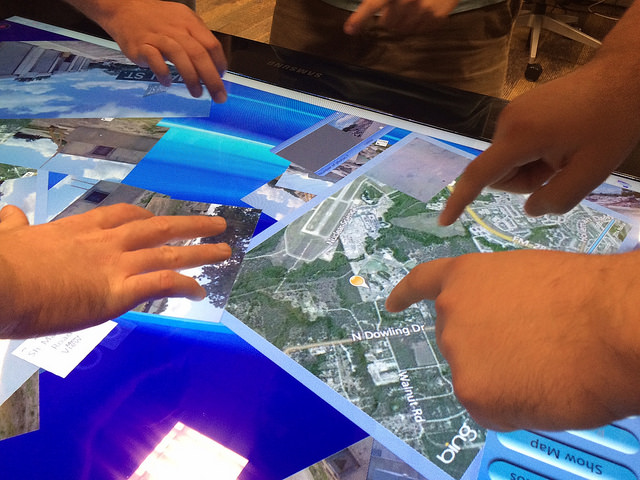
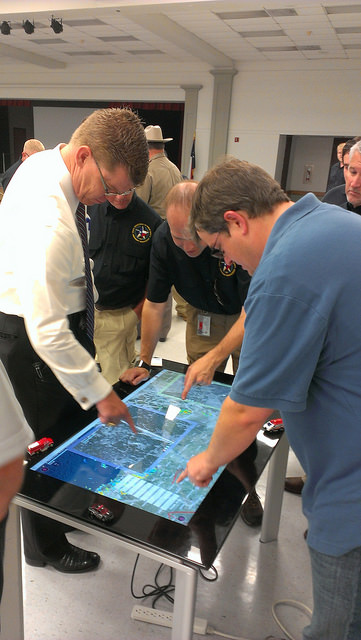
    SituMap acts as a tablet-like digital command center that shows officers maps of the crisis area. With the touch of a finger the table-size display can be zoomed, rotated and drawn on. Like a personalized version of Google Maps, officers can search for locations and measure distances. But it goes further than Google Maps. A pin can be created in the application that could represent a person, police car, or groups of people. The pin can be strategically positioned around the area and directions can then be relayed to officers at the emergency location.

    “An organization’s crisis team, along with emergency responders, can use SituMap to identify where people should be during a specific crisis,” said Maresh-Fuehrer. “With this application, responders can even view floor plans. This could help to identify safe locations such as fire exits and stairwells.”

    PhotoSorter works in tandem with SituMap by allowing emergency responders, crisis planners and community members to share pictures or video of the crisis. Emergency responders can then upload the photos and video into SituMap to help in important decision-making situations.

    SituMap and PhotoSorter were designed and developed at the Island University by Smith. The University Police Department is currently using a beta version of SituMap in training sessions.

    In today’s digital world, people all over the globe can be connected through social media and, with the touch of a button, information about a major accident can be shared worldwide. With SituMap, important responders, as well as the community, can see real-time information on traffic congestion, roadblocks, and closed roads, which will aid in faster response times. The app also has a weather feature built into it which could be used during severe weather events such as a hurricane.