Tag: thermal vacuum testing

  • System of Systems: GPS III bidding, testing

    GPS III Bidding Opens — Again

    The GPS Directorate at the Space and Missile Systems Center (SMC) continues to look for someone to build 22 GPS III satellites in the near future.

    SMC issued a request for proposals on Jan. 8, with rather complicated terms. The first eight GPS III satellites are already under contract, and two have been built, but delivery and launch schedules have dragged. The Air Force incorporated several other payload requirements for the satellites, beyond those of new GPS signals themselves.

    This is the Air Force’s third effort to find a builder.

    The RFP is for “11+ Phase 1 Production Readiness Feasibility Assessment. “ It covers GPS III space vehicles 11 and beyond. The process, if followed as the Air Force envisions, will award up to three relatively small fixed-price contracts.

    According to an Air Force press release, “The scope of this effort includes the current GPS III SV01–08 technical baseline with the addition of redesigned Nuclear Detonation Detection System (NDS), Search and Rescue/GPS (SAR/GPS), and Laser Retroreflector Array (LRA) payloads, Unified S-Band (USB) compliance, Regional Military Protection capability No changes are allowed to the GPS Next Generation Operational Control System (OCX) or Military GPS User Equipment (MGUE) interfaces.”

    The first Air Force effort to recompete the contract for future GPS III satellites came in 2014. A 2015 initiative lowered the bar as far as requirements, but also lowered the award very dramatically, from $200 million each for two companies to $6 million each for three companies.

    The 2016 announcement appears to replicate the terms of the 2015 campaign. There has been no official explanation as to why the terms changed between 2014 and 2015, and why they did not between 2015 and 2016.


    First GPS III Satellite Passes Critical Test

    The first GPS III satellite has passed a critical on-ground, in-lab test, according to Lockheed Martin.

    Rick Ambrose, executive vice president of Lockheed Martin Space Systems, tweeted on Jan. 13 that the satellite had successfully completed its thermal vacuum test (TVAC).

    Lockheed Martin Space Systems is the prime contractor on the GPS III program to build a total of eight GPS IIIs. The contract includes options for up to four more satellites, and the Air Force has told Congress it expects to execute options for at least two of those satellites.

    The first GPS III satellite is expected to launch in 2017.


    USCG-Alert-W

    Coast Guard Issues Jamming Alert

    The U.S. Coast Guard issued a safety alert on Jan. 16, warning mariners of the potential detrimental impact to navigation caused by GPS interference or jamming. The warning emphasizes the importance of understanding how vessel equipment could be impacted by the loss of a GPS signal.

    The Coast Guard states that this past summer, multiple outbound vessels from a non-U.S. port suddenly lost GPS signal reception. The net effect was various alarms and a loss of GPS input to the ship’s surface search radar, gyro units and ECDIS, resulting in no GPS data for position fixing, radar over ground speed inputs, gyro speed input and loss of collision avoidance capabilities on the radar display.

    Fortunately, the vessels were able to safely continue theirvoyage using radar in heads up display, magnetic compass and terrestrial navigation. Approximately six nautical miles later, the vessels’ GPS units resumed operation. Although the vessels had back-up systems to allow a safe transit, the consequences could have been severe, warns the Coast Guard.


    IRNSS Launches Fifth Satellite

    The fifth satellite in India’s Regional Navigation Satellite System rode into orbit Jan. 20, joining a growing fleet of spacecraft to provide positioning services to users across South Asia.

    “With this satellite in place, within our country we will be able to get, 24 x 7, a good positional accuracy,” said A.S. Kiran Kumar, chairman of the Indian Space Research Organisation (ISRO).”

    IRNSS 1E will raise its orbit to an altitude of nearly 36,000 kilometers (22,300 miles) over the next few weeks, entering an orbit centered on 111.75 degrees east longitude and oscillating up to 28.1 degrees north and south of the Equator.

    Two more IRNSS spacecraft are due for launch bythe end of March to complete the constellation.

    The seven satellites — four in inclined geosynchronous orbits like the one intended for IRNSS 1E, and three in equatorial geostationary orbit — will give India an independent navigation system with coverage over Indian territory and regions extending up to 1,500 kilometers (932 miles) from its borders.

    India started launching its navigation satellites in 2013. Each spacecraft is designed to operate for 12 years.

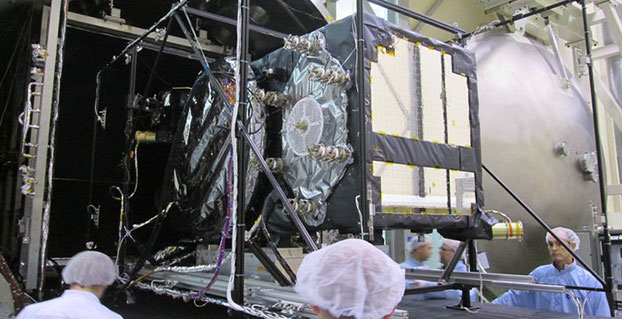
  • GPS III satellite passes thermal vacuum test

    As first reported Jan. 19, Lockheed Martin engineers have proved their design for the GPS III satellite, demonstrating that it can operate in and withstand the harsh conditions it will experience on orbit.

    On Dec. 23, Lockheed Martin’s first GPS III satellite for the U.S. Air Force completed system-level Thermal Vacuum (TVAC) testing, validating the design of the entire assembled satellite. TVAC is a rigorous test designed to prove a satellite’s integrity and operational capabilities by subjecting it to prolonged cycles of simulated space temperature extremes in a special depressurized chamber.

    “TVAC is the most comprehensive and perceptive test performed at the spacecraft level. If there is an issue with your design or production processes, you are going to find it here,” said Mark Stewart, vice president of Lockheed Martin’s Navigation Systems mission area. “Successful completion of this significant test validates the thermal design of the spacecraft and verifies that all spacecraft components and interfaces operate at the temperature extremes of the space environment. We credit this performance to the Back to Basics work we performed earlier and the program’s unique GPS III Non-flight Satellite Testbed.”

    Source: GPS world staff
    The first GPS III satellite undergoes system-level thermal vacuum testing. (Photo: Lockheed Martin)

    In spring 2015, the GPS III satellite’s major functional components were successfully integrated to form the first complete satellite. In the fall, the new satellite also successfully completed acoustic testing, where it was pounded with sound waves to simulate the vibrations it will endure during its launch.

    With eight satellites under contract, the production line is now on a steady tempo at Lockheed Martin’s GPS III Processing Facility outside of Denver, Lockheed Martin said. The first four GPS III satellites are in various stages of assembly and test with most major components — including their structure and propulsion systems, solar arrays, and antennas — already delivered.

    This spring, with Harris Corporation’s delivery of its second navigation payload, the second GPS III satellite is expected to be integrated and begin environmental testing.

    Components for the next four GPS III satellites are already being assembled, tested and delivered on schedule by more than 250 aerospace industry companies from 29 states.

    “We have a world-class industry team supporting the development and production of GPS III for the Air Force and our nation,” continued Stewart. “I thank them for their excellent work and commitment to this program.”

    GPS III will deliver three times better accuracy, provide up to eight times improved anti-jamming capabilities and extend spacecraft life to 15 years, 25 percent longer than the satellites launching today. GPS III’s new L1C civil signal also will make it the first GPS satellite to be interoperable with other international global navigation satellite systems.

  • Four Galileo Satellites Now at ESTEC

    Four Galileo Satellites Now at ESTEC

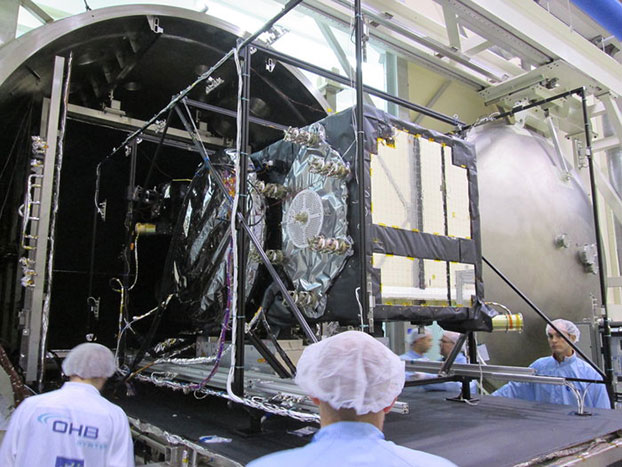
    chamber. Weeks of testing simulated the airlessness and temperature extremes of orbital space, taking place at the ESTEC Test Centre in Noordwijk, the Netherlands during May 2015. (Photo: ESA)
    Weeks of testing simulated the airlessness and temperature extremes of orbital space, taking place at the ESTEC Test Centre in Noordwijk, the Netherlands during May 2015. (Photo: ESA)

    News by the European Space Agency

    Europe’s latest Galileo was unboxed at ESA’s technical centre in the Netherlands in May, bringing the total number of satellites at the site to four.

    ESTEC in Noordwijk is the largest satellite test facility in Europe, with all the equipment needed to simulate every aspect of the launch and space environment under a single roof. It is an essential stop on the way to space for Europe’s Galileo satellites, built by OHB in Bremen, Germany, with navigation payloads from Surrey Satellite Technology Ltd. in Guildford, UK.

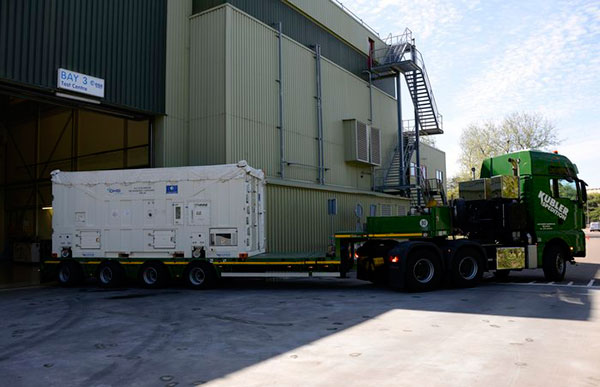
    The 12th Galileo arrived by lorry from Bremen on May 13, in a custom-built environmentally controlled container. The satellite will begin with a thermal vacuum test in a 4.5-meter-diameter stainless steel chamber, subjected to about five weeks of hard vacuum and the temperature extremes of space.

    Galileo-11 recently completed the same trial before moving on to final system testing, including a compatibility run with the ground network.

    Meanwhile, the ninth and tenth satellites are in storage at ESTEC, having passed their own checks. They will be flown to Europe’s Spaceport in French Guiana in late July for launch by Soyuz in September, which will bring the total in orbit into double figures.

    The 12th Galileo satellite, FOC FM-08, arrived at the ESTEC Test Centre on May 13. It was transported by lorry from Bremen in a protective air-conditioned container.
    The 12th Galileo satellite, FOC FM-08, arrived at the ESTEC Test Centre on May 13. It was transported by lorry from Bremen in a protective air-conditioned container.

    The first four Galileos, launched in 2011 and 2012, were in-orbit validation satellites, built by prime contractor Airbus Defence & Space. They confirmed that the overall system worked as planned, while also serving as the foundation of the full constellation to follow.

    The follow-up Full Operational Capability satellites are now being launched regularly to increase the size of the constellation to the point where early Galileo services can begin next year.

    European Partners. Galileo is a collaboration between ESA and the European Commission (EC). The validation phase was co-funded by ESA and the EC, while the full operational phase is funded by the EC. Under a delegation agreement, ESA acts as design and procurement agent on behalf of the commission.

  • First GPS III Satellite Ready for Harsh Environment Testing

    First GPS III Satellite Ready for Harsh Environment Testing

    In April, Lockheed Martin fully integrated the U.S. Air Force’s first next generation GPS III satellite at the company’s Denver-area satellite manufacturing facility.  The first in a design block of new, more powerful and accurate GPS satellites, GPS III Space Vehicle One is now preparing for system-level testing this summer.
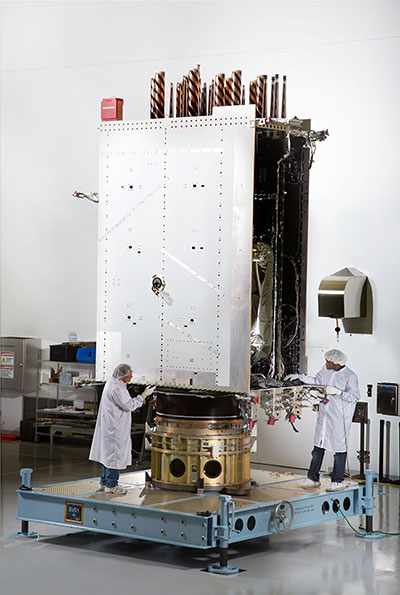
    First Photo a GPS III Satellite: In April, Lockheed Martin fully integrated the U.S. Air Force’s first next-generation GPS III satellite. GPS III Space Vehicle One is now preparing for system-level testing this summer.

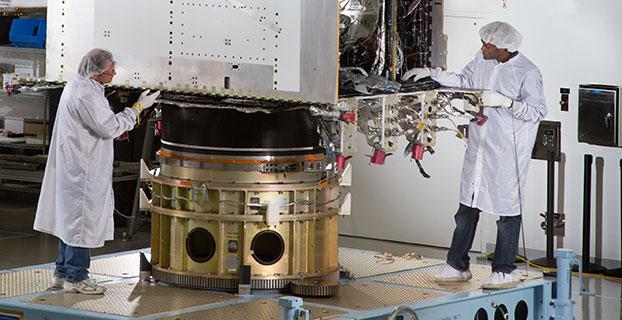
    Using a 10-ton crane, Lockheed Martin engineers and technicians gently lowered the system module of the U.S. Air Force’s first next generation GPS III satellite into place over its propulsion core, successfully integrating the two into one space vehicle.

    The April systems integration event brought together several major fully functional satellite components. The system module includes the navigation payload, which performs the primary positioning, navigation and timing mission. The functional bus contains sophisticated electronics that manage all satellite operations. The propulsion core allows the satellite to maneuver for operations on orbit.

    “The final integration of the first GPS III satellite is a major milestone for the GPS III program,” said Mark Stewart, vice president of Lockheed Martin’s Navigation Systems mission area. “This summer, SV 01 will begin Thermal Vacuum testing, where it will be subjected to simulated harsh space environments. Successful completion of this testing is critical as it will help validate our design and manufacturing processes for all follow-on GPS III satellites.”

    Lockheed Martin is under contract to build eight GPS III satellites at its GPS III Processing Facility near Denver, a factory specifically designed to streamline satellite production.

    GPS III space vehicle one (SV 01) is the first of a new, advanced GPS satellite design block for the Air Force. GPS III will deliver three times better accuracy, provide up to eight times improved anti-jamming capabilities, and extend spacecraft life to 15 years — 25 percent longer than the satellites launching today. GPS III’s new L1C civil signal also will make it the first GPS satellite interoperable with other international global navigation satellite systems.

    The GPS III team is led by the Global Positioning Systems Directorate at the U.S. Air Force Space and Missile Systems Center. Air Force Space Command’s 2nd Space Operations Squadron (2SOPS), based at Schriever Air Force Base, Colorado, manages and operates the GPS constellation for both civil and military users.