Tag: TimeProvider 4100

  • Brazilian operator adopts 5G high-precision protocol with Microchip Technology

    Brazilian operator adopts 5G high-precision protocol with Microchip Technology

    Microchip LogoTIM Brasil’s partnership with Microchip Technology provides the accuracy needed for high-performance network architectures, enabling more efficient data transmission

    Now that it has implemented 5G coverage in all Brazilian state capitals, network operator TIM Brasil has enabled precision time protocol (PTP) in its commercial 5G service.

    To accomplish this, TIM has partnered with Microchip Technology, supplier of the TimeProvider 4100 technology, which allows full compatibility and meets the stringent synchronization requirements of 5G mobile network standards.

    PTP allows precise synchronization and times that can reach nanoseconds among cellular base stations, with security of the data transmitted, by encryption.

    Signal synchronization is essential for a successful 5G consumer experience, ensuring better performance, including reduced latency, more accuracy and better transmission quality.

    “The evolution of the 5G offer by the operator does not occur only in the expansion of coverage, but in the possibility of providing the evolution of the service to the consumer,” said Marco Di Costanzo, network director at TIM Brasil. “We want TIM customers to be able to enjoy 5G networks with the best possible experience.”

    He added, “We are satisfied with the easiness of management and robustness of the new TimeProvider 4100, perceived during our extensive field trials, and we are confident this is a perfect match for the demanding requirements in our mobile deployments. It’s a robust synchronization platform, with high scalability, capacity and flexibility for future growth needs.”

    Tests of the new technology were carried out after TIM’s implementation of 5G networks in Brazilian state capitals, and prove the evolution of the service already used by TIM in its partnership with Microchip for the last 10 years.

    The application of the TimeProvider 4100 technology can have a positive impact on the reduction of latency time and can help improve the signal distribution in indoor networks.

    “Our TimeProvider 4100 offers a robust solution with the flexibility to deploy in a wide range of environments accommodating standards required for mobile 5G implementations due to its impressive versatility,” said Randy Brudzinski, corporate vice president for Microchip’s Frequency & Time Systems business unit. “The device uniquely provides a 1588 grandmaster supporting these standards with the high-precision, accuracy and reliability requirements needed for leading mobile operators like TIM Brasil.”

  • Microchip Technology unifies timing for critical infrastructure with firewall

    Microchip Technology unifies timing for critical infrastructure with firewall

    The company’s TimePictra 11 timing infrastructure management system works with its BlueSky GNSS Firewall to create a unified view for a more secure network timing architecture

    Image: Microchip Technology
    Image: Microchip Technology

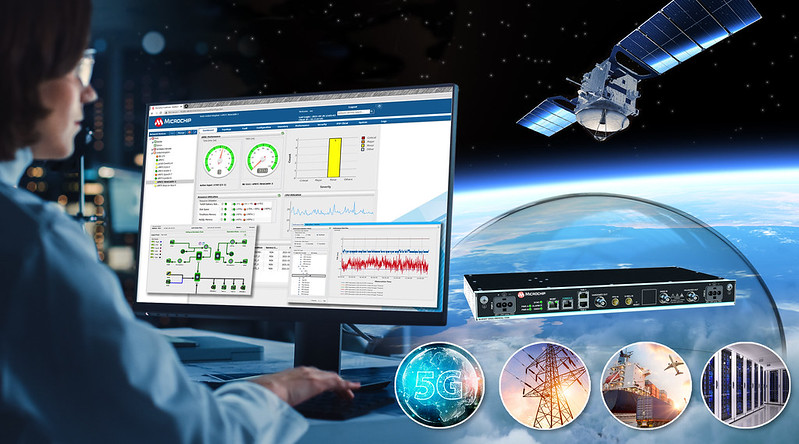
    Microchip Technology Inc. has integrated its BlueSky GNSS Firewall with its TimePictra 11 synchronization monitoring and management platform to protect 5G networks and other critical timing infrastructure from GPS signal jamming and spoofing while providing single-console visibility across the entire timing architecture.

    The move was made to meet the needs of 5G wireless infrastructure, which has more complex and higher density synchronization needs than previous generation networks. 5G is highly dependent on the integrity of live-sky GNSS timing signals.

    “Microchip’s TimePictra system improves overall situational awareness by managing network timing synchronization as well as our GNSS firewall that improves a network’s resilience through real-time GPS threat detection and mitigation,” said Randy Brudzinski, vice president, Frequency and Time Systems business unit. “Our solution’s scalability is particularly valuable for mobile operators who can use TimePictra to monitor GNSS-based source clocks along with our secure network-based timing distribution solutions to deploy a highly resilient timing architecture for their transition to 5G.”

    In addition to requiring precise timing from GNSS sources, critical infrastructure operators need accurate timing to be distributed across their networks so they can ensure reliable performance and service delivery. TimePictra provides full control and monitoring for resilient timing architectures created with Microchip’s broad product portfolio, including its TimeProvider 4100 grandmasters for 5G network synchronization.

    TimePictra also monitors the health and performance of these networks’ distributed Precision Time Protocol (PTP) client clocks. Integrating BlueSky GNSS Firewall management into the TimePictra console view gives operators a unified picture of the entire timing architecture and all timing sources.

    Beyond supporting 5G deployments, TimePictra provides aviation, railway and maritime ports with a regional, national or global view of GNSS reception. TimePictra with BlueSky GNSS Firewall monitors key GNSS observables to detect live-sky signal anomalies and deliver early alerting so that operators can engage alternate procedures that do not rely on GNSS. These capabilities are increasingly important when public safety depends on position and navigation for daily operations.

    Microchip’s TimePictra timing infrastructure management system with its Blue Sky GNSS Firewall is available today.

  • Microchip TimeProvider 4100 Grandmaster now more redundant, resilient

    Microchip TimeProvider 4100 Grandmaster now more redundant, resilient

    IEEE 1588 precise timing grandmaster with gateway clock now offers software-based redundancy

    Photo: Microchip
    Photo: Microchip

    For today’s critical infrastructure providers — 5G wireless networks, smart grids, data centers, cable and transportation services — a fundamental need exists for a redundant, resilient and secure precise timing and synchronization solution.

    Microchip Technology Inc.’s TimeProvider 4100 Release 2.2 grandmaster provides a new level of resiliency with the introduction of an innovative redundancy architecture in addition to support for a multi-band GNSS receiver and enhanced security to ensure always-on precise timing and synchronization.

    Redundancy is key for infrastructure providers to ensure uninterrupted services. Infrastructure deployments previously relied on hardware redundancy to avoid service disruption despite costly modular architectures. Microchip’s TimeProvider 4100 Release 2.2 grandmaster provides redundancy via software implementation, enabling flexible deployment and lower hardware costs without sacrificing ports.

    In addition, the TimeProvider 4100 Release 2.2 grandmaster introduces an increased level of resiliency by supporting a new GNSS multi-band, multi-constellation receiver to protect against time delay resulting from space weather, solar events and other disruptions that may impact critical infrastructure services.

    Multi-band GNSS is particularly important for the highest levels of accuracy, including primary reference time clock class B (PRTC-B, 40 ns) and enhanced primary reference time clock (ePRTC, 30 ns).

    With a focus on security solutions across its technology portfolio, Microchip’s new TimeProvider 4100 Release 2.2 grandmaster adds support for RADIUS and TACACS+ as well as new anti-jamming and anti-spoofing capabilities.

    “Resilient, redundant and secure precise timing and synchronization solutions are necessary to mitigate security risks to critical infrastructure,” said Randy Brudzinski, vice president and general manager of Microchip’s frequency and time business unit. “This latest release brings an innovative software redundancy that enables always-on technology as well as support for multi-band GNSS to eliminate ionospheric time error delays. It provides new key security, anti-jamming and anti-spoofing so critical infrastructure services can be accessed only by authorized, authenticated personnel.”

    In addition, the TimeProvider 4100 Release 2.2 grandmaster provides a super oven controlled crystal oscillator (OCXO) option for enhanced holdover capabilities in case of GNSS disruption.

    The TimeProvider 4100 Release 2.2 grandmaster is a family of products with hardware expansion modules for legacy fan-out or Ethernet fan-out with 10 Gigabit Ethernet support. It can be configured in specific operation modes to act either as a gateway clock, a high-performance boundary clock or an ePRTC.

    The TimeProvider 4100 Release 2.2 grandmaster embeds additional Microchip technology including its OCXO, super OCXO, rubidium atomic clock, field-programmable gate arrays (FPGAs), Ethernet switch, synthesizers and cleaning oscillators.

    The TimeProvider 4100 is part of Microchip’s Virtual Primary Reference Time Clock (vPRTC) product portfolio, offering end-to-end precise time and synchronization solutions. These include Cesium atomic clocks for source of frequency and time, the BlueSky GNSS Firewall for security, TimeProvider 4100 high-performance boundary clock and TimeProvider 4100 Gateway clocks, as well as the TimePictra software suite, which manages the end-to-end precise time architecture across all Microchip timing products.

    Microchip’s TimeProvider 4100 Release 2.2 grandmaster offers several options for software and hardware support including installation, sync audits, network engineering and 24/7 worldwide support. It is available now for both new and already-deployed systems.

  • Microchip updates BlueSky GNSS Firewall Software

    Microchip updates BlueSky GNSS Firewall Software

    Image: Microchip
    Image: Microchip

    U.S. Department of Homeland Security’s live-sky testing evaluations influenced development of BlueSky GNSS Firewall Software Release 2.0

    Microchip Technology Inc. has released a major software update for its BlueSky GNSS Firewall product, providing a higher level of resiliency against GPS vulnerabilities for systems dependent on GPS signal reception.

    Such systems include critical infrastructure such as power utilities, financial services, mobile networks and transportation that rely on GPS-delivered timing to ensure ongoing operations.

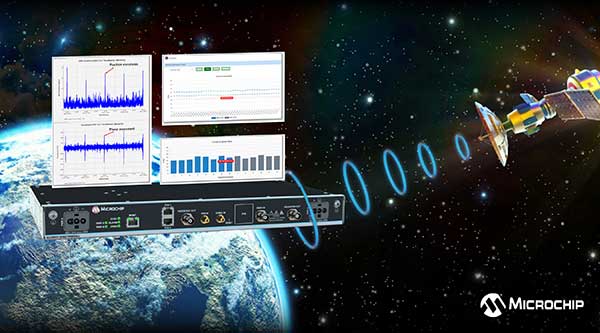
    Microchip’s BlueSky GNSS Firewall Software Release 2.0 performs real-time analysis to detect jamming and spoofing for protecting reception of the GPS signal and hardening response and recovery to avoid signal disruption.

    Release 2.0 includes charting and advanced threshold settings of GNSS observables such as satellites-in-view, carrier-to-noise, position dispersion, phase time deviation and radio frequency (RF) power level to simplify system turn-up and deployment.

    The release also includes improvements developed by Microchip as a result of participation in a 2019 industry live-sky testing event hosted by the U.S. Department of Homeland Security (DHS) Science and Technology Directorate.

    Microchip’s participation in the DHS-hosted GPS Testing for Critical Infrastructure (GET-CI) events included scenarios with spoofed signals, and helped the company identify new solutions to prevent signal disruptions. As a result, Microchip developed the Release 2.0 to address operators’ evolving requirements.

    As a leader in frequency and time systems, Microchip continuously innovates GPS signal reception security technologies for commercial and military operators similar to how network firewalls protect against virus threats. Updates are essential to defend against rapidly-evolving GNSS disruptions and enable critical infrastructure operators to avoid interruptions of service.

    When connected to Microchip’s TimePictra management software, critical infrastructure operators can monitor and analyze GNSS signals in cities, across geographic regions, throughout a country and even globally.

    Other complementary devices and software in Microchip’s suite of GPS systems and services include the TimeProvider 4100 Precise Timing Grandmaster with Gateway Clock, SyncServer 600/650 timing and frequency instrument, miniature atomic clock (MAC), Time Cesium and 5071A cesium primary frequency standard.

  • Microsemi launches latest version of precise timing grandmaster

    Microsemi launches latest version of precise timing grandmaster

    Microsemi has released its TimeProvider 4100 Release 2.0, the latest version of its TimeProvider 4100 precise timing grandmaster.

    The TimeProvider 4100 is a grandmaster complemented by extensive port fan-out for PTP, Network Time Protocol, sync and legacy building integrated timing supplies. According to the company, the TimeProvider 4100 offers multiple ports for current, legacy and future networks that can be connected to multiple base stations for 4G and 5G deployments.

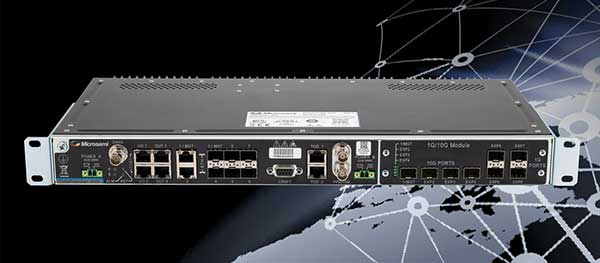
    Microsemi launched its TimeProvider 4100 Release 2.0, the latest version of its TimeProvider 4100 precise timing grandmaster. (Photo: Microsemi)
    Microsemi launched its TimeProvider 4100 Release 2.0, the latest version of its TimeProvider 4100 precise timing grandmaster. (Photo: Microsemi)

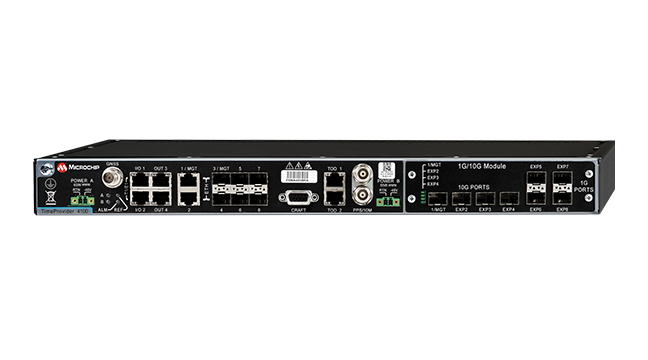
    Version 2.0 of the TimeProvider 4100 includes a number of new features, including an optional expansion module with 10GE support for 1G/10G/100M fan-out, offering four SFP and four SFP+ ports; increased capacity to 790 PTP clients (up from 512 previously) at a full rate of 128 packets per second; a boundary clock that supports Class C and class D; support for Primary Reference Timing Clock Class B (ITU-T G.8272); and support for multiple operation modes.

    The unit can still behave as a fully functional grandmaster from an outputs standpoint and also has the capability to monitor various kinds of inputs, the company added. It also features a new operation mode for a high-performance boundary clock.

    According to Microsemi, TimeProvider 4100 Release 2.0 adds support for PRTC-B in addition to PRTC-A. In addition, it adds support for monitoring presentation through Microsemi’s TimePictra 10 synchronization management system.

  • Microsemi upgrades TimeProvider for 5G deployments

    Microsemi upgrades TimeProvider for 5G deployments

    Photo: Microsemi
    Photo: Microsemi

    Microchip Technology Inc., via its Microsemi subsidiary, has added the TimeProvider 4100 Release 2.0 to its Precision Time Protocol (PTP) PackeTime portfolio.

    TimeProvider keeps services operating through GNSS lapses due to vulnerabilities such as jamming, spoofing or loss of signal. It is also designed to meet one of the biggest 5G network deployment challenges —synchronizing higher volumes of more densely packed base stations.

    Microchip is also introducing Release 3.0 to its Integrated GNSS Master (IGM) family.

    TimeProvider 4100. Release 2.0 adds 10 Gigabit Ethernet support, a boundary clock operation mode that lowers operational costs, and other enhancements to improve how timing flows are distributed from multiple sources to a network’s base stations and other endpoints.

    The 72-channel GNSS receiver coupled with Microsemi’s patented active thermal compensation technology provides excellent accuracy of <10 ns RMS to UTC (USNO). With the time source provided through GNSS satellite input, it is essential to provide flexible support for constellations of choice depending on the region. TimeProvider 4100 supports GPS, GLONASS, BeiDou, Galileo, QZSS, and SBAS in its standard version.

    TimeProvider 4100 2.0 with its 10 GE expansion module has been selected by SK Telecom in Korea for its delivery of 5G services in the Seoul metropolitan area and Chungcheong province.

    IGM 3.0. For service providers that need to deploy more compact PTP 1588 v2 Grandmasters to fewer base stations closer to the network’s edge, Microchip is also introducing Release 3.0 to its Integrated GNSS Master (IGM) family.

    IGM 3.0 combines an IEEE-1588v2 PTP grandmaster with a GNSS receiver and antenna to simplify indoor or outdoor installations. Each of the three IGM 3.0 additions deliver precise time and phase as well as new capabilities enabled by IGM Plus hardware models with enhanced oscillators and GNSS receivers.

    The new oscillator options extend time-keeping holdover performance while the enhanced receiver speeds satellite signal acquisition and improves security by accessing more GNSS constellations simultaneously.

    The receiver upgrade option supports GPS, Galileo, QZSS and GLONASS, and is Beidou-ready. The IGM 3.0 software includes higher PTP capacity to 60 clients along with IPv6 support for traffic and management flows.

    TimeProvider’s Gateway Clock. Extending the TimeProvider 4100’s Gateway Clock operation mode with Microchip’s high-performance boundary clock (HP-BC) operation mode enables it to support the latest high-accuracy ITU-T Class C & D boundary clock standards. These standards dictate extremely accurate time transfer over optical networks so operators can use dense wavelength division multiplexing (DWDM) technology rather than dedicated fiber.

    Release 2.0 accommodates escalating bandwidth requirements of next-generation network devices through an optional expansion module that provides 10 GE interfaces. Expanded monitoring functions enable service providers to understand how time and phase performance is affected by network elements, the company added.

    PTP client capacity has been increased to 790 to provide the scalability that is critical for deployments in mobile network aggregation layers and new DOCSIS 3.1 Remote-PHY cable architectures.

    Both TimeProvider 4100 Release 2.0 and IGM Release 3.0 are managed with TimePictra, the centralized and unified management platform for the company’s family of precise timing systems.

  • Microsemi’s TimeProvider 4100 provides for 4G and 5G base stations

    Microsemi Corporation has launched the TimeProvider 4100, a flexible IEEE 1588 Precision Time Protocol (PTP) grandmaster clock designed to scale from the edge to the aggregation layers of both mobile infrastructure and access networks.

    The TimeProvider 4100 is a gateway clock, a new class of synchronization product which accepts multiple inputs from GNSS, Synchronous Ethernet (SyncE), 1588 PTP and E1/T1 digital transmission links, and distributes timing flows to multiple endpoints such as base stations.

    It supports the GNSS constellations GPS, Beidou, GLONASS and Galileo.

    Mobile and future markets

    Primarily targeting the mobile market, operators and data centers for mobile operator environments, over time the TimeProvider 4100’s platform will also serve mobile network needs associated with machine-to-machine (M2M), internet of things (IoT) and autonomous vehicle applications.

    A gateway clock benefits from multiple layers of protection leveraging other assets in the core of the network. TimeProvider 4100 is a best-in-class 1588 grandmaster complemented by extensive port fan-out for PTP, Network Time Protocol (NTP), SyncE and legacy building integrated timing supplies (BITS), the company said.

    With multiple ports for current, legacy and future networks which can be connected to multiple base stations for 4G and 5G deployments, the device offers customers a cost-effective solution that can be adapted for a wide variety of use cases.

    Mobile operators face tough requirements to drastically increase mobile bandwidth while efficiently leveraging the available spectrum. Cellular networks using only frequency synchronization waste significant spectrum, whereas newer deployments require phase synchronization for efficient spectrum usage and interference mitigation in increasingly densified networks.

    Phase synchronization

    Phase synchronization is imperative for next-generation service deployment. To that end, operators need timing solutions capable of supporting legacy infrastructure and evolving network needs. Microsemi’s TimeProvider 4100 is engineered to provide phase to today’s 4G, LTE and LTE-Advanced (LTE-A) deployments, as well as tomorrow’s cRAN evolutions and 5G networks.

    The device’s platform can be expanded through an internal module, providing customer savings such as power and rack space, and enables great scalability through sub-tenancy mechanisms. TimeProvider 4100 also features port fan-out which can be flexibly used for PTP, NTP, E1/T1, 1 pulse per second (PPS), time of day (ToD) and 10 megahertz (MHz) at the aggregation layer.

    “With our ongoing commitment to delivering system products, Microsemi has demonstrated our leadership in the IEEE 1588 grandmaster market with more than 400 operator deployments worldwide,” said Eric Colard, director of product line management for Microsemi. “We are pleased to leverage this expertise to deliver the TimeProvider 4100. With eight Ethernet ports and four BITS E1/T1 ports in the base unit, TimeProvider 4100 provides a very feature-rich gateway clock device.”

    Microsemi’s TimeProvider family serves the mobile infrastructure market, which is expected by market research firm IHS Markit to be approximately $48 billion in 2018, with hardware expected to account for approximately 62 percent of the market.

    The TimeProvider family is designed to capitalize on growth opportunities related to 5G installations, beginning with trial installations in 2018, growing to a market size of $2.8 billion by 2021 according to the firm’s “Mobile Infrastructure Intelligence Service – 3Q17 Market Tracker.”

    The new device’s flexibility does not compromise its performance and feature set, and meets stringent precise timing requirements, including complying with primary reference time clock (PRTC) and the latest time and phase ITU-T and IEEE industry standards.

    Available upgrades include oscillator options for enhanced holdover performance and an internal expansion module which adds 16 E1/T1 BITS ports to the device. The TimeProvider 4100 also accepts PTP input with assisted partial timing support (APTS) to back up the GNSS signal in case of signal loss for high resiliency of the solution by leveraging 1588v2 grandmasters already deployed at the core of the network.

    Timing and synchronization platform

    TimeProvider 4100 can be managed through Microsemi’s timing and synchronization management platform, TimePictra. In addition, for phase, service providers require more visibility about performance and health of the various network elements participating in the synchronization chain. TimeProvider provides advanced monitoring capabilities, especially for IEEE 1588v2 PTP for phase, and leverages a WebGUI to present results and calculations for easier interpretation.

    In addition to its TimeProvider family, Microsemi also offers highly comprehensive and cost-effective IEEE 1588 and SyncE network synchronization silicon solutions providing time stamping, ultralow jitter (for up to 100G PHYs), IEEE 1588 protocol support (including the ITU-T telecom profile for frequency and phase) and one of the industry’s most established client servos used by numerous carriers worldwide.

    The solutions offered are used by all major equipment vendors across the globe in a variety of wireless and wireline applications and work seamlessly with Microsemi’s full range of TimeProvider equipment.