Tag: turbulence

  • UAVOS control system for HAPS takes on unstable air

    UAVOS control system for HAPS takes on unstable air

    Photo: UAVOS
    Photo: UAVOS

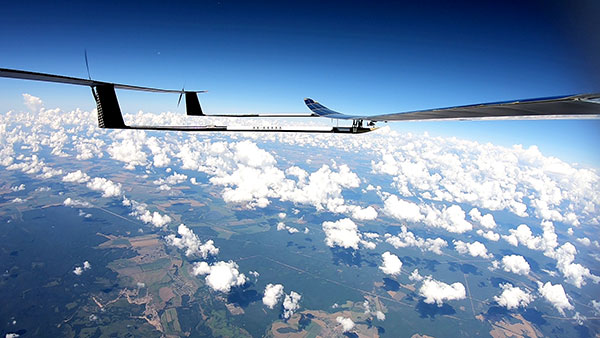
    UAVOS Inc. has performed a series of successful flight trials with High Altitude Pseudo Satellite (HAPS) ApusDuo, testing its unique control system.

    The test flights confirmed that UAVOS’s control system allows aircraft with a large-wing elongation to fly in unstable atmospheric conditions. The ApusDuo aircraft successfully copes with turbulence, actively changing the bend of the wings.

    The total flight time of UAVOS solar-powered test aircraft is more than 1,000 hours. Test flights took place at an altitude of up to 62,000 feet (19,000 meters).

    UAVOS’s control system does not require the installation of wing mechanization. This reduces the aircraft’s weight by 30% or more, improves reliability and simplifies wing production for lower manufacturing costs.
    The ApusDuo drone weighs about 95 lbs (43 kg) and has a wingspan of 49.2 ft. It is launched by a winch. The aircraft is built on the tandem principle, where two of the wings are located one after another with a small elevation difference.

    ApusDuo is controlled by changing the geometry of the aircraft. It is designed to linger at an altitude of about 60,000 feet (18,000 m) for months at a time for surveillance or to provide a temporary boost to communications.

    Additional test flights are planned for this year, said Aliaksei Stratsilatau, UAVOS CEO and lead developer.

    In July, UAVOS became a member of the HAPS Alliance, which aims to accelerate commercial adoption of HAPS technologies.

  • Turbulence not the culprit for Northern Lights’ effect on GNSS

    Researchers at the University of Bath, U.K., have gained new insights into the mechanisms of the Northern Lights, providing an opportunity to develop better satellite technology that can negate outages caused by the natural phenomenon.

    Previous research has shown that the natural lights of the Northern Lights — also known as Aurora Borealis — interfere with GNSS signals. Plasma turbulence within the Northern Lights has been deemed responsible for causing GNSS inaccuracies. However, the latest research found that turbulence doesn’t exist, suggesting new, unknown mechanisms are actually responsible for outages on GNSS signals.

    This is the first time it has been shown that turbulence does not take place within the Northern Lights. The findings will enable new technological solutions to overcome these outages.

    The research team from the University of Bath’s Department of Electronic & Electrical Engineering, in collaboration with the European Incoherent Scatter Scientific Association (EISCAT), observed the Northern Lights in Tromsø, Norway, where they observed and analyzed the Northern Lights simultaneously using radar and a co-located GNSS receiver.

    GNSS signals were used to identify how the Northern Lights interfere with GPS signals. Radar analysis provided a visual snapshot of the make-up of the phenomenon.

    The researchers believe this heightened understanding of the Northern Lights will inform the creation of new types of GNSS technology that are robust against the disturbances of the Northern Lights, and help influence GNSS regulations used in industries such as civil aviation, land management, drone technology, mobile communications, transport and autonomous vehicles.

    “With increasing dependency upon GNSS with the planned introduction of 5G networks and autonomous vehicles which rely heavily on GNSS, the need for accurate and reliable satellite navigation systems everywhere in the world has never been more critical,” said university lead researcher and lecturer Biagio Forte.

    “The potential impact of inaccurate GNSS signals could be severe. Whilst outages in mobile phones may not be life threatening, unreliability in satellite navigations systems in autonomous vehicles or drones delivering payloads could result in serious harm to both humans and the environment,” Forte said. “This new understanding of the mechanisms which affect GNSS outages will lead to new technology that will enable safe and reliable satellite navigation.”

    The Northern Lights occur at North and South magnetic Poles, and are the result of collisions between gaseous particles in the Earth’s atmosphere with charged particles released from the sun’s atmosphere.

    The research was published in the Journal of Geophysical Research: Space Physics.