Tag: Turkey

  • Türkiye establishes early-warning GNSS network for earthquakes

    Türkiye establishes early-warning GNSS network for earthquakes

    Türkiye  is no stranger to earthquakes. In February 2023, a devastating 7.8-magnitude earthquake struck near the Türkiye-Syria border, followed by another nearly as strong. 

    Six Turkish universities have launched a real-time geodetic monitoring network to track earthquake-related ground deformation across Thrace and the Southern Marmara region, reports Hürriyet Daily News.

    TR-TRAK-GNSS will monitor seismic and tectonic activity using 28 GNSS stations. The system is designed to evolve into a major scientific and early-warning infrastructure capable of detecting tectonic deformation in real time and identifying structural movements in buildings across cities and university campuses.

    Once fully deployed, the network will form a continuous monitoring ring encircling Thrace and Southern Marmara.

    The project will be financed through each participating university’s Scientific Research Projects resources, with institutions covering the installation costs of GNSS stations within their own areas of responsibility.

  • Turkish kamikaze drone unveiled

    Turkish kamikaze drone unveiled

    A new Turkish-made twin-jet kamikaze drone, showcased at the Ateş Serbest-2025 exercise, features GNSS-independent autonomy, with GNSS/GPS signals, supplemented by odometric data where necessary, reports Defence Turk and Defence Index. With specially designed avionics and onboard visual-odometry algorithms, the drone can navigate and reach its assigned coordinates without dependence on satellite positioning.

    According to information obtained by both news outlets, the KZ-350 drone is being developed with a target range of 350 km. Its cruising speed is 500 km/h, cruising altitude is 3,000 meters. Its takeoff weight is 120 kg and warhead 25 kg. Two domestically produced jet engines power the drone.

    Once a mission profile is uploaded, the KZ-350 is intended to operate in a “fire-and-forget” mode. It autonomously follows its flight plan to the target area and executes its strike without external guidance.

  • BKZS: Türkiye’s regional GNSS system takes shape

    BKZS: Türkiye’s regional GNSS system takes shape

    Türkiye is laying the groundwork for its own satellite navigation system, the Bölgesel Konumlama ve Zamanlama Sistemi (BKZS), or Regional Positioning and Timing System. As a key pillar of Türkiye’s 2030 Industry and Technology Strategy, BKZS reflects the country’s ambition to gain strategic autonomy in satellite-based positioning, navigation and timing (PNT), moving away from dependence on foreign systems such as GPS.

    Strategic imperatives and security concerns

    BKZS was established as one of the ten flagship goals of Türkiye’s National Space Program, introduced in 2021. It directly addresses growing national security concerns: in times of geopolitical conflict, GNSS signals can be jammed or disabled — leaving nations vulnerable if reliant on foreign services. President Erdoğan’s 2030 roadmap emphasizes preparing for “a new era of challenges,” where technological independence is seen as vital to national sovereignty.

    Building the foundation: Atomic clocks and CubeSats

    At the core of BKZS development is innovative timing technology. The TUBITAK National Metrology Institute has designed Türkiye’s first domestically produced rubidium-based atomic clock for use in positioning satellites. Developed in collaboration with the Turkish Space Agency, the prototype is undergoing qualification testing. Considering that atomic clocks are among the most expensive and sensitive components of a GNSS system, their in-house development not only reduces reliance on foreign suppliers but also delivers significant cost savings and strengthens national expertise. The strategic plan involves an initial technology demonstration phase using a 6U CubeSat, a miniaturized satellite based on the CubeSat standard. This satellite — currently in production — will test the atomic clock in orbit and gather critical performance data, helping to validate system components and gain operational experience ahead of full deployment.

    Regional scope with global ambitions

    BKZS is being designed as a regional system focused on Türkiye and its surrounding geography. Preliminary architecture envisions an eight-satellite constellation with an estimated cost of $2.8 billion. While this figure underscores the program’s scale, it also reflects the strategic priority attached to securing sovereign PNT capabilities. Military users stand to gain the most immediate benefits, with access to secure, independent timing and positioning data. However, the system is also intended for broad civilian use, including smart transportation systems, precision agriculture, emergency response and disaster management.

    Integrated into a broader space strategy

    BKZS is not being developed in isolation. It is part of Türkiye’s wider National Space Program, which includes lunar exploration and autonomous launch capabilities. The Turkish Space Agency oversees coordination, while the Presidency of Defense Industries provides funding and logistical support. This ecosystem approach is designed to foster technological self-reliance across the entire space value chain. Notably, the private sector is also playing a role. Baykar’s space subsidiary, Fergani, is developing a complementary Turkish GNSS constellation with an ambitious plan to launch 100 satellites. Two of these satellites have already been built, with the first scheduled for launch in 2024, demonstrating multiple pathways toward achieving full domestic capability.

    Economic impact and industrial development

    BKZS also supports Türkiye’s economic goals. The 2030 Strategy includes a target to triple high-tech exports to $30 billion. Space technology is expected to contribute significantly to this goal by generating new opportunities for Turkish firms in satellite design, navigation electronics and advanced manufacturing.

    By fostering domestic expertise, BKZS strengthens the foundation for a sustainable, self-sufficient aerospace sector, one capable of supporting both defense and commercial applications.

    Aligning with a global trend

    Türkiye’s efforts echo a growing global trend: building regional or national GNSS systems to reduce reliance on global services. Reflecting this shift, India’s NavIC is a fully operational regional GNSS; Japan’s QZSS, also operational, functions primarily as a GPS augmentation system over the Asia-Pacific; South Korea’s KPS is currently under development to provide independent PNT services across the Korean Peninsula. China’s BeiDou system also began as a regional constellation focused on the Asia-Pacific before expanding to become a global navigation system. Türkiye’s geographic position — at the crossroads of Europe, Asia and the Middle East — positions it uniquely as a potential regional hub for satellite navigation services. While the project is rooted in national objectives, it also opens the door to international cooperation. Italy has emerged as a prospective partner, particularly in advancing space-qualified technologies, offering mutual benefits for both countries.

    Looking ahead

    Beyond 2030, TTürkiye envisions BKZS as a stepping stone toward a broader space infrastructure. This initiative signifies a strategic commitment to establishing a sustained and autonomous presence in space.

    Of course, the success of BKZS will depend on more than ambition. Sustained political commitment, reliable funding, and continued advances in core technologies like atomic clocks and satellite systems will be essential. If these conditions are met, BKZS has the potential not only to enhance Türkiye’s strategic autonomy but also to establish the country as a key contributor to regional — and potentially global — GNSS capability.


  • Emergency satellite mapping of Turkiye and Syria activated

    Emergency satellite mapping of Turkiye and Syria activated

    On Feb. 6, the United Nations Satellite Center (UNOSAT) announced via Twitter that it had activated emergency mapping services of Turkiye and northern Syria after the magnitude 7.8 earthquake hit earlier that day. The satellite images provide an overview of the damage, which can be used for humanitarian efforts and disaster relief, reported Space.com.

    UNOSAT provides emergency mapping services, upon request, to provide satellite imagery analysis during emergencies and disasters. The maps show infrastructure that has been damaged during an emergency, which can then be used to provide relief by disaster response groups.

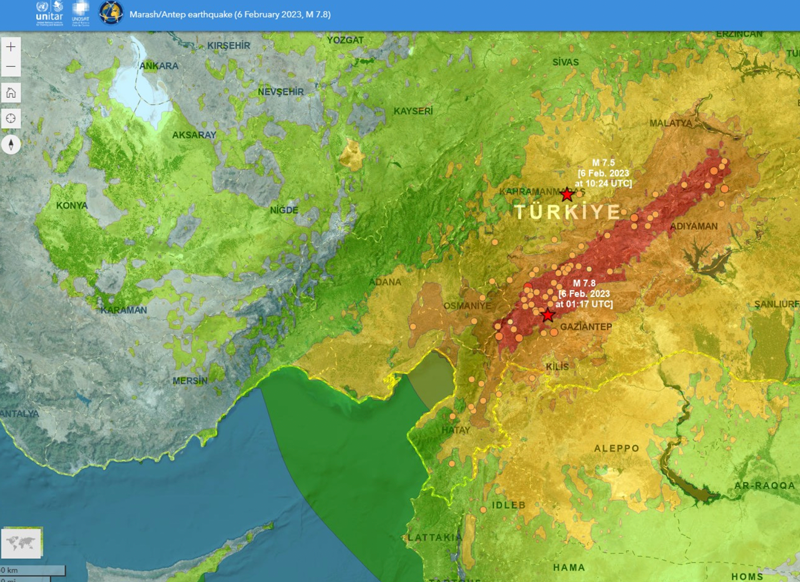
    The impact of the earthquakes was significant and ranks in the red for economic losses and orange for fatalities, according to the U.S. Geological Survey (USGS). (Image: UNOSAT)
    The impact of the earthquakes was significant and ranks in the red for economic losses and orange for fatalities, according to the U.S. Geological Survey (USGS). (Image: UNOSAT)

    The earthquake caused massive destruction throughout Turkiye and Northern Syria, causing an estimated death toll of more than 19,000 as of Feb. 9. Several historical structures dating back thousands of years have also been severely damaged.

    UNOSAT started in 2001 and is hosted by the European Organization for Nuclear Research. It does not operate its own satellites, but coordinates with United Nations member states to gather imagery from government agencies and privately owned satellites. United Nations offices, government agencies and relief organizations can request access to imagery collected by UNOSAT.

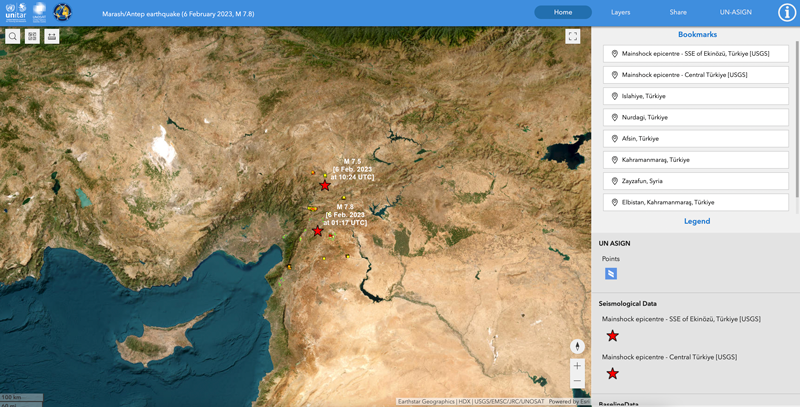
    The USGS reports the earthquake resulted from strike-slip faulting at shallow depths. It appears to be associated with either the East Anatolia fault zone or the Dead Sea transform fault zone. (Image: UNOSAT)
    The USGS reports the earthquake resulted from strike-slip faulting at shallow depths. It appears to be associated with either the East Anatolia fault zone or the Dead Sea transform fault zone. (Image: UNOSAT)

    All maps of Turkey and northern Syria from UNOSAT can be found here. A live interactive map can be found here.

  • Turkish satnav station opens in Antarctica

    Turkish satnav station opens in Antarctica

    Turkey has opened GNSS base station in Antarctica, according to Sputnik News. The station can track changes in the location of icebergs and transmit photos of Antarctica’s surface, as well as process data from GPS, GLONASS and Galileo.

    “A GNSS satellite navigation base station was set up within the framework of the fourth Turkish scientific expedition to Antarctica,” said Turkish Industry and Technology Minister Mustafa Varank, as quoted by the national Anadolu news agency. “A group of specialists from the Turkish General Directorate of Mapping has built Turkey’s first GNSS base station abroad.”

    The Fourth Antarctic Expedition of Turkey began on Feb. 9 under the coordination of the Scientific and Technological Research Council (TUBITAK) Polar Research Institute. The GNSS station operates on Dismal Island, 73 kilometres (45 miles) from Horseshoe Island, where the temporary Turkish science base is located.

    The 24-member Turkish research team joins 15 scientific projects in the Earth, life, and marine sciences. The expedition is being conducted under the auspices of the Turkish Presidential Administration and the Ministry of Industry and Technology and coordinated by the TUBITAK.

  • UAV Creates 3D Model of Largest Mosque in Turkey

    UAV Creates 3D Model of Largest Mosque in Turkey

    Turkey-mosque_adana_W
    Photo: Leica

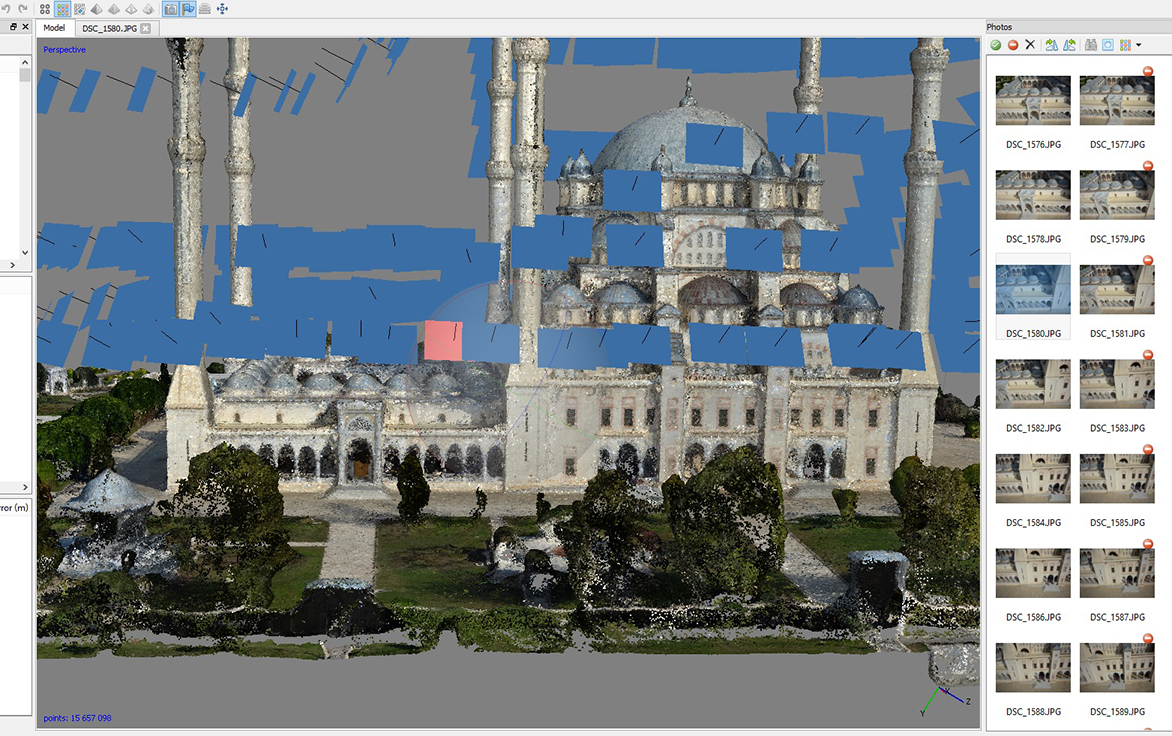
    The Sabancı Merkez Mosque in Adana, Turkey, has been inspected and mapped by an unmanned aircraft system and a detailed 3D model created. The work was carried out by SISTEM A.S. (the Turkish distributor of Leica Geosystems), NRJ Engineering and Aibotix.

    Sabancı Merkez Mosque is the largest in Turkey, with six minarets, four of which are 99 meters high. The largest of its five domes is 32 meters in diameter and 54 meters high, so determining the actual state of the building using conventional methods would be time consuming and costly. Instead, the authorities commissioned a UAV inspection.

    “We needed only three flights to cover all relevant areas and generate comprehensive data,” said SISTEM A.S. employee Bora Yavuz, who has been working with terrestrial laser scanning systems for the past five years. “Compared to laser scanning, collecting the data from the top sections of this huge building by UAV was extremely easy, since nobody had to climb up to the minarets or dangerous places on the domes and wait for the machine to scan. Furthermore, alongside the data registration the generation of point clouds runs automatically.”

    During the flight over the roof of the mosque, the UAV followed a defined route that had been planned on the computer beforehand. The pilot then steered the UAV manually in two more flights around the building.

    The Aibot X6 was carrying a Nikon Coolpix A digital camera and created high-resolution photos with an 80 percent overlap. Using live images from the UAV’s perspective that were sent directly to the screen of a ground station, the pilot could make sure that all relevant areas were captured, and achieve the best possible results by adjusting the camera to the optimum angle during the flight.

    The data was subsequently processed to create an accurate 3D model of the mosque with a precision down to 1-2 centimeters. The high-resolution photos are linked to the model so that damage can be located accurately, with GPS information synchronized with the images for fast post-processing. The images and the model will now be used as the basis for maintenance and repairs.

    Turkey-mosque_adana_2-W Photo: Leica
    Photo: Leica

    Turkey-mosque_adana_3-W
    Photo: Leica

  • MobileMapper 120, GIS Software Combine for Solution in Turkey

    Turkey MM120

    The Geomatics Group, a Spectra Precision distributor and GIS software developer in Turkey, is achieving excellent success marketing the Spectra Precision MobileMapper 120 handheld GIS mapping device running Mobile GIS software developed by the Geomatics Group, according to Spectra Precision.

    MobileMapper 120 uses a Windows open platform enabling it to run any Windows mobile application, including Spectra Precision applications for GIS or Survey, as well as third-party solutions that may better meet local regulations or specific customer requirements. The Geomatics Group has taken advantage of the Windows open platform to develop a specific application and integrated it with the MobileMapper 120 to provide a solution for its Turkish customers.

    A Geomatics Group spokesperson says that sales of the MobileMapper 120 are particularly strong in three sectors in Turkey: mapping electrical infrastructure, orthophoto survey, and mapping public land and assets. Recently, 150 units of the MobileMapper 120 with the Geomatics Mobile GIS software were sold to the Turkey General Directorate of National Property to assist in public property management. According to the spokesperson, the sub-meter accuracy of the Spectra Precision MobileMapper 120 and the Mobile GIS software’s fast and easy menu access, hierarchical database and easily modified attribute library were important features in tests conducted by the customer. In another MobileMapper 120 sale earlier this year, 48 units were sold to the Provincial Directorates of Urban Environment for use in 48 different cities.

    The spokesperson underscored the accuracy of the MobileMapper 120 that has impressed customers by reporting that one electrical grid customer who compared their ProMark 500 GNSS receiver to a MobileMapper 120, into which the Geomatics Group had installed a flying RTK option and using TUSAGA-Aktip (CORS-TR), found only a five-centimeter difference between the two receivers.