The NAVCEN website upgrade and redesign is now live.
“This is an exciting moment for our team,” said Stephanie Southwick, NAVCEN web team. “Thank you again for your patience as we move forth with this transition to improve user experience and to provide the public with timely and reliable maritime safety information.”
As a reminder, while the primary URL will stay the same, all sub-URLs have changed with the transition. Use of any bookmarked legacy URLs will result in broken links, including PDFs and URLs used in automatic downloading of data and products. “We appreciate your patience in re-bookmarking your favorite pages when we update the site,” Southwick said.
The NAVCEN outreach team will work with users to ensure transition to using the redesigned site is as seamless as possible. Communicate with the team at[email protected] with questions or to request additional information.
For more information on the changes, visit this page.
Capt. Adam Moody, 2 SOPS GPS Operations Support flight commander, and Staff Sgt. Carl Ellinger, 2 SOPS GPS mission chief, review a checklist of procedures for a transfer operation at Schriever Air Force Base. (Photo: U.S. Air Force photo/Dennis Rogers)
The 2nd Space Operations Squadron (2 SOPS), based at Schriever Air Force Base, will implement the GPS Issue of Data, Clock software modification this summer in accordance with established guidance, according to Rick Hamilton, CGSIC Executive Secretariat, U.S. Coast Guard Navigation Center.
The modification is in compliance with GPS Interface Specifications IS-GPS-200, which is published for manufacturers to ensure continued device compatibility.
As the largest Department of Defense spacecraft constellation, operators must modify processes, software and operations to meet the ever-growing demand for GPS signals. The squadron conducts software modifications regularly to support the constellation.
The modifications are primarily transparent to users, specifically those with IS-GPS-200 compliant devices. Users who experience issues with their devices or receivers should contact the manufacturer to troubleshoot the problem.
The U.S. Coast Guard Navigation Center provides information and services to civil GPS users. They can be contacted at 703-313-5900 or online.
The U.S. Coast Guard Navigation Center (NAVCEN) is now publishing reports of GPS problems on its website. Any notes about problem resolution, if available, will also be listed.
The website will be updated as new reports are received and processed. All reports made in 2018 are now available, and reports for prior years will be made available in the future.
The reports are being made “to provide better service and situational awareness to the public,” wrote Rick Hamilton, CGSIC executive secretariat, NAVCEN.
Reports will be anonymized to protect the submitter’s personal information and any equipment manufacturer data.
After user and interagency partner input has been collected, any findings will be added to the report along with the suspected cause and resolution, if available.
The webpage will include the following information for each report:
Date/Time of Disruption: Date and time of the report as provided by the reporting source.
Date Submitted: Date the report was submitted to NAVCEN.
Location: The general location of the reported problem based on input from the reporting source. Latitude and longitude may be used for maritime reports.
Type: Installation type as provided by the reporting source. Choices include agriculture, automobile, aviation, communications, first responder, marine, law enforcement, research, surveying, timing, transportation and other (with a fillable field).
Description: Description of the problem. This information from the reporting source is edited for clarity and to remove personal and equipment manufacturer identifying details. The description also provides GPS satellite constellation analysis information as provided by the GPS Operations Center, a determination if authorized GPS testing might have been a factor, and information on correlating reports from other users and interagency partners.
Cause: The most likely cause of the report based on interagency input.
NAVCEN Closed Date: NAVCEN collects interagency input and provides a detailed response to the reporting source for each report submitted. If there are no further questions from the reporting source, and NAVCEN has no other correlating information, NAVCEN will close the case. The results of interagency input will be included in the description field when the case is closed. This date may not correspond to the event end date.
Civil GPS users are encouraged to submit reports of GPS problems to the Coast Guard Navigation Center.
Civil aviation users are encouraged to report GPS anomalies to the Federal Aviation Administration, and military users should contact the GPS Operations Center.
Dana Goward President, Resilient Navigation and Timing (RNT) Foundation
An apparent mass GPS spoofing attack in June involved more than 20 vessels in the Black Sea and suggests that Russia may be aggressively experimenting with signal disruption and spurious substitution.
“GPS equipment unable to obtain GPS signal intermittently since nearing coast of Novorossiysk, Russia. Now displays HDOP 0.8 accuracy within 100m, but given location is actually 25 nautical miles off…”
Subsequent dialog with the ship’s master and examination of various documents and screen grabs he furnished enabled navigation experts to conclude this was a fairly clear case of spoofing: sending false signals to cause a receiver to provide false information. Other vessels in the vicinity experienced the same problem.
The RNT Foundation has received numerous anecdotal reports of maritime problems with the automatic identification system (AIS), a tracking system used for collision avoidance on ships, and with GPS in Russian waters, though this is the first well-documented public account.
Russia has very advanced capabilities to disrupt GPS. More than 250,000 cell towers in Russia have been equipped with GPS jamming devices as a defense against attack by U.S. missiles. And there have been press reports of Russian GPS jamming in both Moscow and the Ukraine. In fact, Russia has boasted that its capabilities “make aircraft carriers useless.”
The U.S. director of National Intelligence issued a report on May 11 that states that Russia and other actors are focusing on improving their capability to jam U.S. satellite systems.
Assuming Russia is behind this, why would they do such a thing? Possibly to encourage use of GLONASS or their terrestrial loran system, Chayka, instead of GPS. Possibly for some security reason known only to them.
Whatever the reason, it reminds us of the vulnerability of GPS signals, and of the plethora of motives that “bad actors” — governmental or private criminal interests — may have to disrupt and deceive GNSS users.
And of the U.S. Coast Guard’s advice about GPS and all satnav: “Trust But Verify.”
Dana Goward is president of the Resilient Navigation and Timing Foundation. He is the proprietor at Maritime Governance LLC. In August 2013, he retired from the federal Senior Executive Service, having served as the maritime navigation authority for the United States. As director of Marine Transportation Systems for the U.S. Coast Guard, he led 12 different navigation-related business lines budgeted at more than $1.3 billion per year. He has represented the U.S. at IMO, IALA, the UN anti-piracy working group and other international forums. A licensed helicopter and fixed-wing pilot, he has also served as a navigator at sea and is a retired Coast Guard Captain.
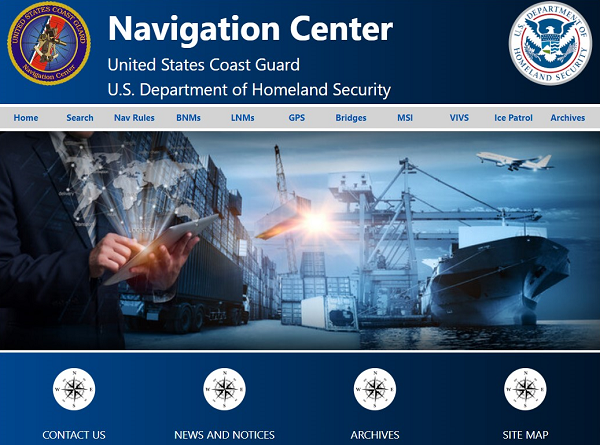 The NAVCEN website upgrade and redesign is now live.