Tag: U.S. Forest Service

  • Can you dig it? Space archeology, virtual reality and GIS

    By Troy Lambert, contributing author

    In Northern Idaho, not only is the Silver Valley near Kellogg one of the richest silver mining areas ever, but it is also the focus of an extensive EPA Superfund cleanup. There are more than 600 mine and prospecting sites in Shoshone County alone. So how do we sort through them and figure out where buildings were, and what sites were actually developed?

    Photo Credit: United States Forest Service, 1968
    Photo Credit: United States Forest Service, 1968

    Using aerial photography and GIS technology, historians, archaeologists and environmental scientists are able to look into the past and determine what actually occurred at individual sites. The United States Forest Service (USFS) and the United States Department of Agriculture (USDA) took aerial photographs of the entire area in 1937, 1948, 1965 and 1974. Other years, they partially photographed the area. Since then, aerial flyovers have been replaced by satellite imagery. All of this data tells environmental scientists where to look for waste materials.

    It also tells archeologists where to look for old structures and other manmade features. Because before a mine site can be cleaned up, it’s history must be documented. Between historic imagery and modern satellite coverage, this task is made simpler.

    Archaeologists all over the world are applying these same techniques, so it comes as no surprise that the 2016 TED Prize, awarded annually, went to space archaeologist Dr. Sarah Parcak of the University of Alabama at Birmingham, whose wish is to: “…discover the millions of unknown archaeological sites across the globe. By creating a 21st-century army of global explorers, we’ll find and protect the world’s hidden heritage, which contains humankind’s collective resilience and creativity,” she told the Alabama News Center.

    Photo Credit: Wikimedia
    Photo Credit: Wikimedia

    Parcak first earned international attention by satellite mapping Egypt using infrared imagery, discovering “17 potential unknown pyramids, 1,000 tombs and 3,100 settlements.” At the heart of her program is an online, citizen scientist, interactive platform that will allow anyone to discover ancient sites from space. The same information and imagery gathered over time will allow her and her teams to monitor looting.

    The program works simply: Once users take a quick tutorial, they are “dealt” a series of images from a deck with a general location like Northern Italy. The images are of a 50-meter-square area, and have already been processed to simplify the explorer’s search. The exact GPS location is encrypted similar to the way patient data privacy is preserved in Electronic Medical Records (EMR) to protect the exact location from potential looters and unethical archeological expeditions.

    All potential discoveries, once vetted, will be passed along to authorities along with the GIS data, so they can then excavate or protect the sites. This enables archaeologists not only to detect sites, but to find and stop looters in a matter of days or weeks rather than months or years.

    GIS can play a huge role in these and other archeological projects, and with the integration of virtual reality, the possibilities are even more exciting.

    Georeferencing Maps and Historical Photos

    While this is not possible with all sites, historical photos of some areas give archaeologists clues of where to start looking for more recent structures and human activity. Georeferencing ancient maps and photos or drawings where possible show what features have changed, what has remained the same, and what impact modern human activity has had on the site.

    Photo Credit: YouTube
    Photo Credit: YouTube

    “Rebuilding” Structures

    Once foundations and other evidence of structures have been found, 3D modeling software such as Esri CityEngine can be used in conjunction with photos to virtually reconstruct buildings, terrain and other features. This gives archeologists and scholars insight to how each site might have been used, and what other evidence to look for.

    Virtual Reality

    As 360-degree cameras have become more affordable and portable (with the release of several new models like the Nikon KeyMission 360), filming sites once they have been visited in this comprehensive way will allow archaeologists who are unable to physically reach the location to “look” for evidence, and offer advice and insight to those on location.

    Explorers in Parcak’s programs who make new discoveries will be able to accompany archaeologists via Periscope, Skype, Google Hangouts and social media, all of which are headed toward 3D video capability, allowing for more immersive and meaningful visits.

    Infrared photos from space allow us to see things on the ground not previously visible. Three dimensional modeling allows us to visualize structures no longer there, and 360-degree video and virtual reality allow us to visit these places from far away.

    The way we discover new things about our world and the way we explore them is changing, and much of that change is possible due to the blend of GIS and virtual reality.


    Troy Lambert is a freelance writer, editor and thriller author living in Boise Idaho. He became interested in using GIS for unique applications while at a museum, and now looks for and writes about unique ways GIS is used and can be used to change our world.
  • U.S. Forest Service Deploys Avenza PDF Maps App for Firefighting

    U.S. Forest Service Deploys Avenza PDF Maps App for Firefighting

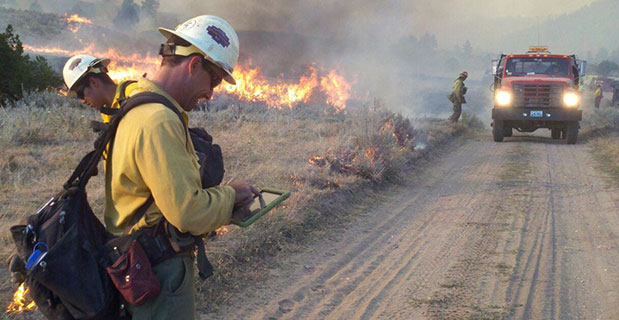
    A San Juan interagency hotshot crew member refers to a map on his iPad as he coordinates execution of their burnout operation.  (Photo credit: Esther Godson)
    A San Juan interagency hotshot crew member refers to a map on his iPad as he coordinates execution of their burnout operation.  (Photo credit: Esther Godson)

    Every year thousands of acres of forests are engulfed in fires. Recognizing the benefits of geospatial technology, the United States Forest Service (USFS) Geospatial Management Office (GMO) is using Avenza System Inc.’s award-winning PDF Maps mobile app to deliver interactive digital maps to firefighters and emergency response teams situated in forests across the United States and its territories.

    The USFS fights wildfires and other natural disasters in more than 155 national forests and 20 national grasslands, totaling an estimated 193 million acres or 30 percent of all federally managed lands. The USFS GMO is responsible for the implementation of the Forest Service geospatial program which includes using technologies such as GIS, remote sensing, cartography, geodesy and GPS.

    The centered blue GPS position on an operations map pinpoints the user’s location. (Photo credit: Carl Beyerhelm)
    The centered blue GPS position on an operations map pinpoints the user’s location. (Photo credit: Carl Beyerhelm)

    With increased use of digital solutions, the USFS benefits from Avenza’s PDF Maps app geospatial technology in enabling its thousands of firefighters and support personnel. The PDF Maps app aids emergency response teams who use digital devices for work in the field.

    The app provides constant access to geographic information and points of interest, with additional interactive features such as measuring, place marking and location tagging. The app operates without the risk of lost reception due to cell tower proximity and does not rely on an Internet connection to use map data. It uses GPS to obtain and display an accurate position on the ground regardless of network connectivity.

    A hardcopy map is compared to its digital counterpart cached on a smartphone. (photo credit: Kari Greer)
    A hardcopy map is compared to its digital counterpart cached on a smartphone. (photo credit: Kari Greer)

    “Accessing maps on mobile devices ensure responders have accurate and current geographic information while they’re out in the field,” said Carl Zulick, Geospatial Information Officer, USFS. “Avenza’s PDF Maps app makes it possible for teams to use any map digitally without requiring a data connection while involved in an emergency situation. Since the maps are location-aware and interactive, we can capture real-time data, photos, and locations. This data can be shared to assess the situation and make necessary strategic changes and improve situational awareness.”

    The PDF Maps app is available now on the iTunes App Store and Google Play Store free of charge for personal recreational use. A Windows version is currently in public beta release. Commercial, government and academic use licensing is available for a nominal annual fee. Pricing of each map is set by the publisher and free maps remain free to users through the PDF Maps app in-app store. Commercial use licensing starts at US$49 per year and drops on a per-device basis as deployment numbers increase.

    Mobile maps help air-tanker pilots avoid the mapped yellow areas, where application of aerial fire retardant is restricted. (Photo credit: Max Wahlberg) 
    Mobile maps help air-tanker pilots avoid the mapped yellow areas, where application of aerial fire retardant is restricted. (Photo credit: Max Wahlberg)
  • U.S. Forest Service deploys Avenza PDF Maps app for firefighting

    A San Juan interagency hotshot crew member refers to a map on his iPad as he coordinates execution of their burnout operation.  (Photo credit: Esther Godson)
    A San Juan interagency hotshot crew member refers to a map on his iPad as he coordinates execution of their burnout operation.  (Photo credit: Esther Godson)

    Every year thousands of acres of forests are engulfed in fires. Recognizing the benefits of geospatial technology, the United States Forest Service (USFS) Geospatial Management Office (GMO) is using Avenza System Inc.’s award-winning PDF Maps mobile app to deliver interactive digital maps to firefighters and emergency response teams situated in forests across the United States and its territories.

    The USFS fights wildfires and other natural disasters in more than 155 national forests and 20 national grasslands, totaling an estimated 193 million acres or 30 percent of all federally managed lands. The USFS GMO is responsible for the implementation of the Forest Service geospatial program which includes using technologies such as GIS, remote sensing, cartography, geodesy and GPS.

    The centered blue GPS position on an operations map pinpoints the user’s location. (Photo credit: Carl Beyerhelm)
    The centered blue GPS position on an operations map pinpoints the user’s location. (Photo credit: Carl Beyerhelm)

    With increased use of digital solutions, the USFS benefits from Avenza’s PDF Maps app geospatial technology in enabling its thousands of firefighters and support personnel. The PDF Maps app aids emergency response teams who use digital devices for work in the field.

    The app provides constant access to geographic information and points of interest, with additional interactive features such as measuring, place marking and location tagging. The app operates without the risk of lost reception due to cell tower proximity and does not rely on an Internet connection to use map data. It uses GPS to obtain and display an accurate position on the ground regardless of network connectivity.

    A hardcopy map is compared to its digital counterpart cached on a smartphone. (photo credit: Kari Greer)
    A hardcopy map is compared to its digital counterpart cached on a smartphone. (photo credit: Kari Greer)

    “Accessing maps on mobile devices ensure responders have accurate and current geographic information while they’re out in the field,” said Carl Zulick, Geospatial Information Officer, USFS. “Avenza’s PDF Maps app makes it possible for teams to use any map digitally without requiring a data connection while involved in an emergency situation. Since the maps are location-aware and interactive, we can capture real-time data, photos, and locations. This data can be shared to assess the situation and make necessary strategic changes and improve situational awareness.”

    The PDF Maps app is available now on the iTunes App Store and Google Play Store free of charge for personal recreational use. A Windows version is currently in public beta release. Commercial, government and academic use licensing is available for a nominal annual fee. Pricing of each map is set by the publisher and free maps remain free to users through the PDF Maps app in-app store. Commercial use licensing starts at US$49 per year and drops on a per-device basis as deployment numbers increase.

    Mobile maps help air-tanker pilots avoid the mapped yellow areas, where application of aerial fire retardant is restricted. (Photo credit: Max Wahlberg) 
    Mobile maps help air-tanker pilots avoid the mapped yellow areas, where application of aerial fire retardant is restricted. (Photo credit: Max Wahlberg)
  • Intergraph Government Solutions Wins USDA Contract Award

    ERDAS_Photogrammetry

    Intergraph Government Solutions (IGS) has been awarded a contract by the U.S. Department of Agriculture (USDA) U.S. Forest Service to provide image processing software across the U.S. Forest Service enterprise. IGS is a wholly-owned subsidiary of Intergraph Corporation, a Hexagon company serving the U.S. federal market.

    IGS will provide capabilities for core image processing and photogrammetry through Hexagon Geospatial’s Power Portfolio, including ERDAS IMAGINE for remote sensing and IMAGINE Photogrammetry. Integration of these products into the organization allows the U.S. Forest Service to perform mission-critical image processing and analysis on nearly 200 million acres of land for objectives such as forest restoration and emergency response to wildfires.

    “The U.S. Forest Service is a long-standing customer of IGS and Hexagon software. This purchase provides the agency with the most advanced geospatial technology for monitoring and managing national forest resources,” said Joe Fehrenbach, CEO and president of IGS.

    The result of a competitive best-value procurement, the award includes a base contract period of one year and an additional four option years. As part of the selection process, the U.S. Forest Service required live demonstrations of the proposed workflow technologies with government-provided datasets and rigorous requirements related to multiple areas of need in their business mission.