Tag: U.S. Marine Corps

  • Breaking down the F-35 jet “mishap”

    Breaking down the F-35 jet “mishap”

    Image: Lance Cpl. Kayla Rainbolt, Marine Corps Air Station Beaufort
    Image: Lance Cpl. Kayla Rainbolt, Marine Corps Air Station Beaufort

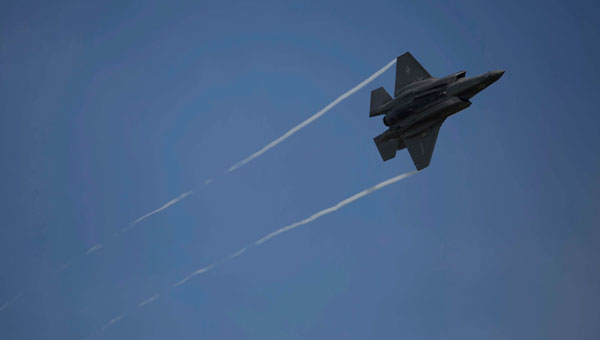
    On Sept. 18, 2nd Marine Aircraft Wing Cpl. Christian Cortez, a pilot, set out on a training mission from the Marine Corps Air Station in Beaufort, South Carolina, only to eject from his Lockheed Martin F-35B Lightening II fighter jet over North Carolina. The U.S. military then lost the expensive, highly automated, lethal jet that was still in flight, as it was set on autopilot when the pilot ejected.

    During the mishap, the U.S. Air Force Joint Base Charleston made a highly usual plea to the public to call with information regarding the lost plane. It is also still unclear why the pilot had to bail out of the jet and those details are actively under investigation.

    The U.S. Marine Corps confirmed on Sept. 19, that debris had been found in South Carolina in Williamsburg County, north of Charleston, reported The New York Times. Joint Base Charleston stated the jet debris is located about two hours north of the base and it is urging residents to avoid the area as the recovery team secures the scene.

    The jet search team consisted of the Second Marine Aircraft Wing, Navy regional authorities in the southeast, the Civil Air Patrol, the Federal Aviation Administration, and local law enforcement teams.

    The Marine Corp released a statement on Sept. 18, stating that its acting commander, Gen. Eric M. Smith, had directed all Marine Corps aviation units to conduct a two-day pause in operations to discuss aviation safety matters and best practices. The statement said that the directive came after three Class-A aviation mishaps occurred during the last six weeks.

    During the pause of operations, aviation commanders plan to review the service’s flight practices, procedures, and policies.

    The jet

    Lockheed Martin’s website states, “with stealth technology, advanced sensors, supersonic speed, weapons capacity and superior range, the F-35 is the most lethal, survivable and connected aircraft in the world. More than a fighter jet, the F-35’s ability to collect, analyze and share data, is a powerful force multiplier that enhances all airborne, surface and ground-based assets in the battlespace enabling men and women in uniform to execute their mission and return home safely.”

    The F-35 program is the most expensive U.S. weapons program of all time and is expected to cost more than $400 billion in development and acquisition and $1.2 trillion to operate and maintain the fleet over 60 years. Each jet costs more than $160 million, depending on the variant.

    Notable program advancements

    Lockheed Martin reached a $4 billion deal with the Pentagon in 2014 to bring in the new fleet of F-35 jets.

    In late 2019, Lockheed Martin received a $25 million initial contract for engineering and manufacturing development for the GPS Spatial Temporal Anti-Jam Receiver (GSTAR) system that was integrated into the F-35 as part of its modernization phase, also known as Block 4. The GSTAR provides protection against enemy jamming and spoofing by utilizing critical GPS capabilities that can quickly adapt to meet specific platform requirements.

    Several unanswered questions

    Several details of this story have left many wondering exactly how this U.S. fighter jet just went missing in U.S. airspace without anyone being able to locate it or know its heading. It is an expensive, highly automated, weaponized aircraft that can create catastrophic damage to its surroundings. 

    As this investigation is ongoing, further details about this incident have not been reported.   
  • BAE Systems and Lockheed Martin tests UAS

    BAE Systems and Lockheed Martin tests UAS


    Image: Air Force Staff Sgt. Rachel Simones/ Department of Defense.
    Image: Air Force Staff Sgt. Rachel Simones/ Department of Defense.

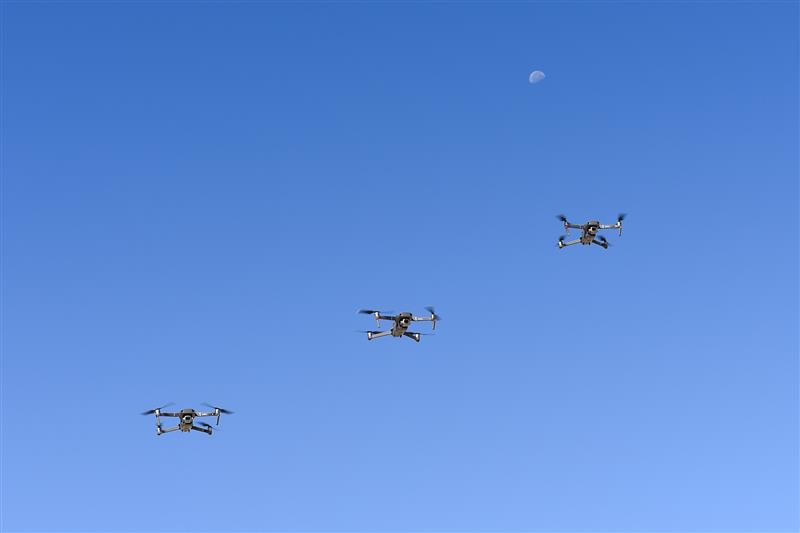
    BAE Systems and Lockheed Martin Skunk Works partnered to test the Skunk Works Stalker and Indago UAS on BAE Systems’ amphibious combat vehicle (ACV) command, control, communication and computers (C4)/UAS variant. The UAS will provide reconnaissance capabilities to support U.S. Marine Corps expeditionary warfare and battle management capabilities.

    BAE Systems tested the Stalker and Indago UAS — in addition to other technology suppliers — as a part of contractor verification testing. With contractor verification testing complete, the USMC plans to conduct additional tests to evaluate whether the AVC C4/UAS is a solution for the Advanced Reconnaissance Vehicle program.

    “By integrating Stalker and Indago on BAE Systems’ ACV platform, we are delivering greater mission flexibility in a small form factor that supports Marine Corps operations,” Jacob Johnson, Skunk Works UAS and attritable systems director, said.

    The Skunk Works Stalker and Indago UAS provide a broad operating envelope and endurance, which enables diverse and demanding missions while maintaining a small operational footprint and crew requirement.

    BAE Systems’ ACV C4/UAS vehicle is a mobile systems integration lab built to demonstrate the technology Marines need to conduct reconnaissance, surveillance and acquisition capabilities, including the ability to sense and communicate targets over the horizon using C4 systems.

  • Northrup Grumman provides Marines with next-gen targeting devices

    Northrup Grumman provides Marines with next-gen targeting devices

    Photo: KaninRoman/iStock / Getty Images Plus/Getty Images
    Photo: KaninRoman/iStock / Getty Images Plus/Getty Images

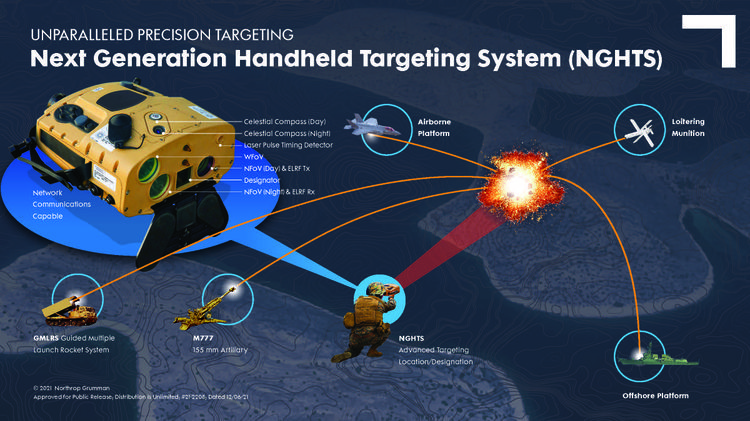
    The U.S. Marine Corps has selected Northrop Grumman to provide the Next-Generation Handheld Targeting System (NGHTS), a compact targeting system that provides advanced precision targeting and can operate in GPS-denied environments.

    NGHTS will provide Marines an enhanced capability to identify and designate targets from extended ranges.

    “NGHTS’ advanced technology will significantly enhance warfighters’ ability to safely complete their missions,” said Bob Gough, vice president of navigation, targeting and survivability, Northrop Grumman. “NGHTS is lightweight and combines four systems into one portable device with state-of-the-art imaging, targeting, ranging, designating and networking. This compact, multi-sensor electro-optical/infrared device lightens Marines’ loads and keeps them connected while adding precision and safety to their missions.”

    This laser-based device can perform rapid target acquisition, laser terminal guidance operation and laser spot imaging. Its high-definition infrared sensors provide accuracy and grid capability over extended ranges.

    Additional features include a high-definition color display and day/night celestial compasses.

  • Northrop Grumman provides handheld targeting device

    Northrop Grumman provides handheld targeting device

    Photo: KaninRoman/iStock / Getty Images Plus/Getty Images
    Photo: KaninRoman/iStock / Getty Images Plus/Getty Images

    The U.S. Marine Corps has selected Northrop Grumman Corp. to provide it with the Next Generation Handheld Targeting System (NGHTS), a compact device that provides high precision targeting and can operate in GPS-denied environments.

    The laser-based device will give Marines an enhanced capability to identify and designate targets from extended ranges, enabling them to identify ground targets under a wide range of conditions.

    NGHTS can perform rapid target acquisition, laser terminal guidance operation and laser spot imaging functions. Its high-definition infrared sensors provide accuracy and grid capability over extended ranges.

    Additional features include a high-definition color display and day/night celestial compasses.

  • Northrop Grumman to equip Marines with next-gen targeting devices

    Northrop Grumman to equip Marines with next-gen targeting devices

    Image: Northrop Grumman
    Image: Northrop Grumman

    The U.S. Marine Corps has selected Northrop Grumman to provide the Next Generation Handheld Targeting System (NGHTS), a compact device that provides precision targeting and is capable of operation in GPS-denied environments.

    The laser-based device will give marines an enhanced capability to identify and designate targets from extended ranges.

    “NGHTS will significantly enhance the ability of marines to identify ground targets under a wide range of conditions,” said Bob Gough, vice president, navigation, targeting and survivability, Northrop Grumman. “Connected to military networks, NGHTS can provide superior situational awareness and accurate coordinates for the delivery of effects from beyond the line of sight.”

    Northrop Grumman’s NGHTS is capable of performing rapid target acquisition, laser terminal guidance operation and laser spot imaging functions. Its high-definition infrared sensors provide accuracy and grid capability over extended ranges. Additional features include a high-definition color display and day/night celestial compasses.

  • SMC awards 3 agreements for modernized GPS handheld

    SMC awards 3 agreements for modernized GPS handheld

    SMC awards multiple rapid prototyping agreements for joint modernized GPS handheld device; four demonstrations to be held

    The Defense Advanced GPS Receiver (DAGR) in use in 2011. (Photo: U.S. Army)
    The Defense Advanced GPS Receiver (DAGR) in use in 2011. (Photo: U.S. Army)

    On June 26, the United States Space Force’s Space and Missile Systems Center awarded three separate rapid prototyping agreements to Collins Aerospace, Raytheon Intelligence & Space and the Technology Advancement Group for a total of $41.1 million.

    The firm-fixed price agreements are for the development of a basic working prototype of the joint modernized GPS handheld device. The contract provides the government with innovative solutions demonstrated via hardware and software prototype development.

    The purpose of this rapid prototyping effort is to produce a joint modernized handheld smaller in size with low power consumption, increased military-code capability, and improved anti-jamming and anti-spoofing capabilities compared to the equipment now used by the military.

    4 demonstrations coming

    This is the second competitive objective under the current Phase I strategy and is the result of a down-select from five to three vendors. It builds off the first objective of Phase I, which focused on mock-ups and drawings.

    These agreements provide for four demonstrations to be held with Army and Marine Corps representatives. The demonstrations give the end users an early opportunity to provide feedback and the ability to influence the final design — ultimately making for a more seamless transition to operations.

    “This is the first major update to the military’s GPS handheld device in more than 15 years,” said Col. Clifford Sulham, User Products Division chief.  “The advanced capabilities of this device will allow our airmen, soldiers, sailors and Marines to conduct operations in GPS-challenged environments.”

  • USS Wasp first carrier to use GPS-based JPALS on deployment

    USS Wasp first carrier to use GPS-based JPALS on deployment

    F-35Bs can use JPALS for precision landings in zero visibility conditions.

    Early in 2018, U.S. Marine Corps F-35B Lightning II fighters deployed to the Pacific aboard the USS Wasp amphibious assault ship, and used Raytheon Company’s  Intelligence, Information and Services business’ Joint Precision Approach and Landing System (JPALS) to guide them onto the ship’s deck.

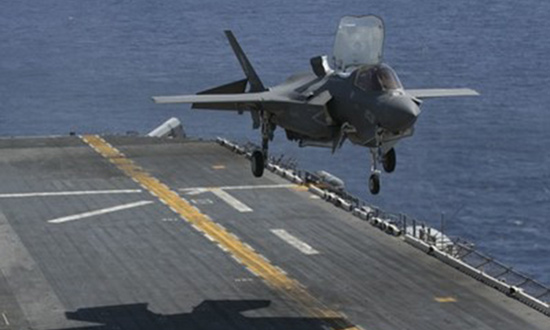
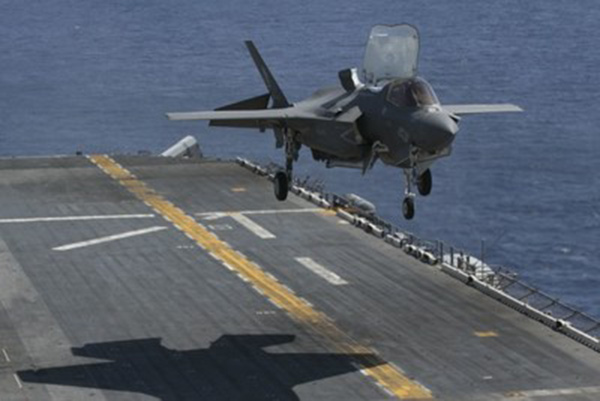
    An F-35B Lightning II prepares to land on the flight deck of the USS Wasp while underway in the Philippine Sea, March 23, 2018. (Photo: U.S. Marine Corps/Lance Cpl. Amy Phan)
    An F-35B Lightning II prepares to land on the flight deck of the USS Wasp while underway in the Philippine Sea, March 23, 2018. (Photo: U.S. Marine Corps/Lance Cpl. Amy Phan)

    JPALS is a differential, GPS-based precision landing system that guides aircraft onto carriers and amphibious assault ships in all weather and surface conditions, including rough waters.

    It uses an encrypted, jam-proof datalink, connecting to software and receiver hardware on the aircraft and an array of GPS sensors, mast-mounted antennas and shipboard equipment, the company said.

    “We’re asking our pilots to land in some of the most difficult conditions on Earth,” said U.S. Navy Captain B. Joseph Hornbuckle III, program manager, Naval Air Traffic Management Systems Program Office. “JPALS goes a long way toward ensuring the safety of our aircrews and the success of our missions.”

    JPAL’s precision navigation is equally effective ashore. A land-based version of the system can be small enough to be either dropped into an austere environment via parachute or driven in on a trailer.

    “Deploying with the F-35 is a good start, but it’s just the beginning,” said Matt Gilligan, Raytheon vice president of Navigation, Weather and Services. “There are many fixed and rotary wing aircraft around the world and across the services that deploy to harsh, low-visibility environments where JPALS would be extremely valuable.”

    The system is slated to go into production in 2019 and will be outfitted on the U.S. Navy’s newest fighter — the F-35 Lightning II — allowing pilots to land with accuracy.