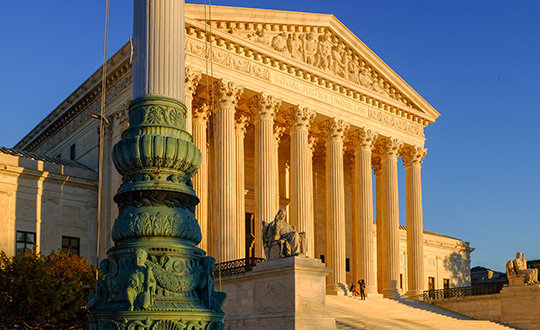
The U.S. Supreme Court ruled June 22 that the government needs a warrant to access a person’s cellphone location history.
In the case Carpenter v. United States, the American Civil Liberties Union represented a man who had months of his cellphone location information turned over to law enforcement without a warrant. Investigators received the cell tower records with a court order that requires a lower standard than the “probable cause” needed to obtain a warrant.
The court found in a 5-to-4 decision that obtaining such information is a search under the Fourth Amendment and that a warrant from a judge based on probable cause is required.
“This is a groundbreaking victory for Americans’ privacy rights in the digital age,” said ACLU attorney Nathan Freed Wessler, who argued the case before the court last November. “The Supreme Court has given privacy law an update that it has badly needed for many years, finally bringing it in line with the realities of modern life.
“The government can no longer claim that the mere act of using technology eliminates the Fourth Amendment’s protections. Today’s decision rightly recognizes the need to protect the highly sensitive location data from our cell phones, but it also provides a path forward for safeguarding other sensitive digital information in future cases — from our emails, smart home appliances, and technology that is yet to be invented.”
Case background
In 2011, without getting a probable cause warrant, the government obtained from cell service companies months’ worth of phone location records for suspects in a robbery investigation in Detroit. For one suspect, Timothy Carpenter, the records covered 127 days and revealed 12,898 separate points of location data. Police seek these kinds of cellphone location records from phone companies tens of thousands of times each year.
After Carpenter was convicted at trial, based in part on the cellphone location evidence, he appealed to the Sixth Circuit Court of Appeals, which ruled 2–1 that no warrant is required under the Fourth Amendment.
The Supreme Court said in its opinion today, “We decline to grant the state unrestricted access to a wireless carrier’s database of physical location information. In light of the deeply revealing nature of CSLI, its depth, breadth and comprehensive reach, and the inescapable and automatic nature of its collection, the fact that such information is gathered by a third party does not make it any less deserving of Fourth Amendment protection. The government’s acquisition of the cell-site records here was a search under that amendment.”
Tech companies and media weigh in
Among the many friend-of-the-court briefs filed in the case is the one from technology companies, which was signed by Google, Facebook, Apple, Verizon, Twitter, Cisco, Microsoft and others. They echoed the ACLU’s arguments, writing that “Fourth Amendment doctrine must adapt to the changing realities of the digital era” and that “Rigid analog-era rules should yield to consideration of reasonable expectations of privacy in the digital age.”
In another friend-of-the-court brief, the Reporters Committee for Freedom of the Press and 19 other media organizations warned of the chilling effect on First Amendment freedoms that can result from easy law enforcement access to the location information of reporters and their sources.
Third-party doctrine
The government’s argument was based on the “third-party doctrine,” which the government reads to provide that by sharing information or records with a “third party” such as a business, a person gives up any reasonable expectation that the information will remain private. The doctrine was established in Supreme Court cases from the 1970s, which reasoned that without an expectation of privacy, there is no Fourth Amendment protection for certain records voluntarily shared with businesses, such as canceled checks sent to a bank or phone numbers dialed on a phone and transmitted over a phone company’s equipment. The government has extended that principle to cover various kinds of digital records, such as cell phone location data.
“The court’s decision is a vindication of the arguments we have persistently made on behalf of Timothy Carpenter throughout this litigation — that the Constitution’s privacy protections fully apply to the digital location data created by using cell phones,” said attorney Harold Gurewitz, who represents Carpenter alongside the ACLU. “The ruling also affirms that prosecutors are required to get a search warrant in order to seize this kind of sensitive personal information.”
The data acquired by police in the case provides a stark demonstration of how location data can reveal extraordinarily private details about people’s lives, from where they sleep to where they pray.
For example, the location data showed that in the early afternoon on a number of Sundays, Carpenter made or received calls from the cell tower sectors nearest to his church. His cellphone records do not routinely show him in that area on other days of the week, implying that he was worshipping at those times. The data also shows which nights he slept at or near his home, and which nights he spent elsewhere.
Carpenter is represented at the Supreme Court by the ACLU, the ACLU of Michigan, defense attorney Gurewitz of Gurewitz & Raben PLC, and Jeffrey Fisher, co-director of the Stanford Law School Supreme Court Litigation Clinic.

