Tag: UAV registration

  • UK House of Commons report issues drone regulation recommendations

    UK House of Commons report issues drone regulation recommendations

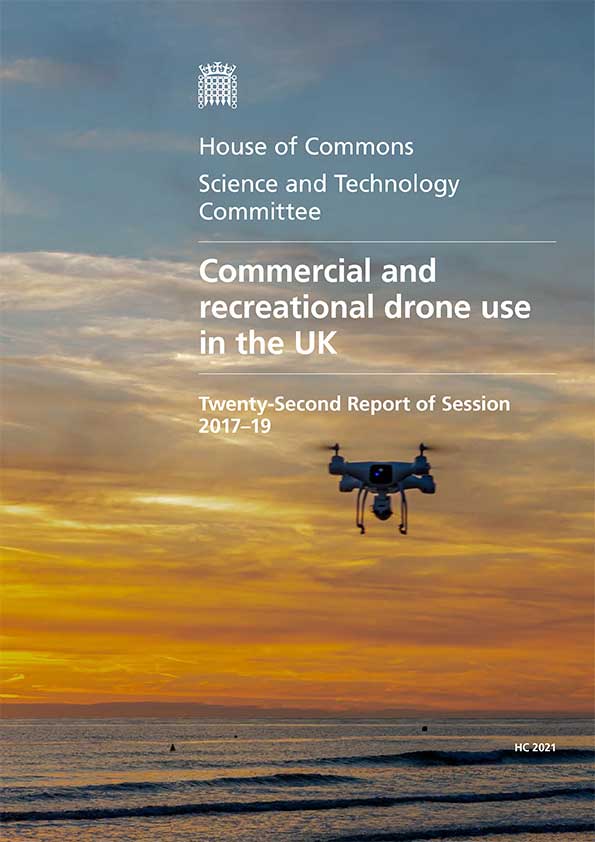
    Photo: UK Drone report cover
    Click for report.

    A committee of the U.K.’s House of Commons issued a report calling for greater drone regulations, including registration, drone ID transmission and geofencing around sensitive locations.

    In the 73-page report “Commercial and Recreational Drone Use in the UK,” the Science and Technology Committee made numerous recommendations to the government.

    In its summary, it recalls drone sightings at Gatwick Airport in December 2018, which caused “significant disruption and highlighted the need for further recognition of the substantial rise in the purchase and use of commercial and civilian drones more widely.”

    Restricted Airspace

    The report calls for more studies, such as on airport/drone collisions. It recommends that the government complete an assessment of the risks that drones pose to manned commercial aircraft and publish the findings by the end of 2020.

    “The committee is concerned that there is no agreed position on the likely consequences of a drone-airplane impact,” the report says.

    The committee also recommends temporary drone flight restriction zones around helicopter landing zones and said the government should consider geo-fencing as a compulsory measure around prisons and high security areas.

    “We recognise the importance of extending Flight Restriction Zones to five kilometres. However, these restriction zones are not clearly or consistently enforced,” the report states. “The lack of a standardised process results in inconsistent denials and permissions being granted to those applying. This is unacceptable.”

    “The government should commission the production of a standardised and unified system through which drone operators can request access to Flight Restriction Zones. This could be achieved by working with National Air Traffic Services on its development of an Airspace User’s Portal. This should be completed no later than summer 2020.”

    Drone Registration

    The report recommends that the government begin a UAV registration system, enabling identification of lawful drone operators. Those registering would also have to pass a knowledge test. It also recommends that drones be “electronically conspicuous” with some form of electronic ID within two years. Both ID and geofencing should be standard in drones, the report said, with penalties for disabling these features.

    If a drone user doesn’t register, “We recommend a sliding scale of penalties for failure to register, starting with a warning, and culminating in a fine and a prison sentence,” the report states.

    BVLOS and UTM tech testing

    A beyond-visual-line-of-sight (BVLOS) testing facility should be established so that unmanned traffic management (UTM) systems and related technologies can be tested, the report recommends.”Clear plans should be set out for this as soon as possible and further testing should begin no later than Summer 2020.”

    The report concludes, “The government should produce a white paper by summer 2020 that outlines the vision for how drones will be integrated into UK communities over the coming years.”

  • FAA expands online UAV registration to commercial users

    Starting March 31, owners of small unmanned aircraft systems (UAS) used for commercial, public and other non-model aircraft operations will be able to use the FAA’s new, streamlined, web-based registration process to register their aircraft.

    The web-based process will significantly speed up registration for a variety of commercial, public use and other users. Registration for those users is $5, the same fee that model aircraft owners pay.

    “Registration is an important tool to help us educate aircraft owners and safely integrate this exciting new technology into the same airspace as other aircraft operations,” said FAA Administrator Michael Huerta.

    All owners of small UAS used for purposes other than as model aircraft must currently obtain a 333 exemption, a public certificate of authorization or other FAA authorization to legally operate, in addition to registering their aircraft. Before today, the FAA required all non-hobby unmanned aircraft owners to register their aircraft with the FAA’s legacy aircraft registry in Oklahoma City, Oklahoma.

    Those owners who already have registered in the legacy system do not have to re-register in the new system. However, the FAA is encouraging new owners who are registering for the first time to use the new, web-based registration system.

    Owners who register under the new system can easily access the records for all of the aircraft they have registered by logging into their on-line account.

    Small UAS owners who have registered under the web-based system who intend to use their aircraft for purposes other than as model aircraft will also need to re-register to provide aircraft specific information.

    The FAA first opened up the web-based registration for model unmanned aircraft owners on Dec. 21, 2015.

    The agency is expanding that existing website to accommodate owners of aircraft used for purposes other than model aircraft. This registration process includes additional information on the manufacturer, model and serial number, in addition to the owner’s physical and email addresses. Like the model aircraft registration process, a certificate is good for three years, but each certificate covers only one aircraft.

    Register here.

  • FAA unveils UAS rule, begins drone registry Dec. 21

    FAA unveils UAS rule, begins drone registry Dec. 21

    The Federal Aviation Administration announced on Dec. 14 an official rule and registration process for hobbyists who own small unmanned aircraft weighing more than 0.55 pounds and less than 55 pounds, including payloads such as on-board cameras.

    The online registration system does not yet support registration of small UAS used for any purpose other than hobby or recreation — for example, using an unmanned aircraft in connection with a business. The FAA is developing enhancements that will allow such online registrations by spring of 2016.

    The registration procedure is a statutory requirement that applies to all hobby aircraft. Under this rule, any owner of a small UAS who has previously operated an unmanned aircraft exclusively as a model aircraft prior to Dec. 21, 2015, must register no later than Feb. 19, 2016. Owners of any other UAS purchased for use as a model aircraft after Dec. 21, 2015, must register before the first flight outdoors.

    The Registration Task Force delivered recommendations to FAA Administrator Michael Huerta and Transportation Secretary Anthony Foxx on Nov. 21. The rule incorporates many of the task force recommendations, the FAA says.

    “Make no mistake: unmanned aircraft enthusiast are aviators, and with that title comes a great deal of responsibility,” Foxx said in the announcement. “Registration gives us an opportunity to work with these users to operate their unmanned aircraft safely. I’m excited to welcome these new aviators into the culture of safety and responsibility that defines American innovation.”

    Owners may register through a web-based system or paper-based process. There is a $5 registration fee, but the FAA is offering a full rebate for those who register before Jan. 20, 2016.

    Under the rule, each aircraft must be marked with a unique number, although not necessarily the serial number. The goal is to help authorities track down an owner if a drone collides with another aircraft, flies too high or encroaches on an airport.

    Registrants will need to provide their name, home address and email address. Upon completion of the registration process, the web application will generate a Certificate of Aircraft Registration/Proof of Ownership that will include a unique identification number for the UAS owner, which must be marked on the aircraft.

    Owners using the model aircraft for hobby or recreation will only have to register once and may use the same identification number for all of their model UAS. The registration is valid for three years.

    “We expect hundreds of thousands of model unmanned aircraft will be purchased this holiday season,” Huerta said. “Registration gives us the opportunity to educate these new airspace users before they fly so they know the airspace rules and understand they are accountable to the public for flying responsibly.”

  • Expert Opinions: FAA UAV registration requirement

    Q: What do you think of the FAA requirement that all UAV purchasers register their devices?

    Lydia Bock President and CEO Geodetics Inc.
    Lydia Bock
    President and CEO
    Geodetics Inc.
    A: We need a pragmatic and sensible response to the integration of UAVs into the civil airspace, balancing safety of civil aviation and the economic benefits associated with the emerging markets and applications of UAV technologies.

    Clearly maintaining flight safety in the national airspace is critical. A balanced approach would include registration of UAVs, education for hobbyists and FAA flight certifications for commercial operations.

    New technologies for automated sense-and-avoid should be investigated, and their certification for use should be streamlined.


    John Studenny Director System Engineering Esterline - CMC Navigation Systems
    John Studenny
    Director System Engineering
    Esterline – CMC Navigation Systems
    A: Registration of all radio-controlled (RC) aircraft or UAVs upon purchase may be too broad or harsh, and may conflict with current freedoms already enjoyed by hobbyists.

    However, as capabilities (altitude, speed, flight duration, payload capacity) increase beyond what today’s RC aircraft or UAVs can deliver, regulations and registration may be required.

    It comes down to UAV capability and how the UAVs are used. That needs to be the focus of any regulation or enforcement.