Tag: UAV testing

  • Raytheon to partner on drone-testing airspace corridor

    Raytheon to partner on drone-testing airspace corridor

    The Northeast UAS Airspace Integration Research Alliance selected Raytheon as a key partner in the development of America’s first and most advanced unmanned aircraft system-testing airspace corridor in New York state.

    Raytheon’s Intelligence, Information and Services business will help plan, design, build and support the state’s next-generation air traffic management system to safely test and manage drones.

    “UASs are playing an increasingly important role in our society, which means we must have low-altitude air traffic management solutions,” said Matt Gilligan, vice president of Raytheon’s Navigation, Weather and Services mission area. “The New York airspace corridor is the first-of-its kind, but it won’t be the last.”
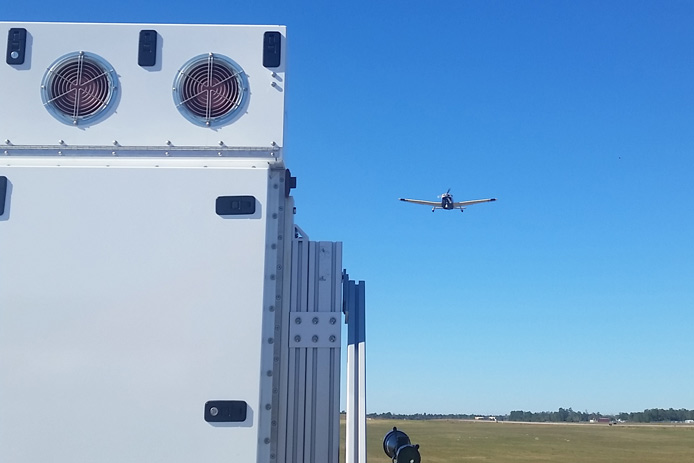
    A single-engine plane lands with the aid of a compact, Raytheon-made low-power radar during a flight-check demonstration for the U.S. government. (Photo: Raytheon)

    The new corridor will extend 50 miles (80 kilometers) west from Griffiss International Airport, which is one of only seven Federal Aviation Administration (FAA)-approved unmanned aircraft systems test sites in America.

    The corridor will allow companies to test both drones and air traffic management technologies in real-world settings, generating valuable data that will inform industry and regulators and ultimately advance the commercial use of drones.

    “We have identified the most qualified organizations to complete the New York UTM corridor and expand our UAS testing capabilities,” said Maj. Gen. Marke F. “Hoot” Gibson (ret), NUAIR Alliance’s chief executive officer. “With all our state economic and technical support, I think we are well positioned to accelerate the UAS industry and further establish this region as a national leader.”

    Raytheon’s leadership in air traffic management includes the low-power radar (LPR), a small, one-meter square Active Electronically Scanned Array (AESA) software-defined radar unit. When numerous LPRs are networked together, the radar units can cover and control the low-altitude flights of smaller craft — a feat not possible with current large radar systems.

    A distributed, low-level LPR network could be created with relative ease, mounting the system atop current cell-phone towers or tall buildings.

    A LPR network could support:

    • safe plane and drone landings
    • aviation surveillance
    • precision weather observations (including 3D wind information and urban hydrology)
    • small drone detection and tracking
    • border security and surveillance
    • wildfire detection
    • elevation and geographic gap fills.
  • Drone Delivery Canada achieves BVLOS in test flights

    Drone Delivery Canada Corp. (DDC) reports the success of a pivotal milestone towards commercializing its drone logistics platform after successfully achieving beyond visual line of sight (BVLOS) in test flights.

    The success of these flights, which took place in Foremost, Alberta, after DDC received a Special Flight Operating Certificate from Transport Canada, prove that DDC’s BVLOS technical capability has now passed the most important landmark that enables the DDC platform to run commercially.

    The systems tested predominantly include DDC’s proprietary FLYTE management system, its avoidance technology and communications platform. During the flights, DDC’s Mission Control Centre in Toronto, 2,500 kilometers away, successfully monitored and record telemetry in real time for each flight.

    DDC is set to become the first and only drone logistics compliant operator approved by Transport Canada, which is expected to occur in the fourth quarter of 2017, followed by commercial operations in the first quarter of 2018.

    Commercial operations are forecast to be based on a revenue model that comprises of integration fees, set-up fees, and on going reoccurring revenue. DDC’s revenue is based on a traditional software as a service
    (SaaS) model format.

    Below is a video of DDC in Foremost, Alberta, performing Beyond Visual Line of Sight (BVLOS) testing.

    “We are the only pure play drone delivery company that has ever successfully achieved BVLOS flights under Transport Canada’s oversight,” claimed Richard Buzbuzian, president of Drone Delivery Canada. “This is a major milestone for our company. With this success in hand, we now have greater visibility than ever before to operate commercially. Additionally, more than ever, we are also seeing international inquiry for our platform. This win has been a major step forward for us, both domestically and internationally.”

    “The success of these flights now allows us to expand our testing with both new and existing clients that include large corporations and government organizations in Canada and abroad,” said Tony Di Benedetto, CEO of Drone Delivery Canada. “Given Canada’s geography and some of the obvious and social opportunities in Northern Canada, we believe the best place to start commercializing this platform is in our own backyard, then internationally as we prove out our systems.”