Tag: ultra low power

  • Sony Israel offers low-power 5G chipset with GNSS

    Sony Israel offers low-power 5G chipset with GNSS

    Innovative chip offers multiple ultra-low power connectivity options and low-power processing for internet of things (IoT) market

    Sony Semiconductor Israel has launched the ALT1350 for the global market. The ALT1350 is a cellular LTE-M/NB-IoT chipset designed to enable additional low-power wide-area (LPWA) communication protocols, as well as GNSS, in a single chipset.

    The ALT1350 incorporates a sensor hub to collect data from the sensors while maintaining ultra-low power consumption. It also provides cellular and Wi-Fi-based positioning and is tightly integrated to provide power-optimized concurrent LTE and GNSS to accommodate various tracking applications, which can be demanding with a single chip.

    “The market demand for this multiprotocol, ultra-low power IoT chipset is intensifying, and Sony’s ALT1350 chipset meets that demand,” said Nohik Semel, CEO at Sony Semiconductor Israel. “This is the game changer we’ve been waiting for, which will enable IoT deployments, utilizing universal connectivity on edge processing and multiple location technologies.”
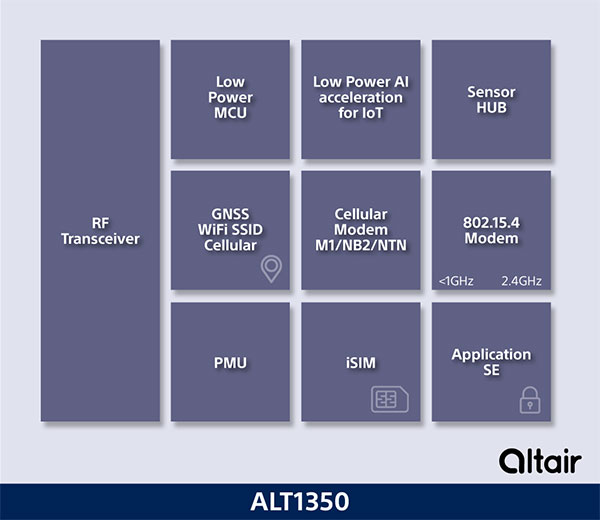
    Diagram: Sony
    Diagram: Sony

    The ALT1350 is an advanced cellular IoT solution, with architecture that resolves IoT service provider’s power-consumption concerns. Its optimized standby mode (eDRX) reduces power consumption by 80% when compared to the current generation and by 85% when using it to send short messages.

    Overall improvements in the system’s power consumption will enable four times longer battery life for a typical device, enabling additional functionalities and use cases with smaller batteries.

    The ALT1350’s sub-GHz and 2.4 GHz integrated transceiver enables hybrid connectivity for smart meters, smart cities, trackers and other devices. This enhances coverage, reduces costs and further decreases power consumption using IEEE 802.15.4-based protocols such as Wi-Sun, U-Bus Air and wM-Bus, in additional point-to-point and mesh technologies.

    The chipset is designed to support the wide-ranging market needs of utilities, vehicle, tracking devices, smart cities, connected health and other verticals. Device manufacturers across all verticals can take advantage of its low power consumption, long-lasting battery life, mature Release 15 LTE-M/NB-IoT software stack, and future compatibility with 3GPP release 17.

    All these guarantee longevity and ensure the ALT1350 will operate with 5G networks. It contains an additional LPWA radio transceiver with targeting operation in <1 GHz and 2.4 ISM bands for universal connectivity options.

    The chipset provides advanced on-the-edge low power processing capabilities, ranging from data collection, low power AI/ML processing of the data, and MCU to enable IOT applications on the chip.

    The device is now sampling to lead customers and will become commercially available in 2023. The ALT1350 also includes a secure element for application usage and integrated SIM designed for PP-0117 to meet GSMA requirements.

  • YIC offers low-power GPS/GNSS module for internet of things

    YIC offers low-power GPS/GNSS module for internet of things

    YIC logoYuechung International Corp. (YIC) is offering a GPS/GNSS module for internet of things (IoT) applications.

    YIC is a manufacturing and design company for quartz crystals, crystal oscillators, GPS/GNSS modules, GPS/GNSS receivers and RF antennas. It provides low-power solutions to solve product problems that require frequent charging.

    YIC’s new product — the Ultra Low Power GPS/GNSS Module (Model YIC71009EBGG and YIC71513PGMGG) — is designed as an IoT product solution, targeted to improve the operating times of IoT applications such as trackers, wearables and portable devices.

    According to its press release, YIC “is dedicated to providing the best solution for GPS devices and sees a tremendous opportunity in the GNSS market to solve power consumption problems.” The recent industry trend of multi-frequency GPS, low-power consumption, and dead reckoning will be advantageous to YIC in terms of high-grade products entering the global market.

    Models YIC71009EBGG and YIC71513PGMGG provide:

    • Ultra-low power consumption – 6mA (Typical).
    • Multi-constellation – GPS/QZSS + GLONASS.
    • Small size

    About YIC

    Founded in 1994 and headquartered in New Taipei City, Taiwan, YIC is a professional partner in frequency control, GPS/GNSS modules, receivers and RF antennas, advanced low power GPS, and small size solutions.

  • Kolmostar releases low-power GNSS module JEDI-200

    Kolmostar releases low-power GNSS module JEDI-200

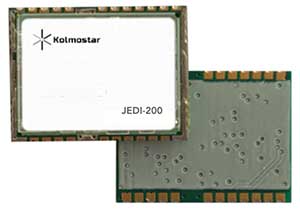
    JEDI-200 reduces the energy of getting one position fix by up to 150 times, according to the company.

    Photo: Kolmostar
    Photo: Kolmostar

    Kolmostar, a positioning technology company, has launched an ultra-low-power GNSS module at IoT World, which took place May 13-16 in Santa Clara, California.

    JEDI-200 reduces the energy for one position fix by up to 150x compared to traditional GNSS sensors, providing a positioning solution for location-based internet-of-things applications, the company said.

    JEDI-200 specification highlights include:

    • 10-mW ultra-low-power consumption (measured) @ 1 Hz navigation rate
    • 1-second ultra-fast time to first fix from cold start
    • 2-meter CEP high positioning accuracy
    • Supports GPS and Beidou constellations
    • 100-byte compressed ephemeris (EPH) to enable A-GPS with speedy download via LPWAN technologies such as LoRaWAN and NBIoT
    • High-performance cloud computing based on 50-byte raw position files for optimized radio transmission efficiency and minimum endpoint power consumption
    • Integrated SAW filter, stand-alone LNA and TCXO
    • 12 x 16 millimeter form factor for easy RF integration

    “JEDI-200 supports GPS as well as Beidou constellations,” said Tao Tong, co-founder and CEO of Kolmostar. “While achieving industry’s lowest power consumption, it helps our customers to achieve high accuracy even in dense urban canyon environment where existing GNSS modules on the market often drift due to multipath and other errors.”

    The JEDI-200 is designed specifically for IoT applications such as human and asset trackers (for bikes, scooters, vehicles, cargo, livestock, pets and more), smart wearables, smart farming and infrastructures,.

    Its reduced level of power consumption and its optimized efficiency with LPWAN technologies solve IoT endpoint deployment’s pain-point of needing frequent recharges or a large battery, enabling new possibilities in location-based IoT applications.

  • Baseband Technologies Granted Patent for Ultra Low-Power GPS Receiver

    Baseband Technologies Inc. has been issued a patent from the United States Patent and Trademark Office for its low-power satellite positioning innovation. U.S. Patent No. 9,116,234, titled “System, Method and Computer Program for a Low Power and Low Cost GNSS Receiver,” describes the technology and processes to significantly reduce the energy required to operate a GPS receiver.

    Baseband’s ultra low-power GPS receiver technology enables consumer electronics manufacturers to integrate its receiver into battery-powered wearable/Internet of Things (IoT) devices using hundreds of times less power than the traditional GPS chipsets.

    “With the wearable market projected to grow multiple times faster than smartphones and with GPS being one of the most requested features, there will be huge rewards for those manufacturers who can offer GPS functionality in their products without impacting the battery life or size,” said Francis Yuen, founder and CEO of Baseband. “For us, innovation is about connecting what is possible with what is valuable to our customers. This patent, in conjunction with others now pending, will enable Baseband to continue to offer ultra low-power positioning capabilities and customer-centric experiences across different market verticals.”

    “It is gratifying that the US Patent and Trademark Office has recognized both our invention and the intellectual property of this very promising technical advancement,” Yuen said. “This newly granted patent will certainly help in our current investment round as well as to fuel continued product development and innovation that will lead to even further advances in ultra low power positioning.”