Tag: universities

  • FAA awards $4.4 million in drone research grants to 7 universities

    FAA awards $4.4 million in drone research grants to 7 universities

    Photo: PhonlamaiPhoto/iStock / Getty Images Plus/Getty Images
    Photo: PhonlamaiPhoto/iStock / Getty Images Plus/Getty Images

    The U.S. Department of Transportation’s Federal Aviation Administration (FAA) has announced $4.4 million in drone research, education and training grants to seven universities.

    Research will focus on three areas:

    • electromagnetic compatibility
    • detect-and-avoid classifications
    • cybersecurity oversight.

    “This funding and our ongoing partnerships with these universities will allow the FAA to safely integrate the airspace that has a growing number of diverse aircraft users,” said FAA Acting Administrator Billy Nolen.

    The research initiatives and grant awardees include:

    Evaluate Unmanned Aircraft Systems (UAS) Electromagnetic Compatibility

    This research will assess the risks, identify drone design vulnerabilities, identify material and procedural mitigations, and propose guidance for safer electromagnetic compatibility with emitted and static fields.

    • University of North Dakota, $325,042
    • University of Kansas, $325,000
    • Drexel University, $325,830

    Investigate Detect-and-Avoid Track Classification and Filtering

    This research will provide proposed metrics, guidance and test methods to assess the effects of false or misleading information on detect-and-avoid capabilities. The findings will support beyond-visual-line-of-sight operations.

    • The Ohio State University, $732,441
    • Embry-Riddle Aeronautical University, $371,000
    • Mississippi State University, $330,000
    • University of North Dakota, $80,000

    Illustrate the Need for UAS Cybersecurity Oversight and Risk Management

    This research will address UAS cybersecurity oversight and risk management as it pertains to the National Airspace System and other FAA systems.

    • University of Kansas, $651,982
    • Oregon State University, $609,226
    • Drexel University, $608,783

    Today’s announcement is the second round of Alliance for System Safety of UAS through Research Excellence (ASSURE) grants, which brings the total of 15 grants valued at $18.3 million for Fiscal Year 2022.

    The ASSURE Center of Excellence is one of six that the FAA has established to help advance technology and educate the next generation of aviation professionals. Research conducted through ASSURE is focused on helping the drone market safely grow and integrate into the nation’s airspace.

    More than 800,000 recreational and commercial drones are in the active drone fleet, and that number is expected to grow.
  • Orolia Academic Partnership Program to support PNT research

    Orolia Academic Partnership Program to support PNT research

    Program will support positioning, navigation and timing (PNT) research at colleges and universities around the world

    Orolia has created the Orolia Academic Partnership Program (OAPP) to build a community to help foster global PNT research and collaboration at top engineering schools and research institutions.

    Orolia will provide qualified institutions with access to the company’s signature Skydel GNSS simulation engine, an advanced GNSS and PNT testing and simulation tool.


    Webinar scheduled

    Orolia will host a webinar on Dec. 14 at 11:00 a.m. EST to introduce OAPP and answer questions about the program and Skydel. Register here.


    Orolia also created an online forum to support its vision to form an interactive community focused on the future of GNSS and PNT research and education.

    The forum allows users to interact with other users and Orolia experts, share information, ask questions and receive feedback. A host of white papers, application notes and detailed technical documents are also available.

    The Skydel platform

    Skydel is an innovative GNSS simulation platform that leverages software, advanced graphics cards and software-defined radios. Users can build custom signals and connect to other systems and devices (such as sensors and inertial measurement units) through Orolia’s open-source plug-in capabilities.

    Skydel also includes the ability to generate and test the vulnerability of GNSS/GPS with integrated interference, jamming and spoofing capabilities. Because Skydel leverages commercial off-the-shelf  hardware, it can run independently of simulation vendors’ hardware.

    “Skydel platform’s versatility and capabilities allow users to perform tests in the field, in the lab, and at home — whether you are running a turnkey system provided by Orolia, our partners, or through your own proprietary hardware,” said Lisa Perdue, director, PNT Testing and Simulation at Orolia. “Unlike other GNSS simulators, Skydel is the only professional platform offering a plug-in architecture that provides real-time and direct access to the core simulation engine. This plug-in architecture unlocks a new range of application and customization that is impossible to imagine with traditional instruments.”

    Perdue added that plug-ins can be shared with the open-source community to leverage all the benefits from a collaborative ecosystem. “We believe this modern architecture is the perfect approach to support academic research as well as allowing users to go further into system integration and customization,” she said.

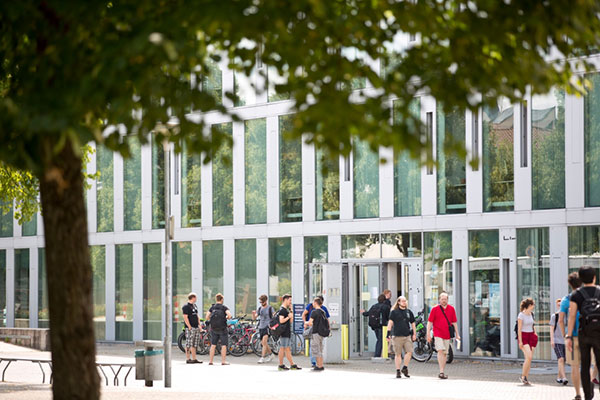
    The University of Stuttgart in Germany is an academic partner. (Photo: Regenscheit, Universität Stuttgart)
    The University of Stuttgart in Germany is an academic partner. (Photo: Regenscheit, Universität Stuttgart)

    Stuttgart Institute a Pioneer

    More than 40 schools throughout North America, Europe, South and Central America and Asia-Pacific are enrolled in OAPP, including the Institute of Navigation (INS) at the University of Stuttgart in Germany, where Skydel is fueling pioneering student research.

    “Skydel allows our students to carry out complex field tests, such as simulating laboratory scenarios in real time and using radio hardware to send signals to commercial or self-developed receivers,” said Thomas Hobiger, INS. “We can compare our navigation solutions with the simulated trajectories while showing the absolute accuracy of our algorithms, meaning the deviation from the actual position.”

    Hobiger added the INS wants graduates to be well-prepared for the demands of the industry and future innovation. According to Statista consumer research, the installed base of GNSS devices worldwide stood at 6.4 billion units in 2019. The Asia-Pacific region led the way, accounting for 3.4 billion GNSS devices, with forecasts suggesting this is set to rise to 5.1 billion devices by 2029.

    “OAPP members can contribute to this community to share their advancements, upload code or make their work available to others in our GitHub repository,” Perdue said. “The goal is to ensure that members can access ideas and expertise of other users across the globe.

    “The need for continuous and reliable GNSS signals as well as methods to protect those signals from jamming, spoofing or meaconing is growing exponentially worldwide,” Perdue said. “These are the main reasons why engineering students should gain valuable experience using a platform that provides accurate PNT simulation and measurement.”

  • Concept3D’s night map feature supports campus security

    A new night map integration feature is available for all Concept3D maps. The toggle-on map overlay is designed to enhance campus safety and security by making it easy to find the best, well-lit routes and critical resources such as emergency phones.

    The Concept3D interactive mapping platform is used by hundreds of major universities, colleges and schools, as well as convention centers, hospitals, resorts, retirement communities, data centers and businesses.

    The night map feature offers all of these clients a way to provide their audiences with important safety and security information for visiting and navigating the campus at night.

    The University of Denver, Boise State University, and Pacific Lutheran University are the first to integrate this feature into their Concept3D-powered interactive campus maps.

    The night map of the campus of Boise State University. (Image: Concept3D)
    The night map of the campus of Boise State University. (Image: Concept3D)

    Boise State University is using the new night map feature to highlight Public Safety Dispatch Centers, Emergency Blue Light and Refugee Phones and locations of automated external defibrillators (AEDs). Each item has a display box that further explain the exact location of the service and additional information.

    Pacific Lutheran uses the night map to display campus AEDs, emergency telephones, and its safety building.

    Colleges and universities that participate in federal Title IV student financial assistance programs must comply with the Clery Act, which requires annual security reporting, details and geographic information about crimes committed on campus and on public areas immediately adjacent to the campus, and timely warnings and emergency notifications, among other requirements.

  • University of Redlands details its GIS master’s program at Esri UC

    Doug Flewelling, Ph.D., gives an overview of the University of Redland‘s master’s degree program for GIS at the 2017 Esri User Conference, which took place July 10-14 in San Diego, California. The program is specifically designed for is professionals in the field looking to further their careers, as well as international students.

  • Penn State highlights online GIS master’s degree program at Esri UC

    Pennsylvania State University assistant professor of geography Anthony Robinson discusses the university’s online geospatial program at the 2017 Esri User Conference, which took place July 10-14 in San Diego, California. The university added a graduate certificate in remote sensing and earth observation to its offerings.