Tag: University of California

  • Research Roundup: GPS reveals volcanic activity under Europe

    Research Roundup: GPS reveals volcanic activity under Europe

    Scientists have discovered new evidence for active volcanism next door to some of the most densely populated areas of Europe. The study crowdsourced GPS monitoring data from antennae across western Europe to track subtle movements in the Earth’s surface, thought to be caused by a rising subsurface mantle plume.

    The Eifel region lies roughly between the cities of Aachen, Trier and Koblenz, in west-central Germany. It is home to many ancient volcanic features, including the circular lakes known as maars. Maars are the remnants of violent volcanic eruptions, such as the one that created Laacher See, the largest lake in the area. The explosion that created the lake is thought to have occurred around 13,000 years ago.

    The mantle plume that fed this ancient activity is thought to still be present, extending up to 400 kilometers (km) into the earth. However, whether or not it is still active is unknown. “Most scientists had assumed that volcanic activity in the Eifel was a thing of the past,” said Corné Kreemer, lead author of the new study. “But connecting the dots, it seems clear that something is brewing underneath the heart of northwest Europe.”
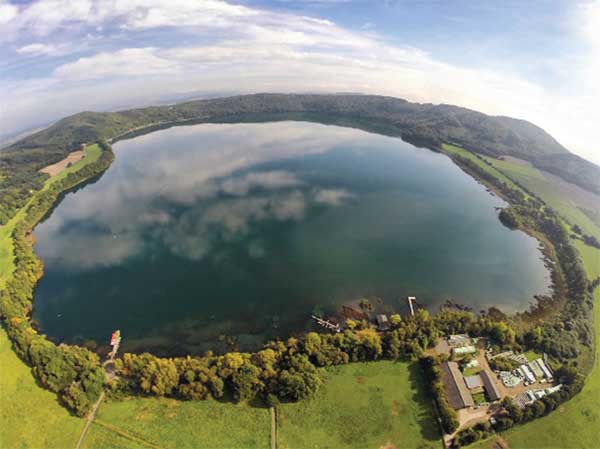
    An aerial view of Laacher See, a volcanic caldera lake with a diameter of 2 km in Rhineland-Palatinate, Germany. Created by volcanic activity, maars like this are also found in other parts of Europe and on other continents, but Eifel-Maars are the classic example worldwide. (Photo: bbsferrari/iStock / Getty Images Plus/Getty Images)
    An aerial view of Laacher See, a volcanic caldera lake with a diameter of 2 km in Rhineland-Palatinate, Germany. Created by volcanic activity, maars like this are also found in other parts of Europe and on other continents, but Eifel-Maars are the classic example worldwide. (Photo: bbsferrari/iStock / Getty Images Plus/Getty Images)

    In the new study, the team — based at the University of Nevada, Reno and the University of California, Los Angeles — used data from thousands of commercial and state-owned GPS stations all over western Europe. The research revealed that the region’s land surface is moving upward and outward over a large area centered on the Eifel, and including Luxembourg, eastern Belgium and the southernmost province of the Netherlands, Limburg.

    “The Eifel area is the only region in the study where the ground motion appeared significantly greater than expected,” said Kreemer. “The results indicate that a rising plume could explain the observed patterns and rate of ground movement.”

    The new results complement those of a previous study in Geophysical Journal International that found seismic evidence of magma moving underneath the Laacher See. Both studies point towards the Eifel being an active volcanic system.

    The implication of this study is that there may not only be an increased volcanic risk, but also a long-term seismic risk in this part of Europe. The researchers urge caution, however. “This does not mean that an explosion or earthquake is imminent, or even possible again in this area. We and other scientists plan to continue monitoring the area using a variety of geophysical and geochemical techniques, to better understand and quantify any potential risks.”
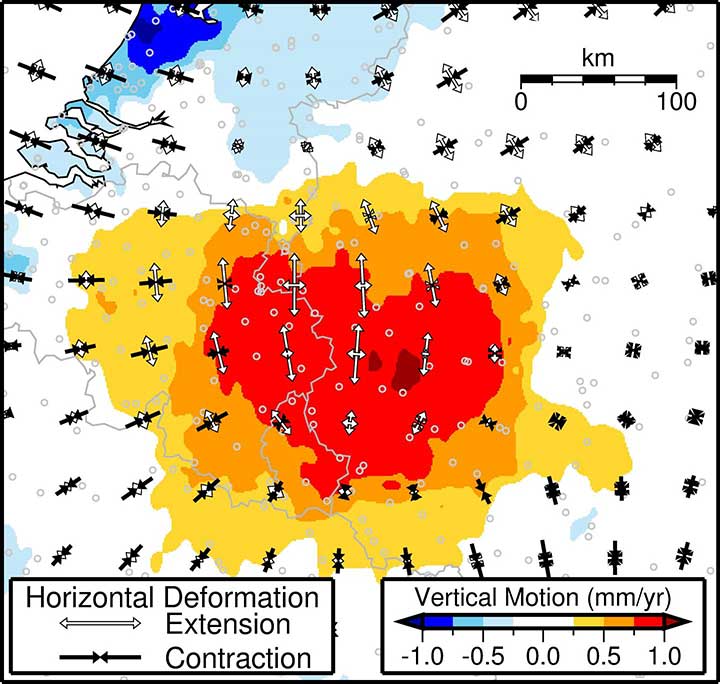
    GPS observations of ground movement under the Eifel area. Colors represent contoured vertical motion inferred from GPS station data, and white and black arrows indicate the direction in which the crust is horizontally stretching or compressing, respectively. The highest upward motion of ~1 mm per year is found near the Eifel volcanic field. (Image: Study authors)
    GPS observations of ground movement under the Eifel area. Colors represent contoured vertical motion inferred from GPS station data, and white and black arrows indicate the direction in which the crust is horizontally stretching or compressing, respectively. The highest upward motion of ~1 mm per year is found near the Eifel volcanic field. (Image: Study authors)

    Citation: “Geodetic evidence for a buoyant mantle plume beneath the Eifel volcanic area, NW Europe” by Corné Kreemer, Geoffrey Blewitt, Paul M. Davis. Geophysical Journal International, Volume 222, Issue 2, Aug. 1, 2020, pp. 1316–1332, https://doi.org/10.1093/gji/ggaa227

  • Institute of Navigation celebrates 75th anniversary

    Institute of Navigation celebrates 75th anniversary

    Logo: ION

    The Institute of Navigation (ION) celebrated its 75th anniversary on June 25.

    On June 25, 1945, ION held its first organizational meeting on the Los Angeles Campus of the University of California.

    According to ION, 55 people attended this meeting, where a “temporary” organization was established until a general meeting could take place in the fall when articles of incorporation could be drafted and adopted, council members elected and the vision for ION could begin to take shape.

    The global impact of ION has been documented in its more than 2,600 technical papers that have been published in Navigation, the Journal of the Institute of Navigation. Navigation was first published in March 1946.

    The Institute of Navigation is a non-profit professional organization advancing the art and science of positioning, navigation and timing.

  • UC San Diego Health launches drone transport program with UPS, Matternet

    Drone service slated to begin February 2020, with goals of enhancing efficacy, reliability and predictability of delivering medical products between hospitals and laboratories.

    In February, the University of California (UC) San Diego Health will launch a pilot project to test the use of unmanned aerial vehicles to transport medical samples, supplies and documents between Jacobs Medical Center, Moores Cancer Center and the Center for Advanced Laboratory Medicine (CALM), speeding delivery of services and patient care currently managed through ground transport.

    Trained professionals will load and operate the drones, which will follow predetermined, low-risk flight paths and will carry no cameras. (Photo: UC San Diego Health)
    Trained professionals will load and operate the drones, which will follow predetermined, low-risk flight paths and will carry no cameras. (Photo: UC San Diego Health)

    The program is a collaboration with UPS, which received in September 2019 the Federal Aviation Administration’s (FAA) Part 135 Standard certification and authorization to use unmanned aircraft systems for a drone delivery program, and Matternet, a Mountain View, California-based drone systems developer for health care institutions. This latest effort builds upon the UPS and Matternet drone project already taking place at WakeMed Health and Hospitals, a private, non-profit health care system based in Raleigh, N.C.

    “Currently, medical samples that must be transported between health care sites are carried by courier cars, which are naturally subject to the variabilities of traffic and other ground issues,” said Matthew Jenusaitis, chief administrative officer for innovation and transformation at UC San Diego Health. “With drones, we want to demonstrate proof-of-concept for getting vital samples where they need to be for testing or assessment more quickly and simply. It’s another way to leverage emerging technologies in a way that can tangibly benefit our patients.”

    The project calls for medical professionals at Jacobs Medical Center, located on the east health campus of UC San Diego in La Jolla, to pack payloads, such as blood samples or documents, into a secure container that attaches to one of Matternet’s M2 rechargeable battery-powered drones.

    The drones will follow predetermined, low-risk flight paths, initially between Jacobs Medical Center and special landing sites at Moores Cancer Center, located less than a mile away and within visual line of sight under the FAA’s Part 107 rules, and then subsequently at CALM, which is near the Jacobs Medical Center. The flights will take only minutes to complete and will be monitored by remote operators. The drones will carry no cameras.

    In May 2018, the FAA designated the city of San Diego as one of nine lead participants in the regulators’ Integration Pilot Program. UC San Diego was also approved by the FAA to test the use of drones in transporting lab specimens and pharmaceuticals throughout its health system.

    “Right now, most biological samples must travel between sites by courier car, within designated hours,” said James Killeen, MD, clinical professor of emergency medicine and director of information technology services at UC San Diego School of Medicine. “That leaves the system vulnerable to the vagaries of road congestion, accidents, construction and more. Travel time can be slow and unpredictable. A drone can fly over such obstacles in a much more direct way, and take just a few minutes to cover the same distance.”


  • Research studies method of fighting fire with UAVs

    By Sharon Rabinovich, Renwick E. Curry and Gabriel H. Elkaim, University of California, Santa Cruz

    Figure 1. Greedy uncertainty suppression (GUS). (Chart: Authors)
    Figure 1. Greedy uncertainty suppression (GUS). (Chart: Authors)

    Exploring a wide area in search of a hazardous substance emitting source or expansion of a fire front is an ideal UAV mission. Wildfire monitoring missions exemplify such a problem.

    Most multi-UAV systems address problems related to search in an environment of interest. The UAVs cooperate and share data to obtain information within a certain aspect of the environment.

    Regardless of the number of UAVs and size of the area of interest (AOI), cooperative systems deliver a perfectly up-to-date picture of the environment with coordination.

    This paper investigates a coordination scheme for missions facing uncertainty about the periphery in the AOI. It takes into account the UAVs’ state, observations, the overall mission, and allocates each UAV to a specific task, enabling the multi-UAV system to act in a coordinated manner.

    If a coordination algorithm for an environment with uncertainty is available, the overall system still leans on sensing capabilities. Even if the system uses the most advanced sensors, sometimes the environmental conditions are restrictive; that is, UAV sensors cannot reach far enough, and measured data can only be local and quantized data.

    The goal of quantized estimation is to develop techniques to effectively reconstruct the data. The research approach relies on a technique for estimation of propagated boundary with quantized measurements and proposes a new class of one-dimensional estimator: the Greedy Uncertainty Suppression (GUS) strategy.

    The monitoring application involves large numbers of possibly randomly distributed inexpensive sensors, with limited sensing and processing. The estimator incorporates observations gathered by multiple observers and uses the quantized kalman filter estimation to update the expected location and unobserved spreadrate.

    More info at www.ion.org/publications/ browse.cfm.

  • Expert Opinions: How will autonomous traffic safety issues affect the GNSS industry?

    Expert Opinions: How will autonomous traffic safety issues affect the GNSS industry?

    Q: How will safety issues raised by increasing autonomous traffic — in the air and on roads — affect the GNSS industry?


    Sanchit Agarwal, VP, Field Operations, Nearmap

    A: Due to increasing autonomous traffic, the GNSS industry will have to adopt the concepts of collective tracking mechanisms in the shared ecosystem. Inherently, all the cars/drones (rovers) will have the sensors to track the traffic “on-the-fly” and make intelligent navigation decisions, but in case of any system malfunction, the collective tracking of devices can facilitate “social” interactions between the rovers. This will serve as an added layer of security in case an autonomous social member goes rogue!


    Zak M. Kassas, Assistant Professor, University of California, Riverside

    A: Future autonomous vehicles will demand full situational awareness and extremely reliable, accurate and secure navigation systems. GNSS will not meet the stringent demands of these autonomous vehicles. To address the inevitable situations where GNSS signals become unusable (due to attenuation or interference) or untrustworthy (due to spoofing), receivers should be coupled with sensors such as IMUs, lidar and cameras, and exploit the plenitude of ambient signals of opportunity such as cellular, digital TV and Wi-Fi.


    Jonathan Auld, VP of Engineering and Safety Critical Systems, Novatel

    A: Safety issues raised by increasing autonomous automotive and airborne traffic will escalate the product development standards and performance requirements of GNSS software, hardware, and correction services used. The GNSS industry is challenged to increase accuracy on lower cost platforms by utilizing multi-frequency, multi-constellation, sensor fusion and precise point positioning. To be able to rely on GNSS in auto-guidance applications, the industry also needs to incorporate GNSS integrity functionalities into our products.