Tag: University of New Brunswick

  • How GPS was affected by the solar eclipse

    How GPS was affected by the solar eclipse

    I had my special ISO-certified glasses ready. Living in Oregon, I wasn’t about to miss the once-in-a-lifetime chance to see a total eclipse of the sun.

    On Aug. 21, my family drove a few miles north to get into the path of totality, which for us lasted about a minute. It was definitely worth the field trip.

    Besides regular folk like me, experts in numerous fields turned their eyes — and their instruments — to the eclipse.

    The National Center for Atmospheric Research took to the air with a Gulfstream V fitted out with sensors and equipment for atmospheric research. The flight gathered data about the sun that can’t be collected from the ground.

    With better instruments than ever before, for the first time scientists had the chance to observe the corona in the infrared spectrum, which may provide insight into the sun’s magnetic fields.

    Back on terra firma, atmospheric scientists closely monitored changes in temperature and other weather effects. The temperature dropped as much as 7 degrees in Crossville, Tennessee, reports the National Weather Service.

    Scientists at zoos and aquariums across the country closely watched animal behavior during totality. Species exhibiting unusual behavior included elephants, hippos, crocodiles and penguins.

    As for GPS, experts from the NASA Jet Propulsion Laboratory, NASA HQ Earth Science Division and the University of New Brunswick kept a close eye on the event, collecting data from GPS receivers and other ionospheric monitoring tools to better understand exactly how the ionosphere reacts to a total eclipse of the sun.

    The scientists found a “decrease in the number of free electrons in the part of the Earth’s ionosphere along the eclipse path where sunlight was temporarily blocked by the moon…

    “TEC [total electron content] time series from two continuously operating GPS monitoring stations near the path of totality…show a small dip of about 2 TECU [TEC units] or so around 18:00 UTC on Aug. 21, coincident with the timing of the eclipse.”

    The eclipse also affected WAAS real-time correction data from geostationary satellites.

    While study of the data continues, it’s clear that GPS easily withstood the eclipse. Learn more here.

  • New name, new version for GAPS software

    New name, new version for GAPS software

    GAPS v6.0.0 is now rebranded as the GNSS Analysis and Positioning Software.

    GAPS software — hosted by the University of New Brunswick, Canada — provides users with accurate satellite positioning using a single GNSS receiver both in static and kinematic mode. Through the use of precise orbit and clock products provided by sources such as the International GNSS Service (IGS) and Natural Resources Canada (NRCan), it is possible to achieve centimeter-level positioning in static mode and decimeter-level positioning in kinematic mode given a sufficient convergence period.

    The newest version provides users with the ability to process various combinations of GPS, Galileo and BeiDou observables as well as several other new processing features for researchers and surveyors.

    Users are invited to submit feedback via email to [email protected].

    GAPS-derived position fixes for a test drive in Fredericton. (Image: UNB)
    GAPS-derived position fixes for a test drive in Fredericton. (Image: UNB)
  • UNB’s PPP Software Centre v2.0 Beta Now Available

    The PPP Software Centre, an email-based Online PPP comparison utility hosted by the University of New Brunswick, is once again functioning with its release of version 2.0 Beta following an extended hiatus while being rewritten.

    The centre is a convenient method for the GNSS community to compare results from several online precise point positioning services. For a more detailed description, including submission instructions, see the homepage at http://www2.unb.ca/gge/Resources/PPP/.

    Note that the report has changed slightly, adding additional features, including final static position estimates tabulated in both Cartesian and geodetic coordinate systems; the name of the Cartesian system (and its epoch); and featuring a so-called Subject Line Interface, allowing advanced users some additional control over the centre’s behavior. This last feature may see some future expansion.

    The centre invites feedback on the utility.

  • New Version of GAPS PPP Software Available

    A new version of the online GAPS precise point positioning software is now available. GAPS — GPS Analysis and Positioning Software — is offered by the University of New Brunswick Geodesy and Geomatics Engineering Department.

    The latest release provides capabilities for handling GPS data files in both RINEX 2 and 3 formats, whether Hatanaka-compressed or not, along with a number of receiver raw file formats. Also, additional input and output data-quality verification is now performed.

    More information on the release can be found here, and the new version is available here.

  • Canadian Science Minister Announces Grant to Langley’s UNB Lab

    Canadian Science Minister Announces Grant to Langley’s UNB Lab

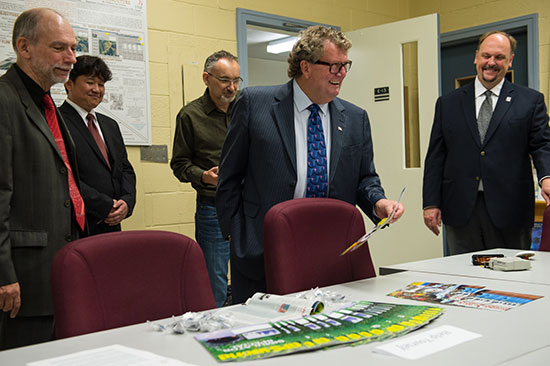
    Professor Langley (center) discusses the UNB geodesy program with Canadian Science Minister Ed Holder (second from left.)
    Professor Langley (fourth from left) discusses the UNB geodesy program with Canadian Science Minister Ed Holder (third from left.)

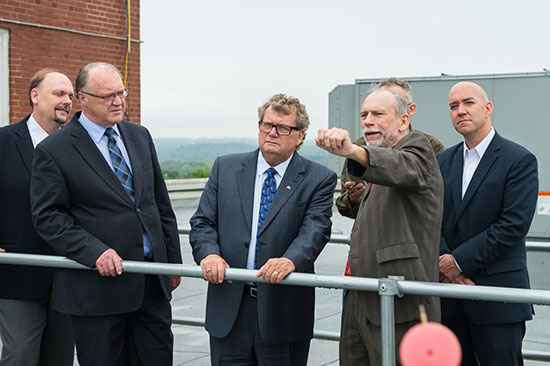
    The Canadian Minister of State for science and technology, Ed Holder, visited the University of New Brunswick on July 28 to announce the awarding by the Natural Sciences and Engineering Council of $2.4 million to 28 UNB researchers.

    He was joined by Keith Ashfield, member of Parliament for Fredericton, where UNB is based, and Craig Leonard, the New Brunswick Minister of Energy and Mines.

    A highlight of the visit was a tour of the Department of Geodesy and Geomatics Engineering to see the work of Prof. Richard Langley and his students. Langley received $170,000 in Natural Sciences and Engineering Research Council (NSERC) funding in the competition. The funding will support the work of his group in improving augmented multi-constellation satellite-based precise positioning in a wide range of environments. Langley is GPS World’s Innovation editor, a post he has held since the magazine’s inception.

    Canadian Science Minister Ed Holder looks at GPS World magazine, which has featured Innovation columns edited by Richard Langley for more than two decades.
    Canadian Science Minister Ed Holder looks at GPS World magazine, which has featured Innovation columns edited by Richard Langley for more than two decades.

    Although GPS was the first widely available satellite navigation system, it has now been joined by the Russian GLONASS system, and will soon be accompanied by the European Galileo system, the Chinese BeiDou system, and the Japanese QZSS — all of which have test satellites now in orbit. There are interesting problems to be solved in gaining maximum benefits from this plethora of GNSS for precise positioning and navigation, and Langley and his team will address a number of them.

    The team is also involved in the analysis of data from the GPS-based instrument on the Canadian CASSIOPE scientific satellite launched at the end of September 2013. The instrument, which precisely determines the position of the satellite and provides information on the state of the Earth’s ionosphere, was designed at UNB.

    The NSERC Discovery Grants Program is an integral component of the government’s efforts to develop, attract and retain the world’s most talented researchers at Canadian universities. The program funds discovery research in a multitude of scientific and engineering disciplines, which builds a broad base of research capacity across the country.

    Professor Langley gave the following presentation at the NSERC Discovery Grants Scholarships Rollout Announcement at UNB on July 28: