
Tag: University of Strathclyde

  • CPI TMD demonstrates quantum navigation at sea for UK

    CPI TMD demonstrates quantum navigation at sea for UK

    CPI Electron Device Business – TMD Technologies Division has successfully completed sea trials of its cquantum-hybrid inertial navigation system (INS) aboard the THV Galatea, operated by Trinity House, the General Lighthouse Authority for England, Wales, the Channel Islands and Gibraltar.

    This milestone shows that quantum-enabled sensing hardware can operate stably in maritime conditions, with the potential to provide resilient positioning without continuous reliance on GNSS.

    Research indicates that a 24-hour GNSS outage could cost the UK economy £1.4 billion through cascading effects on logistics, transportation and critical infrastructure, underscoring the need for GNSS-independent solutions. By proving that quantum sensors can operate in operational conditions aboard a working vessel, CPI TMD is advancing technologies that reduce reliance on satellite navigation and improve resilience across maritime, defense and commercial sectors.

    The Harlequin System: Quantum-Enhanced INS

    The Harlequin system is a quantum-classical hybrid INS designed to extend GNSS holdover — the ability to maintain accurate position when satellite signals are unavailable or unreliable. Developed under an Innovate UK funded project, with partners from industry and academia, including the University of Strathclyde, and Joseph Cotter’s group at Imperial College London, Harlequin integrates classic INS components (a precise clock, a ring laser gyroscope, and a MEMS accelerometer) with CPI TMD’s gMOT-based quantum accelerometer.
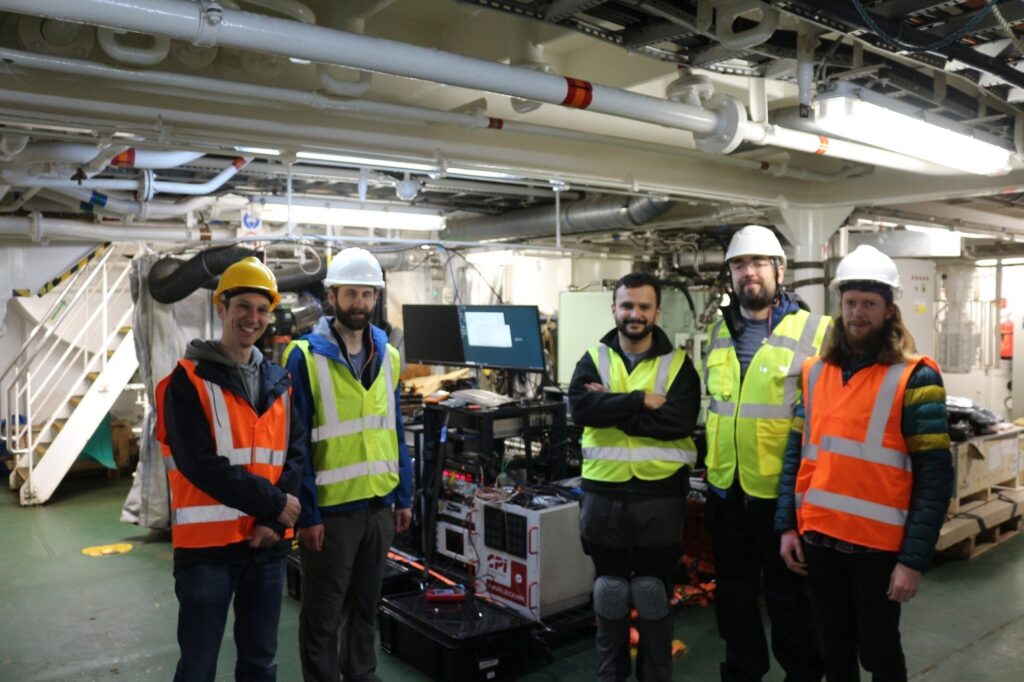
    Onboard team for the sea trial. (Photo: CPI TMD)
    Onboard team for the sea trial. (Photo: CPI TMD)

    The gMOT cold atom source, developed by CPI TMD, the University of Strathclyde and Kelvin Nanotechnology, is a grating-based magneto-optical trap that provides a source of ultra-cold atoms that forms the basis of a portable, rugged quantum sensor.

    Conventional INS technology accumulates errors over time, causing position estimates to drift. By integrating its cold-atom accelerometer technology with classical INS technology, Harlequin leverages quantum-enhanced sensing to perform periodic drift corrections, extending the period over which a vessel can maintain accurate position in the absence of satellite-derived timing and positioning.

    Real-world trials: Operating around a working vessel

    The Harlequin trial demonstrates that quantum sensors can operate reliably outside the lab, functioning in the harsh conditions of real-world maritime operations—a crucial validation step toward field-deployable systems.

    The sea trial took place aboard the THV Galatea, which is not a scientific test vessel but an operational ship with a demanding day job: keeping shipping routes safe by ensuring buoys and lights are correctly placed and maintained, surveying the seabed for hazards, marking wrecks, and supporting marine-infrastructure projects such as cables and pipelines.

    The Harlequin system had to be loaded, tested and unloaded around the Galatea’s regular operational schedule, adding complexity to the trial and underscoring the system’s ability to integrate into real-world maritime workflows.

    Next Steps: System Upgrades and Second Trial

    Data gathered during the trial will inform a program of system upgrades aimed at improving performance and enhancing suitability for long-term shipboard operation. A second field trial is planned for the end of 2026 to validate improvements and bring it closer to operational readiness.


  • English, Scottish firms to develop a more accurate atomic clock for GNSS

    English, Scottish firms to develop a more accurate atomic clock for GNSS

    New atomic clock technology will improve GNSS location accuracy, as well as addressing the scalability of other quantum technologies being developed

    Nanofabrication experts Kelvin Nanotechnology have teamed up with product design specialist Wideblue, the University of Strathclyde and the University of Birmingham on a UK Research and Innovation  (UKRI) project funded by the Industrial Strategy Challenge Fund to develop innovative techniques in the miniaturisation of optical atomic clocks.

    The new clock technology will help improve GNSS location accuracy, as well as addressing the scalability of other quantum technologies being developed by the academic partners.

    “Small, low cost atomic clocks will be essential as we develop a resilient position, navigation and timing (PNT) infrastructure to support our financial, power distribution and communications services,” said Roger McKinlay, challenge director – Quantum Technologies at UKRI.

    Cold atomic samples have led to profound advancements in precision metrology by measuring the frequency separation of discrete atomic energy levels. These atomic clocks are the ultimate timekeepers, with the state-of-the-art instruments providing a timing accuracy that it would neither gain nor lose a second in over 30 million years.

    Because of the high level of accuracy in these instruments, atomic clocks are used to coordinate systems that require extreme precision, such as GNSS. Each satellite network contains multiple atomic clocks that contribute precision timing data, which is decoded to provide location data by effectively synchronizing each receivers’ atomic clocks with those of the satellite.

    “The project is a feasibility study which aims to facilitate the miniaturization of state-of-the-art atomic clocks.” said Russell Overend, managing director of Wideblue. “To achieve such high timing resolution, the atomic clock makes use of ultra-narrow transitions in strontium atoms, providing orders of magnitude better performance than their rubidium counterparts due to narrower atomic features. In simple terms, the narrower the atomic transition the more accurate the atomic clock.

    At Strathclyde, cold atom clock experiments are aided by expertise in grating magneto-optical traps (gMOTs), illustrated here. (Image: Aidan Arnold, University of Strathclyde)
    At Strathclyde, cold atom clock experiments are aided by expertise in grating magneto-optical traps (gMOTs), illustrated here. (Image: Aidan Arnold, University of Strathclyde)

    An important factor in cold atomic clock technology is grating magneto-optical traps (gMOTs). With gMOTs, diffraction gratings split and steer an incoming beam into a tripod of diffracted beams, allowing trapping in the four-beam overlap volume. 

    Wideblue will develop the optical system that will deliver the laser light onto the gMOT chip. Kelvin Nanotechnology will manufacture the gMOT and compact collimation optics designed by Wideblue. The University of Strathclyde will design the gMOT chip, and the University of Birmingham will perform the testing of the prototype optical system.

    “Atomic clocks are an integral component in modern technology and impact our daily routines from computing and financial transactions to the navigation systems we use in our phones and cars,” said James McGilligan, Kelvin Nanotechnology, “As state-of-the-art atomic clocks push new boundaries in precision measurement, we face a new challenge of bringing this complex and large physical apparatus into a compact and user-friendly system where we can make the largest societal and economic impact.

    “Our current collaboration with Wideblue and our academic partners aims to address the scalability of one such atomic clock by reducing the optical constraints into scalable micro-fabricated components as a critical step to bringing laboratory performance out into real world applications,” McGilligan said.

    “With support from the Quantum Technologies Challenge in UKRI — part of the UK National Quantum Technologies Programme — we are ensuring that the UK economy and society will benefit from the next generation of quantum devices and be quantum ready,” McKinlay said.