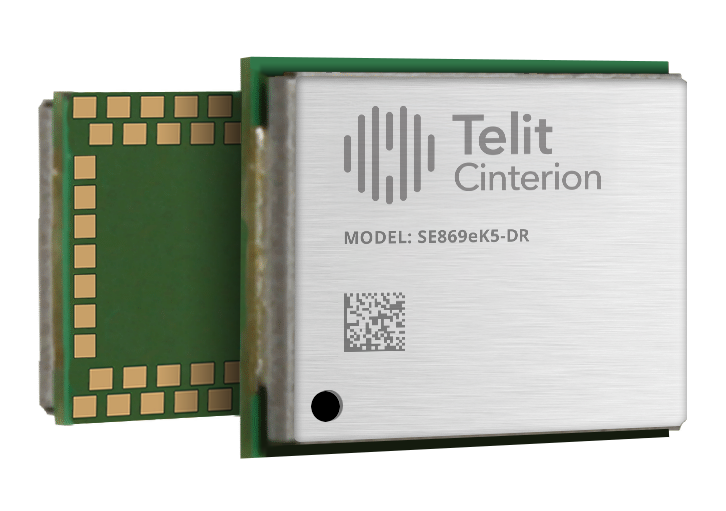
Telit Cinterion, an end-to-end IoT solutions enabler based in Irvine, California, has launched the SE869eK5-DR, a dual-band, multi-constellation positioning receiver with untethered dead reckoning (UDR) built on the Airoha AG3335 chipset family.
The UDR ensures reliable, continuous positioning even when satellite signals are lost due to jamming, interference or physical obstructions, delivering continuous and reliable location data for mission-critical applications without depending on a car connection.
With its power-efficient design, the module is ideal for mission-critical applications in business and government that demand ultra-reliable location information, and long battery life. Applications include fleet management, automotive telematics systems, and high-value asset tracking, where uninterrupted and precise location data is critical for operational efficiency.
Building on the successful Telit Cinterion SL869 series, the SE869eK5-DR adds an integrated six-axis sensor for UDR. This allows the module to maintain a position fix even when signals are blocked or jammed, able to track high-value assets deep inside buildings or in underground parking garages.
The SE869eK5-DR also supports L1 and L5 bands, which maximizes resiliency through frequency redundancy. If one band’s signals are degraded by physical obstructions, the other band provides an alternative set of signals. The module also supports differential GNSS (DGNSS) positioning for applications that require sub-meter-level accuracy.
The SE869eK5-DR includes features that streamline product development. Its UDR technology is simple to integrate because it doesn’t require any external application information, which shortens the design phase. It also automatically identifies the direction of movement (forward or reverse), eliminating the need for a separate heading pin. While the SE869eK5-DR introduces an additional 34 pins for future use, it remains backward compatible with previous 24-pin generations, allowing device OEMs to upgrade existing designs.
SE869eK5-DR engineering validation testing (EVT) samples are available now, with design validation testing (DVT) samples scheduled for November.
Visit the Telit Cinterion booth (E314) at SIDO Sept. 17-18, 2025 in Lyon, France, to learn more.