Tag: urban congestion

  • Ford Studies Space Robots for Connected Vehicle Communications

    Ford is studying communications between space robots and Earth to enhance future applications of the connected-car communications protocol. The research furthers the company’s commitment to the development of connected vehicle communications to help reduce traffic congestion and aid in the advancement of emergency vehicle communication methods, Ford said.

    Ford has launched a three-year research partnership with the telematics department of St. Petersburg Polytechnic University in Russia in its association with that country’s space industry. The goal is to analyze space-based robotic communications systems for vehicle mesh networks to aid in mobility solutions.

    The development of connected vehicle communications has the potential to reduce traffic accidents and ease congestion by enabling vehicles to communicate with each other, and to communicate with buildings, traffic lights, the cloud and other systems to deliver a message or detect and respond to imminent collision warnings.


    Webinar: The Connected Vehicle

    All major international car-makers are installing telematics units, sending a signal that wireless information and connectivity is here to stay in the vehicle, and location will be a big part of the growth. To learn more about the rapid changes in the connected vehicle field, tune in to our September 19 webinar, hosted by Wireless LBS editor Janice Partyka. Registration is free.


    “Ford has been committed to the research and development of connected vehicle communications for more than a decade,” said Paul Mascarenas, chief technical officer and vice president, Ford research and innovation. “Our participation in this research can aid in the development of next-generation Ford driver-assist technologies. These technologies will globally benefit Ford customers, other road users and the environment.”

    Emergency Situations. One promising development from Ford’s research project with St. Petersburg Polytechnic University is the advancement in emergency vehicle communication methods. Ford is analyzing how emergency messages should be sent to ensure delivery if network failures were to occur, identifying the systems and methods that provide redundancy in case of primary delivery failure.

    For example, if an accident were to cause vehicle-to-cloud communications (V2C) to be broken, a vehicle may still have access to a vehicle-to-vehicle (V2V) communications network. An emergency signal message could potentially be sent through V2V to a vehicle nearby, and then between vehicles and infrastructures until it reached EMS.

    “The research of fallback options and robust message networks is important,” said Oleg Gusikhin, technical leader in systems analytics for Ford. “If one network is down, alternatives need to be identified and strengthened to reliably propagate messages between networks.”

    Space Telematics. Telematics — the long-distance transmission of digital information — developed for use on space stations provide excellent potential for improving the reliability of future vehicle-to-cloud, vehicle-to-infrastructure, vehicle-to-vehicle and other forms of communication (V2X). The communications blend multiple networking technologies including dedicated short-range communication (DSRC), cellular LTE wireless broadband and mesh networking to ensure robust and reliable connectivity for optimum signal strength for critical messages.

    Using the knowledge accrued from analyzing the space robots, Ford engineers could then develop an algorithm that is integrated into the V2X system resulting in a message that would route through the appropriate network depending on the level of its importance. An emergency message, for example, may be communicated through the faster mesh network, whereas an entertainment-related message would route through a vehicle-to-infrastructure application, an embedded device or a brought-in device network.

    “We are analyzing the data to research which networks are the most robust and reliable for certain types of messages, as well as fallback options if networks were to fail in a particular scenario,” said Oleg Gusikhin, technical leader in systems analytics for Ford. “In a crash, for example, a vehicle could have the option to communicate an emergency though a DSRC, LTE or a mesh network based on the type of signal, speed and robustness required to reach emergency responders as quickly as possible.”

    The specific space robots leveraged for Ford’s telematics analysis include the JUSTIN Humanoid, EUROBOT Ground Prototype and NASA Robonaut R2.

    Here is a video showing how Ford is studying space robot communications.

    Findings from this work could potentially enhance Ford’s wireless communication technologies and Blueprint for Mobility. Ford’s Blueprint for Mobility details the company’s vision on how to tackle the issues of mobility in an increasingly crowded and urbanized planet between now and 2025.
  • Urban GPS Navigation Improved 50-90 Percent, Researchers Say

    A new system developed by Universidad Carlos III de Madrid (UC3M) researchers uses sensors to improve the ability of GPS to determine a vehicle’s position compared to use of conventional GPS devices by up to 90 percent.

    The prototype can guarantee the position of the vehicle to within 1 or 2 meters in urban settings, the researchers said.

    The system can be installed in any vehicle for little cost and may eventually work on smartphones, the researchers said. Their findings are described in the report, “Context-Aided Sensor Fusion for Enhanced Urban Navigation.”

    Sensor Fusion. The prototype system incorporates a conventional GPS signal with those of other sensors (accelerometers and gyroscopes) to reduce the margin of error in establishing a location. “We have managed to improve the determination of a vehicle’s position in critical cases by between 50 and 90 percent, depending on the degree of the signals’ degradation and the time that is affecting the degradation on the GPS receiver,” said David Martín, a researcher at the Systems Intelligence Laboratory (LSI – Laboratorio de Sistemas Inteligentes) at UC3M. The system was jointly designed and developed by LSI and the Applied Artificial Intelligence Group (GIAA – Grupo de Inteligencia Aplicada Artificial).

    The margin of error of a commercial GPS, such as those that are used in cars, is about 15 meters in an open field, where the receiver has wide visibility from the satellites. However, in an urban setting, the determination of a vehicle’s position can be off by more than 50 meters, due to the signals bouncing off of obstacles like buildings, trees, or narrow streets. In certain cases, such as in tunnels, communication is lost, hindering the GPS applications reaching Intelligent Transport Systems, which require a high level of security.

    “Future applications that will benefit from the technology that we are currently working on will include cooperative driving, automatic maneuvers for the safety of pedestrians, autonomous vehicles or cooperative collision warning systems,” the scientists comment.

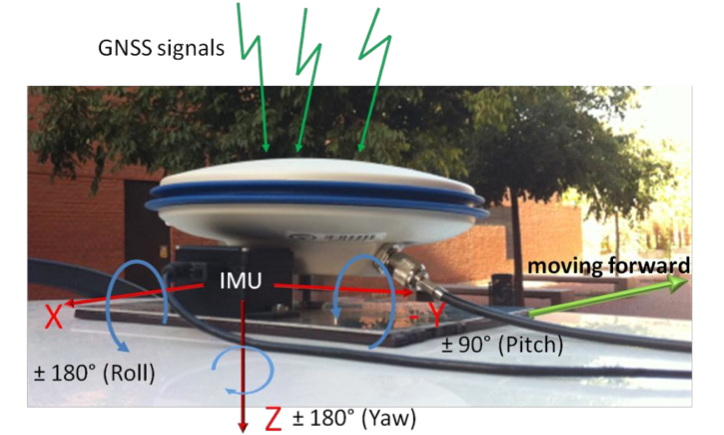
    Integration of GNSS antenna of rover receiver and IMU in a platform over the roof of the vehicle.
    Integration of GNSS antenna of rover receiver and IMU in a platform over the roof of the vehicle.

    The greatest problem presented by a commercial GPS in an urban setting is the loss of all satellite signals. “This occurs continually, but commercial receivers partially solve the problem by making use of the urban maps that attempt to position the vehicle in an approximate point,” Martín said. “These devices can indicate to the driver approximately where he is, but they cannot be used as a source of information in an Intelligent Transport System like those we have cited.”

    The basic elements that make up this system are a GPS and a low-cost inertial measurement unit (IMU). The latter device integrates three accelerometers and three gyroscopes to measure changes in velocity and maneuvers performed by the vehicle. Then, everything is connected to a computer that has an application that merges the data and corrects the errors in the geographic coordinates. Enrique Martí of UC3M’s GIAA explains, “This software is based on an architecture that uses context information and a powerful algorithm (an unscented Kalman filter) that eliminates the instantaneous deviations caused by the degradation of the signals received by the GPS receiver or the total or partial loss of the satellites.”

    The current prototype can be installed in any type of vehicle. It is already working on board the IVVI (Intelligent Vehicle based on Visual Information, pictured above), a car that has become a platform for research and experimentation for professors and students at the university.

    The LSI and UC3M researchers working on this “intelligent car” can capture and interpret all of the information available on the road, and that drivers use. To do this, the team is using optical cameras, infrareds and lasers to detect whether drivers are crossing the lines on the road, or whether there are pedestrians in the vehicle’s path, as well as to adapt the speed to the traffic signals and analyze the driver’s level of sleepiness in real time.

    Next Steps. The researchers will analyze the possibility of developing a system that makes use of the sensors that are built into smartphones, because intelligent telephones are equipped with more than ten sensors, such as an accelerometer, a gyroscope, a magnetometer, GPS and cameras, in addition to Wi-Fi, Bluetooth or GSM communications.

    “We are now starting to work on the integration of this data fusion system into a mobile telephone,” said Enrique Martí, “so that it can integrate all of the measurements that come from its sensors in order to obtain the same result that we have now, but at an even much lower cost, since it is something that almost everyone can carry around in his pocket.”

  • TomTom Launches Quarterly Congestion Index

    TomTom launches the first quarterly Congestion Index that accurately identifies and analyses traffic congestion in major cities across Europe. The report, initially covering 31 cities, finds Warsaw the most congested city in Europe.


    On average, journey times in Warsaw are 42% longer than when traffic in the city is flowing freely and 89% longer during morning rush hour. The TomTom Congestion Index, including individual city reports, can be found at www.tomtom.com/congestionindex.

    The TomTom Congestion Index is the world’s most accurate barometer of congestion in urban areas. The Index is uniquely based on real travel time data captured by vehicles driving the entire road network. TomTom’s traffic database contains over five trillion data measurements and is growing by five billion measurements every day. The overall congestion level for all the cities analysed in Europe is 24% – meaning journey times take 24% longer than when traffic is flowing freely.

    The top ten most congested European cities, ranked by overall congestion level, between January and March 2012 were:

    Warsaw, 42%
    Marseille, 41%
    Rome, 34%
    Brussels, 34%
    Paris, 32%
    Dublin, 30%
    Bradford – Leeds, 28%
    London, 27%
    Stockholm, 27%
    Hamburg, 27%
     
    “Over the years, with the help of our customers, we have built the largest and most accurate database of travel times in the world,” said Harold Goddijn; Chief Executive Officer of TomTom. “When we combine this travel database with our detailed real-time traffic information and routing technology, we can not only pin point congestion, but can guide drivers away from congested areas onto faster routes.”

    “Even when only a percentage of drivers use a different and faster route, the available capacity on the entire road network increases, which benefits all drivers,” Goddijn added.

    TomTom’s Congestion Index also compares congestion levels between January and March 2012 with the same period in 2011.  Based on this analysis, Bradford – Leeds in the UK saw the biggest increase in traffic congestion with journey times slowing significantly. Munich, Berlin, Marseille and Vienna all saw increased levels of congestion. Lisbon, Bern, Amsterdam, Milan and Rome all experienced a reduction in congestion levels.

    TomTom also launched the first quarterly Congestion Index that accurately identifies and analyzes traffic congestion in major cities across North America. The report, initially covering 26 major cities, finds Los Angeles to be the most congested city in North America. On average, journey times in Los Angeles take 33% longer than when traffic in the city is flowing freely and 77% longer during evening rush hour. 

    The Congestion Index compares travel time during non-congested periods (free flow) with travel times in peak hours. The difference is expressed as a percentage increase in travel time, representing the congestion level. The top ten most congested North American cities, ranked by overall congestion level, between January and March 2012 were:
     
    Los Angeles, 33%
    Vancouver, 30%
    Miami, 26%
    Seattle, 25%
    Tampa, 25%
    San Francisco, 25%
    Washington, 24%
    Houston, 23%
    Toronto, 22%
    Ottawa, 22%
     
    TomTom’s Congestion Index also compares congestion levels between January and March 2012 with the same period in 2011.  Based on this analysis, Seattle saw the biggest increase in traffic congestion, while Houston, Ottawa and San Francisco also saw increased levels of congestion. Conversely, Edmonton, New York, Boston, Minneapolis and Toronto experienced a reduction in congestion levels.