Tag: Volocopter

  • M3 Systems, Pipistrel and Volocopter complete air traffic tests in France

    M3 Systems, Pipistrel and Volocopter complete air traffic tests in France

    The flight test is the third of several to simulate a variety of real-world scenarios that demonstrate how UTM and ATM intersect with multiple aircraft types.

    M3 Systems, Pipistrel and Volocopter have completed their first joint flight test campaign in France at Pontoise airfield.

    The week-long flight tests simulated three different avoidance maneuvers in real-world situations where unforeseen circumstances occur, such as a complete airport or vertiport closure, an unavailable final approach and takeoff area, and traffic deconfliction.

    M3 Systems was created from engineering activities in GNSS and consulting activities in air traffic management (ATM), including for uncrewed aircraft. M3 played a role in Galileo signal definition, among other projects for Europe’s various space agencies. Pipstrel is a light aircraft manufacturer specializing in electric propulsion, and Volocopter specializes in urban air mobility (UAM) systems.

    The joint campaign among the three companies — with French partners Groupe ADP and its subsidiary Hologarde — aimed to achieve smooth interaction within and between the new lower airspace’s unmanned traffic management (UTM) and standard civil aviation ATM systems.
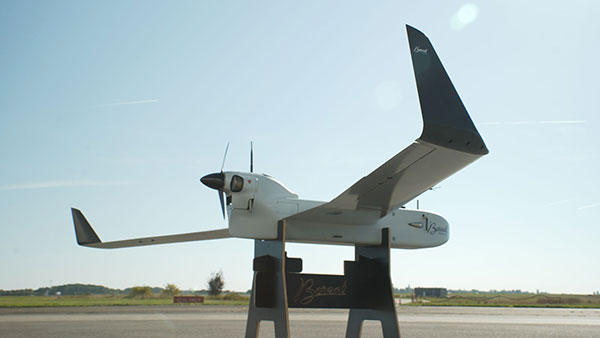
    The Boreal system is a fixed-wing UAV with high-endurance and heavy payload capacity. (Photo: M3 Systems)
    The Boreal system is a fixed-wing UAV with high-endurance and heavy payload capacity. (Photo: M3 Systems)

    The aviation industry is experiencing an innovation upsurge driven by technology and societal pressure for new forms of aviation focused on sustainable, digital and autonomous air mobility. The resulting solutions will generate a significant increase in traffic density in the lower airspace.

    Because existing ATM systems are not designed to handle such volumes or digitalization, coordinating existing and new traffic management systems for brand-new aircraft integration will ensure efficient large-scale operations. This includes commercial, general and drone aircraft for cargo and passenger flights, both crewed and uncrewed.

    The CORUS-XUAM project, funded by the European Union’s initiative Single European Sky ATM Research (SESAR) Joint Undertaking, focuses on solving the challenge of conventional and new traffic management system integration and consists of 19 partners and 11 third parties. M3 Systems, Pipistrel and Volocopter all completed individual flight-test campaigns before this event to bring their aircraft in line with the U-space services.
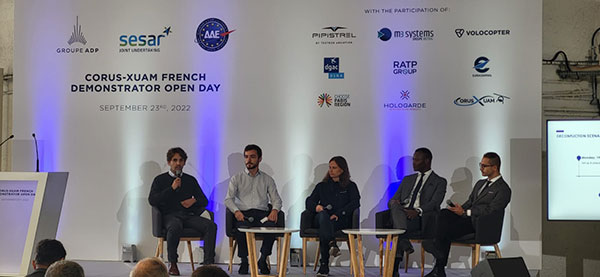
    A week of flight tests ended with an Open Day air show and presentations. (Photo: M3 Mobility)
    A week of flight tests ended with an Open Day air show and presentations. (Photo: M3 Mobility)

    The CORUS-XUAM flight test conducted at Pontoise airfield near Paris is the third of several flight tests to simulate a variety of real-world scenarios that demonstrate how UTM and ATM intersect with multiple aircraft types.

    Moreover, the CORUS-XUAM project will continue to proactively test and create a safe and controlled lower airspace under the European Union’s ambitious Single European Sky (SES) initiative throughout 2022.

    The successful flight tests at Pontoise airfield were conducted with M3 System’s Boreal remotely piloted aircraft system, Pipistrel’s crewed Velis Electro, the only type-certified electric aircraft in commercial service in the world, and Volocopter’s fullscale, remotely piloted 2X prototype. Pipistrel uses the conventional ATM tower and system while Volocopter and M3 Systems use the UTM system. The following three flight scenarios were tested:

    • The unexpected occupancy of a final-approach-and-takeoff plan and aircraft diversion because of priority landing of another aircraft (Pipistrel and Volocopter aircraft).
    • The diversion of a flight path because of the closure of an airport or vertiport (M3 Systems).
    • The diversion of a flight path with two aircraft flying the same path (M3 Systems and Volocopter aircraft).

    “These successful tests confirm that our Boreal UAS will be an enabler for future XUAM operations in situations where aircraft need to safely divert paths to another vertiport due to an unforeseen closure or another aircraft in the air,” explained Marc Pollina, M3 Systems CEO. “By providing rerouting demonstrations and tactical communications with U-Space service providers, M3 Systems can support future coordination between AAM and airport operators.”

    Pipistrel is “As the manufacturer of the only type-certified electric aircraft in commercial service in the world, proud to take part in technical projects that shape the vision of air mobility and make progress in a meaningful way,” said Gabriel Massey, Pipistrel president. “The CORUS project and Paris demonstrations clearly show how UAM vehicles will be able to fly safely in regular airspace post-2030 and will help to unlock new lower-noise and lower-emission air passenger and air cargo services.”

    In 2019, Volocopter tested its 2X ATM integration at Helsinki airport and was actively involved in the development of the European U-Space Concept of Operations, according to Oliver Reinhardt, Volocopter’s chief risk and certification officer. “Building an efficient ecosystem around UAM is Volocopter’s mission, and connecting ATM/UTM integration with our digital platform, VoloIQ, is poised to be an integral part of bringing UAM to megacities worldwide,” Reinhardt said. “I am looking forward to the next CORUS-XUAM test flights later this year in Germany and what we can achieve there.”

    The project has received funding from the SESAR Joint Undertaking under the European Union’s Horizon 2020 research and innovation program under grant agreement No. 101017682.

  • Examining the first phases of airborne street traffic

    It’s been a couple of months since we ran an update on unmanned aircraft, so there are lots of news items to dust off and maybe look at more closely.

    I suppose we’ve all seen those futuristic movies with masses of orderly air traffic traveling rapidly down invisible roads hundreds of feet above cities — maybe the Jetsons first got us thinking about this vision of tomorrow? Well, unmanned flying taxi demos in Dubai certainly caught my attention. Could this be the launch of the first phase of “airborne street traffic”?

    Demo UAVs in Dubai, China

    The two-seater UAV built by Volocopter demonstrated in Dubai has 18 rotors, and during the five-minute demo for the media, Crown Prince Sheikh Hamdan bin Mohammed was flown at around 200 meters over sand, rather than over a populated city. There surely could be a number of safety elements yet to be implemented before we see this become operational — but you have to start somewhere.

    The Volocopter demo was preceded at the beginning of this year by the appearance of a single-seat Chinese demo vehicle. This smaller eight-rotor drone by EHang took a shot at being a future “over-city” cab.

    Urbain Air Project

    In the meantime, Airbus and HAX, a start-up investor, are seeking innovators to participate in a four-month program to advance developments in urban-air mobility — innovations which could speed-up development of “flying cars.”

    The project is looking for technologies already being developed in:

    • Urban air transport vehicle technology
    • UAV sense and avoid technology
    • Airport runway and landing detection systems
    • Emergency safety systems for airborne vehicles
    • Required infrastructure for airborne transport vehicles
    • Autonomous airborne vehicle technology
    • Aerial maneuver decision making and support systems
    • Air traffic management systems
    • Aerial collision detection and avoidance systems
    • Battery packaging and management systems for airborne vehicles

    Several startups could be funded with at least $100,000 each, and will be asked to spend four months in Shenzhen, China, turning their concepts into prototypes with support from HAX and Airbus engineers.

    Safety Standards?

    All interesting stuff, but at some stage someone has to take a serious look at the safety standards needed to protect prospective passengers. The existing designs appear to have some flight control redundancy, and there are hints of a possible loss of data-link reversionary mode, but there might be more significant work to be done before any regulatory agency such as the Federal Aviation Administration (FAA) were to validate system reliability. But good luck to these innovators and other companies who are working towards implementing this fascinating concept.

    At the other end of the drone spectrum, Renishaw Canada recently showed off a drone made of titanium and produced using 3D printing.

    The Firefly is a 3D-printed titanium rocket-powered drone that can fly at nearly supersonic speeds, with onboard telemetry and a spring-released wing. The Mach 0.8 drone has been produced by the Renishaw additive manufacturing group for an unnamed North American aerospace company. The drone can apparently house a number of miniaturized sensors for data collection.

    Possible applications of this unique high-speed, short-duration drone could include data collection flying into storms and hurricanes, or perhaps for longer distance surveying when launched from a future Mars rover.

    Boeing Acquires Aurora Flight

    And on the business front, the recent news is that Boeing is in the process of acquiring Aurora Flight Sciences Corp. Adding Aurora as an independent operation alongside Insitu will probably lead to migration of technology between the two Boeing UAS units, which is presumably why Aurora is being acquired.

    Aurora has focused on electric propulsion systems and automation and autonomy for robotic operations and UAVs. Aurora has also collaborated with Boeing in the past on rapid prototyping for drones, and structural assemblies for military and commercial applications.

    As a unit of the Boeing Company, Aurora technologies for long-endurance aircraft, robotic co-pilots, and autonomous electric multi-rotor UAVs will have a better opportunity to make it to product level, and wider applications should be possible for these unique capabilities.

    Based in Manassas, Virginia, with facilities and offices in five other states around the United States — including R&D facilities right next to Massachusetts Institute of Technology in Cambridge — Aurora employees more than 550 people. They also have an office in Luzern, Switzerland.

    FAA Regulations Revisited

    Finally, according to AUVSI, in the year since the FAA released the Part 107 regulations for the operation of small UAS (sUAS), users have requested more than 1,000 waivers to work outside the parameters of these regulations. The Part 107 regulations permit users to request such waivers, provided operations can be shown to be safe. The majority of these waiver requests were to operate at night — whereas the regulations only permit operation within Visual Line of Sight (VLOS) in daylight.

    AUVSI argues that certain commercial operations have only been possible through the use of these waivers, and therefore the regulations should be revised to enable normal operations without the need to grant individual waivers on a case-by-case basis. The FAA’s position may be that until such operations can be proven to be safe over time, the agency wants to know who’s exceeding which parameters, and under what conditions — hence the need for individual written applications, so that analysis of safety aspects is possible. Then subsequent monitoring will show that levels of operation may be safely exceeded on a regular basis.

    This is how aviation agencies have always managed aviation safety. A UAS operator might demonstrate operational capabilities, show an acceptable safety level, and thereby prove that pushing the envelope is okay. Sometimes it can take time, but with good visibility on both sides, it’s possible that progress could be made reasonably quickly.