Tag: wireless network

  • Trimble Unveils Suite of GNSS Timing Products for LTE Market

    Trimble Unveils Suite of GNSS Timing Products for LTE Market

    ICM-chip_keyboard
    Photo: Trimble

    Trimble has introduced a new portfolio of time and frequency products to address the synchronization needs of the growing LTE small cell market.

    The products are designed for a wide range of small cell synchronization applications. The products provide increased holdover capabilities and more robust signals with multi-constellation GNSS technology to sync wireless networks more efficiently, Trimble said.

    Regardless of whether a network is using 3G, 4G LTE, LTE-Advanced wireless technologies or a combination, synchronization and syntonization are essential for mobile networks. The new LTE-Advanced features — such as Enhanced Inter-Cell Interference Coordination (eICIC), Coordinated Multipoint Transmission (CoMP), Carrier Aggregation (CA) and Multi-Media Broadcast over a Single Frequency Network (MBSFN) — require an even higher degree of precision. Carriers are making significant investments in small cells, LTE-A and Heterogeneous networks to increase capacity and coverage. Network synchronization is a must to achieve both objectives, Trimble said.

    The Mini-T GG Disciplined Clock is a multi-GNSS (GPS and GLONASS) embedded module, optimized to generate precise 10MHz output and pulse per second. It utilizes the latest in GNSS technology, combined with a precision ovenized oscillator for near-atomic-clock precision timing. The Mini-T GG provides 24-hour holdover capability and is suitable for pico and microcells.

    The Trimble 360 multi-GNSS receiver is designed to cover the full spectrum of small cells — residential femtocell to rural microcell. The Trimble 360 timing products support GPS, GLONASS and BeiDou systems, and are Galileo-ready. In addition to full constellations, the 360 products support Satellite-Based Augmentation Systems (SBAS) and the Asian Pacific Quasi-Zenith Satellite System (QZSS).

    The compact, surface-mount ICM SMT 360 timing module, measuring 19 x 19 mm, generates a precise 10MHz reference clock for synchronization of residential and enterprise femtocell networks. It provides holdover capability, which allows the module to extend the availability of reference timing outputs. The Resolution SMT 360 is available in the same 19 x 19 mm form factor, and provides a pulse per second that provides nanosecond accuracy to any application requiring precision time reference such as wireless networks, utilities and digital broadcasting.

    The Trimble Mini-T GG disciplined clock, ICM-SMT 360 module and Resolution SMT 360 timing module and starter kit are available now. The Trimble 360 multi-GNSS receiver is expected to be available in January 2015.
  • Nasdaq Offers Precision Time Service for Trading

    Nasdaq — the trading and exchange technology company — is launching a trade time-stamping service at its data center in Carteret, New Jersey, with access to a NIST-certified GPS antenna. The High Precision Time service is provided by Perseus, a provider of global high-speed connectivity, and enables Nasdaq customers to synchronize their time systems across a multitude of data centers.

    High Precision Time offers access to a National Institute of Standards and Technology (NIST)-certified GPS antenna as well as Network Time Protocol (NTP) and Precision Time Protocol (PTP) connectivity with nanosecond accuracy to the Coordinated Universal Time UTC (NIST) timescale. These NIST-certified options allow Nasdaq co-located clients at the Nasdaq data center in Carteret to synchronize their system clocks. This tool can be used as clients’ primary time service, or as a back-up for clients which already use Nasdaq’s shared GPS service or have their own dedicated GPS antenna.

    “The relationship with Nasdaq is an important step in helping our shared customers mitigate the risks of inaccurate time stamps when disseminating and trading on sensitive market information,” said Anthony Gerace, President, Global Financial Services at Perseus Telecom. “This is especially important for compliance and high-precision trading.”

    Nasdaq co-located clients can connect to High Precision Time services via a simple inter-cabinet cross-connect with:

    • Certified NIST GPS antenna access
    • Certified UTC (NIST) timescale accuracy and reporting
    • Choice of delivery protocols: NTP (Network Time Protocol) and PTP (Precision Time Protocol)

    “Our adoption of Perseus’ precision time service is another example of our commitment to provide member firms with technology solutions that reduce risk exposure,” said Stacie Swanstrom, Head of Global Access Services and senior vice president of Global Trading and Market Services at Nasdaq. “Transparency and choice is a hallmark of Nasdaq’s philosophy, which is why we continuously improve our Nasdaq Data Center environment while being mindful of the challenges and complexities of the markets.”

  • Satellite-Synchronized Network Clock Released by SEL

    Satellite-Synchronized Network Clock Released by SEL

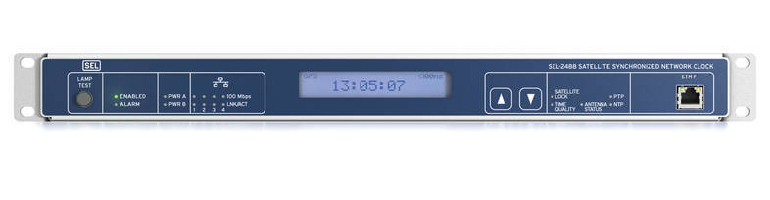
    The SEL-2488 satellite-synchronized network clock. Photo: SEL
    The SEL-2488 satellite-synchronized network clock. Photo: SEL

    SEL has released a new network clock designed for critical infrastructure and harsh environments. Model SEL-2488 receives GNSS time signals and distributes precise time via multiple output protocols, including IRIG-B and NTP.

    The SEL-2488 provides time-delay compensation for antenna cables and output cables on per-port basis to further optimize time distribution accuracy. For security, the clock features the Syslog Ethernet standard for event messaging, role-based accounts and LDAP for user authentication, and secure HTTPS web interface.

    The clock synchronizes with precise time accuracy to within ±40 nanoseconds to UTC for power protection applications. The standard TCXO holdover accuracy is 36 µs/day and the optional OCXO holdover accuracy is5 μs/day.

    Time can be distributed from eight time outputs configurable for IRIG-B or time pulse outputs. The SEL-2488 also includes four standard Ethernet ports, which provide NTPv4 and are available in copper as well as single- or multimode fiber.

    With Satellite Signal Verification, the SEL-2488 uses signals from a second satellite constellation to validate the GPS time signals, providing a layer of protection from GPS spoofing attacks. The SEL-2488 also provides an option for a second, redundant power supply and operates in a temperature range of –40° to +85°C (–40° to +185°F).

    The SEL-2488 supports DHCP with a captive portal, LDAP, an HTTPS device webpage, and acSELerator QuickSet SEL-5030 software for easy and secure configuration.

  • Jackson Labs Delivers Low Phase-Noise Frequency and Timing Reference

    Jackson Labs Delivers Low Phase-Noise Frequency and Timing Reference

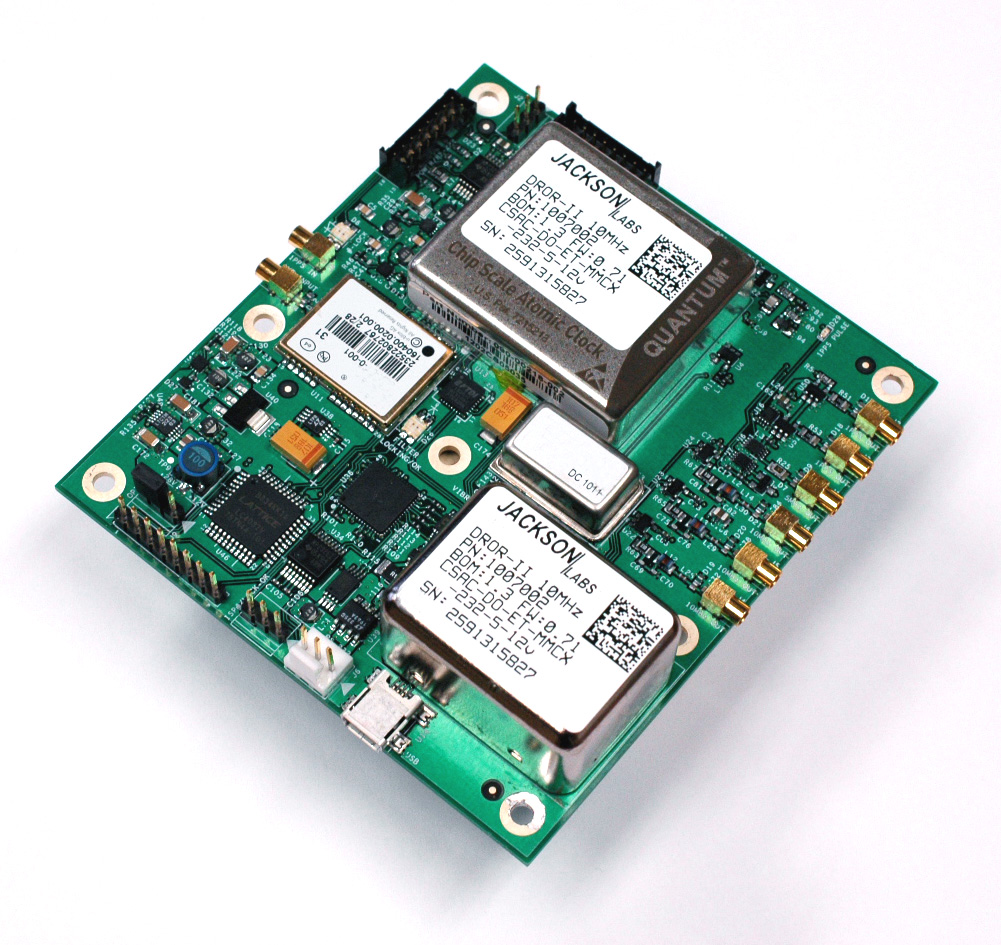
    The DROR-II by Jackson Labs.
    The DROR-II by Jackson Labs.

    Jackson Labs Technologies, Inc., a designer and manufacturer of GPS, timing and frequency equipment, is offering the DROR-II, a 10-MHz/5-MHz/1-PPS GPS-Disciplined Atomic Frequency and Timing Reference (GPSDO).

    The DROR-II is a ruggedized frequency and timing reference with a Cesium Vapor Atomic Oscillator followed by a precision SC-cut Crystal Double-Oven Oscillator and an actively vibration-compensated VCXO oscillator, with specific emphasis on ultra low phase noise performance under extreme vibration and acceleration such as could be encountered in aircraft, tracked vehicles, and wheeled vehicles.

    The DROR-II unit is optimized for operation in high-vibration and high-acceleration environments that require ultra-low phase noise performance and high frequency stability under extreme conditions. The DROR-II combines the strengths of three different on-board oscillators to provide an overall performance that has not been achievable with legacy products, at a steady-state power consumption of less than 3.85W, the company said.

    The DROR-II uses a GPS receiver to provide long-term phase and frequency accuracy of the built-in CSAC atomic oscillator which is followed by an SC-cut, Double Oven OCXO (DOCXO) for very high short-term stability and low phase noise, which is itself followed by a three-axis electronically vibration-compensated crystal oscillator for ultra-low-noise under high vibration. Using these four signal sources cascaded to each other allows unmatched Phase Noise and Short Term Stability (ADEV) while also providing long-term atomic holdover, very fast warmup, and long-term phase-lock to UTC. Short term stability of 1E-012 (1ppt), and phase noise floors of -162dBc/Hz are achieved. Frequency stability over 24 hours is better than 5E-013 (0.5ppt) typically when locked to GPS.

    The DROR-II supplies three isolated 10-MHz Sine Wave outputs, two CMOS 1PPS, and one 5-MHz output that is phase-synchronized to UTC via the internal GPS receiver. DROR-II contains a 50-channel WAAS/EGNOS/MSAS-enabled GPS receiver that provides support for avionics systems through integrated three-axis gyro-accelerometers and a -160-dBm GPS tracking capability. DROR-II power requirements are less than 3.85W steady-state, and only a single supply of between 11.0V to 32V is required. Support for an external LCD display is standard.

    The unit can be monitored and controlled by an RS-232 port or a USB port via industry standard SCPI-99 Commands (GPIB commands), and is capable of generating numerous NMEA-0183 output sentences for easy integration into existing infrastructure. The DROR-II can be ordered with various OCXO options and with different temperature ranges.

  • Connor-Winfield Offers GPS-Disciplined Clock

    Connor-Winfield Offers GPS-Disciplined Clock

    Connor-Winfield-FTS500-W
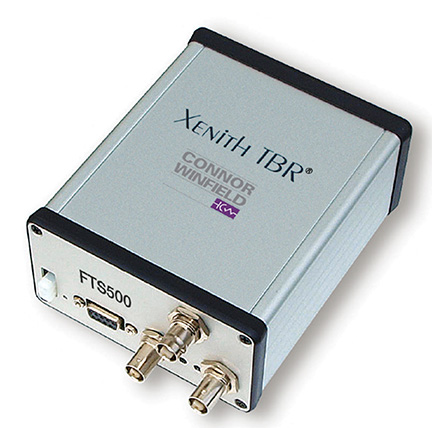
    The FTS500 Xenith TBR

    The FTS500 Xenith TBR (Time Base Reference) by Connor-Winfield is designed for DVB/DAB, wireless communications, time-stamping, or any other timing vital application.

    The Xenith TBR module is a GPS-driven, mixed-signal phase lock loop, providing a 1PPS CMOS output and generating a 10-MHz SINE output from an intrinsically low jitter voltage controlled crystal oscillator (VCXO). The 10-MHz output is disciplined from an on-board GPS receiver, which drives the long-term frequency stability. Its on-board CW25 timing GPS receiver along with a dual-oven system provides the highest quality timing and synchronization signals combined with superb hold-over characteristics. The unit is housed in a 106 x 125 x 56 millimeter strong aluminum enclosure.