The Joint Counter-Small Unmanned Aircraft Systems office successfully tested BAE Systems’ APKWS laser-guidance kits in a counter-unmanned aircraft systems (C-UAS) mission.
During the Department of Defense-led exercise at Yuma Proving Ground, Arizona, the 70 mm APKWS-guided rockets demonstrated 100% effectiveness when fired against 25-to-50-pound UAVs traveling at more than 100 miles an hour. The APKWS C-UAS solution is platform agnostic, permitting multiple options to accelerate fielding.
APKWS transforms unguided rockets into smart munitions for precision strikes on soft and lightly armored targets. An updated proximity fuse for the standard M151 warhead enables laser-guidance kits to target Class-2 and Class-3 UAVs, which typically weigh less than 55 lbs. The fuse retains the legacy point denotation capability for flexibility of the weapon in the field.
APKWS now enables rockets to engage and destroy UAVs at a fraction of the cost of existing C-UAS systems with unprecedented precision.
The kits are available to all U.S. armed forces, as well as allies via foreign military sales.
The recommendation is based on demonstrations at Yuma Proving Ground, Arizona
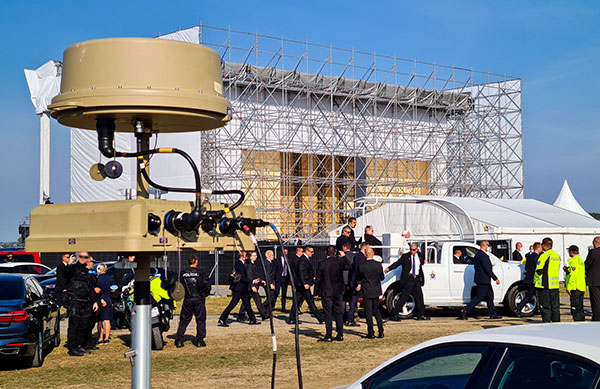
In September 2021, EnforceAir helped safeguard Pope Francis and a crowd of 60,000 in Slovakia. A ground-level tactical kit provided 360-degree azimuth coverage, fending off a rogue drone and sending it back to its original takeoff position. (Photo: D-Fend)
EnforceAir, a solution that counters small unmanned aerial systems (sUAS), has been recommended by the U.S. Department of Defense’s (DoD) Joint Counter-sUAS Office (JCO).
EnforceAir was recognized for its RF detection and mitigation, its demonstrated impressive effectors and its ability to force land certain drones. D-Fend Solutions’ EnforceAir was the only RF cyber takeover technology named.
EnforceAir automatically executes cyber drone detection and takeover mitigation of rogue drones for safe landings and outcomes, empowering security agencies and professionals with control while preserving operational continuity.
The JCO recommendation is the result of a formal U.S. government evaluation event held at Yuma Proving Ground in April 2022.
“It’s an honor to be recognized by the U.S. DoD Joint C-sUAS Office, following a rigorous demonstration and evaluation” said Zohar Halachmi, Chairman and CEO of D-Fend Solutions. “We’re excited to provide continued support for the counter-drone mission, within a layered defense, integrated in the most advanced C-UAS systems for the nation’s defense.”
EnforceAir is D-Fend’s flagship offering. With hundreds of deployments worldwide, EnforceAir focuses on the most dangerous drone threats in the military, public safety, airport, prison, major event and critical infrastructure environments.
A division of the U.S. Army Futures Command is conducting stratospheric experimentation using the Zephyr ultra-long endurance stratospheric unmanned aerial system (UAS). The tests are being carried out at Yuma Proving Ground in Arizona by he Assured Positioning, Navigation and Timing/Space (APNT/Space) Cross-Functional Team (CFT), which is based in Huntsville, Alabama.
The first flight of 2022, launched June 15, demonstrated Zephyr’s energy storage capacity, battery longevity, solar panel efficiency and station-keeping abilities that will further the army’s goal to implement ultra-long endurance stratospheric UAS capabilities.
During the flight, the Zephyr accomplished a number of firsts, including
first flight into international airspace
first flight over water
longest continuous flight utilizing satellite communication controls
the farthest demonstration from its launch point while carrying a commercial, off-the-shelf payload
breaking the world record for longest duration UAS flight (26 days) set by the same aircraft in 2018. This flight has completed 36 days and is still flying over Yuma Proving Ground.
“Ultra-long endurance unmanned platforms have the potential to provide significant military capabilities and enhanced confidence as part of the Army’s diversified multi-layered architecture,” said Michael Monteleone, director of the APNT/Space CFT. “We have seen incredible progress in high-altitude platforms in recent years. This experimentation allows us to build on that knowledge by demonstrating multiple payload types, fully exploring the military utility of stratospheric operations, and modernizing areas of deep sensing, long-range targeting and resilient communications.”
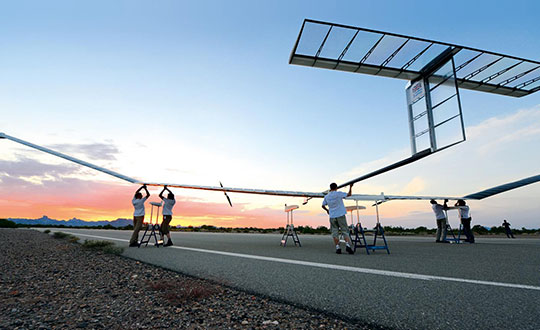
Zephyr is prepared for a flight test. (Photo: Airbus)
Upcoming Second Launch. A second Zephyr flight will launch in the coming weeks and travel over the Pacific Ocean. The flight will demonstrate a prototype payload, developed by the Army Futures Command, over multiple combatant commands, and continue to inform high-altitude requirements.
The Airbus-developed Zephyr is the first high-altitude UAS of its kind, providing a persistent and adaptable longevity in the stratosphere. The experiments are performed with cooperation of the Intelligence, Surveillance and Reconnaissance (ISR) Task Force, U.S. Army Program Executive Office – Aviation, and multiple combatant commands under an Other Transaction Authority (OTA), with T2S Solutions LLC as the integrator.
The APNT/Space CFT is responsible for accelerating the delivery of advanced APNT, tactical space and navigation warfare capabilities to the soldier. Working with a core team of experts, the CFT informs technology and system requirements through continuous experimentation and prototyping, technology integration and soldier feedback. Through this process, the APNT/Space CFT supports the Army Futures Command in delivering next-generation weapons, vehicles and equipment at an accelerated rate, giving Army forces the ability to deploy, fight and win decisively against any adversary, anytime and anywhere.