Wheeler Also Discusses Spectrum Incentive Auction on CTIA Stage
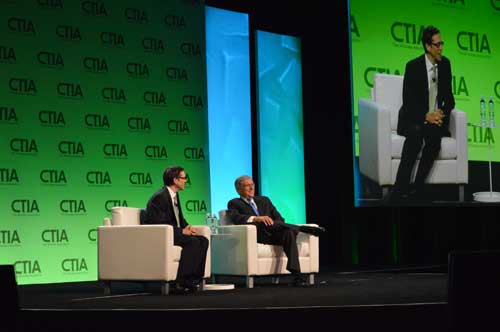
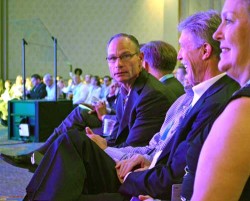
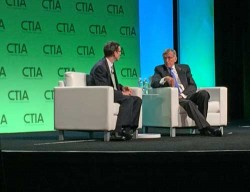
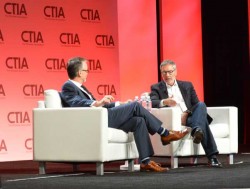
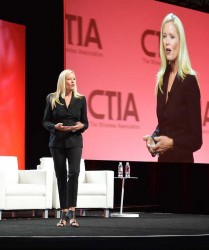
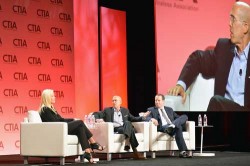
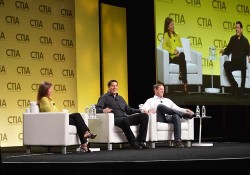
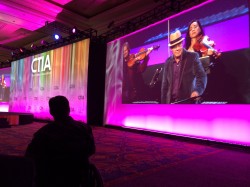
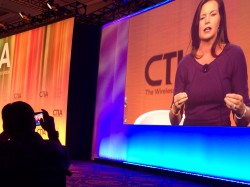
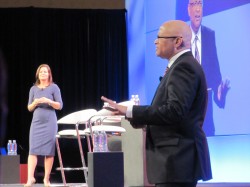
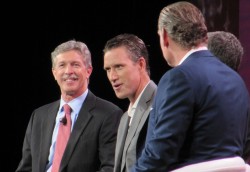
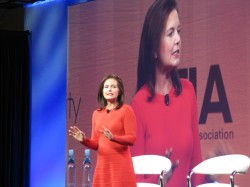
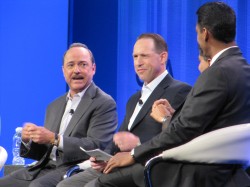
LA Times writer Jon Healey interviews the FCC’s Tom Wheeler in a fireside chat at CTIA.
As one of Super Mobility 2015’s first speakers, Federal Communications Commission (FCC) Chairman Tom Wheeler reaffirmed his support for the net neutrality rules that CTIA-The Wireless Association, the event’s host, has been fighting in court.
Wheeler harkened back to his speech to this same audience last year where he received a “less than thunderous response” to his suggestion that broadband should be classified as a public utility. Previously, the FCC had treated broadband as an information service separate from the telephone network.
“If you have that kind of a role in delivery of Internet, then you ought to be governed under a similar set of rules that apply to everyone and not have a wireless exception,” Wheeler said.
Net neutrality rules enacted by the FCC early this year prohibit mobile broadband providers from throttling Internet content and utilizing paid prioritization. CTIA filed a brief with the U.S. Court of Appeals in Washington, D.C., this summer in conjunction with other industry associations, opposing the regulation saying it could have “devastating impact on Americans and the U.S. economy.”
“Imposing Title II on wireless would be a gross overreaction that would interrupt the world’s best wireless industry and interfere with the significant innovations and competition consumers enjoy today.”
Wheeler disagreed on stage during a fireside chat with Los Angeles Times editorial writer Jon Healey. He pointed out the “tens of billions of dollars” the wireless industry has invested.
“I’m very bullish on the continued growth of this industry and the continued protection of consumers and how they use the net,” he said.
Wheeler said he was also “supremely confident” that the incentive auction for 600MHz of broadcast TV spectrum, scheduled to start March 29, 2016, would go off without a hitch and that broadcasters would be there and would agree to sell their spectrum rights. Don’t believe him? Take it from James Murdoch, new CEO of News Corp., he said.
“I told him I was going to be talking to you today, and I said, ‘Can I tell him you’re going to show up?’ and he said, ‘Yup,’” Wheeler explained to Healey. “We had a fascinating discussion about how the broadcast business has changed. The most interesting part of my conversation with…Murdoch was talking about innovation and need to be continually innovative. The broadcast auction offers incredible opportunities for broadcasters to get a pot of money to innovate with without losing the business model they’ve been successful with.”
GPS World reports live from CTIA Super Mobility 2015 in Las Vegas Sept. 8-11, organized by CTIA—The Wireless Association. The Western Hemisphere’s largest mobile innovation summit brings together 35,000 professionals who work in the mobile technology industry, including leaders in wireless, indoor location, connected car and Internet of Things (IoT), among many others.
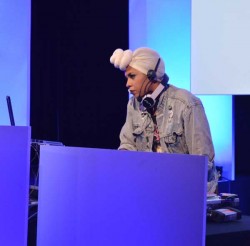
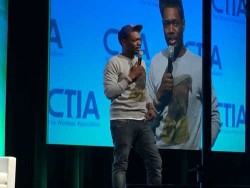
GPS World digital editor Bethany Chambers and Wireless editor Janice Partyka will be reporting all week here on GPSWorld.com, on Facebook and on Twitter @GPSWorld. This convention is far from conventional in its use of multimedia to fuel the excitement surrounding all things mobile; the show has an official DJ in Los Angeles-based Bella Foxx and an emcee in Saturday Night Live’s Michael Che. Keynotes also follow the multimedia theme this year, with DreamWorks CEO & cofounder Jeffrey Katzenberg, Wikipedia founder Michael Wales and iHeartMedia Chairman Bob Pittman scheduled to appear.
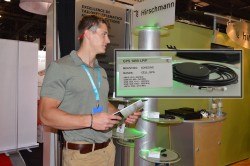
GPS World talks to Taoglas VP of North American Sales Tim Dolan on the show floor in Las Vegas about the Storm Antenna. He explains what makes it unique to the market–and what comes next.
TeleCommunication Systems Inc. Senior Vice President of Commercial Solutions Jay Whitehurst introduces VirtuMedix at CTIA Super Mobility 2015. The telemedicine solution utilizes location-based services to connect patients with clinicians in their area.
Olivier Pauzet, vice president of marketing and market strategy at Sierra Wireless, details AirVantage connectivity services for fleet tracking and the recent addition of Google cloud integration.
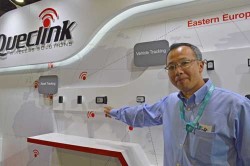
Jorge Pineda, vice president of sales for Queclink Wireless Solutions, shares information on the company’s U.S. and international sales plans for 2015 and beyond, with a focus on fleet tracking and global LTE expansion.
Parsec Technologies CEO Michael Neenan introduces the company’s LTE/GPS antenna. The antenna, which you can find out more about at parsec-t.com, is already in production and available for sale, and Neenan previews how the antenna will be used further in a watch coming out later this year. Find out more about the Texas-based company’s antenna, touted for its flexibility and interoperability.
Janet Jaiswal, vice president of enterprise marketing, and Gurinder Dhillon, senior director of Internet of Things (IoT) platforms and analytics, demonstrate how AerCloud and AerVoyance work together to enable rapid development, deployment and monitoring of IoT solutions.
NavCom’s StarFire Network is a global satellite-based augmentation system (GSBAS) that provides five centimeter positioning accuracy on a worldwide basis. (more…)
The announcement is notable in that it expands the relationship formed in June 2011 between Septentrio and Altus, with Septentrio more closely integrating the Altus subsidiary. Additionally, Septentrio is now manufacturing Altus GNSS RTK receivers at its factory in Belgium while Septentrio is closing its separate sales office in the U.S., merging that functionality into Altus, according a spokesman.
The Torrance, California-based Altus, started by Vancans in 2007, has long focused on the surveying sector. Vancans himself is a Fellow of the Royal Institution of Chartered Surveyors in the U.K.
“Ten years ago 90% of the high-precision GPS market was survey or survey-related. But survey is not a high-growth market. Today survey is probably 20% of the market and that’s doing things like putting a $10,000 receiver on a $4,000 lawn mower,” Vancans explains. “The growth market outside that (in consumer wireless) is huge, and it offers many new opportunities and will continue to grow.”
The survey market will continue to be in the Altus and Septentrio strategy, particularly leveraging Altus products with Septentrio’s advanced receiver technology experience in the OEM market.
Vancans has watched for two decades as use in emerging Asian economies has increased demand for surveying equipment and speculates what’s happening in the U.S. and other Western markets with OEM growth will eventually be mirrored there. He estimates the Chinese receiver market alone has grown ten-fold since he worked as president of Leica GPS nearly 20 years ago.
“What’s interesting and exciting is that it will be a big growth market for OEM or non-survey applications based on domestic Asian manufacturers using Western and increasingly Asian OEM,” Vancans says.
“If you can master the distribution capabilities in the OEM market in North America in the next couple of years, that will form the foundation of what happens in Asia in the future.”
Altus’ announcement also came with news the company hired Mo Kapila as OEM sales manager for Septentrio products. Kapila’s background is in embedded wireless, according to Vancans.
Vancans, who spent two days on the CTIA show floor, says the consumer wireless industry is on Altus’ radar, although he is still “very wary” of that side of the business. As general manager of Thales Navigation (which later re-merged as Magellan) in the early-2000s the company worked on a GPS attachment for Palm and integration into other consumer devices.
“The professional high-precision market is stable and products have a long shelf life,” he says. “On the other hand, the good thing with the consumer market is the constant changes in devices, the churning. As consumer markets take up high-precision GNSS products , they will be embedded in products which are rapidly outdated.”
Altus is taking a wait-and-see approach when it comes to professional-grade receivers for the consumer market.
“If the price lowers, the longevity will too,” he says. “The high end will likely go down to meet the low end – the cheap and easy, changeable model.”
Vancans says Septentrio will continue to differentiate itself from competitors based on its low power consumption relative to the functionality and size of the device, and robust positioning, whether it’s for professionals or consumers.
“If you look to the future and think of how much satellites will proliferate and signal availability will open,” he says, “it’s a good position for us to be in with the continuous consumerization of high-precision GPS and GNSS.”
When comedian Larry Wilmore started out Day 2 at CTIA Super Mobility Week by reporting from a connected car on the show floor, he was only half joking when he said, “It’s almost like you’re driving in a smart phone, and with smart phones getting bigger it’s not too far off. I think I saw an HTC this size.”
The experts in the keynote Connected Car panel agreed: The car is the new smart phone.
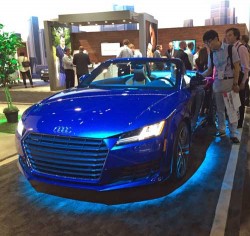
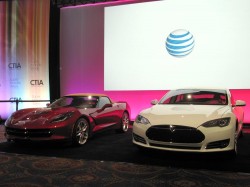
Just ask Ralph de la Vega, CEO of the just-formed AT&T Mobile and Business Solutions Group, who called the Chevy Corvette “the best smart phone I’ve ever gotten to test.” The Corvette was conveniently displayed next to the stage, along with a connected Tesla Model S.
As CTIA CEO Meredith Atwell Baker pointed out, what was once relegated to the CTIA show floor is now in dealerships all across the U.S. The statistics thrown out by de la Vega supported this observation. Thirty-two percent of new cars sold globally (and 60% of new cars sold in the U.S.) by 2017 will be embedded with cellular technology. Seventy-two percent of people would delay a new car purchase one year to buy a connected car by their preferred automaker.
De la Vega co-moderated the panel with Glenn Lurie, his successor as CEO of AT&T Mobility. Panelists representing General Motors/OnStar, Ericsson, VoiceBox and Tesla overwhelmingly agreed that the emphasis on the connected car going forward has to be safety.
“[Drivers are] trying to fill the time and be productive. People naturally want to do that. They’re going to bring the phone in, reach over, grab it and try to do things. And the more capabilities, the more they’ll do it,” said Mike Kennewick, co-founder & CEO of VoiceBox, maker of natural language technology. “It’s imperative as we bring the Internet into the car, there’s a component that allows you to do it safely.”
What that would mean, exactly, though, was a matter of opinion. Each panelist had a chance to discuss their company’s recent and coming advancements.
De la Vega says AT&T’s studies show people prefer a shared family data plan that would allos them to share data across people and across devices, and a belief by the wireless provider that customers should be able to add their cars to their rate plans.
GM has successfully integrated 4G/LTE into 33 different models in the U.S. and Canada and next plans expansion in Europe, Mary Chan, President of Global Connected Consumer at GM shared.
VoiceBox’s Kennewick calls the voice recognition in cars today “just like the movies” but says VoiceBox strives to simplify the apps in cars and make voice activation less about reiterative command-and-control.
Telsa, a leader in over-the-air auto updates, will be launching a mass market car “in a few years” and is now exploring how best to keep the customer experience focused in the car. Tesla CIO Jay Vijayan also said the company is considering opening up its infotainment stystem to other partners.
MobileFocus, a technology demonstration event held at Caesar’s Palace in Las Vegas Sept. 9, showcased dozens of companies previewing new smartphones, tablets, GPS devices and wireless receivers. This year’s Western-themed barbeque dinner event gave exhibitors of all sizes a chance to meet one-on-one with end users and demonstrate their innovations.
TEOCO, a provider of assurance, analytics and optimization solutions to communications service providers, has expanded the testing capabilities of its AIRCOM Device Test Lab in Columbia, Maryland, with additional test systems from Rohde & Schwarz. Combined with Rohde & Schwarz’s conformance and carrier test case support, the R&S TS-LBS Location Based Services (LBS) and the R&S CMW-PQA Performance Test Systems enable TEOCO to support new industry and carrier testing requirements for next-generation wireless technologies including carrier aggregation, IMS, VoLTE, RCS, E911 over IMS, LTE A-GNSS, LTE OTDOA and LTE eCID.
Release 10 and beyond, also referred to as LTE-Advanced, allows for a substantial uplift in the capacity and throughput of LTE, in addition to mobile device performance improvements. In LTE-Advanced, carrier aggregation (CA) is a key feature that allows the combination of multiple carriers to increase bandwidth and ultimately data rates in the network. To meet this need, the R&S CMW-PQA test system performs automated testing of a devices downlink, uplink and bidirectional data performance with or without carrier aggregation under simulated network conditions.
LBS is already a key technology enabling a myriad of new applications that people depend on every day. LTE and additional satellite constellations are being leveraged to improve availability and performance of location technologies indoors and outdoors. Higher customer expectations are driving the need for more advanced testing methodologies, and the R&S TS-LBS test system supports field-to-lab testing where real-world conditions are captured with high performance 16-bit resolution, and replayed in the lab for more accurate simulation.
“We are excited to expand our testing capability and capacity for LTE-Advanced and LBS-enabled devices,” said Hemant Minocha, Executive Vice President at TEOCO. “And given the increase in test complexity and costs, we are pleased to be working with a partner such as Rohde & Schwarz whose expertise in conformance and carrier acceptance testing and breadth of test cases helps future-proof our investment while delivering the quality and results our customers have come to expect.”
GPS World reports live from CTIA Super Mobility Week in Las Vegas Sept. 9-12. The first ever Super Mobility Week now combines the former CTIA annual conference and MobileCON, and is expected to draw 1,100 exhibitors from around the world and features major product launches and trade news.
GPS World Digital Editor Bethany Chambers, Wireless Editor Janice Partyka and LBS Editor Kevin Dennehy will be reporting all week here on GPSWorld.com, on Facebook and on Twitter @GPSWorld. The convention has some unique twists, including a house band led by Thomas Dolby (producer of 1982 hit “She Blinded Me With Science”) and the largest-ever tradeshow heat map, showing event popularity by tracking Wi-Fi connections throughout the conference.
The morning sunlight steams into the Sands Expo Center.
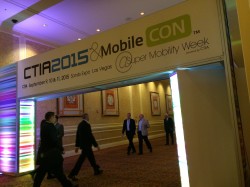
The former spring CTIA conference and fall MobileCON show have now been wrapped into one large fall Super Mobility Week. Photo: GPS World
The line to register formed long before the 8 a.m. opening time on Day 1 at CTIA Super Mobility Week.
Crowds head to and from CTIA Super Mobility Week registration on Day 1.
Super Mobility Week attendees have miles of walking in the next three days. Sands Expo has 2.25 million square feet of show floor and meeting space.
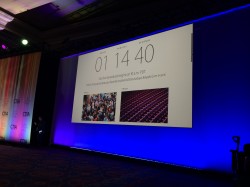
A screen counts down to the Apple Live Event, an announcement that had the crowd abuzz.
Thomas Dolby leads a string quartet in a cover of “Bittersweet Symphony.”
CTIA President & CEO Meredith Atwell Baker opens Super Mobility Week.
CTIA President Meredith Atwell Baker laughs as The Daily Show’s Larry Wilmore provides news updates between opening keynotes.
Michel Combes, CEO of Alcatel-Lucent, speaks about the “video first” world we live in during the mobile video panel. Photo: GPS World
In the same panel, Hulu’s Tim Connolly reminisces about attending CTIA back when it was an “IT show.”
CTIA fielded a panel of experts moderated by CNBC’s Julia Boorstin to respond to Apple’s Live Event.
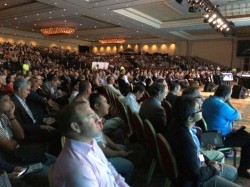
CTIA’s opening keynotes attracted a standing-room-only crowd.
Photo: GPS World
CTIA CEO Meredith Atwell Baker opens Day 2 of CTIA, saying of government regulation “We need engagement not from D.C. but from where you live.” Photo: GPS World
AT&T’s Ralph de la Vega and Glenn Lurie moderated the Connected Car panel at CTIA. Photo: GPS World
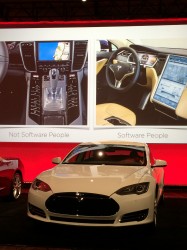
A connected Chevy Corvette and Tesla Model S sit beside the stage during the Day 2 Morning Keynote. Photo: GPS World
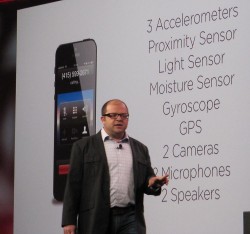
Jeff Lawson, CEO of Twilio, speaks on “The Ways of the Software People.” Photo: GPS World
Jeff Lawson, CEO of Twilio, comparing “hardware people” and “software people,” says Tesla’s Model S interior forgoes extra buttons for useful, adaptable software. Photo: GPS World
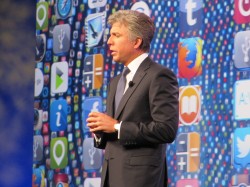
SAP CEO Bill McDermott’s book Winner’s Dream comes out in October. Photo: GPS World
Photo: GPS World
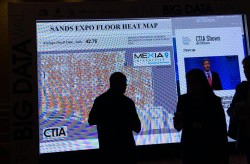
The show floor heat map, by Mexia, uses sensors throughout Sands Expo to show where people are connecting to Wi-Fi. Photo: GPS World
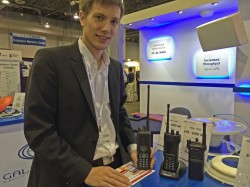
Tobias Eger, product marketing manager for Israel-based Galtronics, displays some of the company’s GPS antennas. Photo: GPS World
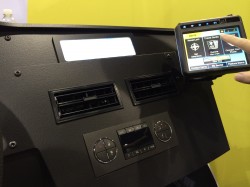
Hertz NeverLost GPS navigation system incorporates Bluetooth connection, hands-free calls, travel guides, weather, and flight information. Photo: GPS World
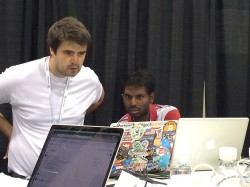
Igor Barinov of Santa Clara, California, and Bhaskar Vooradi of Detroit pour over their work during the Ford App Pursuit Hackathon on the CTIA show floor, with $50,000 at stake. Photo: GPS World
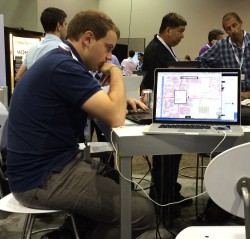
Joshua Carr of Winchester, England, works on his idea for a Ford AppLink app. He’ll present his idea September 11 on the final day of CTIA Super Mobility Week. Photo: GPS World
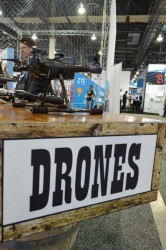
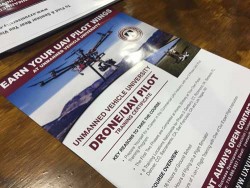
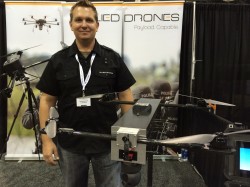
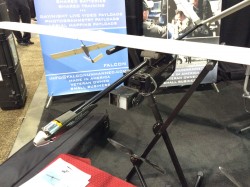
Joshua Kornoff, president of Allied Drones, started building UAVs for Hollywood special effects and now has branched into other areas. Photo: GPS World
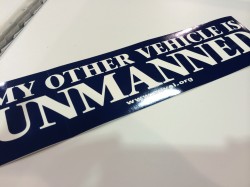
A bumper sticker from the Association for Unmanned Vehicle Systems. Photo: GPS World
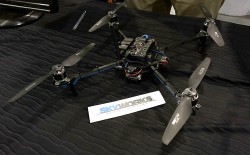
Skyworks, started by University of Nevada – Las Vegas students, is now launching drones for indoor use. Photo: GPS World
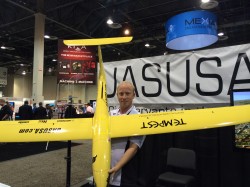
Cody Remington, sales manager for UASUSA, says his company’s UAVs are “efficient and aesthetically pleasing.” Photo: GPS World
Falcon Unmanned differentiates itself by having a modular payload that’s plug-and-play, says President Chris Miser. Photo: GPS World
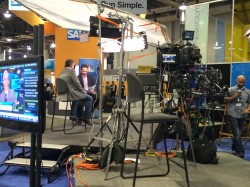
CNBC broadcasts live from the Super Mobility Week show floor. Photo: GPS World
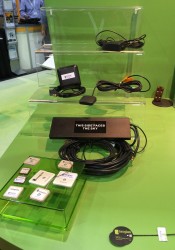
Taoglas antennas on display at CTIA. Photo: GPS World
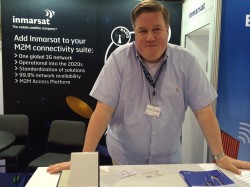
Joel Schroeder, director for strategic development at Inmarsat, says the mix of devices, air time and a standardized API management platform, has the company primed for growth in the next year. Photo: GPS World
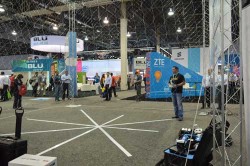
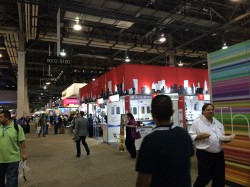
The show floor features 1,100 booths. Photo: GPS World
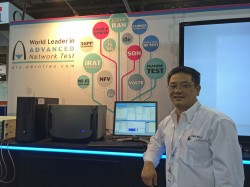
James Trinh, regional sales manager for Aeroflex, says “all the technologies converging at once means more complexing — and more need for testing.” Photo: GPS World
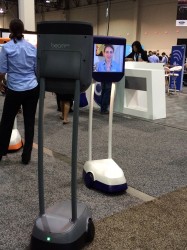
Suitable Technologies demonstrated its remote presence system, BeamPro, on the show floor. Photo: GPS World
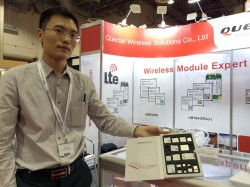
Jaron Xu, Marketing Director for Quectel Wireless, displays some of the modules the Shanghai-based company is just starting to market in the U.S. Photo: GPS World
On the last day of the CTIA Super Mobility Week, attendees were registering for the 2015 show, also in Las Vegas. Photo: GPS World
Thomas Seiler, CEO of u-blox AG, and Nick Papadopoulos, president of u-blox America, speak exclusively to GPS World about what makes u-blox the industry leader in embedded wireless technology and about the innovations on display at CTIA. They also give a preview of new products that will be coming out soon.
GNSS modules are a relatively new area of business for the London-based Telit, already the leader in cellular modules. Taneli Tuurnala, CEO of Telit GNSS Solutions, admits that Telit is currently the No. 2 player in the GNSS market. But that won’t last, he says. And here’s why.
Thorsten Hertel, PhD, OTA Specialist for Rohde & Schwarz, gives GPS World a demonstration of the DST200 RF Diagnostic Chamber, which provides accurate radiated testing of wireless devices. He also highlights some recent updates.
Get to Know Maxtena (9/11/14) – On the CTIA show floor, Vanja Maric, Director of Sales & Marketing for Maxtena, explains more about Rockville, Md.-based Maxtena, “the antenna innovations company.”
What To See at the u-blox Booth at CTIA (9/10/14) – In this first clip of our interviews with u-blox executives, Nick Papadopoulos, president of u-blox America, Inc., tells CTIA Super Mobility Week show-goers what they should see at the u-blox booth, #5229 on the show floor.
Taneli Tuurnala: What’s New from Telit (9/9/14) – See the first clip of our interview with Telit GNSS Solutions CEO Tuurnala, on what to expect in the next six months from the company.
Crowds streamed into the Sands Expo and Convention Center, Las Vegas, to the sounds of ’80s music icon Thomas Dolby and a string quartet covering the ’90s hit “Bittersweet Symphony,” but the buzz wasn’t about the morning keynote speech that would kick off CTIA Super Mobility Week. Instead, the impending Apple Live Event had taken over as a countdown clock ticked on the big screen.
The Apple circus — though alluded to in introductory remarks by CTIA Chairman Dan Mead, CEO of Verizon Wireless, and CTIA President Meredith Atwell Baker — would have to wait. First on the agenda: Several topics affecting the industry, with an emphasis on spectrum allocation.
Atwell Baker set up the three-day show, the first combining the CTIA conference with MobileCON. She cited dozens of figures about the incredible growth of the industry before focusing in on the need for a successful spectrum incentive auction with projected 886% mobile data usage growth by 2019.
“The U.S. had the third-lowest amount of spectrum dedicated to LTE,” she said. “How do we close the gap? The AWS-3 and 600MHz auction are a great start. We hear the wireless carriers may sit out of these auctions. Really? Given our track record, I’m incredulous wireless carriers wouldn’t bring billions of dollars to these auctions.”
The Federal Communications Commission (FCC) has been pushing for the spectrum incentive auctions to reallocate spectrum from television broadcasters to wireless providers for ever-increasing mobile usage.
In introducing Tom Wheeler, chairman of the FCC, Atwell Baker lauded his determination to bring the auctions to fruition.
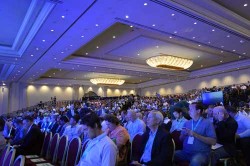
Wheeler jumped right into his list of the Top 3 issues facing the business for the standing-room only crowd: the incentive auction, net neutrality and competition in the wireless industry.
Wheeler balanced his concerns with equal doses of praise, lauding CTIA for a “very thoughtful” paper arguing that mobile broadband should not be subject to the same rules as fixed broadband while alternately questioning why some consumers have been led to believe they have unlimited data usage or why others are targets for throttled usage.
“I’m hard-pressed to understand how either practice, much less the two together, could be a reasonable way to manage a network,” he said.
He also touched on the need to keep competition alive in the business and avoid the “walled gardens” of the past that created barriers to entry in the market.
“Where competition exists the commission must protect it. This industry has always told policymakers, ‘We’re different, we’re competitive, but in the last couple of years the FCC and Department of Justice had to be poised to protect that dynamic.”
Wheeler pointed out the wireless industry’s $260 billion 10-year infrastructure investment as “living proof that profit and progress can go hand in hand” before concluding on the topic of a shared front: spectrum allocation.
“Our greatest public asset is that which we cannot see: Spectrum. Your government has heard your cry for more spectrum. The Congress responded with a creative and courageous solution,” he said, “an incredibly complex, never-before attempted undertaking.”
With fall tradeshow season fast approaching and 2015 vehicles hitting the road, Scott McCormick, President of the Connected Vehicle Trade Association (CVTA), took the time to answer some questions for GPS World about one key conference, CTIA’s Super Mobility Week, and what to expect in the connected vehicle market for the second half of 2014. The CVTA is a nonprofit industry group dedicated to accelerating technologies in the consumer and commercial auto market. CVTA will be well represented at Super Mobility Week, with about a third of its membership comprised of companies involved in the wireless industry. However, McCormick won’t be in attendance in Las Vegas; that’s because he’s a member of the organizing committee and will be moderating sessions at ITS World Congress, being held that same week in Detroit.
Do you think that ITS World Congress will end up cannibalizing the connected vehicle crowd from Super Mobility Week?
Yes, I think it will a lot. Most of the connected vehicle companies don’t work solely in DSRC, they work in cellular and WiFi, too, so it really depends on where their business needs are. The company with the large multinational presence will certainly be at World Congress because that’s where the networking capability is, while CTIA will be most of the cellular providers. It’s about connecting with your channel partners, your supply base and your potential customers. It’s not really about seeing new technologies, but about engaging new customers.
What we are announcing is about doing something that will help benefit collaborative industries. We have our core industries, but there are now insurers, data mining companies, security companies, all these other companies that are not in the automotive space that are doing things related to it. A few years ago we had people in Silicon Valley begin working in the automotive space but they didn’t understand the user interface in the car, where you need to have control and return your attention to driving as quickly as possible. All the devices they knew were designed to focus your attention. It’s the same thing today: The insurers don’t know how to work with the automakers. Neither did the telecoms. They’re completely different business models, but they’re channel partners. This is not just about a company to hire, but where can we gain utility and expertise.
So your announcement will be about reaching into a second tier of companies that just a few years ago were not involved in the connected vehicle space?
That’s a perfect way to characterize these companies; they all have to deal with interoperability issues.
What will be the hottest topics at Super Mobility Week?
There will be three: privacy, data ownership, and security. Security is the only one that’s important, and it’s for simple reasons. The United States has no personal privacy data law and it never will. The issue is one that we’re not going to solve. Everybody wants to talk but nothing ever comes of it.
The same question with data ownership. Why would my privacy or data ownership be device-specific? It should be device-agnostic. Anytime you transfer data, there are two levels of ownership. Of the data in the connected vehicle, an infinitesimally small amount is related to location or driving behavior. Although we talk about privacy and data ownership, nobody’s going to define data ownership.
Security, however, is a huge issue, because once you clear a gateway into the system, it can be breached. I’m not concerned about terrorists, it’s more just teens with nothing to do who want to rock the system. I’m most concerned about the insufficiency of the code. There’s an average of 43 networks in a car, and while they’re not likely going to affect braking, that doesn’t mean if you tinker with things long enough you couldn’t figure it out and remotely control functions. That’s really sophisticated and of very low value to do it to one vehicle.
It’s more important to ask if the overall infrastructure is protected. Systems have to be designed to be secure, detectable, and reparable. It’s incumbent upon cellular companies to take that responsibility.
Will they accept that responsibility?
If they don’t, people won’t use it. Now we understand that when a car is purchased it’s based largely on the perception of quality of service, not just on the quality of the engine or the comfort of the ride … it’s about how long until my connection breaks off and why didn’t I know about that traffic jam or that this road was icy if another guy did in a different make and model car.
How do you think this year’s show will be different from last year’s show?
Last year a lot of industries were still coming off the recession and going back to core competencies. This year I expect to see a lot of innovative companies coming out with much more focused sort of innovation where in the past it was about trying to be everything to everybody. In particular, the connected life stuff is going to be interesting because those are the people that when you look at it you’ll say, this is something I haven’t seen before or wasn’t aware of and it’s new and consequential.
The automakers will be a part of a lot of those discussions. Do you think we’ll hear anything new?
There will be some talk about the aftermarket. The average person keeps cars for 11 years. Now if I just bought a new car and next year someone has something really cool, I can’t just go buy a new car. But if I could add it … now there’s another revenue stream for the OEMs.
What are some innovations you think we’ll see hitting the market in the next year?
The machine-to-machine market is going to have a lot. Also, I just read a report that a lab figured out how to do 1000-times the data transmission speed of the fastest fiber-optic system by running it across copper. We have certain sized pipelines today and a certain time to get data from here to there, and we’re exploring how we can best do that with what we have.
By all estimates the global connected car service market is expected to top $130 billion by 2019. What will fuel that growth the most? Safety and security? Infotainment? And is that growth sustainable?
By 2020 we’re looking at a $200 billion market … and that’s going to be because of security. The problem with the automotive industry is that they have a very difficult time communicating the value proposition, because they’re used to selling business-to-business. But in the cellular industry you don’t question paying several hundred dollars a month for your phone, because they communicate that well to consumers. So the question is really one of both developing the product and service and understanding the consumer.
CTIA has talked a lot about safe driving policy and distracted driving legislation. Where do you see this policy going in the next year?
I see the federal government moving at a glacial pace. They were 2 months late on the vehicle-to-vehicle report, they were supposed to work on the interstate commercial vehicle rule, and they’re struggling with a transportation authorization bill that’s not anywhere near where it should be. There are things that the federal government needs to be involved in and things they have no business being involved in, like setting standards. The automakers will do what the consumers want. Look what happened with backup cameras. Even before there was legislation requiring backup cameras because of kids being hit, the automakers decided to put it on certain models because the consumers wanted it.
What policies will come into play in the next year?
One is very critical. The American Jobs Act is pushing to allow unlicensed devices to use the 5.9 (GHz) spectrum (currently allocated to licensed Intelligent Transportation Systems), and we have conveyed what a bad idea that is. The FCC has tested it in lab conditions, not with hundreds of cars at an actual intersection. This is not like connecting a toaster and refrigerator, this is hundreds of people in the backseats of cars attempting to connect and disconnect (to WiFi). That’s the equivalent of a denial-of-service attack. Unless we deal with this soon, it’s going to be a real safety risk. The problem is once the spectrum gets reallocated, it’s going to be really hard to take it away.